



Perfecting your email authentication and crafting compelling subject lines won't guarantee inbox placement if your sender reputation is damaged. Most marketing teams obsess over content quality and technical configurations while overlooking the invisible score that mailbox providers use to route every message you send. Your sender reputation acts as a gatekeeper, determining whether campaigns reach engaged subscribers or vanish into spam folders. This guide explains what sender reputation actually is, how it functions in 2026's evolving email ecosystem, and the practical steps you need to manage it effectively to protect your deliverability and maximize campaign ROI.
Key takeaways
| Point | Details |
|---|---|
| Reputation controls placement | Your sender reputation directly determines whether emails land in the inbox or spam folder |
| Multiple factors matter | IP address, domain authority, engagement rates, and authentication protocols all influence your score |
| Domain reputation dominates | In 2026, domain reputation carries more weight than IP reputation for most mailbox providers |
| Active management required | Successful reputation management demands IP warming, list hygiene, monitoring tools, and engagement optimization |
| Tools provide visibility | Google Postmaster, Sender Score, and verification platforms help track and improve reputation metrics |
What is sender reputation and how does it work?
Sender reputation functions like a credit score for your email program. Mailbox providers including Gmail, Outlook, and Yahoo assign this dynamic score to evaluate the trustworthiness of every IP address and domain sending messages through their systems. The score updates continuously based on real-time sending behavior and recipient interactions.
When you send an email, receiving servers instantly query reputation databases to decide routing. High reputation scores earn inbox placement. Poor scores trigger spam filtering or outright blocking. This split-second decision happens before recipients ever see your message, making reputation the ultimate arbiter of email success.
Several critical factors shape your reputation score:
- Authentication validity through SPF, DKIM, and DMARC protocols
- Bounce rates from invalid or inactive addresses
- Spam complaint frequency from recipients
- Engagement metrics including opens, clicks, and replies
- Sending volume patterns and consistency
- List acquisition methods and subscriber quality
Modern spam filters use machine learning algorithms that weigh engagement signals heavily. A message that recipients ignore or delete without opening damages your reputation more severely than outdated rule-based filters would penalize it. Understanding your email address reputation helps you recognize which behaviors mailbox providers reward or punish.
Mailbox providers treat sender reputation as a predictive indicator of whether future emails will provide value to recipients or constitute unwanted messages.
The consequences of poor reputation extend beyond individual campaigns. Once your score drops below provider thresholds, recovery requires weeks or months of careful remediation. Prevention through proactive management delivers far better results than attempting repairs after deliverability collapses.
The evolving roles of IP and domain reputation in 2026
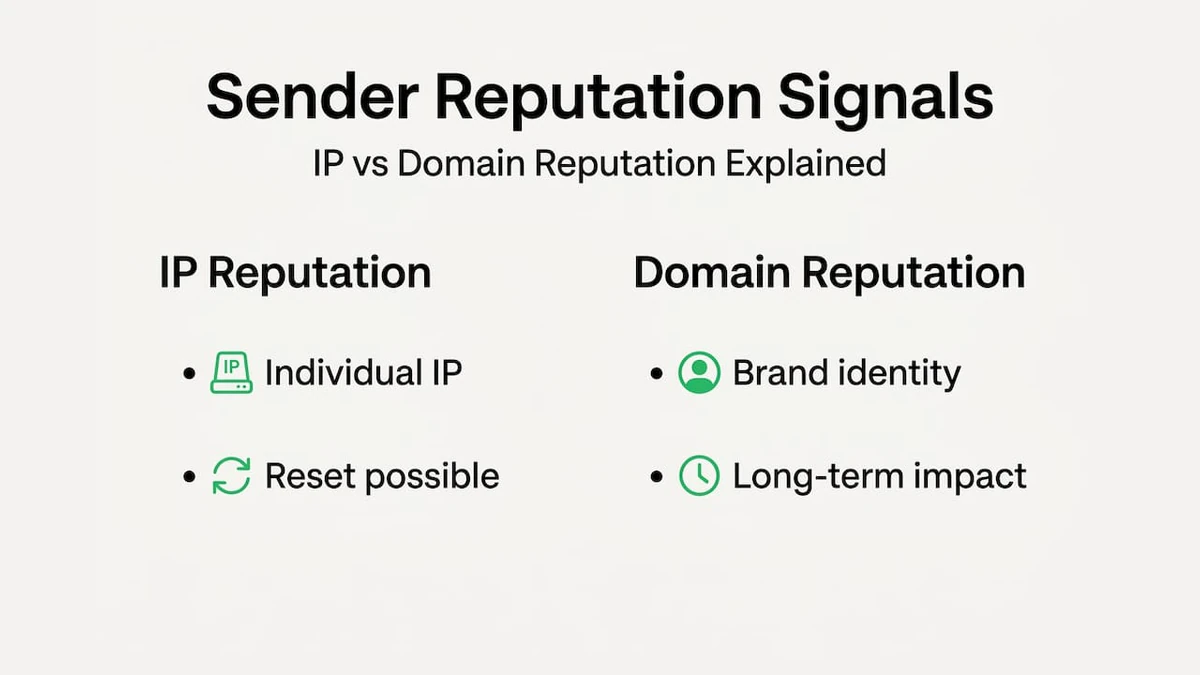
Email senders must understand that IP and domain reputation operate as distinct but interconnected reputation signals. IP reputation ties directly to the specific IP address sending your emails. If you share an IP with other senders, their behaviors influence your deliverability. Dedicated IPs provide complete control but require careful management and sufficient volume to maintain warm status.
Domain reputation follows your sending domain regardless of which IP addresses you use. This persistence makes domain reputation increasingly critical in 2026, as major providers now weigh domain signals more heavily than IP reputation when making filtering decisions. You cannot reset domain reputation by switching IPs, making protection essential from day one.
| Factor | IP Reputation | Domain Reputation | | --- | --- | | Scope | Tied to specific IP address | Follows domain across all IPs | | Sharing risk | High on shared IPs | Not affected by IP sharing | | Reset capability | Can switch IPs and warm new ones | Cannot reset, only rebuild | | Provider weighting | Declining importance | Dominant factor in 2026 | | Warm-up required | Yes, 4-6 weeks typical | Built gradually over time |
New dedicated IPs require systematic warming to build positive reputation signals. The typical warm-up spans four to six weeks, starting with small volumes sent to your most engaged subscribers. You gradually increase daily send volumes while monitoring bounce rates and engagement metrics. Rushing this process triggers spam filters and damages the IP before you establish positive history.

Shared IPs offer cost advantages for smaller senders but carry inherent risks. Your deliverability depends partly on other senders sharing the same IP infrastructure. One bad actor can damage reputation for everyone on the shared pool. Dedicated IPs cost more and demand higher sending volumes to maintain warmth, but they give you complete control over reputation factors.
Some marketers explore residential IPs hoping for deliverability advantages. While residential IPs may receive slightly different treatment from certain filters, they do not provide magical solutions to reputation problems. The fundamental factors affecting reputation remain identical regardless of IP type. Focus your energy on the behaviors that build trust rather than seeking technical shortcuts.
Pro Tip: Prioritize domain reputation management above all else in 2026, as you cannot escape domain reputation by switching infrastructure, and providers increasingly use domain signals as the primary filtering criterion.
Understanding these reputation differences helps you allocate resources effectively. Invest in domain protection through consistent positive sending behaviors rather than over-indexing on IP management strategies that deliver diminishing returns.
Best practices for managing sender reputation
Building and maintaining strong sender reputation requires systematic execution across multiple dimensions. Follow this framework to establish positive signals and avoid common pitfalls that damage deliverability.
Implement gradual IP warming with volume benchmarks. Start new IPs at 50-100 emails daily to highly engaged subscribers. Double volume every three days while monitoring metrics. Reach full volume after four to six weeks of consistent positive signals.
Configure authentication protocols correctly. Set up SPF records authorizing your sending IPs. Implement DKIM signing to verify message integrity. Deploy DMARC policies to prevent domain spoofing and gain visibility into authentication failures.
Maintain rigorous list hygiene practices. Remove hard bounces immediately after each campaign. Suppress addresses generating soft bounces after three consecutive failures. Eliminate subscribers showing zero engagement over 90 days.
Monitor reputation metrics using specialized tools. Check Google Postmaster Tools weekly for domain reputation and spam rate data. Review Sender Score monthly to track IP reputation trends. Set up alerts for sudden metric changes.
Verify blacklist status regularly. Query major blacklists including Spamhaus, SURBL, and Barracuda every two weeks. Address listings immediately by identifying root causes and submitting removal requests after fixing issues.
Optimize campaigns for engagement signals. Segment lists to target subscribers most likely to interact. Send relevant content matched to subscriber interests and behaviors. Test send times to maximize open and click rates.
Modern spam filters powered by artificial intelligence weigh engagement metrics heavily when calculating reputation scores. Messages that recipients open, click, and reply to generate powerful positive signals. Conversely, emails that subscribers ignore or delete without opening damage your reputation even if technical factors appear perfect.
The quality of your email list directly impacts every reputation factor. Invalid addresses create bounces. Disengaged subscribers ignore your messages. Spam traps trigger filtering. Maintaining email list hygiene through regular verification and engagement-based suppression protects your reputation more effectively than any other single tactic.
Pro Tip: Launch warming campaigns exclusively to subscribers who opened or clicked within the past 30 days to generate maximum positive engagement signals during the critical early reputation-building phase.
Consistent execution of these practices builds reputation steadily over time. Shortcuts and aggressive tactics deliver short-term gains but create long-term damage that requires months to repair. Patient, methodical management wins the email deliverability game.
Monitoring and measuring sender reputation performance
Tracking reputation metrics provides visibility into your standing with mailbox providers and enables proactive issue resolution before campaigns suffer. Several tools offer different perspectives on reputation health.
Google Postmaster Tools delivers domain-specific insights for Gmail, the largest consumer mailbox provider. The platform shows your domain reputation rating, spam complaint rates, authentication status, and delivery errors. Check these metrics weekly to catch emerging problems early.
Microsoft SNDS provides IP-level data for Outlook and Hotmail. The service reports trap hits, complaint rates, and overall reputation scores for IPs sending to Microsoft properties. Monitor SNDS monthly or after significant program changes.
Sender Score by Validity assigns a 0-100 numerical score to your sending IPs based on reputation factors across multiple providers. Scores above 90 indicate good reputation. Scores below 70 signal serious deliverability risks requiring immediate attention.
Key performance indicators reveal reputation health:
- Inbox placement rate measuring the percentage of sent emails reaching primary inboxes
- Bounce rate tracking invalid addresses and server rejections
- Spam complaint rate showing recipient reports per thousand messages
- Engagement rate combining opens, clicks, and other positive interactions
- IP reputation score from third-party monitoring services
Benchmarking your metrics against industry standards provides context for performance evaluation. Technology companies average 58% inbox placement rates, while retail brands achieve 62%. Complaint rates should remain below 0.1% of sent volume. IP reputation scores should exceed 95 for optimal deliverability.
| Tool | Primary Metrics | Ideal Target | Check Frequency |
|---|---|---|---|
| Google Postmaster | Domain reputation, spam rate | High rating, <0.1% spam | Weekly |
| Microsoft SNDS | IP reputation, trap hits | Green status, zero traps | Monthly |
| Sender Score | Overall IP reputation | Score >90 | Monthly |
| Blacklist monitoring | Listing status | Zero listings | Biweekly |
Continuous monitoring enables rapid response when reputation degrades. A sudden spike in bounce rates might indicate list quality issues requiring immediate verification. Rising complaint rates signal content or targeting problems needing creative adjustments. Declining engagement suggests list fatigue demanding segmentation refinements.
Establish baseline metrics during periods of normal sending activity. Track trends over time rather than obsessing over daily fluctuations. Significant deviations from baseline patterns warrant investigation and corrective action. Regular reputation monitoring transforms reactive firefighting into proactive reputation management.
Enhance your sender reputation with AI-powered verification
Maintaining a clean, engaged email list stands as the foundation of strong sender reputation. Every invalid address generates bounces that damage your score. Spam traps lurking in your database trigger filtering. Disengaged subscribers ignore your messages, signaling low value to mailbox providers.
BillionVerify offers AI-first email verification designed for enterprise senders managing large-scale email programs. The platform's multi-layer verification technology identifies invalid addresses, disposable emails, spam traps, role-based addresses, and risky domains before they damage your reputation. Real-time API integration and bulk processing handle millions of verifications monthly, making list hygiene practical even at massive scale.
Using verification tools reduces bounce rates below 2%, minimizes spam complaints, and prevents blacklist incidents that destroy deliverability. Clean lists generate higher engagement rates as you focus sending on real, active subscribers. The ROI impact extends beyond reputation protection to improved conversion rates and campaign performance.
Pro Tip: Integrate email verification into your signup process and verify your entire database quarterly to maintain optimal list quality and protect sender reputation continuously.
Explore comprehensive email list hygiene strategies to complement verification with engagement-based suppression and re-engagement campaigns. Combining verification technology with strategic list management delivers the cleanest possible audience and strongest sender reputation.
Frequently asked questions
What is sender reputation?
Sender reputation is a trust score that mailbox providers assign to IP addresses and domains based on sending behaviors and recipient interactions. Providers use this score to decide whether incoming emails deserve inbox placement or spam filtering. The score updates continuously based on factors including authentication, bounce rates, complaints, and engagement metrics.
How does IP reputation differ from domain reputation?
IP reputation ties to specific sending IP addresses and can be reset by warming new IPs, while domain reputation follows your sending domain across all infrastructure and cannot be reset. In 2026, mailbox providers weigh domain reputation more heavily than IP reputation when making filtering decisions, making domain protection critical for long-term deliverability success.
What are the fastest ways to improve sender reputation?
Improve reputation by removing invalid addresses to reduce bounces, suppressing disengaged subscribers to boost engagement rates, implementing SPF, DKIM, and DMARC authentication, and targeting your most active subscribers with relevant content. Verify your list using professional tools to eliminate spam traps and risky addresses. Consistent positive signals over four to six weeks rebuild damaged reputation.
How does sender reputation affect deliverability at different providers?
Gmail relies heavily on domain reputation and engagement signals when filtering messages. Outlook considers both IP and domain reputation with emphasis on complaint rates and authentication. Yahoo prioritizes engagement metrics and sender consistency. All major providers use similar core factors but weight them differently, making comprehensive reputation management essential for consistent inbox placement across providers.
What role do engagement metrics play in sender reputation?
Engagement metrics including opens, clicks, replies, and forwards generate powerful positive reputation signals in modern AI-driven spam filters. High engagement tells providers that recipients value your emails. Low engagement or immediate deletions signal unwanted mail. Providers increasingly prioritize engagement over technical factors when calculating reputation scores, making relevant, targeted content critical for maintaining strong reputation.