



Startups can lose significant email marketing costs by sending campaigns to non-existent email addresses. Basic regex validation might catch obvious typos, but it can't tell you whether an address actually exists or if the mailbox is ready to receive messages. API-based email verification solves this problem by performing comprehensive checks that go far beyond simple format validation, protecting your sender reputation and marketing budget.
Key takeaways
| Point | Details |
|---|---|
| Regex limitations | Regex only validates email format, not whether the address actually exists or can receive mail. |
| API advantages | APIs verify domain existence, test SMTP connections, and detect disposable addresses for complete validation. |
| Deliverability impact | API verification dramatically improves email deliverability while protecting your sender reputation from bounces. |
| Cost savings | Using an API prevents wasted marketing spend on invalid addresses and reduces blacklist risk. |
Why basic email validation methods fall short
Most developers start with regex-based email validation because it's quick to implement. You write a pattern that checks for an @ symbol, some characters before and after, and a domain ending. Done, right? Not even close.
Regex only confirms that an email address follows the correct format. It doesn't verify that the domain exists, that mail servers are configured, or that the mailbox is real and accepting messages. You could have a perfectly formatted address like "user@totallynonexistentdomain123456.com" that passes regex with flying colors but bounces immediately when you try to send.
Pro Tip: Relying solely on regex validation is like checking if a phone number has the right number of digits without calling it to see if anyone answers.
The consequences of this superficial validation are severe:
- High bounce rates damage your sender reputation with email service providers
- Spam filters become more aggressive toward your future campaigns
- Marketing automation platforms may suspend your account for excessive bounces
- You waste resources sending messages that never reach anyone
Many marketers mistakenly believe that if an email passes format validation, it's deliverable. This misconception leads to lists full of abandoned addresses, typos, and fake entries that systematically undermine campaign performance. Understanding why use email verification API technology becomes essential once you recognize these limitations.
"Format correctness tells you nothing about deliverability. An email can be perfectly structured and completely undeliverable at the same time."
How APIs enhance email verification accuracy
API-based email validation performs a sophisticated series of checks that validate every layer of an email address. These checks happen in milliseconds but provide comprehensive assurance that an address is legitimate and deliverable.
The verification process works systematically:
- Format validation: Confirms the address follows proper email syntax and structure
- Domain verification: Checks that the domain name exists and is properly registered
- MX record validation: Confirms mail exchange records are configured to receive email
- SMTP connection test: Connects to the mail server to verify the specific mailbox exists
- Disposable email detection: Identifies temporary email services used for fraud or spam
- Role-based address detection: Flags generic addresses like info@ or support@ that may have lower engagement
This multi-layered approach catches issues that simple format checks miss entirely. When an API tests the SMTP connection, it's essentially knocking on the door of the mailbox to confirm someone's home. This real-time verification dramatically reduces bounce rates and protects your sender reputation.
Pro Tip: Run API verification on user input in real time during signup to catch typos immediately, when users can still correct them.
| Verification Type | What It Checks | Why It Matters |
|---|---|---|
| Domain validation | DNS records and domain registration | Prevents sending to non-existent domains |
| MX record check | Mail server configuration | Confirms the domain can receive email |
| SMTP verification | Mailbox existence at the server level | Validates the specific address is active |
| Disposable detection | Temporary email service databases | Blocks low-quality signups and fraud |
Comparing regex and API email verification methods
The difference between regex validation and API verification isn't just technical. It fundamentally changes what you can trust about your email list quality.

Regex validation happens instantly on the client side or server without any external calls. It's perfect for catching obvious mistakes like missing @ symbols or spaces in email addresses. For a contact form where you just want to filter out garbage input, regex does the job.
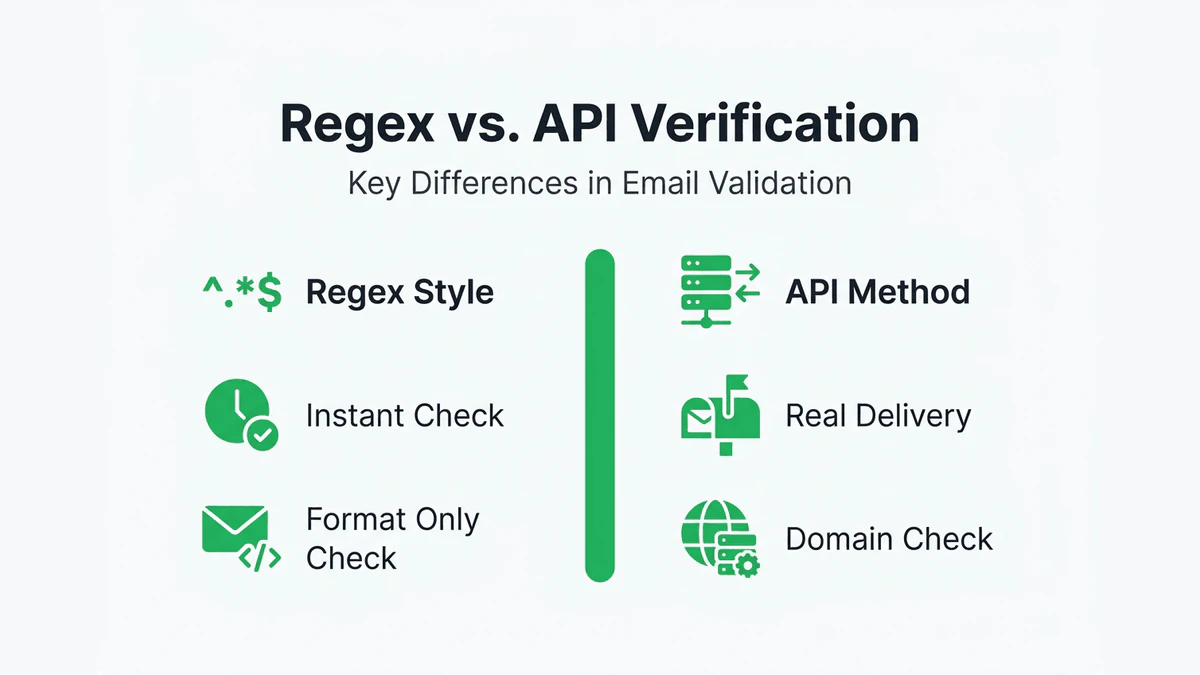
API verification requires a network call to an external service that performs real-world checks. It takes longer (usually 50-200 milliseconds) but provides actual deliverability assurance. For email marketing campaigns where sender reputation is critical, APIs are essential.
| Aspect | Regex Validation | API Verification |
|---|---|---|
| Speed | Instant (< 1ms) | Fast (50-200ms) |
| Accuracy | Format only | Comprehensive deliverability |
| Cost | Free | Per-verification fee |
| Catches typos | No | Yes (domain correction) |
| Detects disposable emails | No | Yes |
| Verifies mailbox exists | No | Yes |
| Best for | Quick format checks | Marketing campaigns, user registration |
Understanding essential email verification methods helps you choose the right tool for each situation.
Consider your use case carefully:
- Use regex when: You need instant client-side feedback, costs must be zero, or you're doing preliminary filtering
- Use API when: Sender reputation matters, you're running paid campaigns, or you need to verify list quality
- Use both when: You want instant format feedback plus background verification for optimal user experience
For high-volume SaaS applications and email marketing platforms, API verification isn't optional. The cost of poor deliverability and damaged sender reputation far exceeds the small per-verification fee.
Implementing an email verification API: best practices
Integrating an email verification API effectively requires more than just making an API call. Strategic implementation maximizes the value you get from verification while creating smooth user experiences.
Follow these implementation steps for best results:
- Verify at the point of entry: Check email addresses during signup or lead capture when users can immediately correct errors
- Provide helpful feedback: When API validation identifies typos in email domains, suggest the correction to users
- Handle edge cases gracefully: Plan for API timeouts or service interruptions with fallback validation
- Batch verify existing lists: Before sending campaigns, clean your entire database to remove invalid addresses
- Set verification thresholds: Decide which validation failures block registration versus which just flag records for review
Pro Tip: Store verification results with timestamps so you can re-verify addresses that haven't been checked recently, as mailbox status changes over time.
Real-time verification during user signup creates the best experience. When someone types "user@gmial.com" instead of "user@gmail.com," your API can catch this instantly and suggest the correction. This prevents fake addresses from entering your system while helping legitimate users complete registration successfully.
For existing email lists, batch verification is critical:
- Export your entire email database before major campaigns
- Submit addresses for bulk verification through the API
- Remove hard bounces and invalid addresses completely
- Flag risky addresses (disposable, catch-all, role-based) for monitoring
- Reduce email bounce rate by systematically cleaning your lists quarterly
Don't forget to handle the API response data intelligently. Most verification APIs return detailed information about why an address passed or failed. Use this data to segment your list, personalize follow-up strategies, and identify patterns in invalid submissions that might indicate fraud or bot activity.
Enhance your email marketing with AI-first email verification
Protecting your sender reputation and maximizing campaign ROI requires more than basic validation. AI-first email verification from BillionVerify combines advanced API technology with machine learning to deliver 99.9% accuracy in just 50 milliseconds.
Our platform integrates seamlessly with your existing workflows, whether you're verifying individual signups in real time or cleaning massive lists before campaigns. Thousands of marketers and SaaS developers trust BillionVerify to reduce bounces, prevent blacklisting, and ensure every email reaches its intended recipient. Start protecting your email marketing investment today.
Frequently asked questions about email verification APIs
What makes API-based email verification superior to regex?
API verification performs real-world deliverability checks beyond format validation. While regex only confirms an email follows proper syntax, APIs verify domain existence, test mail server connectivity, check if the specific mailbox exists, and detect disposable or risky addresses. This comprehensive validation prevents bounces and protects sender reputation in ways format checking never can.
Can email verification APIs detect spam traps?
Yes, advanced email verification APIs maintain databases of known spam trap addresses and can identify patterns associated with trap networks. They flag these high-risk addresses so you can remove them before sending campaigns. However, spam trap detection is never 100% perfect since new traps are constantly created, which is why maintaining good list hygiene practices remains essential.
How often should I verify my email lists using an API?
Verify your entire list at least quarterly, and always verify before major campaigns. Email addresses decay over time as people change jobs, abandon accounts, or mailboxes fill up. For high-value contacts, verify every 30-60 days. Always verify new addresses immediately at the point of capture to prevent invalid entries from entering your database in the first place.
Is real-time API verification recommended during user sign-up?
Absolutely. Real-time verification during signup catches typos when users can still correct them, prevents fake addresses from entering your system, and improves data quality from day one. Modern APIs respond in 50-200 milliseconds, fast enough that users barely notice the delay. The small latency is worth the dramatic improvement in list quality and deliverability.
Do API verifications work internationally or only in specific regions?
Reputable email verification APIs work globally across all countries and domains. They verify addresses regardless of geographic location, language, or email provider. Look for providers that explicitly support international domains and have infrastructure distributed worldwide for fast response times. BillionVerify, for example, supports verification in over 200 countries with consistently low latency.
What happens if an API verification service is temporarily unavailable?
Implement fallback validation in your code to handle API timeouts or service interruptions gracefully. You can default to regex validation temporarily, queue addresses for later verification, or allow registration with a flag for manual review. Never let API downtime completely block user registration, but do mark unverified addresses clearly so you can clean them before adding to marketing campaigns.