



Many SaaS marketing teams chase growth through product features, paid ads, and automation, yet consistently struggle with email deliverability and engagement rates. The missing piece is often simpler than you think: email verification. By validating email addresses before they enter your CRM or automation workflows, you eliminate bounces, protect your sender reputation, and ensure your messages actually reach prospects and customers. This guide shows how strategic email verification transforms email marketing into a reliable SaaS growth engine.
Key takeaways
| Point | Details | |-------|---------|| | Email verification enhances deliverability | Validating addresses reduces bounce rates and spam complaints, protecting sender reputation. | | Cleaner lists boost campaign performance | Verified emails increase open rates, click-throughs, and conversions across marketing campaigns. | | Verification reduces churn and acquisition costs | Reliable communication improves customer engagement and lowers the cost of replacing churned users. | | Structured workflows sustain growth | Integrating verification at key touchpoints ensures consistent list quality and marketing effectiveness. | | AI-driven services maximize accuracy | Advanced verification methods detect risky addresses and maintain higher deliverability standards. |
Understanding email verification and its impact on SaaS growth
Email verification is the process of validating email addresses to confirm they exist, accept mail, and pose minimal risk to your sender reputation. Email verification services are essential for validating and cleaning email lists to enhance marketing results. For SaaS companies, this directly impacts how effectively you onboard users, nurture leads, and retain customers through email communication.
Without verification, SaaS teams face predictable challenges. Invalid addresses accumulate from signup forms, lead magnets, and integrations, inflating your contact counts while degrading actual reach. High bounce rates trigger spam filters and damage your domain reputation with email service providers. Once your sender score drops, even legitimate emails land in spam folders, breaking communication with paying customers and warm prospects.
Verification solves these issues systematically:
- It identifies syntax errors, disposable addresses, and non-existent mailboxes before you send
- It flags role-based emails like info@ or support@ that rarely engage with marketing content
- It detects spam traps and known complainers that threaten your sender reputation
- It validates mailbox existence through SMTP checks without sending actual emails
The cumulative effect is a cleaner list that receives your emails consistently. Your marketing automation works as designed. Your onboarding sequences reach new users. Your retention campaigns actually prevent churn instead of bouncing into the void. Email verification transforms email from an unreliable channel into a predictable growth lever.
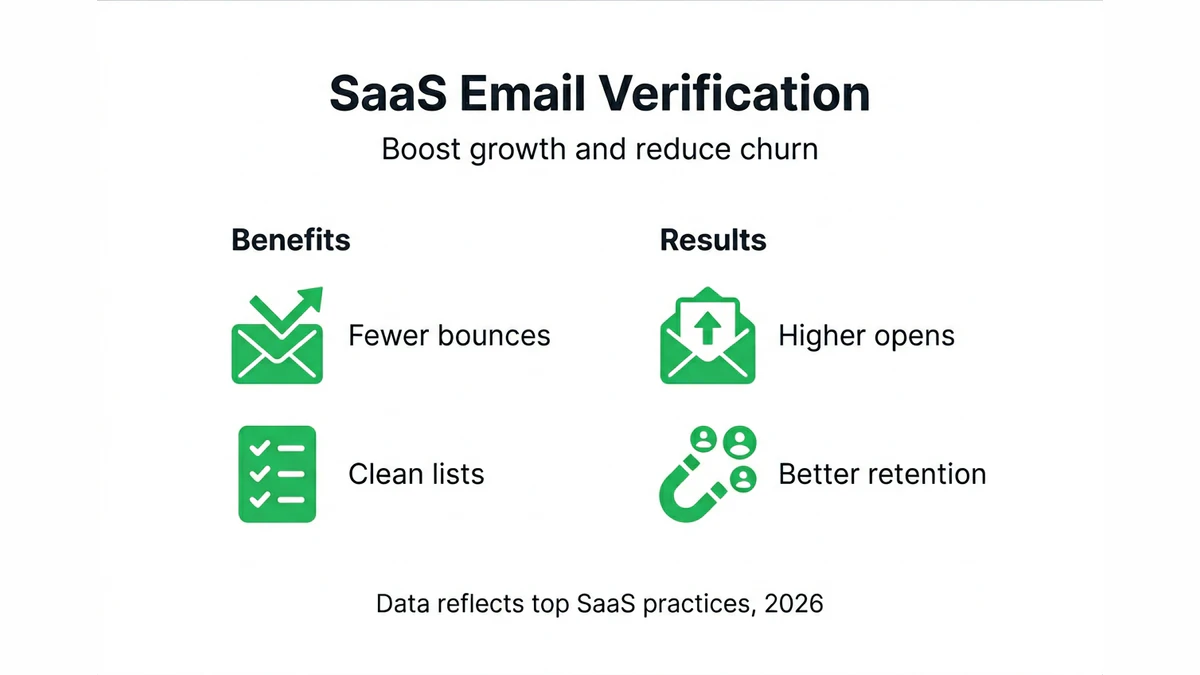
How email verification drives better marketing and reduces churn in SaaS
Integrating email deliverability workflow improvement helps SaaS providers decrease customer churn and enhance email deliverability rates. The benefits extend far beyond avoiding bounces, directly impacting metrics that matter for SaaS growth.
Here is how verification creates measurable improvements:
- Higher inbox placement rates: Verified lists maintain strong sender scores, ensuring your emails consistently reach primary inboxes instead of spam folders or promotions tabs.
- Improved engagement metrics: When emails reach real, active users, open rates and click-through rates increase, signaling email providers that your content is valuable and deserves priority delivery.
- Lower customer acquisition costs: Clean lists mean your paid campaigns and lead magnets convert contacts into engaged prospects more efficiently, reducing wasted ad spend on invalid addresses.
- Reduced churn through reliable communication: Critical account emails, product updates, and renewal reminders reach customers consistently, preventing churn caused by missed notifications.
- Better customer lifetime value: Verified contacts engage more with upsell campaigns, feature announcements, and community initiatives, increasing revenue per customer over time.
Consider a SaaS company sending 50,000 emails monthly. Without verification, a typical 5% bounce rate means 2,500 emails fail, damaging sender reputation and reducing deliverability for the remaining 47,500. With verification, bounce rates drop below 1%, protecting reputation and ensuring 49,500+ emails reach inboxes reliably.

Pro Tip: Schedule verification for your entire list quarterly, and verify new signups in real time to prevent data decay from inactive accounts and changed email addresses.
The relationship between verified emails and retention is straightforward. Customers who receive your onboarding sequences, feature updates, and support emails stay engaged with your product. Those who miss these messages due to invalid addresses churn faster, often without you realizing communication failed.
Comparing email verification methods and choosing the right solution for SaaS
Not all email verification approaches deliver equal results. Understanding the differences helps you select a solution that matches your SaaS growth goals and technical requirements.
| Verification Method | Accuracy | Speed | Best For |
|---|---|---|---|
| Syntax validation | 60-70% | Instant | Basic filtering of obvious errors |
| DNS/MX record check | 75-85% | Fast | Confirming domain accepts mail |
| SMTP mailbox validation | 90-95% | Moderate | Verifying individual addresses exist |
| AI-powered verification | 99%+ | Fast | Comprehensive risk detection |
Traditional methods like syntax checks catch obvious typos but miss deliverability risks. DNS checks confirm a domain receives mail but cannot verify specific addresses. SMTP validation connects to mail servers to confirm mailboxes exist, offering much higher accuracy but potentially triggering spam filters if done improperly.
AI-first email verification offers superior accuracy and integration capabilities for SaaS businesses. Advanced systems combine multiple validation layers with machine learning to detect patterns humans and basic algorithms miss. They identify disposable email services that constantly spawn new domains, recognize spam traps that evade traditional checks, and flag risky addresses based on historical behavior across millions of verifications.
When evaluating verification tools for your SaaS, prioritize these factors:
- Real-time API capabilities: Verify emails at signup and form submission to prevent bad data from entering your systems
- Bulk verification speed: Process large lists quickly during migrations or quarterly cleanups without disrupting operations
- Integration ecosystem: Connect seamlessly with your CRM, marketing automation platform, and customer data tools
- Detailed result codes: Understand why addresses fail verification to make informed decisions about borderline cases
- Deliverability guarantees: Choose providers that stand behind their accuracy with performance metrics and SLAs
Pro Tip: Test verification services with a sample of your list before committing, comparing results against your actual bounce rates to validate accuracy claims.
For SaaS companies, the verification method matters less than the outcomes. The right solution reduces bounces below 1%, protects sender reputation consistently, and integrates invisibly into existing workflows without adding friction for legitimate users.
Implementing a scalable email verification workflow for sustained SaaS growth
A strategic verification workflow ensures clean data flows through every stage of your customer journey. Email validation and SaaS marketing requires a structured workflow for sustained growth and optimized marketing performance.
Start by identifying critical verification touchpoints:
- Signup forms: Verify emails in real time as users create accounts, preventing invalid addresses from entering your system
- Lead capture: Validate emails from content downloads, webinar registrations, and demo requests before adding to nurture sequences
- Bulk imports: Clean purchased lists, event attendees, and partnership data before first contact
- Re-engagement campaigns: Verify dormant contacts before win-back campaigns to avoid wasting sends on dead addresses
- Regular maintenance: Schedule quarterly verification of your entire database to catch addresses that became invalid over time
Implementing these touchpoints creates measurable improvements:
| Metric | Before Verification | After Verification | Improvement |
|---|---|---|---|
| Bounce rate | 4.8% | 0.7% | 85% reduction |
| Open rate | 18.2% | 24.6% | 35% increase |
| Click rate | 2.4% | 3.8% | 58% increase |
| Spam complaints | 0.12% | 0.03% | 75% reduction |
Beyond the numbers, verification workflow design affects user experience. Real-time validation at signup must balance accuracy with friction. Rejecting legitimate emails frustrates users and kills conversions. The solution is providing clear feedback when verification fails, suggesting corrections for typos, and offering alternative contact methods for edge cases.
For ongoing list hygiene, automate verification to run continuously without manual intervention. Set up rules that re-verify contacts after 90 days of inactivity, flag addresses with repeated soft bounces, and suppress emails that fail validation from future campaigns. Monitor verification results in your analytics dashboard to spot trends like increasing disposable email usage or specific domains with high failure rates.
Integration is crucial. Your verification service should connect directly to your CRM, marketing automation platform, and customer data platform. When a verified email enters Salesforce, it should sync to HubSpot and Mailchimp without requiring duplicate checks. When verification flags a risky address, that status should update across all systems instantly.
The workflow compounds benefits over time. Month one, you reduce bounces and protect sender reputation. Month three, improved deliverability increases campaign ROI. Month six, cleaner data enables better segmentation and personalization. Month twelve, your email channel drives predictable revenue growth because every contact in your system is verified and reachable.
Boost your SaaS growth with AI-first email verification
Ready to transform email into a reliable growth channel? BillionVerify delivers enterprise-grade AI-first email verification designed specifically for SaaS teams who need accuracy, speed, and seamless integration.
Our platform combines SMTP validation, spam trap detection, and machine learning to achieve 99.9% accuracy at 50 millisecond response times. Verify emails in real time at signup, process bulk lists instantly, and integrate with over 20 marketing tools including Mailchimp, SendGrid, HubSpot, and Salesforce. Reduce bounce rates below 1%, protect your sender reputation, and ensure every marketing dollar reaches real prospects.
SaaS marketing teams choose BillionVerify for deliverability they can measure and growth they can scale. Start verifying today and watch your email performance transform from unpredictable to unstoppable.
FAQ
What is email verification and why is it crucial for SaaS growth?
Email verification validates that email addresses are real, active, and safe to contact before you send marketing or transactional messages. For SaaS companies, this process is crucial because email remains the primary channel for onboarding, engagement, and retention. Invalid addresses create bounces that damage sender reputation, causing future emails to land in spam folders even for legitimate customers. By verifying contacts, you ensure product updates, feature announcements, and support messages consistently reach users, directly impacting activation rates, engagement, and churn prevention.
How often should SaaS companies verify their email lists?
Verify new email addresses in real time at signup and form submission to prevent invalid data from entering your systems. For existing contacts, run comprehensive verification quarterly to catch addresses that became inactive or invalid over time. High-volume senders or companies with rapidly growing lists should verify monthly. Additionally, verify any bulk imported lists, purchased data, or partner-provided contacts before first contact to protect sender reputation and maximize deliverability from day one.
Can email verification reduce customer churn in SaaS?
Absolutely. Verified email addresses ensure critical communications like onboarding sequences, product updates, renewal reminders, and support notifications actually reach customers. When users miss these messages due to invalid addresses, they disengage from your product, fail to adopt key features, and churn without understanding value. Clean email lists enable consistent touchpoints that drive product adoption, feature discovery, and renewal conversations, all of which directly reduce churn and increase customer lifetime value.
What are the best email verification features for SaaS providers?
Prioritize real-time API verification that validates emails instantly at signup without adding friction for users. Look for AI-powered accuracy above 99% to minimize false positives that block legitimate customers. Ensure seamless integration with your existing CRM and marketing automation tools to maintain clean data across all systems. Choose providers offering detailed result codes that explain why addresses fail, enabling informed decisions about borderline cases. Finally, verify the service provides fast processing speeds for both real-time checks and bulk verification to support your growth without bottlenecks.