



Most marketers assume sending email is straightforward: write a message, hit send, and watch results roll in. The reality is far more complex. Behind every successful campaign lies infrastructure that handles authentication, delivery, bounce management, and real-time tracking across millions of messages. Email APIs provide this foundation, enabling programmatic control over sending and validation workflows that directly impact deliverability and engagement. This guide explains what email APIs are, how they differ from traditional SMTP, and practical ways to integrate them into your marketing operations to reduce bounce rates and improve campaign performance.
Key Takeaways
| Point | Details |
|---|---|
| Programmatic sending and tracking | Email APIs enable applications to send, receive, and track messages via HTTP requests with real time feedback and status updates. |
| API versus SMTP advantages | APIs use HTTP and provide asynchronous sending, faster delivery, and richer analytics compared with SMTP. |
| Validation reduces bounce | Validation APIs improve list hygiene by validating addresses before sending, reducing waste and protecting sender reputation. |
| Combined sending and validation | Combining sending and validation APIs improves deliverability and engagement by reducing waste and enabling proactive quality checks. |
What is an email API and how does it work?
An email API is a programmatic interface that enables applications to send, receive, and track emails via HTTP/REST requests to an email service provider. Unlike manual email clients, APIs let your marketing platform, CRM, or application trigger emails automatically based on user actions, schedule broadcasts, and capture detailed engagement data in real time.
The core mechanics involve RESTful HTTP POST requests with JSON payloads containing sender details, recipient addresses, subject lines, message bodies, attachments, and custom metadata. When your application sends a request, the API processes it and returns status codes indicating success, errors, or warnings. This immediate feedback allows developers to handle failures gracefully, retry sends, or flag problematic addresses for review.
Real-time event tracking happens through webhooks, which are callbacks the API sends to your server when specific events occur. You receive notifications for opens, clicks, bounces, spam complaints, and unsubscribes without polling for updates. This approach supports scalability because your system processes events asynchronously as they happen, rather than querying databases constantly.
Email APIs integrate seamlessly with transactional and marketing workflows. For transactional emails like password resets or order confirmations, APIs trigger sends based on user behavior with minimal latency. For marketing campaigns, they enable segmentation, personalization, and A/B testing at scale. The email verification API benefits extend this by validating addresses before sending, reducing waste and protecting your sender reputation.
Key components of email API requests include:
- Sender information with authenticated domain credentials
- Recipient list with personalization variables and metadata
- Message content in HTML and plain text formats
- Tracking parameters for opens, clicks, and custom events
- Delivery options like scheduling, priority levels, and retry logic
The email API technical guide provides deeper implementation details, but the fundamental value lies in automation and visibility. You control exactly when emails send, who receives them, and how your system responds to delivery outcomes.
Email API vs SMTP: understanding the differences
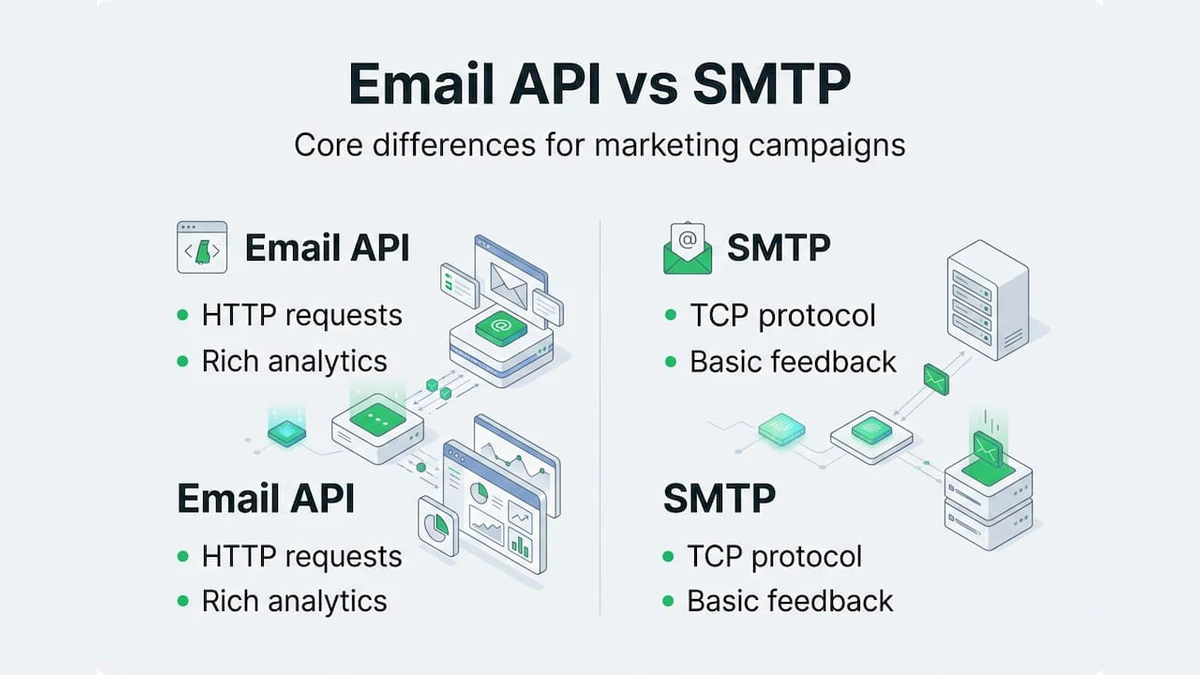
SMTP has been the standard protocol for email transmission since the 1980s, relying on TCP connections to transfer messages between mail servers. It works well for basic sending but struggles with modern marketing demands like high-volume campaigns, detailed analytics, and programmatic control.
Email APIs use stateless HTTP, enabling faster scale, better error handling, and rich analytics compared to SMTP's synchronous TCP connections. When you send via SMTP, your application maintains an open connection until the server confirms receipt or times out. This synchronous process creates bottlenecks when sending thousands of messages simultaneously. APIs, by contrast, accept requests asynchronously and return immediate acknowledgments, allowing your application to continue processing while the ESP handles delivery.

Analytics capabilities differ dramatically. SMTP provides basic delivery confirmations but lacks visibility into opens, clicks, or engagement patterns. Email APIs offer detailed event tracking via webhooks, letting you capture user behavior in real time and feed it back into your CRM or analytics platform. This data drives segmentation, retargeting, and campaign optimization in ways SMTP cannot support.
Error handling also improves with APIs. SMTP error codes are cryptic and require manual interpretation. APIs return structured JSON responses with clear error messages, suggested fixes, and retry logic. When an address bounces, you receive detailed reasons like invalid domain, mailbox full, or spam block, making list hygiene and troubleshooting far more efficient.
| Feature | SMTP | Email API |
|---|---|---|
| Protocol | TCP synchronous | HTTP asynchronous |
| Speed at scale | Slower, connection overhead | Faster, stateless requests |
| Analytics | Basic delivery status | Real-time opens, clicks, bounces |
| Error handling | Cryptic codes | Structured JSON responses |
| Integration complexity | Requires mail server config | RESTful endpoints, simple auth |
| Best for | Simple transactional sends | High-volume marketing campaigns |
Pro Tip: For large volume campaigns, prioritize email APIs for deliverability and insights. Reserve SMTP for legacy systems or simple transactional needs where advanced tracking is unnecessary.
The email APIs vs SMTP comparison extends to validation workflows as well. APIs enable real-time address verification during signup, while SMTP only reveals invalid addresses after bounce, wasting sends and damaging reputation. The email SMTP comparison highlights these trade-offs in technical depth.
Email validation APIs: improving list quality and deliverability
Validation APIs verify addresses via checks like syntax, DNS/MX, SMTP handshake, and detect disposable or role-based emails. These multi-stage processes happen in milliseconds, allowing you to validate addresses in real time as users sign up or in batch mode before launching campaigns.
Syntax validation ensures addresses follow standard formatting rules, catching typos like missing @ symbols or invalid characters. DNS/MX checks confirm the domain has valid mail exchange records, preventing sends to non-existent domains. SMTP handshake verification connects to the recipient's mail server to confirm the mailbox exists without actually sending an email. This step identifies invalid addresses before they bounce.
Advanced validation detects catch-all domains, which accept all emails regardless of whether the mailbox exists. These addresses carry higher risk because you cannot confirm validity until after sending. Role-based addresses like info@ or support@ often have lower engagement and higher complaint rates, making them poor targets for marketing campaigns. Disposable email detection identifies temporary addresses from services like Mailinator or Guerrilla Mail, which users abandon quickly and never check.
The impact on deliverability is substantial. Validation reduces bounce rates by over 20%, boosts opens by 65%, and helps maintain bounce rates under ISP thresholds. Internet service providers monitor bounce rates closely, throttling or blocking senders who consistently exceed 2% to 5% bounce thresholds. By removing invalid addresses before sending, you protect your sender reputation and maintain inbox placement.
List hygiene impacts deliverability critically. Addresses decay over time as people change jobs, abandon accounts, or switch providers. A list can degrade by 22% annually without regular validation. Maintaining bounce rates below 2% avoids ISP throttling and keeps your domain off spam blacklists. The email validation process guide provides detailed workflows for implementing validation at scale.
Pro Tip: Combine real-time validation at sign-up with batch validation pre-send for best results. Real-time validation prevents bad data from entering your CRM, while batch validation catches addresses that decayed since signup.
Validation workflows for different scenarios:
- Real-time signup validation: Verify addresses as users submit forms to block invalid entries immediately
- CRM ingestion validation: Check imported lists before adding contacts to your database
- Pre-campaign batch validation: Validate entire segments before launching broadcasts to remove risky addresses
- Ongoing list hygiene: Schedule monthly or quarterly validation to catch decayed addresses
- Post-bounce cleanup: Validate bounced addresses to distinguish temporary issues from permanent failures
The email validation for SaaS marketing use case demonstrates how validation improves conversion rates by ensuring trial signup emails reach real users. The email validation stages breakdown shows technical implementation details for each verification step.
Best practices for integrating email APIs in marketing workflows
Integrate validation APIs at signup and CRM ingestion in real-time plus batch pre-campaign for maintaining bounce rates below 2%. This hybrid approach catches invalid addresses at entry while also cleaning existing lists before sends. Real-time validation prevents bad data from polluting your database, reducing storage costs and improving segmentation accuracy.
Pair sending APIs with validation APIs to leverage webhook event tracking and analytics feedback. When you send via API, you receive detailed bounce codes indicating whether failures are temporary or permanent. Feed this data back into your validation workflow to update contact statuses automatically. Temporary bounces like mailbox full may resolve themselves, while permanent bounces like invalid domain should trigger immediate suppression.
Buying API services provides infrastructure benefits like IP warming and reputation management. Building your own email infrastructure requires managing dedicated IPs, warming them gradually to establish sender reputation, monitoring blacklists, and handling ISP feedback loops. API providers handle this complexity, giving you access to warmed IPs and reputation monitoring out of the box.
Monitor ISP thresholds and segment risky emails for testing. Different ISPs have varying tolerance for bounces and complaints. Gmail may throttle senders above 0.3% spam complaint rates, while Outlook tolerates slightly higher thresholds. Segment contacts by provider and monitor metrics separately to identify problem areas before they impact your entire sender reputation.
| Metric | Target | Impact of Missing Target |
|---|---|---|
| Bounce rate | Below 2% | ISP throttling, blacklisting |
| Open rate | 15% to 25% | Indicates list quality and relevance |
| Validation accuracy | 98%+ | False positives waste sends, false negatives cause bounces |
| Spam complaint rate | Below 0.1% | Damages sender reputation, triggers blocks |
| List decay annual rate | Monitor 20% to 25% | Requires regular revalidation |
Implementation steps from ingestion to campaign launch:
- Validate addresses in real-time during signup forms and landing page submissions
- Run batch validation on imported lists before adding to CRM
- Segment contacts by validation status: verified, risky, invalid
- Suppress invalid and high-risk addresses from campaign sends
- Configure webhook endpoints to receive bounce and engagement events
- Update contact records automatically based on delivery outcomes
- Schedule quarterly revalidation of entire database to catch decay
- Monitor deliverability metrics by ISP and adjust sending patterns
The email deliverability workflows article details how SaaS companies implement these practices to maintain high inbox placement. The email verification best practices guide covers advanced techniques like engagement-based validation, where you suppress contacts who have not opened emails in 90 days to improve overall engagement metrics.
Integration with marketing platforms happens through native connectors or custom API implementations. Most email service providers offer pre-built integrations with validation APIs, allowing you to enable real-time verification with minimal configuration. For custom workflows, RESTful APIs provide flexibility to validate at any point in your data pipeline, from web forms to backend CRM processes.
Enhance your email campaigns with BillionVerify
Implementing the validation and sending best practices outlined above requires a reliable email verification partner. BillionVerify provides an AI-first email verification API tailored for marketers managing high-volume campaigns. The platform helps maintain bounce rates below 2%, ensuring high deliverability and protecting your sender reputation from ISP penalties.
BillionVerify offers both real-time and batch validation workflows, seamlessly integrating with your existing marketing stack. Real-time verification validates addresses at signup, preventing invalid data from entering your CRM. Batch validation processes entire lists before campaign launches, identifying risky addresses that could damage deliverability. The multi-layer verification technology detects disposable emails, spam traps, role-based addresses, and catch-all domains with 98%+ accuracy.
Trusted by e-commerce and SaaS teams, BillionVerify reduces wasted sends and improves engagement metrics across campaigns. The email verification API benefits extend beyond bounce reduction to include better segmentation, improved conversion rates, and lower email costs. The email validation process guide demonstrates how to implement validation workflows that scale with your business.
Frequently asked questions
What is an email API and what are its main functions?
An email API is a programmatic interface that lets applications send, receive, and track emails via HTTP requests to an email service provider. Main functions include triggering transactional and marketing emails, capturing real-time engagement events like opens and clicks, handling bounces and complaints, and providing detailed analytics for campaign optimization.
How do email APIs differ from SMTP?
Email APIs use stateless HTTP protocols that enable asynchronous processing and faster scale compared to SMTP's synchronous TCP connections. APIs provide structured JSON responses with detailed error handling and real-time webhooks for engagement tracking, while SMTP offers only basic delivery confirmations with cryptic error codes.
Why do email validation APIs matter for deliverability?
Validation APIs verify addresses through multi-stage checks including syntax, DNS/MX records, SMTP handshake, and detection of disposable or role-based emails. This process reduces bounce rates by over 20% and helps maintain rates below the 2% ISP threshold, protecting sender reputation and ensuring consistent inbox placement.
How does real-time validation improve campaign outcomes?
Real-time validation verifies addresses as users sign up, preventing invalid data from entering your CRM and reducing list pollution. This approach improves segmentation accuracy, lowers bounce rates, and increases engagement by ensuring you only send to valid, active addresses that users actually monitor.
What are common integrations with marketing platforms?
Email APIs integrate with major marketing platforms and CRMs through native connectors or RESTful endpoints. Common integrations include real-time validation at web form submission, batch validation before campaign launches, webhook event tracking to update contact records, and automated suppression of bounced or complained addresses based on delivery outcomes.