



TL;DR:
- B2B email list decay averages 25-30% annually, requiring continuous hygiene practices.
- Effective hygiene involves ongoing validation, suppression of invalid addresses, and regular list refreshes.
- Combining hygiene with proper authentication significantly improves email deliverability and campaign success.
B2B email lists decay 25-30% annually due to employee turnover, company rebranding, and domain changes, and most marketing teams only notice when campaign performance starts slipping. The real problem is that many marketers treat email hygiene as a one-time fix rather than an ongoing discipline. They delete hard bounces after a campaign, call it clean, and move on. That misunderstanding costs real revenue. This article breaks down what B2B email hygiene actually involves, the mechanics behind a robust workflow, the edge cases that trip up even experienced senders, and how to build a measurement culture that keeps your list performing at its best.
Key Takeaways
| Point | Details |
|---|---|
| Hygiene protects deliverability | Ongoing email hygiene is the foundation for getting your B2B campaigns into inboxes and maximizing response. |
| Real-time validation is key | Validate emails at the point of capture to prevent issues before they enter your list. |
| Advanced tactics needed for B2B | Catch-all domains, role-based addresses, and strict corporate filters require extra diligence in B2B hygiene. |
| Measure and iterate | Track key metrics like bounce rates and list decay to refine your hygiene process and sustain high performance. |
What is B2B email hygiene and why does it matter?
B2B email hygiene is not a single action. It is an ongoing process of maintaining email lists free from invalid, risky, unreachable, or unengaged addresses to protect deliverability, sender reputation, and campaign performance. Think of it as the systematic discipline of ensuring every address on your list is worth sending to, not just today, but consistently over time.
Why does this matter so much in B2B specifically? Because the stakes are higher. Corporate spam filters are more aggressive than consumer inboxes. A single spike in bounce rates or complaint rates can trigger filtering at the domain level, meaning your emails stop reaching entire organizations. Deliverability problems in B2B do not just hurt one campaign. They compound across your entire sender reputation.
The relationship between hygiene and campaign success is direct and measurable. Here are the key performance benchmarks every B2B email marketer should track:
- Bounce rate: Keep total bounces below 2%, with hard bounces below 0.5%
- Spam complaint rate: Stay under 0.1-0.3% to avoid ISP and mailbox provider penalties
- Inbox placement rate: Target above 95% for effective campaign reach
- Open rates: B2B open rates typically range from 20-42% with strong hygiene practices
- Click-through rate (CTR): Healthy B2B CTR benchmarks sit between 2-4%
When hygiene slips, these numbers erode quietly. You may not see dramatic failures immediately. Instead, open rates drift downward, replies slow, and inbox placement degrades over weeks. By the time the numbers look alarming, the sender reputation damage is already significant.
"Poor list hygiene is one of the leading causes of deliverability failures in B2B email programs. Most senders don't realize the damage until they're already on a blocklist."
The B2B email environment is uniquely strict because corporate IT departments configure spam filters to protect employees from phishing and unsolicited mail. Role-based addresses like info@ or support@ often route through filtering layers that generic consumer filters do not apply. This means B2B senders need a higher standard of hygiene, not just the basics.
Essential mechanics: The anatomy of effective email hygiene
Now that we have established why hygiene is essential, let us look at what B2B marketers need to actually do, step by step, for a robust hygiene workflow. The core mechanics include validation at capture, suppression of bounces and complaints, removal of inactive contacts, double opt-in implementation, and scheduled list refreshes.
Here is how an effective B2B hygiene workflow operates in sequence:
- Validate at the point of entry. Every new address entering your CRM or email platform should pass real-time syntax, domain, and SMTP verification before it is stored.
- Suppress hard bounces immediately. Any address that generates a hard bounce must be removed from active sending within the same campaign cycle.
- Flag and review soft bounces. Addresses that bounce softly two or more times within a defined window should move to a suppression queue for review.
- Identify and suppress role-based addresses. Addresses like admin@, noreply@, or sales@ are rarely monitored by individuals and generate poor engagement.
- Run scheduled list refreshes. A step-by-step cleaning cycle every quarter catches decay that real-time checks miss.
- Re-engage before suppressing inactives. Run a structured re-engagement sequence before removing contacts who have not opened or clicked in 6-12 months.
The continuous loop of capture, prevent, pre-send block, scheduled refresh, and monitoring integrates cleanly with platforms like HubSpot and Outreach, making automation practical for most B2B teams.
| Hygiene action | Basic approach | Advanced approach | Deliverability impact |
|---|---|---|---|
| Bounce handling | Remove after campaign | Real-time suppression | High |
| Role-based filtering | Manual review | Automated suppression | Medium-High |
| Catch-all domain handling | Send to all | Risk-score and segment | High |
| Inactive suppression | Annual removal | Quarterly with re-engagement | Medium |
| Validation at capture | None or basic syntax | Multi-layer SMTP + domain check | Very High |
For bulk email validation at scale, automated tools that run multi-layer checks at the point of capture eliminate the bulk of bad addresses before they ever enter your system.

Pro Tip: Sequence matters more than frequency. Starting hygiene at the point of first entry is far more effective than running quarterly batch cleans on a list that has already accumulated thousands of risky addresses.
Advanced verification tactics and edge cases in B2B
Basic hygiene steps are critical, but B2B marketers also face specialized challenges that B2C senders rarely encounter. Here is how to navigate the edge cases that can undermine even a well-maintained list.
Modern email verification layers include syntax checking, domain and MX record validation, SMTP ping testing, catch-all detection, disposable address detection, spam trap identification, and risk scoring for greylisted and temporary addresses. Each layer catches a different category of problematic address.
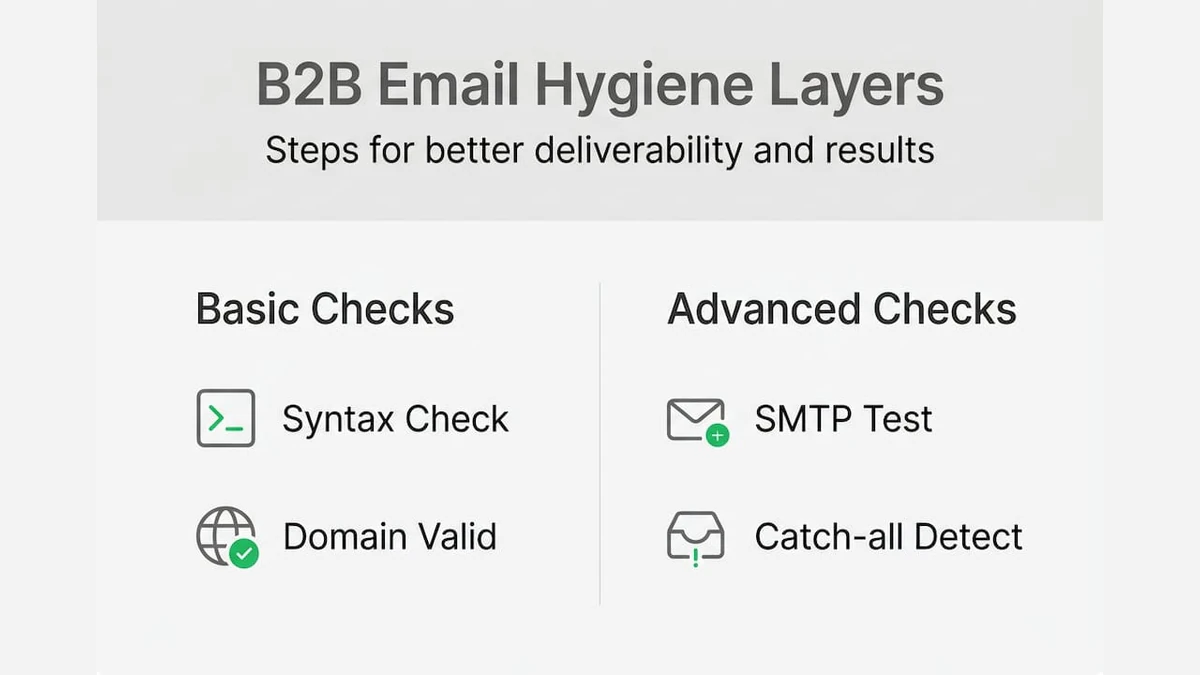
Catch-all domains are particularly tricky in B2B. A catch-all domain accepts all incoming email regardless of whether the specific mailbox exists, which means SMTP pings return a positive result even for invalid addresses. The edge cases around catch-all domains require safe versus unsafe verdicts based on historical engagement data and domain reputation, not just technical validation.
Here is a comparison of basic versus layered verification approaches:
| Verification method | Basic | Layered/Advanced |
|---|---|---|
| Syntax check | Yes | Yes |
| Domain/MX validation | Yes | Yes |
| SMTP ping | Sometimes | Always |
| Catch-all detection | No | Yes |
| Spam trap detection | No | Yes |
| Risk scoring | No | Yes |
| Greylist adaptive probes | No | Yes |
For email verification best practices in 2026, the most effective B2B programs use risk scoring to segment catch-all domains into high-confidence and low-confidence tiers, then adjust sending strategy accordingly rather than sending to all or suppressing all.
Additional edge cases to monitor:
- Recycled spam traps: Old addresses reactivated by ISPs to catch senders with poor list hygiene
- Purchased or scraped lists: These carry extremely high trap density and should never enter a verified sending list without full multi-layer validation
- Greylisted servers: Corporate mail servers that temporarily reject unknown senders, requiring adaptive retry logic
- Role-based addresses: Suppress these from marketing sends but retain for transactional communications where appropriate
Pro Tip: The safest way to avoid spam traps is to validate the source of every list growth channel. If you cannot trace where an address came from, treat it as high risk until verified.
How to track performance and build a culture of continuous hygiene
After addressing key mechanics and B2B-specific nuances, B2B marketers need measurement habits and a team culture to sustain high performance over time. Tracking the right metrics and reviewing them consistently is what separates teams that maintain strong deliverability from those that react to crises.
The primary metrics to monitor are:
- Overall bounce rate: Target below 2%, with hard bounces below 0.5%
- Spam complaint rate: Keep under 0.3% to protect sender reputation with mailbox providers
- Inbox placement rate: Aim for above 95% across major corporate and consumer domains
- List decay rate: Lists decay 25-30% annually, so quarterly reviews are the minimum viable cadence
- Open and click rates: Use these as leading indicators of list quality, not just content performance
Building hygiene as a competitive advantage means creating feedback loops where better engagement improves sender reputation, which improves inbox placement, which improves engagement further. That virtuous cycle only works if measurement is embedded into your workflow, not treated as a post-campaign audit.
Empirical results confirm the value. Verification reduced bounces from 8% to below 3% in documented B2B programs, quarterly hygiene cycles drop bounce rates by 30%, and implementing full authentication with SPF, DKIM, and DMARC boosts inbox placement to 83% compared to 74% without DMARC.
| Metric | Target benchmark | Review frequency |
|---|---|---|
| Hard bounce rate | Below 0.5% | After every send |
| Total bounce rate | Below 2% | After every send |
| Complaint rate | Below 0.3% | Weekly |
| Inbox placement | Above 95% | Monthly |
| List decay | Monitor 25-30% annual | Quarterly |
For teams focused on measuring hygiene ROI and building email list success strategies, the most important step is assigning ownership. Hygiene should have a named owner in the marketing operations function, with defined review cycles and escalation paths when metrics fall outside benchmarks.
"Clean lists are not just a technical asset. They are a strategic advantage that compounds over time, improving every metric that matters to revenue-focused B2B marketing teams."
Why 'one-off cleaning' is a trap: A seasoned B2B email marketer's view
Most B2B marketing teams run a list clean when something goes wrong. Bounces spike, a campaign underperforms, or someone flags a deliverability issue. The team scrubs the list, metrics recover temporarily, and the cycle repeats six months later. This approach is not hygiene. It is reactive maintenance, and it leaves significant performance on the table.
The core problem is that one-off cleans create false confidence. A list that passes a batch clean in January will have decayed meaningfully by April, particularly in B2B where personnel changes are constant. The fix is not cleaning more often. It is building hygiene into every touchpoint where data enters or ages within your system.
Another insight that many teams miss: inactivity definitions must align with your sales cycle, not with generic email marketing benchmarks. A contact who has not opened in 90 days might be perfectly valid in a B2B context with a 12-month sales cycle. Suppressing them prematurely removes real pipeline potential.
Hygiene also works as a lever for team alignment. When marketing operations, sales, and demand generation share the same list quality standards and metrics, the entire revenue function benefits. Use hygiene reviews as a forcing function to align on data standards, not just as a technical compliance task. That shift in framing is what separates teams that improve open rates sustainably from those chasing short-term fixes.
Supercharge your B2B email hygiene with BillionVerify
Applying these hygiene principles at scale requires the right infrastructure. BillionVerify's AI-powered email verification platform gives B2B marketing teams real-time validation at the point of capture, multi-layer verification that detects spam traps, catch-all domains, role-based addresses, and risky domains, plus deliverability monitoring that keeps your sender reputation protected across every campaign.
With integrations across more than 20 major CRM and email marketing platforms, BillionVerify fits directly into your existing workflow without disruption. Whether you are validating millions of addresses in bulk or running real-time checks on new registrations, the platform scales to your volume. Explore the full step-by-step guide to see exactly how to implement a continuous hygiene system that protects your deliverability and maximizes campaign ROI.
Frequently asked questions
How often should a B2B email list be cleaned?
Quarterly hygiene cycles reduce bounces by 30%, making quarterly the minimum recommended cadence, while real-time validation on every new entry delivers the strongest ongoing protection.
What are the most important metrics for B2B email hygiene?
Prioritize overall bounce rate below 2%, complaint rate below 0.3%, inbox placement rate above 95%, and annual list decay rate as your four core benchmarks.
What makes B2B email hygiene harder than B2C?
B2B lists face faster decay from employee turnover, and catch-all domains and role-based addresses require specialized handling that standard B2C hygiene tools are not designed to manage.
Can email hygiene alone ensure my campaigns reach the inbox?
Hygiene is essential but not sufficient on its own. Full authentication with SPF, DKIM, and DMARC boosts inbox placement to 83% versus 74% without DMARC, making authentication a required complement to list hygiene.