



B2B email marketing operates by different rules than B2C. Longer sales cycles, multiple decision-makers, and higher stakes require different strategies. This comprehensive guide covers B2B-specific email tactics that nurture leads, build relationships, and drive business results.
B2B vs. B2C Email Marketing
Understanding the fundamental differences shapes your entire strategy.
Key Differences
Sales Cycle Length:
- B2C: Minutes to days
- B2B: Weeks to months (sometimes years)
Decision Makers:
- B2C: Usually one person
- B2B: Multiple stakeholders (average 6-10 people in B2B buying decisions)
Purchase Value:
- B2C: Lower, emotion-driven
- B2B: Higher, logic-driven (though emotion still matters)
Relationship Focus:
- B2C: Transaction-oriented
- B2B: Relationship-oriented
Content Needs:
- B2C: Entertainment, lifestyle, deals
- B2B: Education, ROI proof, risk reduction
B2B Email Benchmarks
Average Performance:
- Open rate: 15-25%
- Click rate: 2-5%
- Click-to-open rate: 10-15%
- Unsubscribe rate: 0.1-0.5%
High Performers:
- Open rate: 25-35%
- Click rate: 5-10%
- Click-to-open rate: 15-25%
Note: Benchmarks vary significantly by industry, list quality, and content type.
Why Email Excels for B2B
Professional Channel: Email is where business gets done.
Nurturing Power: Perfect for long sales cycles requiring multiple touches.
Scalable Personalization: One-to-one communication at scale.
Measurable: Track engagement through entire buyer journey.
Content Distribution: Ideal for sharing valuable business content.
Building B2B Email Lists
Quality matters more than quantity in B2B.
B2B List Building Strategies
Content Marketing:
- Whitepapers and research reports
- Industry guides and ebooks
- Webinars and virtual events
- Online tools and calculators
- Templates and frameworks
Website Optimization:
- Demo request forms
- Free trial signups
- Newsletter subscriptions
- Resource library access
- Pricing calculator gates
Events and Networking:
- Trade show lead capture
- Speaking engagements
- Industry meetups
- Virtual conferences
- Webinar co-hosting
LinkedIn Strategies:
- LinkedIn lead gen forms
- Content engagement follow-up
- InMail campaigns
- Group participation
Lead Magnet Ideas for B2B
Research and Data:
- Industry benchmark reports
- Original research findings
- Market analysis
- Trend predictions
Educational Content:
- Comprehensive guides
- How-to tutorials
- Best practices compilations
- Framework templates
Tools and Resources:
- ROI calculators
- Assessment tools
- Comparison matrices
- Vendor selection checklists
Case Studies:
- Customer success stories
- Implementation guides
- ROI documentation
- Before/after analyses
Data Enrichment
Enhance Lead Information:
- Company size and industry
- Job title and seniority
- Technology stack
- Funding status
- Growth indicators
Why Enrichment Matters:
- Better segmentation
- More personalization
- Lead scoring accuracy
- Sales intelligence
B2B List Quality
Quality Indicators:
- Valid business email addresses
- Accurate company information
- Confirmed opt-in
- Recent engagement
Red Flags:
- Generic email addresses (gmail, yahoo)
- Outdated job titles
- Invalid domain names
- No company information
Maintaining clean email lists is critical for B2B success, where each contact represents significant potential value.
B2B Email Segmentation
Segmentation is even more critical in B2B.
Segmentation Dimensions
For comprehensive guidance, see our email segmentation guide.
Firmographic:
- Company size (employees, revenue)
- Industry/vertical
- Location/geography
- Company type (startup, enterprise, agency)
Role-Based:
- Job function (marketing, IT, finance)
- Seniority level (C-suite, director, manager)
- Buying role (decision maker, influencer, user)
Behavioral:
- Website activity
- Content consumption
- Email engagement
- Product usage (for existing customers)
Lifecycle Stage:
- Subscriber
- Marketing qualified lead (MQL)
- Sales qualified lead (SQL)
- Opportunity
- Customer
Account-Level:
- Target account tier
- Account engagement score
- Buying stage
- Relationship status
Creating Effective Segments
Example Segments:
High-Priority Prospects:
- Enterprise companies (1000+ employees)
- In target industry
- Decision-maker job title
- Multiple website visits this month
- Downloaded product-focused content
Warm Leads:
- Engaged with multiple emails
- Visited pricing page
- Attended webinar
- Not yet talked to sales
At-Risk Customers:
- Declining product usage
- No recent support tickets
- Haven't opened emails in 60 days
- Contract renewal in 90 days
Dynamic Segmentation
Automatic Segment Updates: Segments should update automatically based on behavior and data changes.
Example:
- Lead visits pricing page → Moves to "Sales Ready" segment
- Customer usage drops below threshold → Moves to "At Risk" segment
- Lead opens 5+ emails → Moves to "Highly Engaged" segment
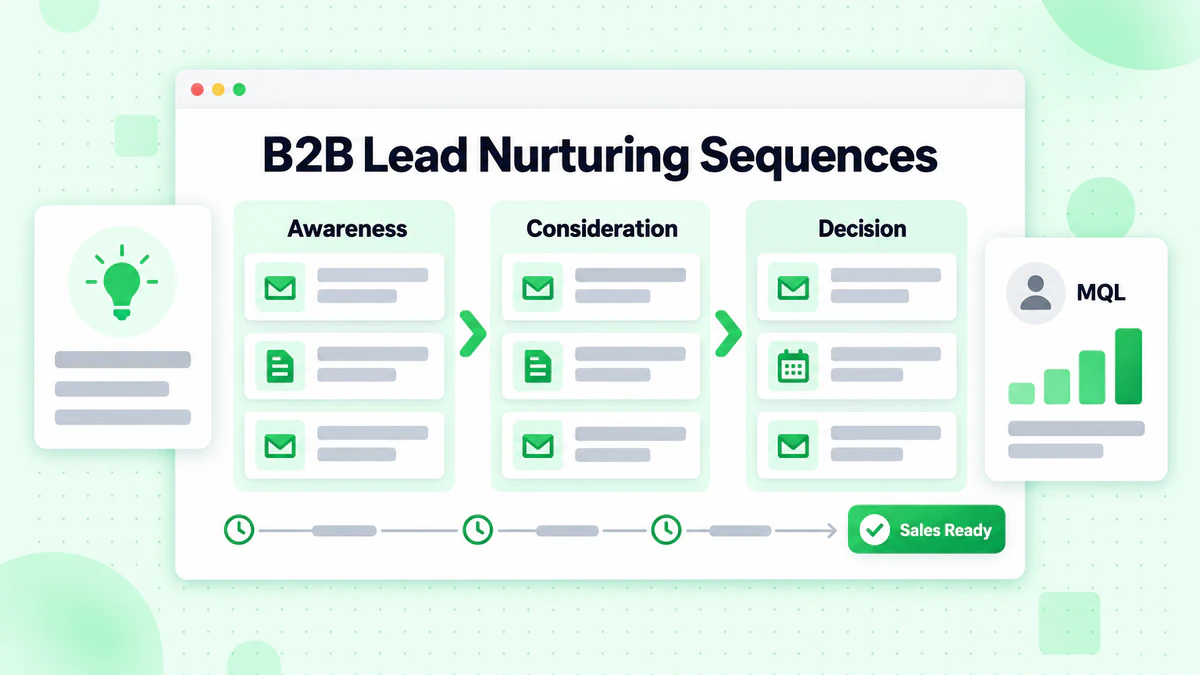
B2B Lead Nurturing Sequences
Nurturing leads through long sales cycles.
Lead Nurturing Fundamentals
Purpose: Build relationships and trust until prospects are ready to buy.
Key Principles:
- Provide value at every touch
- Educate, don't just sell
- Match content to buyer stage
- Be patient with timing
- Always have a next step
Awareness Stage Nurturing
Goal: Educate about the problem/opportunity.
Content Types:
- Industry trend articles
- Educational blog posts
- Thought leadership
- Benchmark data
- Problem/solution overviews
Email Example:
Subject: The hidden cost of [problem]

Hi [First Name],

Most [job title]s don't realize that [problem] costs
companies an average of $X per year.

We recently published research showing exactly how
this impacts businesses like [Company].

[Read the Research →]

If this resonates, I'd love to hear how you're
currently handling [problem].

Best,
[Signature]
Consideration Stage Nurturing
Goal: Help evaluate solutions.
Content Types:
- Product comparisons
- Buyer's guides
- Case studies
- Webinars and demos
- ROI calculators
Email Example:
Subject: How [Similar Company] solved [problem]

Hi [First Name],

Since you've been researching [topic], I thought
you'd find this relevant.

[Similar Company] faced the same challenges you're
likely dealing with. Here's how they solved it
(with specific results):

[Read the Case Study →]

Key results:
• 40% reduction in [metric]
• $X saved annually
• 3-month payback period

Would a quick call to discuss how this might apply
to [Company] be helpful?

Best,
[Signature]
Decision Stage Nurturing
Goal: Facilitate purchase decision.
Content Types:
- Pricing information
- Implementation guides
- Security/compliance docs
- References and testimonials
- Free trials/pilots
Email Example:
Subject: Everything you need to move forward

Hi [First Name],

You've done your research on [solution]. Here's
everything you might need to take the next step:

📋 Implementation timeline: [Link]
🔒 Security documentation: [Link]
💰 ROI calculator: [Link]
📞 References available: [Reply to request]

Is there anything else blocking a decision? I'm
happy to address any remaining concerns.

Best,
[Signature]
Sample Nurture Sequence
8-Week Lead Nurture Campaign:
Week 1: Welcome + Educational content Week 2: Industry insight/trend content Week 3: Problem-focused content Week 4: Solution overview Week 5: Case study Week 6: Comparison guide Week 7: ROI/value content Week 8: Consultation offer
Branching Logic:
- High engagement → Accelerate to sales conversation
- Low engagement → Slower cadence, different content
- Specific interest shown → Topic-specific path
Account-Based Email Marketing
Targeting specific high-value accounts.
ABM Email Principles
Account-Centric View: Think accounts, not individuals. Multiple people at target accounts receive coordinated messaging.
Personalization Depth: Go beyond first name. Reference specific company challenges, news, and context.
Coordination: Align email with other channels (ads, direct mail, sales outreach).
Patience: ABM plays the long game. Build relationships over months.
ABM Email Tactics
Account Research: Before emailing, understand:
- Company news and announcements
- Key initiatives and priorities
- Technology stack
- Organizational structure
- Pain points and challenges
Multi-Threading: Engage multiple stakeholders at target accounts:
- Executive sponsor
- Day-to-day user
- Technical evaluator
- Procurement/finance
Personalized Content:
- Industry-specific messaging
- Company-specific references
- Role-specific value props
- Competitor displacement angles
ABM Email Examples
Initial outreach:
Subject: Congrats on [recent news], [First Name]

Hi [First Name],

I noticed [Company] recently [specific news/event].
Congratulations—that's exciting.

Given your focus on [initiative], I thought you might
find this relevant: [specific resource about their challenge].

We've helped similar companies in [industry] achieve
[specific result]. Happy to share more context if
you're interested.

Best,
[Signature]
Multi-Stakeholder Coordination:
To: Technical Lead
Subject: How [Company] would integrate with [solution]

Hi [First Name],

I know [Decision Maker] has been exploring [solution
category]. I put together a technical overview
specifically for [Company]'s environment:

• Integration with [their existing tool]
• Data migration approach
• Security compliance (SOC 2, GDPR)
• API documentation

[View Technical Overview →]

Worth a 15-minute call to discuss technical requirements?

Best,
[Signature]
ABM at Scale
Tiered Approach:
Tier 1 (Top 10-20 accounts):
- Highly personalized 1:1 emails
- Custom content and landing pages
- Sales and marketing collaboration
- Multi-channel orchestration
Tier 2 (Next 50-100 accounts):
- Industry-personalized content
- Account-specific touches
- Marketing-led with sales input
Tier 3 (Broader target accounts):
- Industry segment personalization
- Automated nurture with ABM elements
- Marketing-owned programs
B2B Email Content Strategies
Creating content that resonates with business buyers.
Thought Leadership
What It Is: Original perspectives and insights that establish expertise.
Email Applications:
- CEO/founder letters
- Industry commentary
- Prediction pieces
- Contrarian viewpoints
- Framework introductions
Example:
Subject: The conventional wisdom about [topic] is wrong

Hi [First Name],

Everyone says [common belief about topic].

But our data shows something different. After analyzing
[X companies/Y data points], we found that [contrarian
insight].

Here's what that means for [job function] professionals:

[Key insight 1]
[Key insight 2]
[Key insight 3]

[Read the Full Analysis →]

I'd love to hear if this matches your experience.

Best,
[Signature]
Educational Content
What It Is: Genuinely helpful information that solves problems.
Email Applications:
- How-to guides
- Best practices
- Framework explanations
- Skill development
- Industry education
Email Approach:
- Lead with value
- Teach something useful
- No hard sell required
- Build trust over time
Case Studies and Social Proof
What It Is: Evidence that your solution works.
Email Applications:
- Customer success stories
- Results and ROI data
- Video testimonials
- Implementation examples
Effective Structure:
- Similar company (industry, size)
- Specific challenge
- Solution implemented
- Quantified results
- Relevant takeaways
Product-Focused Content
What It Is: Information about your solution.
Balance:
- Mostly educational content (70-80%)
- Some product content (20-30%)
- Product content should still educate
Product Email Types:
- New feature announcements
- Use case explanations
- Integration highlights
- Product comparison content
- Demo invitations
B2B Email Campaigns
Campaign types that work for B2B.
Product Launch Emails
Sequence Structure:
- Teaser/coming soon
- Launch announcement
- Feature deep dive
- Use case/application
- Customer testimonials
- Limited-time offer (if applicable)
Key Elements:
- Clear value proposition
- Specific benefits (not just features)
- Social proof
- Clear next step
Webinar Promotion
Pre-Webinar Sequence:
- Initial invitation (2-3 weeks before)
- Reminder with speaker/topic highlight (1 week)
- Last chance to register (1-2 days)
- Day-of reminder (morning)
Post-Webinar Sequence:
- Thank you + recording access (same day)
- Key takeaways + related resources (2-3 days)
- Follow-up offer/consultation (1 week)
Subject Line Examples:
- "You're invited: [Webinar title]"
- "[Speaker name] on [topic] - Save your spot"
- "Tomorrow: [Webinar topic] starts at [time]"
- "Your recording is ready: [Webinar title]"
Event Marketing
Pre-Event:
- Save the date
- Registration invitation
- Agenda highlights
- Speaker spotlights
- Logistics information
During Event:
- Daily highlights
- Session reminders
- Networking opportunities
- Real-time updates
Post-Event:
- Thank you message
- Content recap
- Presentation access
- Next steps
- Feedback request
Customer Onboarding
B2B Onboarding Sequence:
Day 0: Welcome + account setup Day 1: Key contact introduction Day 3: First quick win tutorial Day 7: Check-in + resources Day 14: Best practices Day 21: Advanced features Day 30: Success review + expansion opportunities
Key Focuses:
- Reduce time to value
- Introduce key contacts
- Provide self-service resources
- Prevent early churn
- Set foundation for expansion
Renewal and Expansion
Pre-Renewal Sequence:
- 90 days out: Relationship check-in
- 60 days out: Value delivered recap
- 30 days out: Renewal discussion
- 14 days out: Final details
Expansion Opportunities:
- Usage milestone emails
- New feature relevant to their use
- Upgrade benefits
- Cross-sell complementary products
B2B Email Personalization
Going beyond basic personalization.
Basic B2B Personalization
Contact Level:
- First name
- Job title
- Company name
Company Level:
- Industry
- Company size
- Location
Advanced B2B Personalization
Behavioral:
- Content consumed
- Pages visited
- Emails engaged with
- Product features used
Contextual:
- Current customer status
- Account health score
- Relationship history
- Recent interactions
Account Intelligence:
- Company news and events
- Funding/growth signals
- Technology stack changes
- Competitor mentions
Dynamic Content
Personalization Blocks: Different content sections based on recipient attributes.
Example:
Hi [First Name],

[IF industry = healthcare]
With HIPAA compliance requirements tightening...
[ELSE IF industry = finance]
With SOX compliance audits approaching...
[ELSE]
With increasing regulatory requirements...
[END IF]

Here's how [solution] helps:

[IF company_size > 1000]
Enterprise features you'll need:
• Feature A
• Feature B
[ELSE]
Getting started is simple:
• Step 1
• Step 2
[END IF]
Personalization at Scale
Use Data Enrichment: Third-party data fills gaps in your knowledge.
Create Templates with Variables: Design email templates with multiple personalization points.
Segment First, Personalize Second: Start with good segmentation, then layer personalization.
Test Personalization Impact: Measure whether personalization improves results.
B2B Email Automation
Automating B2B email workflows.
Essential B2B Automations
Lead Capture Response: Immediate response when someone downloads content or requests information.
Lead Scoring Updates: Automated emails when lead score reaches thresholds.
Behavior-Triggered Emails:
- Website visit to key pages
- Email engagement
- Product usage
- Content downloads
Lifecycle Triggers:
- New subscriber welcome
- Lead to MQL
- Customer onboarding
- Renewal approaching
Lead Scoring Integration
Score-Based Triggers:
- Score 0-30: Educational nurture
- Score 31-60: Solution-focused content
- Score 61-80: Sales development reach-out
- Score 81+: Sales handoff
Example Workflow:
IF lead_score increases above 70
AND last_sales_contact > 30 days
THEN send "Ready to talk?" email
AND notify sales
Sales and Marketing Alignment
Handoff Emails: Notify sales when leads hit qualification criteria.
Automated Updates: Keep sales informed of marketing engagement.
Attribution Tracking: Track which emails influence pipeline and revenue.
Feedback Loops: Sales can trigger marketing emails or flag issues.
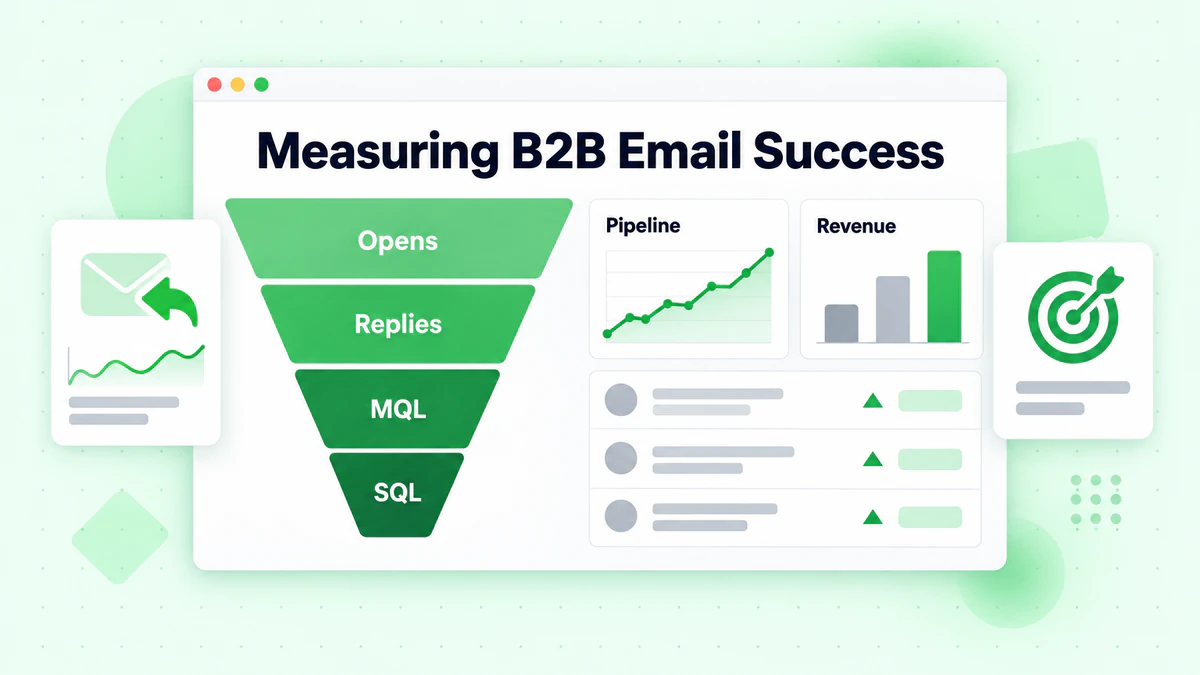
Measuring B2B Email Success
B2B metrics and measurement.
B2B-Specific Metrics
Engagement Metrics:
- Open rate
- Click rate
- Reply rate (important for 1:1 emails)
- Forward rate
Lead Metrics:
- Leads generated
- Lead quality score
- Marketing qualified leads (MQLs)
- Sales qualified leads (SQLs)
Revenue Metrics:
- Pipeline influenced
- Revenue influenced
- Customer acquisition cost
- Email-attributed revenue
Account Metrics (for ABM):
- Account engagement score
- Contacts engaged per account
- Account penetration
- Account progression through stages
Attribution Challenges
Long Sales Cycles: Multiple touches over months make attribution difficult.
Multiple Stakeholders: Same company, different people engaging.
Multi-Channel Journeys: Email is one touchpoint among many.
Approaches:
- First touch attribution
- Last touch attribution
- Multi-touch attribution
- Account-based attribution
Reporting for B2B
Weekly Reports:
- Email performance metrics
- Lead generation numbers
- Notable engagement
Monthly Reports:
- Campaign performance
- Lead flow analysis
- Pipeline contribution
- A/B test results
Quarterly Reports:
- Revenue attribution
- Program ROI
- Strategic insights
- Optimization recommendations
B2B Email Best Practices
Key principles for B2B email success.
Writing for B2B
Be Professional, Not Boring: Business email should be professional but still human and engaging.
Focus on Value: Every email should provide value to the recipient.
Be Specific: Generic messages get ignored. Specific messages get responses.
Respect Their Time: Business people are busy. Get to the point quickly.
Use Data and Evidence: B2B buyers want proof. Include statistics, case studies, and evidence.
Design for B2B
Keep It Clean: Professional, simple designs. Avoid flashy elements.
Mobile Optimization: Executives check email on phones. Ensure mobile readability.
Text-Based for 1:1: Personal outreach emails should look like regular emails, not marketing.
Balance for Newsletters: Marketing emails can have more design, but keep it professional.
Timing for B2B
Best Days: Tuesday, Wednesday, Thursday Best Times: 10am-11am, 2pm-3pm (recipient's time zone) Avoid: Weekends, Monday mornings, Friday afternoons
Test Your Audience: Every audience is different. Test to find your optimal times.
Frequency Guidelines
Nurture Sequences: 1-2 emails per week Newsletters: Weekly or bi-weekly Product Updates: As needed, not more than monthly ABM: Varies by relationship stage
Signal-Based Adjustment: Increase frequency when engagement is high. Decrease when engagement drops.
Common B2B Email Mistakes
Avoid these pitfalls.
Mistake 1: Too Promotional
Problem: Every email is a sales pitch. Fix: 80/20 rule—80% value, 20% promotional.
Mistake 2: Ignoring the Buyer Journey
Problem: Same messages regardless of stage. Fix: Map content to buyer stages.
Mistake 3: One-Size-Fits-All
Problem: No segmentation or personalization. Fix: Segment by industry, role, stage, and behavior.
Mistake 4: Neglecting Nurture
Problem: Expecting quick conversions. Fix: Build nurture programs for long sales cycles.
Mistake 5: Poor Data Quality
Problem: Invalid emails, outdated contacts. Fix: Regular list verification and data hygiene.
Mistake 6: Sales and Marketing Disconnect
Problem: Marketing and sales don't coordinate. Fix: Shared definitions, handoff processes, regular alignment.
Mistake 7: Ignoring Replies
Problem: Sending from no-reply addresses, not monitoring responses. Fix: Encourage and monitor replies. They're valuable engagement.
B2B Email Checklist
Strategy Checklist
- [ ] Defined ideal customer profile (ICP)
- [ ] Mapped buyer journey stages
- [ ] Created content for each stage
- [ ] Segmented list appropriately
- [ ] Built nurture sequences
- [ ] Aligned with sales team
Campaign Checklist
- [ ] Clear goal defined
- [ ] Target segment selected
- [ ] Content provides value
- [ ] Personalization applied
- [ ] Clear CTA
- [ ] Mobile optimized
- [ ] Tracking in place
List Quality Checklist
- [ ] Valid email addresses
- [ ] Accurate company data
- [ ] Proper consent documented
- [ ] Regular verification
- [ ] Bounce management
- [ ] Suppression list maintained
Data Quality for B2B
Clean data is essential for B2B email success.
B2B Data Challenges
Job Changes: B2B contacts change jobs frequently. Company Changes: Mergers, acquisitions, closures. Email Bounces: Higher rate than B2C due to job changes. Data Decay: B2B data decays 20-30% annually.
Verification for B2B
Verify Before Campaigns: Check email validity before major sends. Implement bulk email verification for large B2B databases.
Monitor Bounce Rates: Unusual bounces may indicate data quality issues. Learn how to reduce email bounce rates effectively.
Regular List Hygiene: Quarterly verification of entire database using email list cleaning services.
Real-Time Validation: Verify new leads at point of capture using email verification at form submission.
Impact of Invalid Emails
Deliverability Damage: Bounces hurt sender reputation and email deliverability. Wasted Resources: Sending to invalid addresses. Skewed Metrics: Invalid emails distort engagement rates. Sales Frustration: Sales can't follow up on bad leads.
Understanding email verification best practices helps protect your B2B sender reputation.
Conclusion
B2B email marketing requires patience, value, and strategic thinking. The longer sales cycles and multiple stakeholders mean you're building relationships, not just sending campaigns. By providing consistent value, personalizing thoughtfully, and aligning with sales, email becomes your most powerful tool for nurturing leads and driving business growth.
Remember these key principles:
- Value first: Every email should help the recipient
- Patient nurturing: Build relationships over time
- Smart segmentation: Right message to right person at right time
- Sales alignment: Marketing and sales work as one team
- Quality data: Clean lists enable everything else
The foundation of effective B2B email is reaching real business contacts. Invalid emails mean missed opportunities and damaged deliverability.
Ready to ensure your B2B emails reach valid business addresses? Start with BillionVerify to verify your business contacts and maximize your email marketing ROI.
For local B2B prospecting, Google Maps provides verified business listings as a cost-effective alternative to LinkedIn for regional campaigns. Local business directory cleaning helps ensure contact accuracy before adding directory-sourced leads to B2B sequences.
Agencies and B2B service providers can enrich prospect lists with contacts from Clutch, G2, and other review platforms. The agency email finder workflow guide covers how to turn review site data into verified, deliverable contact lists.