



TL;DR:
- Email verification accuracy impacts deliverability, bounce rates, and campaign ROI at enterprise scale.
- Multi-layer checks like syntax, DNS, SMTP, and catch-all detection are essential for reliable validation.
- Ongoing re-verification and real-time checks are critical to maintain list quality and maximize email program performance.
Email verification accuracy sits at the center of every high-performing enterprise email program. When your list contains even a small percentage of invalid addresses, the consequences ripple outward: bounce rates climb, sender reputation erodes, and inbox placement drops. For mid to large enterprises sending millions of emails per month, the margin for error is razor thin. Email validation accuracy metrics directly influence deliverability and ROI, making tool selection a strategic decision rather than a technical afterthought. This article breaks down what accuracy really means, which technical checks matter most, and how to evaluate verification solutions against the demands of enterprise-scale email operations.
Key Takeaways
| Point | Details |
|---|---|
| Accuracy benchmarks matter | Aim for 98-99% accuracy but test with your own data for real results. |
| Catch-all domains reduce certainty | Even the best tools cannot guarantee 100% accuracy due to ambiguous servers. |
| Layered checks boost results | Combining syntax, MX, SMTP, and disposable detection delivers the best list hygiene. |
| Continuous verification is key | Regular re-verification helps sustain deliverability and ROI as lists and domains change. |
What defines email verification accuracy?
Accuracy in email verification means correctly classifying every address on your list as either valid, invalid, or risky. A tool that misclassifies valid addresses as invalid wastes reach. One that passes invalid addresses as valid drives up bounce rates and threatens your sender reputation. Both errors carry real cost at enterprise scale.
The industry standard for top-tier tools sits at 98-99% accuracy, though real-world performance often lands closer to 95-98% depending on list composition and domain complexity. Independent testing across 50k+ email datasets confirms measurable differences between providers, which means vendor claims alone should never be the basis for tool selection.
For practical measuring verification accuracy, the key benchmarks to track are:
- Bounce rate: Should stay below 2% after verification
- Delivery rate: Healthy campaigns maintain 95% or higher
- False positive rate: Valid emails incorrectly flagged as invalid
- False negative rate: Invalid emails that slip through as valid
| Metric | Healthy benchmark | Risk threshold |
|---|---|---|
| Bounce rate | Below 2% | Above 5% |
| Delivery rate | 95% or higher | Below 90% |
| Verification accuracy | 98-99% | Below 95% |
| False positive rate | Below 1% | Above 3% |
Why does a 1-2% variance matter? On a list of 2 million addresses, a 2% error rate means 40,000 misclassified contacts. That volume is enough to trigger spam filters, damage domain reputation, and reduce campaign ROI significantly. Understanding these benchmarks is the first step toward selecting a tool that performs under real enterprise conditions. You can also review industry comparisons to see how leading providers stack up against these standards.
Core technical checks that affect accuracy
After understanding what accuracy means, it helps to examine the specific technical checks that drive verification results. Each method adds a layer of confidence, and the combination of multiple checks is what separates enterprise-grade tools from basic validators.
The primary verification methods, in order of depth, are:
- Syntax check: Validates that the email format follows RFC standards. Fast and reliable, but catches only formatting errors.
- Domain and MX record check: Confirms the domain exists and has valid mail exchange records. Eliminates addresses on non-functional domains.
- SMTP connection check: Simulates sending a message to verify the mailbox exists without actually delivering an email. High value, but subject to server-side restrictions.
- Disposable email detection: Identifies addresses from temporary email providers. Critical for protecting registration flows.
- Role-based address detection: Flags addresses like info@ or admin@ that belong to groups rather than individuals, reducing engagement rates.
- Catch-all domain detection: Identifies servers that accept all incoming mail regardless of whether the specific mailbox exists.
Core verification methodologies including syntax, MX, SMTP, disposable, and role-based checks form the foundation of any credible tool. However, catch-all detection and SMTP probing require advanced logic beyond standard queries, which is why accuracy varies so widely between providers.

| Check type | Coverage | False positive risk | Key weakness |
|---|---|---|---|
| Syntax | High | Very low | Misses valid-looking invalid addresses |
| MX record | High | Low | Domain may exist but mailbox may not |
| SMTP | High | Medium | Greylisting and firewalls can block probes |
| Disposable detection | Medium | Low | New providers emerge constantly |
| Role-based detection | Medium | Low | Some role addresses are actively monitored |
| Catch-all detection | Low to medium | High | Certainty is inherently limited |
For guidance on advanced catch-all detection and how enterprise tools handle ambiguous results, the technical approach matters as much as the feature list. You can also review validation best practices that go beyond basic regex to understand the full scope of what robust verification requires.
Pro Tip: Prioritize tools that layer multiple checks sequentially rather than running them in isolation. Multi-layered systems catch edge cases that single-method tools consistently miss, especially at high volumes.
The catch-all dilemma: Handling ambiguous servers
Building on the technical checks above, catch-all domains represent the most persistent accuracy challenge in email verification. A catch-all server is configured to accept all incoming mail for a domain, regardless of whether the specific mailbox exists. When a verification tool sends an SMTP probe to a catch-all server, it receives a positive response even for addresses that will never reach a real inbox.
Catch-all servers reduce accuracy across all tools, and even the best solutions use risk scoring rather than definitive validation because certainty is never 100% achievable in these cases.
Catch-all servers are a key edge case that no tool fully resolves. The most effective approach involves:
- Random address probing: Sending test probes with clearly fictional local parts to detect whether a server accepts everything
- Risk scoring: Assigning a probability score to catch-all addresses rather than marking them valid or invalid
- Historical data cross-referencing: Using engagement data from prior sends to refine risk estimates
- Domain reputation analysis: Evaluating the domain's overall sending and receiving patterns
Variance in catch-all handling across leading tools is significant, and provider performance on this specific check is one of the clearest differentiators between average and enterprise-grade solutions.
For marketers managing large lists, the practical implication is this: catch-all addresses should be segmented and treated with caution rather than included in high-volume sends without review. Reviewing best tools for catch-all handling can help you identify which platforms offer the most reliable risk flags.
Pro Tip: Use tools that return a risk level flag (low, medium, high) for catch-all addresses rather than a binary valid/invalid result. This allows your team to make informed decisions about whether to include, suppress, or test those addresses with a small warm-up send.
Periodic re-verification is also essential because catch-all configurations change. A domain that accepted all mail last quarter may have tightened its settings, and lower bounce rate strategies depend on keeping that data current.
Factors beyond algorithms: Real-world variables
Accuracy is not purely an algorithm problem. Several operational and environmental factors influence how well any verification tool performs against your specific list, and ignoring them leads to overconfidence in reported accuracy rates.
SMTP behaviors, real-time versus batch processing, and domain changes all affect results in ways that no algorithm can fully anticipate. Key real-world variables include:
- Greylisting: Some mail servers temporarily reject unknown senders, causing SMTP checks to return false negatives. Tools without retry logic will misclassify these addresses.
- Provider throttling: High-volume verification against major providers like Google or Microsoft can trigger rate limits, reducing the depth of SMTP checks.
- Firewall restrictions: Corporate domains often block external SMTP probes entirely, making it impossible to confirm mailbox existence.
- Evolving disposable domains: Temporary email providers launch new domains constantly, and tools that rely on static blocklists fall behind quickly.
- Spam trap aging: Addresses that were once valid can become spam traps over time, and only tools with continuously updated databases catch these.
On the processing side, real-time API verification at the point of signup consistently outperforms batch scrubbing for ongoing list health. Batch processing is valuable for existing lists, but it creates a gap between when an address is collected and when it is verified. Real-time checks eliminate that gap entirely. For a detailed breakdown of the tradeoffs, real-time vs batch processing covers the operational implications for enterprise teams.
The re-verification schedule matters as much as the initial check. For dynamic lists with regular new signups, re-verifying every 3 to 6 months is a sound baseline. Campaigns sent to stale lists see measurable drops in improving ROI with verification because domain and mailbox statuses shift constantly.
Key benchmark: Healthy email programs maintain a bounce rate below 2% and a delivery rate above 95%. If your metrics fall outside these ranges after verification, the tool or the re-verification schedule needs adjustment. Consistently protecting deliverability requires treating verification as an ongoing process, not a one-time event.
Our take: What most marketers miss about verification accuracy
Having covered the accuracy factors in depth, here is our candid perspective on what actually separates effective verification programs from ineffective ones in practice.
Most enterprise marketers focus heavily on vendor accuracy claims during the evaluation phase and then never revisit those claims after onboarding. A tool that performs at 98% accuracy against a generic benchmark dataset may perform at 93% against your specific list, particularly if your audience skews toward corporate domains with strict SMTP restrictions or industries with high catch-all prevalence. No tool reaches absolute 100% accuracy, and empirical testing against your own list data is the only reliable way to measure real performance.
The second gap we observe consistently is the failure to integrate verification into list-building workflows from the start. Running a bulk scrub before a campaign is useful, but it treats verification as a cleanup task rather than a quality control system. When verification happens at the point of data capture, the entire downstream process improves, including segmentation, personalization, and ROI of verification accuracy.
The marketers who get the most value from verification are the ones who test, measure, and iterate rather than treating accuracy as a fixed property of the tool they selected.
Next steps: Get enterprise-grade email accuracy
With a clear picture of what drives verification accuracy, the next step is applying that knowledge to a platform built for enterprise demands. BillionVerify combines multi-layer verification technology with real-time API access and bulk processing to deliver the accuracy and scale that large email programs require.
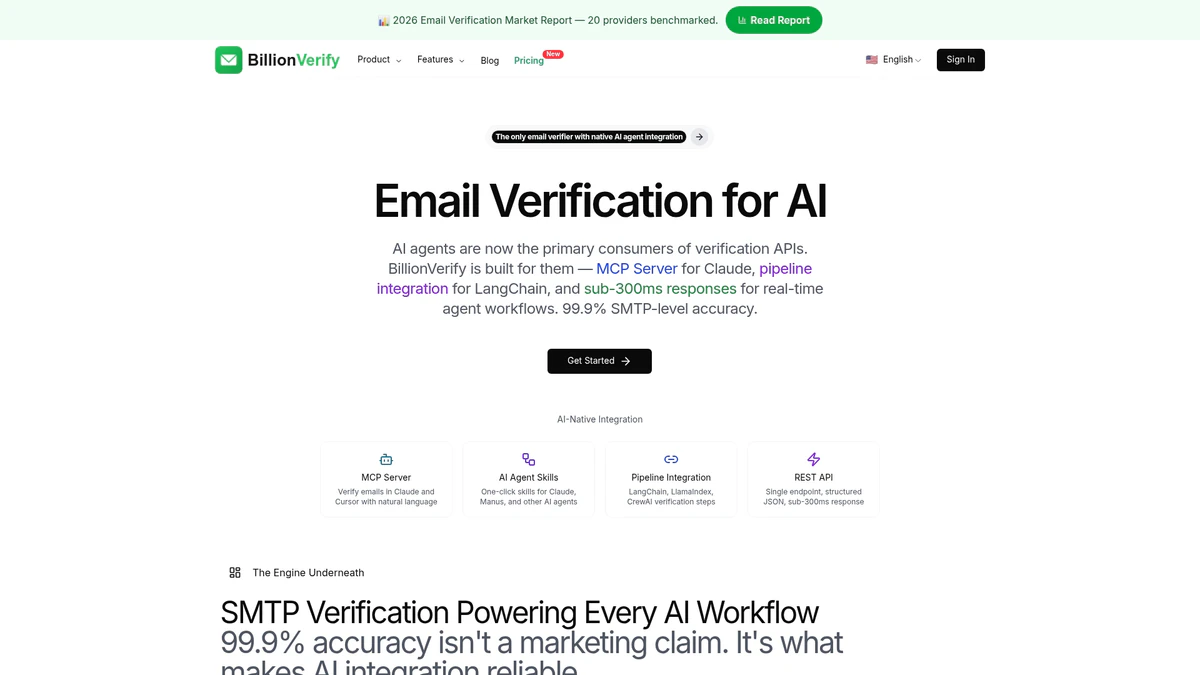
If your current tool is not providing risk-level flags for catch-all addresses, real-time verification at signup, or continuous database updates for disposable domains, it may be time to evaluate alternatives. AI-first email verification from BillionVerify is designed to handle millions of verifications per month with the precision enterprise senders need. You can also see top providers compared side by side to understand where BillionVerify stands against the competition. Better accuracy starts with the right infrastructure.
Frequently asked questions
What is a good accuracy rate for email verification tools?
Top tools benchmark at 98-99% accuracy, but real-world performance against enterprise lists often falls in the 95-98% range depending on list composition and domain types.
How do catch-all email domains affect verification accuracy?
Catch-all servers accept all incoming mail regardless of mailbox existence, making it impossible to confirm address validity with certainty and reducing overall accuracy for lists with high catch-all prevalence.
Can any tool guarantee 100% accuracy for email verification?
No. Due to SMTP limitations, greylisting, and constantly changing domain configurations, no verification tool can guarantee 100% accuracy, which is why ongoing testing and re-verification are essential.
How often should you re-verify your email list?
For most enterprise programs, re-verifying every 3-6 months is the recommended baseline, and periodic re-verification before large campaigns helps maintain list quality and protect sender reputation.