



When evaluating email verification services, accuracy is the metric that matters most—yet it's also the most commonly misunderstood and misrepresented. A verification service that's 99% accurate sounds impressive until you realize that 1% error rate means 10,000 wrong results for every million emails verified. This guide explores what email verification accuracy truly means, how to evaluate it, and why choosing a service with genuinely high accuracy is crucial for your email marketing success. For foundational concepts, see our complete guide to email verification.
What Does Email Verification Accuracy Mean?
Email verification accuracy measures how often a service correctly identifies whether an email address is valid or invalid. But this simple definition masks significant complexity.
The Two Types of Accuracy Errors
Accuracy errors fall into two categories, each with different consequences for your business:
False Positives (Type I Errors): The service marks an address as invalid when it's actually valid. This costs you real subscribers—people who want your emails but won't receive them because they were incorrectly removed from your list.
False Negatives (Type II Errors): The service marks an address as valid when it's actually invalid. This leaves bad addresses in your list, where they'll generate bounces, harm your sender reputation, and waste your resources.
Different verification services make different tradeoffs between these error types. Some prioritize never removing good addresses (accepting more false negatives), while others prioritize never keeping bad addresses (accepting more false positives). The best services minimize both.
Beyond Simple Valid/Invalid
Modern email verification goes beyond binary valid/invalid classification. A comprehensive service provides nuanced results:
Definitely Valid: The mailbox exists, accepts mail, and shows no risk indicators.
Definitely Invalid: The address cannot receive email—it will definitely bounce.
Risky but Deliverable: The address might work but shows warning signs (catch-all domain, role-based address, low-quality domain).
Unknown: The address cannot be definitively verified due to server configurations or temporary issues.
Accuracy should be evaluated across all these categories, not just the binary classification.
Why Email Verification Accuracy Matters
The difference between 99% and 99.9% accuracy might seem trivial, but at scale, it's substantial.
The Mathematics of Accuracy
Consider a business verifying 500,000 email addresses:
At 99% accuracy (1% error rate):
- 5,000 emails classified incorrectly
- Some valid addresses removed (lost customers)
- Some invalid addresses kept (bounces, reputation damage)
At 99.9% accuracy (0.1% error rate):
- 500 emails classified incorrectly
- 10x fewer errors
- Significantly less damage to your list and reputation
For enterprise-scale verification of millions of emails, that 0.9% difference translates to tens of thousands of better decisions.
Real-World Impact of Accuracy Errors
Lost Revenue from False Positives: Every valid address incorrectly marked as invalid represents a real customer you can no longer reach. If your average subscriber is worth $50 annually and you incorrectly remove 1,000 valid addresses, that's $50,000 in lost potential revenue.
Deliverability Damage from False Negatives: Invalid addresses left in your list generate bounces. High bounce rates damage your sender reputation, causing more emails to land in spam—affecting all your subscribers, not just the bad addresses.
Wasted Resources: Sending to invalid addresses wastes your email platform fees, your team's time analyzing artificially deflated engagement metrics, and your sending reputation.
The Compound Effect
Accuracy matters most over time. Small errors in each verification cycle compound:
- Quarter 1: 99% accuracy leaves 1% errors
- Quarter 2: Another 1% errors added, some overlap with Quarter 1 errors
- Quarter 3: Error accumulation continues
- Year end: List quality has degraded significantly
Higher accuracy in each cycle means less accumulation and better long-term list health.
How to Measure Email Verification Accuracy
Don't take accuracy claims at face value. Here's how to evaluate verification accuracy yourself.
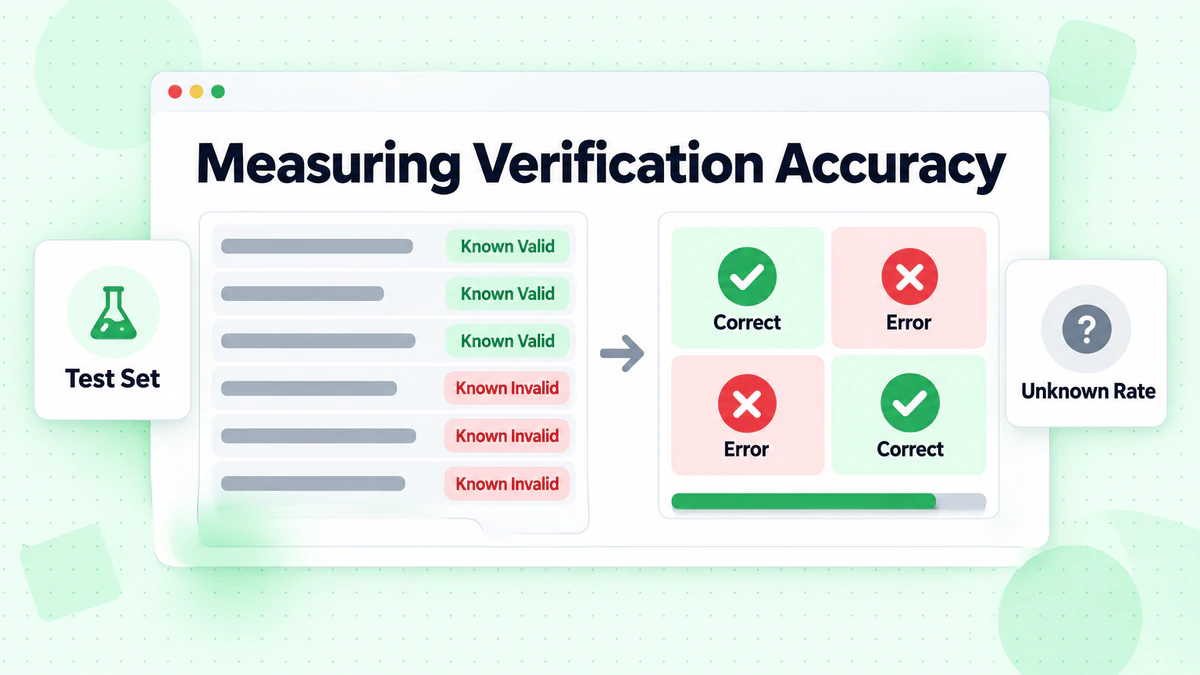
Method 1: Test Set Validation
Create a test set of known-status email addresses and see how accurately the service classifies them.
Build Your Test Set:
- Collect addresses you know are valid (your own addresses, team members, confirmed customers)
- Create addresses you know are invalid (random strings @gmail.com, addresses at expired domains)
- Include edge cases (catch-all domains, role-based addresses, recently bounced addresses)
Run the Test:
- Submit your test set through the verification service
- Compare results against known status
- Calculate accuracy rates for each category
Interpret Results:
- What percentage of known-valid addresses were correctly identified?
- What percentage of known-invalid addresses were correctly identified?
- How were edge cases handled?
A service claiming 99.9% accuracy should correctly identify at least 99.9% of your test addresses.
Method 2: Bounce Rate Comparison
After verifying a list with a service, send to the "valid" addresses and measure your actual bounce rate.
Expected Results:
- A truly accurate service should leave you with bounce rates under 0.5%
- Bounce rates of 1-2% suggest accuracy problems
- Bounce rates above 2% indicate significant false negatives
Important Caveats:
- Some bounces occur due to temporary issues, not verification errors
- Very new lists may have lower decay than older lists
- This method doesn't catch false positives (you won't know if valid addresses were removed)
Method 3: Parallel Verification
Submit the same list to multiple verification services and compare results.
What to Look For:
- High agreement between services suggests accuracy
- Significant disagreements highlight addresses that are difficult to verify
- One service consistently differing from others may indicate accuracy issues
Limitations:
- If all services use similar methods, they may share the same blind spots
- This measures agreement, not absolute accuracy
- More expensive than single-service verification
Method 4: Longitudinal Tracking
Track the long-term performance of addresses that passed verification.
Metrics to Monitor:
- What percentage of "valid" addresses bounce within 30/60/90 days?
- Do verified addresses show expected engagement patterns?
- How quickly does verified list quality decay?
Interpretation:
- Higher-quality verification should result in slower list decay
- Addresses that bounce soon after verification suggest false negatives
- Consistent low bounce rates over time confirm accuracy
Factors That Affect Verification Accuracy
Understanding what influences accuracy helps you evaluate services more effectively.
SMTP Server Behavior
Email verification relies on SMTP conversations with mail servers. Different servers behave differently:
Catch-All Servers: Accept all incoming mail regardless of whether specific addresses exist. Verification cannot determine if a specific mailbox is valid—it can only detect that the domain is catch-all configured.
Greylisting Servers: Temporarily reject first connection attempts, then accept retries. Services without proper greylisting handling may incorrectly mark these as invalid.
Rate-Limited Servers: Throttle or block verification attempts. Services may return "unknown" or incorrect results when blocked.
Accept-Then-Bounce Servers: Accept all mail during SMTP conversation, then generate bounces later. These are difficult to detect during verification.
The best services implement sophisticated handling for all these scenarios.
Detection Database Quality
Beyond SMTP verification, accuracy depends on threat detection databases:
Disposable Email Detection: How comprehensive is the list of known disposable email domains? Are new domains added quickly?
Spam Trap Identification: Does the service maintain current spam trap intelligence? How quickly are new traps identified?
Domain Intelligence: Does the service track domain changes, expirations, and configuration updates?
BillionVerify maintains continuously-updated threat databases with real-time updates, catching threats that services with weekly or monthly update cycles miss.
Infrastructure and Technical Approach
Verification infrastructure affects accuracy:
Global Distribution: Services with global infrastructure can verify addresses faster and more reliably across different geographic regions.
Connection Handling: Sophisticated connection pooling and retry logic improve accuracy for difficult-to-verify addresses.
AI/ML Integration: Machine learning models can identify patterns that rule-based systems miss, improving accuracy for edge cases.
Common Accuracy Claims and What They Really Mean
Marketing claims about accuracy can be misleading. Here's how to interpret them.
"99% Accuracy"
This sounds impressive but is actually below industry standards. A 1% error rate is significant at scale. Be wary of services claiming only 99% accuracy—or worse, services that don't publish accuracy metrics at all.
"99.9% Accuracy"
This is the standard claimed by professional services. BillionVerify achieves this level through:
- Sophisticated SMTP handling for edge cases
- Real-time threat database updates
- AI-powered pattern detection
- Global infrastructure for reliable verification
"100% Accuracy"
Be skeptical of any service claiming 100% accuracy. Email verification has inherent limitations (catch-all domains, accept-then-bounce servers) that make perfect accuracy impossible. Claims of 100% accuracy suggest either dishonest marketing or a fundamental misunderstanding of email verification.
"Industry-Leading" or "Best-in-Class"
These claims are often made without supporting evidence. Ask for specific accuracy metrics and methodology. Legitimate services can provide concrete numbers.
Accuracy "Guarantees"
Some services offer accuracy guarantees—typically refunding credits for any address that bounces after being marked valid. These are confidence indicators but don't change actual accuracy. The best approach is high accuracy in the first place, not refunds for errors.
Comparing Email Verification Accuracy Across Services
When evaluating multiple services, use a systematic comparison approach.
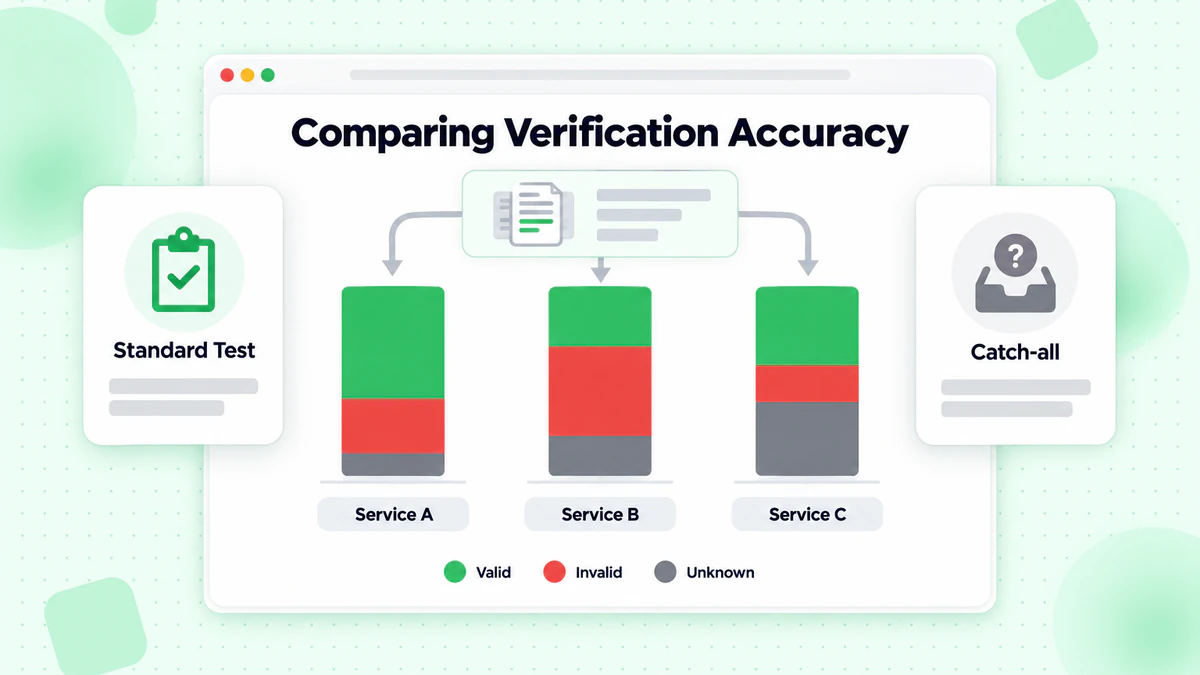
Create a Standardized Test
Develop a test set that includes:
- 100+ known-valid addresses
- 100+ known-invalid addresses
- 50+ catch-all domain addresses
- 50+ role-based addresses
- 20+ disposable email addresses
- Known spam trap addresses (if you have access)
Run Parallel Verification
Submit your test set to each service you're evaluating. Document:
- How each address was classified
- Processing time
- Any additional information provided
Analyze Results
Accuracy Metrics:
- Overall accuracy rate
- False positive rate (valid marked invalid)
- False negative rate (invalid marked valid)
- Accuracy by category (syntax, domain, mailbox, disposable, etc.)
Edge Case Handling:
- How were catch-all domains handled?
- Were role-based addresses flagged appropriately?
- Was disposable email detection accurate?
Additional Value:
- Did the service provide risk scores or confidence levels?
- Was additional information provided (domain age, etc.)?
- How detailed were the results?
Consider the Full Picture
Accuracy is crucial but isn't the only factor:
- Speed: How quickly were verifications completed?
- Price: What's the cost per verification?
- Integration: How easily does the service integrate with your tools?
- Support: Is help available when you need it?
The best service offers high accuracy combined with good performance across all dimensions.
BillionVerify's Approach to Accuracy
BillionVerify achieves 99.9% accuracy through multiple complementary approaches.
Multi-Layer Verification
Every email address passes through comprehensive verification layers:
- Syntax Validation: Checks email format against RFC standards
- Domain Verification: Confirms the domain exists and has valid MX records
- MX Record Analysis: Identifies the mail servers responsible for the domain
- SMTP Verification: Connects to mail servers to verify mailbox existence
- Threat Detection: Checks against disposable email, spam trap, and malicious address databases
- Risk Assessment: Evaluates overall address quality and risk level
Intelligent SMTP Handling
Our SMTP verification engine handles edge cases that trip up other services:
Greylisting Detection: We recognize greylisting behavior and implement appropriate retry logic, avoiding false negatives from initial rejections.
Catch-All Identification: We identify domains configured to accept all mail, marking them appropriately rather than assuming validity.
Rate Limit Management: Intelligent throttling prevents triggering rate limits that could cause verification failures.
Connection Optimization: Our global infrastructure maintains optimal connection paths to mail servers worldwide.
Real-Time Threat Intelligence
Our threat databases update continuously, not on weekly or monthly schedules:
Disposable Email Detection: New disposable email services are added within hours of identification, not days or weeks.
Spam Trap Intelligence: Partnerships with major ISPs and email providers give us current spam trap data.
AI-Powered Pattern Recognition: Machine learning identifies suspicious patterns even from unknown domains.
Transparency and Confidence
We provide detailed results that help you understand verification decisions:
Status Categories: Clear classification of valid, invalid, risky, and unknown addresses Risk Scores: Nuanced assessment beyond binary classification Reason Codes: Explanation of why each address received its status Confidence Levels: Indication of verification certainty
Improving Your Overall Verification Accuracy
Beyond choosing an accurate service, these practices improve your overall accuracy outcomes.
Verify at the Right Times
At Signup: Catch invalid addresses before they enter your list Before Campaigns: Ensure list quality before important sends Regularly: Maintain accuracy as lists naturally decay After Anomalies: Re-verify if you notice unusual bounce patterns
Combine Multiple Signals
Verification results are one input among several:
Engagement Data: Addresses that pass verification but never engage may still be problematic Historical Patterns: Addresses with past bounce history deserve extra scrutiny Source Quality: Factor in the quality of different acquisition channels
Handle Edge Cases Appropriately
Catch-All Domains: Accept they can't be definitively verified; treat with appropriate caution New Addresses: Recently created addresses may not have established reputation yet Role-Based Addresses: Consider whether these fit your marketing purposes regardless of validity
Monitor and Adjust
Track Actual Bounces: Compare verification predictions against actual bounce data Refine Your Approach: Adjust handling based on observed patterns Report Issues: Good verification services want to know about false positives/negatives to improve
The Future of Email Verification Accuracy
Email verification accuracy continues to evolve as technology advances.
AI and Machine Learning
Increasingly sophisticated ML models improve accuracy for difficult cases:
- Pattern recognition for disposable emails from unknown domains
- Behavioral analysis for spam trap identification
- Predictive modeling for address lifecycle
Real-Time Data Integration
Better integration with email ecosystem data improves accuracy:
- ISP feedback loops
- Industry-wide bounce data
- Domain registration intelligence
Privacy-Preserving Verification
As privacy regulations tighten, verification must balance accuracy with data protection:
- Minimal data collection
- No unnecessary storage
- Compliance with global privacy requirements
Conclusion
Email verification accuracy isn't just a specification on a features page—it's the foundation of effective list management. The difference between adequate and excellent accuracy compounds over time, affecting your deliverability, engagement, and ultimately your revenue.
When evaluating verification services, look beyond marketing claims. Test accuracy yourself, compare results across services, and choose a provider that combines high accuracy with the speed, features, and support your business needs.
BillionVerify delivers 99.9% accuracy through multi-layer verification, intelligent SMTP handling, real-time threat intelligence, and AI-powered detection. Combined with our real-time response and 24/7 support, we provide the accuracy and service your email list deserves. For help choosing the right solution, see our best email verification service comparison.
Try BillionVerify free with 100+ daily credits and see accurate verification in action.
Frequently Asked Questions
What accuracy rate should I expect from an email verification service?
Professional services should achieve at least 99% accuracy, with the best services reaching 99.9%. Be skeptical of claims above 99.9%—email verification has inherent limitations that make perfect accuracy impossible.
How can I test a verification service's accuracy?
Create a test set of known-valid and known-invalid addresses, then verify them through the service. Compare results against known status to calculate accuracy. Also track bounce rates on addresses marked as valid—low bounce rates confirm accuracy.
Why do different verification services give different results?
Services use different verification methods, maintain different threat databases, and handle edge cases differently. Catch-all domains, in particular, may be classified differently by different services based on their approach to uncertainty.
Is 99% accuracy good enough?
For small lists, 99% accuracy may be acceptable. For larger lists, the 1% error rate becomes significant—10,000 errors per million emails. Consider whether the cost of errors justifies paying for higher accuracy.
How often should I reverify my list?
Quarterly verification is standard for most businesses. Email addresses decay at 2-3% monthly, so regular reverification catches addresses that have become invalid. High-volume senders may benefit from monthly verification.
What affects email verification accuracy?
Key factors include: SMTP server behavior (catch-all, greylisting), threat database quality and freshness, infrastructure capabilities, and the sophistication of detection algorithms. The best services handle all these factors well.