



Segmented email campaigns generate up to 760% more revenue per recipient compared to non-segmented campaigns. Yet many marketers still send the same message to their entire list, missing massive opportunities to connect with their audience. Email list segmentation transforms generic broadcasts into targeted conversations that drive real business results. This guide reveals why segmentation matters and how to implement strategies that improve open rates, click-throughs, and revenue for e-commerce and SaaS professionals.
Key Takeaways
| Point | Details |
|---|---|
| Revenue uplift from segmentation | Segmented emails generate up to 760 percent more revenue per recipient than non segmented campaigns. |
| Ecommerce segment returns | High value customers and cart abandoners respond differently, delivering the strongest revenue gains. |
| SaaS segmentation focus | Segmentation by role, company size, and engagement level in SaaS emails delivers up to 760 percent more revenue. |
| Balanced segmentation approach | Start with 3 to 5 core segments and avoid over or under segmentation to maintain relevance and keep management practical. |
The impact of email segmentation on campaign performance
The numbers tell a compelling story. Segmented campaigns show higher unique open rates, longer click-through rates, and up to 760% more revenue per recipient. This performance gap reveals why treating every subscriber the same leaves money on the table.
E-commerce brands see the most dramatic results when they segment by behavior and purchase patterns. High-value customers respond differently than first-time buyers, and cart abandoners need different messaging than loyal repeat purchasers. E-commerce behavioral triggers generate 1529% more revenue compared to broadcast emails. These aren't marginal gains. They represent the difference between campaigns that pay for themselves and campaigns that transform your bottom line.
| Metric | Non-Segmented | Segmented | Improvement |
|---|---|---|---|
| Open Rate | 18-22% | 30-35% | +55-59% |
| Click-Through Rate | 2-3% | 4-6% | +101% |
| Revenue per Recipient | Baseline | 7.6x Baseline | +660% |
| Unsubscribe Rate | 0.5% | 0.2% | -60% |
SaaS companies benefit from different segmentation criteria. SaaS cold emails have 38-42% open rates and personalized segmented emails deliver up to 760% more revenue. Segmenting by role, company size, and engagement level allows you to speak directly to a CTO's technical concerns while addressing a marketing director's ROI questions. This precision builds trust and accelerates decision cycles.
The key benefits for marketers include:
- Higher engagement rates that signal quality to inbox providers
- Increased relevance that reduces spam complaints and unsubscribes
- Better ROI through efficient resource allocation
- Deeper customer insights from segment-specific performance data
- Improved sender reputation that protects long-term deliverability
Segmentation enables personalized messaging that speaks to specific needs, pain points, and interests. When a subscriber receives content that matches their current stage in the customer journey, they're far more likely to open, click, and convert. Generic messages get ignored. Relevant messages get results.
Pro Tip: Focus segmentation on behavior and engagement rather than demographics for best results. Purchase history, email opens, and website activity predict future actions better than age or location.
Now that we understand the performance boost, let's explore how to practically segment your lists to avoid common pitfalls and optimize results.
Best practices and nuances in segmenting email lists
Starting simple beats starting overwhelmed. Begin with three to five core segments like new subscribers, active customers, and inactive contacts. These foundational groups give you immediate wins without drowning you in complexity. You can always add more sophisticated segments as you learn what drives results for your specific audience.

Oversegmentation creates problems just as serious as no segmentation at all. When you divide your list into dozens of tiny groups, you face impossible management challenges. Each segment needs unique content, testing, and monitoring. Small segments also lack statistical significance for meaningful testing. On the flip side, undersegmentation treats different customer types as identical, destroying relevance.
Start with 3-5 core segments, audit data quality, automate dynamic segments, and perform quarterly re-segmentation. Markets move fast. Customer preferences shift. What worked last quarter might miss the mark today. Regular reviews keep your segments aligned with current reality.
Balancing automation with human oversight prevents both under-optimization and over-reliance on algorithms. AI tools identify patterns you'd miss manually, but they can't replace strategic thinking about what matters to your business. Use automation to handle the heavy lifting of updating segments based on behavior triggers. Reserve your judgment for deciding which segments deserve investment and which need refinement.
Segment by lead source and engagement over static demographics. Where someone came from tells you about their intent and awareness level. How they interact with your emails reveals their interest and readiness to buy. Age and job title provide context, but behavior predicts action.
"Segmentation boosts deliverability through improved engagement signals. When you send relevant content to interested recipients, they open and click. Those positive interactions tell inbox providers your emails deserve the inbox, not the spam folder. Better targeting creates a virtuous cycle of higher deliverability and stronger results." — Email Deliverability Expert
Key implementation steps:
- Map your customer journey to identify natural segmentation points
- Collect behavioral data through email clicks, website visits, and purchase patterns
- Create segments based on engagement levels and recency of interaction
- Set up automation rules to move contacts between segments dynamically
- Monitor segment health through size, growth rate, and performance metrics
- Combine or retire segments that consistently underperform
Pro Tip: Use 'pause' segments to exclude uninterested recipients and protect reputation. When someone hasn't opened your last 10 emails, continuing to send damages your sender score. Move them to a re-engagement campaign or remove them entirely.
Lead source is a top predictive factor; segmentation boosts deliverability through improved engagement signals. Someone who signed up through a webinar has different expectations than someone who downloaded a lead magnet. Honor those differences in your messaging.
Having refined your segmentation approach, next we'll compare segmentation strategies tailored to e-commerce versus SaaS to clarify practical applications.
Comparing segmentation strategies: e-commerce vs SaaS
E-commerce and SaaS businesses face fundamentally different customer journeys, requiring distinct segmentation approaches. Understanding these differences helps you apply the right strategy for your business model.
| Aspect | E-commerce Segmentation | SaaS Segmentation |
|---|---|---|
| Primary Criteria | Purchase history, browse behavior, cart abandonment, product preferences | Role, company size, feature usage, trial stage, engagement level |
| Key Segments | First-time buyers, VIP customers, cart abandoners, seasonal shoppers, product category fans | Free trial users, paying customers, power users, at-risk accounts, decision makers |
| Typical Frequency | Daily to weekly sends | Weekly to monthly sends |
| Main Goal | Drive repeat purchases and increase order value | Nurture leads and reduce churn |
| Revenue Driver | Behavioral triggers and personalized recommendations | Education and feature adoption |
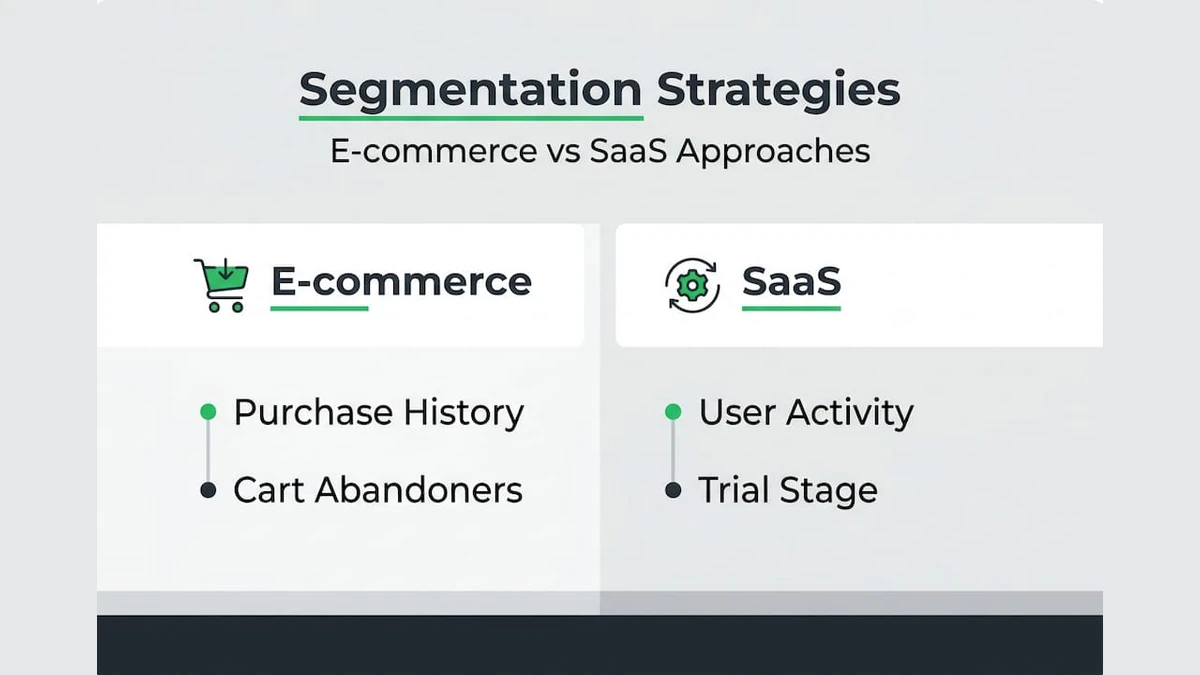
E-commerce top verticals achieve 14% higher growth using high-value customer and cart abandoner segments. These segments work because they target specific moments of high purchase intent. A cart abandoner is already interested. They just need the right nudge at the right time.
For e-commerce, segment by:
- Purchase frequency (first-time, occasional, frequent buyers)
- Average order value (budget, mid-range, premium customers)
- Product category preferences (apparel, electronics, home goods)
- Cart abandonment stage (viewed, added to cart, reached checkout)
- Seasonal buying patterns (holiday shoppers, back-to-school buyers)
SaaS marketers segment by role, company size and engagement with open rates of 23-30% and CTR of 3-4%. These segments reflect the complexity of B2B buying decisions where multiple stakeholders evaluate solutions over weeks or months.
For SaaS, segment by:
- User role (end user, manager, executive, technical buyer)
- Company size (startup, SMB, mid-market, enterprise)
- Trial stage (just signed up, actively exploring, nearing expiration)
- Feature usage (power users, basic users, inactive users) | Account health (growing usage, stable, declining engagement)
Creating and testing segments effectively:
- Define clear criteria for each segment based on measurable behaviors or attributes.
- Set up automation rules in your email marketing platform to update segments in real time.
- Create segment-specific content that addresses unique needs and pain points.
- Run A/B tests within segments to optimize messaging and timing.
- Monitor performance metrics for each segment weekly to identify trends.
- Iterate based on results, combining underperforming segments or splitting high-performers.
Personalization drives the open and click rate improvements you see in segmented campaigns. When an e-commerce customer who buys running shoes sees an email about new trail running gear, that's relevant. When a SaaS trial user at day 5 receives tips for the exact feature they explored yesterday, that's timely. Generic messages can't compete with that level of precision.
Ongoing testing reveals what resonates with each segment. The message that converts cart abandoners might fall flat with VIP customers. The feature highlight that excites a technical user might bore an executive. Test everything, measure ruthlessly, and let data guide your decisions.
With clear strategic distinctions, let's examine how to apply these segmentation concepts to your campaigns effectively for sustained results.
Implementing and optimizing segmented email campaigns
Automation transforms segmentation from a manual chore into a dynamic system that updates itself. Modern CRM and email marketing platforms let you set rules that automatically move contacts between segments based on their actions. Someone who makes their first purchase automatically moves from the prospect segment to the customer segment. A trial user who hasn't logged in for five days moves to the at-risk segment.
Integrating segmentation with A/B testing amplifies both strategies. Test subject lines, send times, and content variations within specific segments to discover what works for each group. What converts high-value customers might not work for first-time buyers. Testing within segments gives you precise insights instead of averaged results across your entire list.
Steps for setting up, monitoring, and updating segments:
- Connect your email platform to your CRM and website analytics for complete behavioral data
- Define segment entry and exit criteria based on specific actions or attributes
- Create automated workflows that trigger when contacts enter or leave segments
- Set up dashboards to track segment size, growth, and key performance metrics
- Review segment performance monthly to identify opportunities and issues
- Update segment criteria quarterly based on changing business priorities and customer behavior
- Archive or merge segments that consistently underperform or become too small
Measuring engagement metrics per segment identifies where you're winning and where you need improvement. Segmented emails achieve over 30% open rates and 101% higher click rates versus non-segmented emails. But averages hide the full story. One segment might deliver 45% open rates while another struggles at 18%. Those insights tell you where to focus your optimization efforts.
Pro Tip: Use engagement signals from segments to improve deliverability and prevent spam filtering. Inbox providers watch how recipients interact with your emails. High engagement from well-targeted segments improves your sender reputation. Poor engagement from irrelevant messages damages it.
Automated flows produce 48.57% open rates, proving engagement gains from tailored messaging. These flows work because they deliver the right message at the right moment in the customer journey. A welcome series for new subscribers, a cart abandonment sequence for shoppers, or a feature adoption campaign for trial users all leverage segmentation to maximize relevance.
Regular audits of list hygiene maintain data quality and segmentation accuracy. Invalid email addresses corrupt your segments and skew your metrics. Hard bounces damage your sender reputation. Spam traps destroy deliverability. Clean lists power accurate segments that drive real results. Verify new subscribers immediately and re-verify your entire list quarterly to catch degraded addresses.
Optimization never stops. Customer behavior evolves. Market conditions shift. Competitors change tactics. Your segmentation strategy needs continuous refinement through testing and measurement. The segments that work today might need adjustment tomorrow. Stay curious, keep testing, and let performance data guide your decisions.
After applying these techniques, consider next how new technologies can further boost segmentation benefits for your campaigns.
Enhance your email campaigns with BillionVerify
Accurate segmentation starts with clean data. Invalid email addresses corrupt your segments, skew your analytics, and damage your sender reputation. BillionVerify's AI-first email verification ensures every address in your segments is valid, active, and safe to contact.
Our enterprise-grade platform detects disposable emails, spam traps, role-based addresses, and risky domains before they contaminate your carefully crafted segments. Real-time verification catches problems at signup. Bulk processing cleans existing lists. API integration keeps your data fresh automatically. When your segments contain only verified addresses, your campaigns reach real people who can actually engage.
Verified lists improve segmentation precision by eliminating the noise of invalid addresses. Your metrics reflect true subscriber behavior instead of bounces and dead ends. Your sender reputation stays strong because you're not hitting spam traps or invalid domains. Your ROI increases because every send reaches someone who can respond.
"Clean lists power accurate segments. Accurate segments drive better targeting. Better targeting delivers higher engagement and revenue. BillionVerify provides the foundation for segmentation strategies that actually work."
With accurate, verified lists powering your segments, let's answer common questions to further clarify segmentation for your email marketing success.
Frequently asked questions
What is email list segmentation?
Email list segmentation divides your subscriber list into smaller groups based on shared characteristics, behaviors, or preferences. Instead of sending the same message to everyone, you target specific groups with content that matches their needs and interests. This approach increases relevance, improves engagement rates, and drives better campaign results across all key metrics.
How often should I re-segment my email lists?
Re-segment at least every three months to maintain accuracy and relevance as customer behaviors and market conditions change. Quarterly re-segmentation is recommended to keep pace with changes in customer behavior and market dynamics. Use automation tools to update segments continuously based on real-time actions, then conduct strategic reviews quarterly to refine your overall segmentation approach.
Can I have too many segments in my email list?
Yes, oversegmentation creates management nightmares and dilutes your impact. Oversegmentation creates tiny, unmanageable groups that complicate execution and reduce impact. Start with three to five core segments that address your most important business objectives. Add new segments only when you have the resources to create unique content and the audience size to generate meaningful results. Review segments regularly to combine or remove underperforming groups.
Does segmentation improve email deliverability?
Absolutely. More targeted emails generate higher open and click rates, which send positive signals to inbox providers about your email quality. Segmentation boosts engagement signals, which improves deliverability and inbox placement rates. Better engagement reduces spam complaints and unsubscribes, protecting your sender reputation. When you consistently send relevant content to interested recipients, inbox providers reward you with better deliverability across your entire program.