



When verifying email addresses, one of the most challenging scenarios you'll encounter is the catch-all email server. These servers accept mail for any address at their domain, making it impossible to determine through standard SMTP verification whether a specific mailbox actually exists. Understanding catch-all email detection is crucial for anyone serious about maintaining email list quality and maximizing deliverability rates. For foundational concepts, see our complete guide to email verification.
In this comprehensive guide, we'll explore everything you need to know about catch-all emails: what they are, why they exist, how to detect them, and most importantly, how to handle them in your email verification workflow. Whether you're a developer building an email validation system or a marketer trying to clean your email list, this guide will give you the knowledge and tools you need to deal with catch-all domains effectively.
A robust email verification strategy must account for catch-all servers. Without proper detection and handling, your verification results may give you false confidence about email deliverability. Let's dive into the technical details and practical solutions.
What is a Catch-All Email Server?
A catch-all email server, also known as an accept-all server, is configured to accept incoming email for any address at its domain, regardless of whether that specific mailbox exists. When you send an email to anyaddress@catchall-domain.com, the server accepts it without bouncing, even if no mailbox named "anyaddress" has ever been created.
How Catch-All Configuration Works
In a typical email server configuration, when a message arrives for a non-existent mailbox, the server responds with a "550 User not found" or similar rejection message. This behavior allows email verification systems to determine whether an address exists by checking the server's response.
Catch-all servers behave differently. They're configured to accept all incoming mail regardless of the recipient address. The mail might then be:
- Routed to a designated mailbox - A single administrator receives all messages
- Stored in a general queue - Messages are held for later sorting
- Silently discarded - Accepted but deleted without delivery
- Forwarded to another system - Sent to a different server for processing
Here's an example of how this looks in a Postfix mail server configuration:
# /etc/postfix/main.cf
# Standard configuration - rejects unknown recipients
local_recipient_maps = proxy:unix:passwd.byname $alias_maps

# Catch-all configuration - accepts all recipients
local_recipient_maps =
Why Organizations Use Catch-All Servers
There are several legitimate reasons why organizations configure catch-all email:
1. Preventing Lost Business Communications
Small businesses often worry about missing important emails due to typos or variations in employee names. If someone emails john.smith@company.com but the actual address is jsmith@company.com, a catch-all configuration ensures the message isn't lost.
2. Flexible Email Routing
Some organizations use catch-all as part of a sophisticated email routing system. All incoming mail goes to a central queue where it's automatically sorted and distributed based on rules.
3. Security Monitoring
Security teams sometimes configure catch-all to monitor what addresses attackers or spammers are targeting. This intelligence helps identify phishing attempts or data breaches.
4. Legacy System Compatibility
Organizations migrating from one email system to another may temporarily enable catch-all to ensure no messages are lost during the transition.
5. Privacy Protection
Some privacy-conscious organizations use catch-all domains to create unique email addresses for each service they sign up for, making it easier to track which companies share or leak their data.
The Problem for Email Verification
For email verification purposes, catch-all servers present a significant challenge. When you perform SMTP verification on a catch-all domain, the server responds with a "250 OK" acceptance for every address you test—whether real or completely fabricated.
Consider this SMTP session example:
> MAIL FROM:<test@verify.local>
< 250 OK
> RCPT TO:<real.user@catchall-domain.com>
< 250 OK
> RCPT TO:<completely.fake.address@catchall-domain.com>
< 250 OK
> RCPT TO:<asdfghjkl12345@catchall-domain.com>
< 250 OK
All three addresses receive the same positive response, making it impossible to distinguish the real user from the fake addresses through SMTP verification alone.
How to Detect Catch-All Email Servers
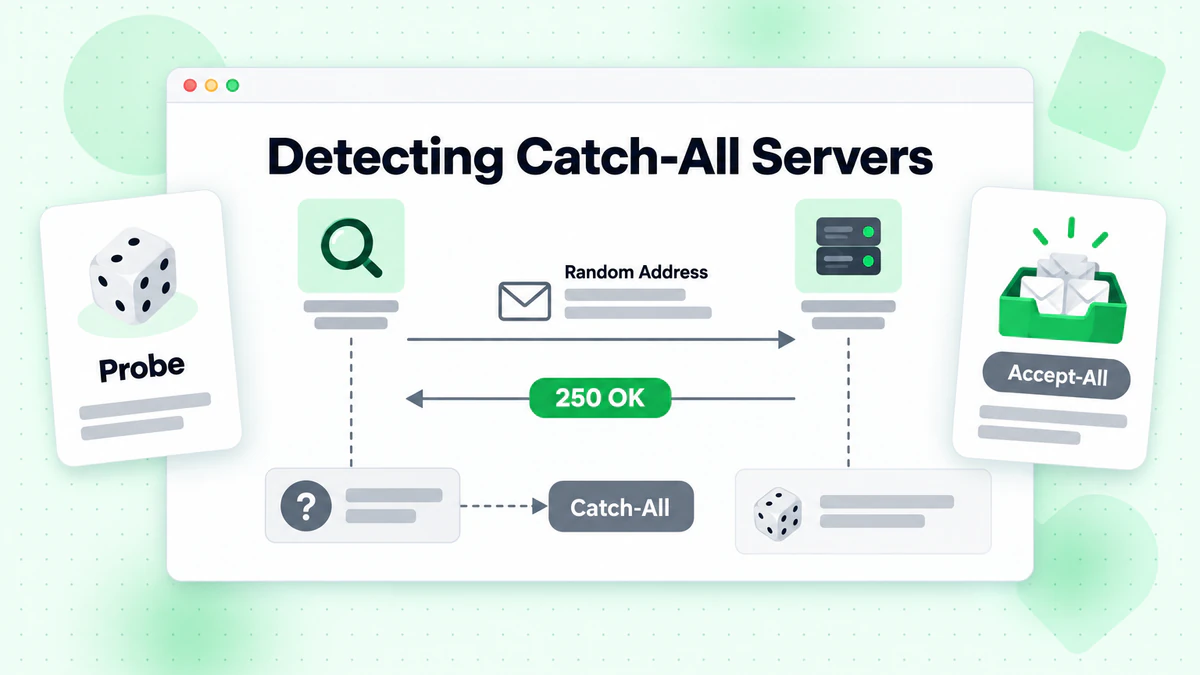
Detecting whether a mail server is configured as catch-all requires a clever approach: testing with an address that definitely shouldn't exist and observing the server's response.
The Detection Algorithm
The basic catch-all detection algorithm works as follows:
- Generate a random, non-existent address at the target domain
- Perform an SMTP verification on this fake address
- Analyze the response:
- If the server accepts the fake address → It's likely catch-all
- If the server rejects the fake address → Normal verification applies
Implementation in Node.js
Here's a complete Node.js implementation for catch-all detection:
const net = require('net');
const dns = require('dns').promises;
const crypto = require('crypto');

class CatchAllDetector {
  constructor(options = {}) {
    this.timeout = options.timeout || 10000;
    this.fromEmail = options.fromEmail || 'verify@verify.local';
    this.fromDomain = options.fromDomain || 'verify.local';
  }

  /**
   * Generate a random email address that definitely doesn't exist
   */
  generateRandomEmail(domain) {
    const randomString = crypto.randomBytes(16).toString('hex');
    const timestamp = Date.now();
    return `nonexistent-${randomString}-${timestamp}@${domain}`;
  }

  /**
   * Get the primary MX server for a domain
   */
  async getMXServer(domain) {
    try {
      const records = await dns.resolveMx(domain);
      if (!records || records.length === 0) {
        return null;
      }
      // Sort by priority and return the primary server
      records.sort((a, b) => a.priority - b.priority);
      return records[0].exchange;
    } catch (error) {
      return null;
    }
  }

  /**
   * Perform SMTP verification on an email address
   */
  async smtpVerify(email, mxServer) {
    return new Promise((resolve) => {
      const socket = new net.Socket();
      let step = 0;
      let result = { accepted: false, response: '' };

      const commands = [
        null, // Wait for greeting
        `EHLO ${this.fromDomain}\r\n`,
        `MAIL FROM:<${this.fromEmail}>\r\n`,
        `RCPT TO:<${email}>\r\n`,
        'QUIT\r\n'
      ];

      socket.setTimeout(this.timeout);

      socket.on('data', (data) => {
        const response = data.toString();
        const code = parseInt(response.substring(0, 3));

        if (step === 0 && code === 220) {
          socket.write(commands[1]);
          step++;
        } else if (step === 1 && code === 250) {
          socket.write(commands[2]);
          step++;
        } else if (step === 2 && code === 250) {
          socket.write(commands[3]);
          step++;
        } else if (step === 3) {
          result.response = response.trim();
          result.accepted = code === 250 || code === 251;
          socket.write(commands[4]);
          socket.destroy();
          resolve(result);
        } else if (code >= 400) {
          result.response = response.trim();
          result.accepted = false;
          socket.destroy();
          resolve(result);
        }
      });

      socket.on('timeout', () => {
        result.response = 'Connection timeout';
        socket.destroy();
        resolve(result);
      });

      socket.on('error', (error) => {
        result.response = `Error: ${error.message}`;
        socket.destroy();
        resolve(result);
      });

      socket.connect(25, mxServer);
    });
  }

  /**
   * Detect if a domain is configured as catch-all
   */
  async detectCatchAll(domain) {
    // Get MX server
    const mxServer = await this.getMXServer(domain);
    if (!mxServer) {
      return {
        isCatchAll: null,
        reason: 'Could not resolve MX records',
        domain
      };
    }

    // Generate a random non-existent email
    const fakeEmail = this.generateRandomEmail(domain);

    // Test the fake email
    const result = await this.smtpVerify(fakeEmail, mxServer);

    return {
      isCatchAll: result.accepted,
      reason: result.accepted
        ? 'Server accepts mail for non-existent addresses'
        : 'Server rejects non-existent addresses',
      domain,
      mxServer,
      testEmail: fakeEmail,
      serverResponse: result.response
    };
  }

  /**
   * Verify an email with catch-all detection
   */
  async verifyWithCatchAllDetection(email) {
    const domain = email.split('@')[1];

    // First, detect if domain is catch-all
    const catchAllResult = await this.detectCatchAll(domain);

    if (catchAllResult.isCatchAll === null) {
      return {
        email,
        valid: null,
        catchAll: null,
        reason: catchAllResult.reason
      };
    }

    // Get MX server
    const mxServer = await this.getMXServer(domain);

    // Verify the actual email
    const verifyResult = await this.smtpVerify(email, mxServer);

    return {
      email,
      valid: verifyResult.accepted,
      catchAll: catchAllResult.isCatchAll,
      reason: catchAllResult.isCatchAll
        ? 'Address accepted but domain is catch-all (deliverability uncertain)'
        : verifyResult.accepted
          ? 'Address verified successfully'
          : 'Address rejected by server',
      serverResponse: verifyResult.response
    };
  }
}

// Usage example
async function main() {
  const detector = new CatchAllDetector();

  // Test catch-all detection
  const domains = ['gmail.com', 'example.com', 'company.com'];

  for (const domain of domains) {
    console.log(`\nTesting domain: ${domain}`);
    const result = await detector.detectCatchAll(domain);
    console.log(`Is Catch-All: ${result.isCatchAll}`);
    console.log(`Reason: ${result.reason}`);
    if (result.serverResponse) {
      console.log(`Server Response: ${result.serverResponse}`);
    }
  }

  // Verify specific email with catch-all detection
  const emailResult = await detector.verifyWithCatchAllDetection('user@example.com');
  console.log('\nEmail Verification Result:');
  console.log(JSON.stringify(emailResult, null, 2));
}

main().catch(console.error);
Implementation in Python
Here's the equivalent Python implementation:
import socket
import dns.resolver
import secrets
import time
from dataclasses import dataclass
from typing import Optional

@dataclass
class CatchAllResult:
    is_catch_all: Optional[bool]
    reason: str
    domain: str
    mx_server: Optional[str] = None
    test_email: Optional[str] = None
    server_response: Optional[str] = None

@dataclass
class VerificationResult:
    email: str
    valid: Optional[bool]
    catch_all: Optional[bool]
    reason: str
    server_response: Optional[str] = None

class CatchAllDetector:
    def __init__(self, timeout: int = 10, from_email: str = 'verify@verify.local',
                 from_domain: str = 'verify.local'):
        self.timeout = timeout
        self.from_email = from_email
        self.from_domain = from_domain

    def generate_random_email(self, domain: str) -> str:
        """Generate a random email address that definitely doesn't exist."""
        random_string = secrets.token_hex(16)
        timestamp = int(time.time() * 1000)
        return f"nonexistent-{random_string}-{timestamp}@{domain}"

    def get_mx_server(self, domain: str) -> Optional[str]:
        """Get the primary MX server for a domain."""
        try:
            records = dns.resolver.resolve(domain, 'MX')
            mx_records = sorted(
                [(r.preference, str(r.exchange).rstrip('.')) for r in records],
                key=lambda x: x[0]
            )
            return mx_records[0][1] if mx_records else None
        except Exception:
            return None

    def smtp_verify(self, email: str, mx_server: str) -> dict:
        """Perform SMTP verification on an email address."""
        result = {'accepted': False, 'response': ''}

        try:
            sock = socket.socket(socket.AF_INET, socket.SOCK_STREAM)
            sock.settimeout(self.timeout)
            sock.connect((mx_server, 25))

            # Receive greeting
            response = sock.recv(1024).decode()
            if not response.startswith('220'):
                result['response'] = response.strip()
                return result

            # Send EHLO
            sock.send(f'EHLO {self.from_domain}\r\n'.encode())
            response = sock.recv(1024).decode()
            if not response.startswith('250'):
                result['response'] = response.strip()
                return result

            # Send MAIL FROM
            sock.send(f'MAIL FROM:<{self.from_email}>\r\n'.encode())
            response = sock.recv(1024).decode()
            if not response.startswith('250'):
                result['response'] = response.strip()
                return result

            # Send RCPT TO
            sock.send(f'RCPT TO:<{email}>\r\n'.encode())
            response = sock.recv(1024).decode()
            result['response'] = response.strip()
            code = int(response[:3])
            result['accepted'] = code in (250, 251)

            # Send QUIT
            sock.send(b'QUIT\r\n')
            sock.close()

        except socket.timeout:
            result['response'] = 'Connection timeout'
        except socket.error as e:
            result['response'] = f'Socket error: {str(e)}'
        except Exception as e:
            result['response'] = f'Error: {str(e)}'

        return result

    def detect_catch_all(self, domain: str) -> CatchAllResult:
        """Detect if a domain is configured as catch-all."""
        # Get MX server
        mx_server = self.get_mx_server(domain)
        if not mx_server:
            return CatchAllResult(
                is_catch_all=None,
                reason='Could not resolve MX records',
                domain=domain
            )

        # Generate a random non-existent email
        fake_email = self.generate_random_email(domain)

        # Test the fake email
        result = self.smtp_verify(fake_email, mx_server)

        return CatchAllResult(
            is_catch_all=result['accepted'],
            reason='Server accepts mail for non-existent addresses' if result['accepted']
                   else 'Server rejects non-existent addresses',
            domain=domain,
            mx_server=mx_server,
            test_email=fake_email,
            server_response=result['response']
        )

    def verify_with_catch_all_detection(self, email: str) -> VerificationResult:
        """Verify an email with catch-all detection."""
        domain = email.split('@')[1]

        # First, detect if domain is catch-all
        catch_all_result = self.detect_catch_all(domain)

        if catch_all_result.is_catch_all is None:
            return VerificationResult(
                email=email,
                valid=None,
                catch_all=None,
                reason=catch_all_result.reason
            )

        # Get MX server
        mx_server = self.get_mx_server(domain)

        # Verify the actual email
        verify_result = self.smtp_verify(email, mx_server)

        if catch_all_result.is_catch_all:
            reason = 'Address accepted but domain is catch-all (deliverability uncertain)'
        elif verify_result['accepted']:
            reason = 'Address verified successfully'
        else:
            reason = 'Address rejected by server'

        return VerificationResult(
            email=email,
            valid=verify_result['accepted'],
            catch_all=catch_all_result.is_catch_all,
            reason=reason,
            server_response=verify_result['response']
        )


# Usage example
if __name__ == '__main__':
    detector = CatchAllDetector()

    # Test catch-all detection
    domains = ['gmail.com', 'example.com', 'company.com']

    for domain in domains:
        print(f"\nTesting domain: {domain}")
        result = detector.detect_catch_all(domain)
        print(f"Is Catch-All: {result.is_catch_all}")
        print(f"Reason: {result.reason}")
        if result.server_response:
            print(f"Server Response: {result.server_response}")

    # Verify specific email with catch-all detection
    email_result = detector.verify_with_catch_all_detection('user@example.com')
    print("\nEmail Verification Result:")
    print(f"  Email: {email_result.email}")
    print(f"  Valid: {email_result.valid}")
    print(f"  Catch-All: {email_result.catch_all}")
    print(f"  Reason: {email_result.reason}")
Advanced Detection Techniques
Basic catch-all detection can be improved with these advanced techniques:
1. Multiple Probe Testing
Instead of testing with just one fake address, test with multiple randomly generated addresses. This helps identify servers with inconsistent behavior:
async detectCatchAllAdvanced(domain, probeCount = 3) {
  const results = [];

  for (let i = 0; i < probeCount; i++) {
    const fakeEmail = this.generateRandomEmail(domain);
    const result = await this.smtpVerify(fakeEmail, await this.getMXServer(domain));
    results.push(result.accepted);

    // Small delay between probes to avoid rate limiting
    await new Promise(resolve => setTimeout(resolve, 500));
  }

  // Analyze results
  const acceptedCount = results.filter(r => r).length;

  if (acceptedCount === probeCount) {
    return { isCatchAll: true, confidence: 'high' };
  } else if (acceptedCount === 0) {
    return { isCatchAll: false, confidence: 'high' };
  } else {
    return { isCatchAll: null, confidence: 'low', note: 'Inconsistent server behavior' };
  }
}
2. Pattern-Based Detection
Some catch-all servers are configured with patterns. Test addresses with different formats:
const testPatterns = [
  `nonexistent${Date.now()}@${domain}`,           // Random with timestamp
  `zzz-fake-user-zzz@${domain}`,                  // Obvious fake pattern
  `test.${crypto.randomUUID()}@${domain}`,        // UUID format
  `admin-backup-${Date.now()}@${domain}`          // Administrative-looking
];
3. Response Code Analysis
Analyze the specific SMTP response codes and messages for additional insight:
function analyzeResponse(response) {
  const code = parseInt(response.substring(0, 3));
  const message = response.toLowerCase();

  if (code === 250) {
    if (message.includes('accepted for delivery')) {
      return { accepted: true, type: 'explicit_accept' };
    }
    return { accepted: true, type: 'standard_accept' };
  }

  if (code === 550) {
    if (message.includes('user unknown') || message.includes('no such user')) {
      return { accepted: false, type: 'user_not_found' };
    }
    if (message.includes('rejected') || message.includes('denied')) {
      return { accepted: false, type: 'policy_rejection' };
    }
  }

  if (code === 451 || code === 452) {
    return { accepted: null, type: 'temporary_failure' };
  }

  return { accepted: code < 400, type: 'unknown' };
}
Best Practices for Handling Catch-All Emails
Once you've detected a catch-all domain, you need a strategy for handling those addresses in your email verification workflow.
Strategy 1: Risk-Based Classification
Implement a risk classification system that assigns different confidence levels:
function classifyEmailRisk(verificationResult) {
  const { valid, catchAll, domain } = verificationResult;

  if (!valid) {
    return { risk: 'high', action: 'reject', reason: 'Invalid email address' };
  }

  if (!catchAll) {
    return { risk: 'low', action: 'accept', reason: 'Verified deliverable' };
  }

  // Catch-all domain - assess additional risk factors
  const riskFactors = [];

  // Check domain age and reputation (would need external data)
  // Check if domain is a known business domain
  // Check email pattern (role-based, random, etc.)

  const localPart = verificationResult.email.split('@')[0];

  if (isRoleBasedAddress(localPart)) {
    riskFactors.push('role_based');
  }

  if (looksRandomlyGenerated(localPart)) {
    riskFactors.push('random_looking');
  }

  if (riskFactors.length >= 2) {
    return { risk: 'high', action: 'reject', reason: 'Catch-all with multiple risk factors' };
  }

  if (riskFactors.length === 1) {
    return { risk: 'medium', action: 'flag', reason: 'Catch-all with one risk factor' };
  }

  return { risk: 'medium', action: 'accept_with_caution', reason: 'Catch-all domain' };
}

function isRoleBasedAddress(localPart) {
  const rolePatterns = [
    'admin', 'info', 'support', 'sales', 'contact',
    'help', 'webmaster', 'postmaster', 'noreply', 'no-reply'
  ];
  return rolePatterns.some(pattern =>
    localPart.toLowerCase().includes(pattern)
  );
}

function looksRandomlyGenerated(localPart) {
  // Check for high entropy (random-looking strings)
  const consonants = localPart.match(/[bcdfghjklmnpqrstvwxyz]/gi) || [];
  const vowels = localPart.match(/[aeiou]/gi) || [];

  if (consonants.length > 0 && vowels.length === 0) {
    return true; // No vowels suggests random
  }

  if (localPart.length > 20) {
    return true; // Very long local parts are suspicious
  }

  // Check for number sequences
  if (/\d{5,}/.test(localPart)) {
    return true; // Long number sequences
  }

  return false;
}
Strategy 2: Engagement-Based Filtering
For marketing purposes, consider using engagement data to filter catch-all addresses:
function shouldIncludeInCampaign(email, engagementData, catchAllStatus) {
  // Always include if we have positive engagement history
  if (engagementData.hasOpened || engagementData.hasClicked) {
    return { include: true, reason: 'Previous engagement confirmed' };
  }

  // Non-catch-all verified emails are safe
  if (!catchAllStatus.isCatchAll && catchAllStatus.verified) {
    return { include: true, reason: 'Verified deliverable' };
  }

  // Catch-all with no engagement history - be cautious
  if (catchAllStatus.isCatchAll) {
    // Check if we've successfully delivered before
    if (engagementData.previousDeliveries > 0 && engagementData.bounceRate < 0.1) {
      return { include: true, reason: 'Previous successful deliveries' };
    }

    // New catch-all address with no history
    return {
      include: false,
      reason: 'Catch-all domain with no engagement history',
      recommendation: 'Send verification email first'
    };
  }

  return { include: true, reason: 'Default include' };
}
Strategy 3: Gradual Warming
When dealing with catch-all addresses, implement a gradual sending strategy:
class CatchAllWarmingStrategy {
  constructor() {
    this.warmingGroups = {
      verified: { dailyLimit: 1000, priority: 1 },
      catchAllEngaged: { dailyLimit: 500, priority: 2 },
      catchAllNew: { dailyLimit: 100, priority: 3 }
    };
  }

  categorizeAddress(email, verification, engagement) {
    if (!verification.catchAll) {
      return 'verified';
    }

    if (engagement.hasInteracted) {
      return 'catchAllEngaged';
    }

    return 'catchAllNew';
  }

  buildSendingQueue(emails, verifications, engagements) {
    const categorized = {
      verified: [],
      catchAllEngaged: [],
      catchAllNew: []
    };

    emails.forEach(email => {
      const category = this.categorizeAddress(
        email,
        verifications[email],
        engagements[email] || {}
      );
      categorized[category].push(email);
    });

    // Build queue respecting daily limits
    const queue = [];

    Object.entries(this.warmingGroups)
      .sort((a, b) => a[1].priority - b[1].priority)
      .forEach(([category, config]) => {
        const addresses = categorized[category].slice(0, config.dailyLimit);
        queue.push(...addresses.map(email => ({
          email,
          category,
          priority: config.priority
        })));
      });

    return queue;
  }
}
Real-World Case Studies
Case Study 1: E-commerce Company List Cleaning
A mid-sized e-commerce company with 500,000 email subscribers wanted to improve their deliverability rates. Their analysis revealed:
Initial State:
- 500,000 total subscribers
- 12% bounce rate on campaigns
- 45,000 addresses (9%) on catch-all domains
Verification Results:
- 425,000 verified deliverable (non-catch-all)
- 45,000 catch-all addresses identified
- 30,000 invalid addresses removed
Catch-All Handling Strategy:
Instead of removing all catch-all addresses, they implemented a tiered approach:
- Tier 1 - Keep: 15,000 catch-all addresses with previous engagement (opens or clicks within 6 months)
- Tier 2 - Verify: 20,000 catch-all addresses sent a re-engagement campaign
- Tier 3 - Remove: 10,000 catch-all addresses with no engagement history and suspicious patterns
Results After 3 Months:
- Bounce rate dropped to 2.1%
- Open rates increased by 18%
- Sender reputation score improved significantly
- Email deliverability reached 98.5%
Case Study 2: B2B SaaS Lead Validation
A B2B SaaS company receiving 10,000 new leads monthly implemented catch-all detection in their signup flow:
Challenge: Many B2B leads came from company domains configured as catch-all, making verification difficult. They couldn't simply reject all catch-all addresses without losing valuable leads.
Solution:
async function validateB2BLead(email, companyInfo) {
  const verification = await verifyEmail(email);
  const catchAllResult = await detectCatchAll(email.split('@')[1]);

  if (!verification.valid) {
    return { accept: false, reason: 'Invalid email' };
  }

  if (!catchAllResult.isCatchAll) {
    return { accept: true, reason: 'Verified deliverable', confidence: 'high' };
  }

  // Catch-all domain - use company info to validate
  const domainMatchesCompany = email.split('@')[1].includes(
    companyInfo.name.toLowerCase().replace(/\s+/g, '')
  );

  if (domainMatchesCompany) {
    // Email domain matches company name - likely legitimate
    return {
      accept: true,
      reason: 'Catch-all but matches company domain',
      confidence: 'medium',
      requireVerification: true
    };
  }

  // Catch-all with unrelated domain
  return {
    accept: true,
    reason: 'Catch-all domain',
    confidence: 'low',
    requireVerification: true,
    sendDoubleOptIn: true
  };
}
Results:
- Lead acceptance rate maintained at 95%
- False positive rejection reduced by 60%
- Double opt-in confirmation rate for catch-all: 72%
- Overall lead quality improved by 25%
Using BillionVerify for Catch-All Detection
While building your own catch-all detection is possible, using a professional email verification service like BillionVerify provides significant advantages:
API Integration Example
const axios = require('axios');

async function verifyWithBillionVerify(email) {
  const response = await axios.post(
    'https://api.billionverify.com/v1/verify',
    { email },
    {
      headers: {
        'Authorization': `Bearer ${process.env.BV_API_KEY}`,
        'Content-Type': 'application/json'
      }
    }
  );

  const result = response.data;

  return {
    email: result.email,
    deliverable: result.deliverable,
    isCatchAll: result.is_catch_all,
    isDisposable: result.is_disposable,
    isRoleBased: result.is_role_address,
    qualityScore: result.quality_score,
    recommendation: result.recommendation
  };
}

// Bulk verification with catch-all handling
async function bulkVerifyWithStrategy(emails) {
  const results = await Promise.all(
    emails.map(email => verifyWithBillionVerify(email))
  );

  return {
    safe: results.filter(r => r.deliverable && !r.isCatchAll),
    catchAll: results.filter(r => r.deliverable && r.isCatchAll),
    invalid: results.filter(r => !r.deliverable),
    stats: {
      total: results.length,
      safeCount: results.filter(r => r.deliverable && !r.isCatchAll).length,
      catchAllCount: results.filter(r => r.deliverable && r.isCatchAll).length,
      invalidCount: results.filter(r => !r.deliverable).length
    }
  };
}
Advantages of Using BillionVerify
Higher Accuracy: Our catch-all detection uses multiple verification techniques and maintains an extensive database of known catch-all domains.
Additional Intelligence: Beyond catch-all detection, you get disposable email detection, role-based address identification, and quality scoring.
Rate Limit Management: We handle rate limiting and IP rotation, ensuring consistent verification without blocks.
Historical Data: Access to historical verification data helps identify patterns and improve decision-making.
Real-Time Updates: Our catch-all database is continuously updated as domain configurations change.
Conclusion
Catch-all email detection is a critical component of any comprehensive email verification strategy. While these servers present challenges for verification, understanding how they work and implementing proper detection and handling strategies allows you to maintain high deliverability rates without losing valuable contacts.
Key takeaways from this guide:
- Catch-all servers accept all mail regardless of whether the specific mailbox exists
- Detection involves testing with addresses that definitely don't exist
- Don't automatically reject catch-all addresses—implement risk-based strategies
- Use engagement data to make informed decisions about catch-all contacts
- Consider professional services like BillionVerify for production systems
Ready to implement catch-all detection in your workflow? Try our email checker tool to test individual addresses, or explore the BillionVerify API for seamless integration into your applications.
By properly handling catch-all domains, you'll improve your email deliverability, protect your sender reputation, and make better decisions about your email contacts. For help choosing the right solution, see our best email verification service comparison.