



TL;DR:
- Email verification APIs improve deliverability by reducing bounce rates and protecting sender reputation.
- They deliver a significant ROI by preventing costs related to undeliverable emails and increasing inbox placement.
- However, they face challenges with catch-all domains, greylisting, and advanced email structures requiring layered verification strategies.
Bounce rates, sender reputation, and campaign ROI are three metrics most marketing teams track obsessively, yet the single lever with the most direct influence on all three is frequently treated as an afterthought. Email verification APIs change that equation. A 29:1 return on investment is achievable when verification prevents the cascading costs of undeliverable mail, from wasted send volume to blacklisting risk. This article explains what verification APIs do, how to measure their impact with precision, where they break down, and how to integrate them into your existing marketing stack for sustained, measurable gains.
Key Takeaways
| Point | Details |
|---|---|
| Verification APIs boost ROI | Automating email list hygiene with APIs can yield exceptional returns and reduce waste. |
| Deliverability hinges on verification | Improved sender reputation and inbox placement depend on robust, ongoing list verification. |
| Edge cases require smart handling | Technical nuance—like catch-all domains and special address formats—demands more than basic checks. |
| Strategic ownership is key | Marketing teams, not just IT, must lead on verification for maximum campaign success. |
What are verification APIs and why they matter
An email verification API is a programmatic interface that checks whether an email address is valid, deliverable, and safe to send to before a message ever leaves your system. Rather than waiting for bounce notifications after a campaign fires, the API interrogates each address in real time or in bulk, flagging problems before they damage your sender reputation or inflate your bounce rate.
Understanding why use verification APIs starts with recognizing the categories of problems they solve:
- Hard bounces: Permanent delivery failures caused by nonexistent addresses or invalid domains. These are the most damaging to sender reputation.
- Soft bounces: Temporary failures from full inboxes or server outages. Repeated soft bounces on the same address signal a problem worth acting on.
- Spam traps: Addresses maintained by ISPs and blocklist operators to catch senders with poor list hygiene. Hitting them can trigger immediate blacklisting.
- Role-based addresses: Addresses like info@ or support@ that route to groups, not individuals, and typically generate low engagement and high complaint rates.
- Disposable emails: Temporary addresses created to bypass registration gates, which inflate your list without adding real audience value.
Knowing how email verification works at the technical level clarifies why APIs outperform manual methods. The verification process typically runs through syntax checks, domain and MX record validation, and an SMTP handshake that confirms whether a mailbox actually exists, all without sending a live message.
The business case is direct. Hard bounce rates above 2% trigger automatic throttling or suspension from providers like Google and Microsoft. Verification reduces hard bounces by 85%, from 8.4% down to 1.2%, cuts total bounces by 74%, and improves inbox placement by 49% across a one-million-send analysis. Those are not marginal gains. They are the difference between a campaign that reaches its audience and one that quietly fails in the background.
Pro Tip: Automate verification at every entry point, whether that is a sign-up form, a CRM import, or a purchased list, so hygiene scales with your list growth without adding manual review cycles.
Quantifying impact: Deliverability, ROI, and sender reputation
Marketing leaders need numbers that hold up in a business case. The data on verification API impact is specific enough to do exactly that.
Consider what happens when a mid-size organization spends $250 on verifying a list before a major send. The ROI from prevented costs can reach $7,150 per month in avoided penalties, reduced ESP overage fees, and recovered revenue from emails that actually land in the inbox. Across documented case studies, sender scores climbed from 67 to 98, and Gmail inbox placement jumped from 41% to 94% after consistent verification practice was implemented.

Here is how key metrics shift before and after verification API integration:
| Metric | Before verification | After verification |
|---|---|---|
| Hard bounce rate | 8.4% | 1.2% |
| Total bounce rate | ~10% | ~2.6% |
| Inbox placement | ~60% | ~89% |
| Sender score | 67 | 98 |
| Gmail inbox rate | 41% | 94% |
| Estimated monthly ROI | Baseline | Up to 29:1 |
The mechanism behind these gains is worth understanding. When bounce rates drop, ISPs interpret your sending behavior as trustworthy. That trust translates directly into preferential inbox placement. Higher inbox placement means more opens, more clicks, and more conversions, without changing a single word of your email copy.
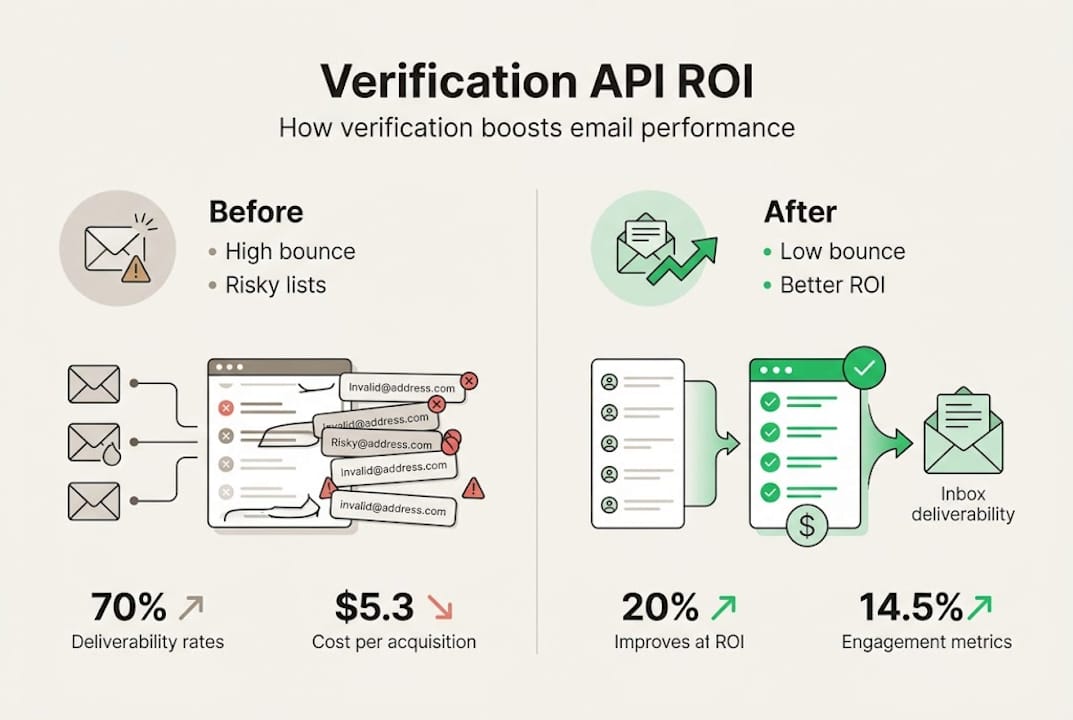
For teams focused on email marketing ROI with verification, the leverage is significant. You are not just cleaning a list. You are protecting every dollar spent on creative, targeting, and distribution by ensuring the message actually arrives.
Key numbers worth citing in internal business cases:
- Hard bounces reduced by 85% with consistent verification
- Inbox placement improved by 49% based on large-scale send analysis
- Bounce rate reduction of 74% for total bounces across verified lists
- Sender reputation recovery from below-average to near-perfect scores in documented campaigns
Sender reputation and deliverability are not abstract concepts. They are scored, tracked, and acted upon by every major inbox provider, and verification APIs are the most direct tool available to influence both.
Critical verification challenges: Edge cases and failure modes
Verification APIs are powerful, but they are not infallible. Understanding where they struggle is essential for building a reliable implementation.
Catch-all domains are among the most common challenges for B2B marketers. A catch-all domain is configured to accept every incoming email, regardless of whether the specific mailbox exists. When your API sends an SMTP probe, the server responds positively to every address. The result is that risky or invalid addresses pass verification and end up on your send list. For B2B campaigns where a significant portion of contacts use corporate domains, this creates real deliverability exposure.
Other common edge cases that trip up verification implementations include:
- Greylisting: Some mail servers temporarily reject unknown senders and accept them on retry. A verification API that does not retry may flag valid addresses as undeliverable.
- SMTP lies and rate limiting: Certain servers return false positives or negatives to protect against probing. High-volume verification can trigger rate limits that skew results.
- Plus-addressing: Addresses like user+tag@domain.com are valid and widely used for filtering, but overly strict regex patterns reject them.
- Quoted local parts and special characters: Addresses like o'brien@domain.com or "user name"@domain.com are technically valid per RFC standards but are frequently rejected by basic validators.
- Disposable email detection: Disposable providers rotate domains constantly, so static blocklists go stale quickly.
Here is a practical comparison of common pitfalls and suggested safeguards:
| Challenge | Risk | Safeguard |
|---|---|---|
| Catch-all domains | False valid results | Flag as risky, suppress or test separately |
| Greylisting | False invalid results | Use APIs with retry logic |
| SMTP rate limiting | Incomplete verification | Throttle requests, use async verification |
| Plus-addressing | Valid emails rejected | Use RFC-compliant syntax validation |
| Disposable emails | List inflation | Use real-time, updated blocklists |
Pro Tip: Do not rely on regex alone for syntax validation. Combine it with domain-level checks and SMTP probing through a reputable best API option for verification that handles edge cases at scale. A good API verification guide will walk you through layered verification logic that catches what single-method approaches miss.
How to integrate and optimize verification APIs for your campaigns
Implementation quality determines whether you capture the full value of verification or leave most of it on the table. Here is a structured approach to getting it right.
Step-by-step integration process:
- Audit your current list. Before connecting an API, run your existing database through a bulk verification pass to establish a clean baseline. Remove hard bounces, spam traps, and role-based addresses immediately.
- Connect the API to your sign-up forms. Real-time verification at the point of entry prevents bad data from entering your system in the first place. This is the highest-leverage integration point.
- Integrate with your ESP or CRM. Most enterprise platforms support webhook or native API connections. Map verification status fields to your contact records so suppression lists update automatically.
- Set up batch verification for imported lists. Any list that enters your system through a CSV import, a partner data exchange, or a lead generation campaign should pass through bulk verification before being activated.
- Build a feedback loop. Connect bounce data from your ESP back into your verification workflow. Addresses that bounce despite passing verification should be flagged for re-verification or permanent suppression.
Choosing between real-time and batch verification:
- Use real-time verification at registration, checkout, and any form where a user submits their email directly. It catches typos and invalid addresses instantly, improving data quality at the source.
- Use batch verification before major campaign launches, seasonal sends, or any time a list has been dormant for 90 days or more. Hard bounce benchmarks from Google and Microsoft set the acceptable threshold at under 2%, and batch verification before large sends is the most reliable way to stay below it.
Ongoing optimization practices:
- Re-verify inactive segments every 90 to 180 days, since email addresses decay at roughly 22% per year
- Monitor inbox placement rates after each major send and correlate changes with verification coverage
- Use email hygiene for campaigns as an ongoing discipline, not a one-time project
- Leverage accuracy with API verification improvements by selecting providers that update their detection models regularly
Pro Tip: Schedule a full list verification pass at least two weeks before any major campaign launch. This gives your team time to review flagged segments, update suppression lists, and adjust targeting without compressing the send timeline.
The overlooked truth: Verification APIs aren't just IT's job
Most organizations treat email verification as an infrastructure concern, something the technical team configures once and maintains quietly in the background. That framing is a strategic mistake, and it costs marketing leaders real competitive advantage.
When verification is owned exclusively by IT, it gets optimized for uptime and error rates, not for campaign performance and revenue outcomes. The business questions, which segments carry the highest bounce risk, which acquisition channels generate the most invalid addresses, and how list quality correlates with conversion rates, go unasked because no one in the marketing function is looking at verification data.
The organizations that extract the most value from email verification as a marketing discipline treat it as a strategic input to campaign planning, not a technical checkbox. CMOs who own data quality decisions see faster sender reputation recovery, cleaner audience segmentation, and more reliable attribution. Verification is not set-and-forget. It is an ongoing strategy that compounds over time, and it belongs on the marketing leadership agenda.
Put verification APIs to work for your campaigns
The gap between a list that performs and one that quietly erodes your sender reputation often comes down to whether verification is built into your workflow or bolted on after problems appear. If your current process relies on post-send bounce data to identify bad addresses, you are already paying the cost in deliverability and missed revenue.
BillionVerify gives enterprise marketing and sales teams the API infrastructure to verify millions of addresses per month, with real-time and bulk options, integrations across 20-plus ESPs and CRMs, and multi-layer detection for disposable emails, spam traps, catch-all domains, and role-based addresses. Start with a list audit today and see exactly where your deliverability risk is concentrated before your next major send.
Frequently asked questions
How do verification APIs reduce email bounce rates?
Verification APIs detect invalid, risky, or mistyped addresses before sending, reducing hard bounces by 85% and improving inbox placement by up to 49% based on large-scale send analysis.
What common mistakes can cause verification to reject valid emails?
Overly strict regex filters block valid addresses containing plus signs, apostrophes, or quoted local parts that are technically deliverable and RFC-compliant.
When should marketers use real-time versus batch verification?
Use real-time verification at sign-up to prevent bad data at the source, and batch verification before major campaigns to ensure your list stays below the 2% hard bounce threshold set by Google and Microsoft.
How do verification APIs contribute to ROI?
By preventing spend on undeliverable addresses and protecting sender reputation, verification APIs can generate a 29:1 return on investment, with documented sender score improvements from 67 to 98 in real campaign environments.