



Email list decay runs at 23% annually, meaning a significant share of your contacts become invalid every year without ongoing hygiene. For enterprise marketing teams, choosing the wrong email verification API is not just a technical inconvenience. It translates directly into wasted ad spend, damaged sender reputation, and campaigns that never reach the inbox. With dozens of providers claiming 99% accuracy and enterprise-grade reliability, knowing which criteria actually matter is the real challenge. This guide breaks down what separates strong APIs from weak ones, compares the top options using real benchmark data, and gives you a practical framework for matching the right solution to your workflow.
Key Takeaways
| Point | Details |
|---|---|
| Prioritize low false positives | Choose APIs with less than 1% false positive rates to protect your email reputation and deliverability. |
| Hybrid methods outperform single checks | Multi-layered verification including SMTP, AI, and catch-all detection is crucial for enterprise accuracy. |
| Test with your own data | Always benchmark multiple APIs on your lists to validate accuracy and fit before full integration. |
| Compliance and speed matter | Look for SOC2 certification, <500ms real-time responses, and strong documentation for smooth enterprise deployment. |
| Workflow fit beats brand | Select the verification API that aligns with your signup, bulk hygiene, and automation use cases—not just the biggest names. |
What makes a great email verification API?
Not all verification APIs operate the same way under the hood. Understanding validation API methodologies is the first step toward making an informed choice. The strongest platforms use a multi-layered approach, and you should expect nothing less for enterprise use.
A modern API should cover all of the following checks:
- Syntax validation using RFC 5321 regex to catch malformed addresses
- Domain and MX record checks to confirm the domain can receive mail
- SMTP handshake verification to test whether the mailbox actually exists
- Disposable domain detection to filter temporary email services
- Role-based address flagging to identify addresses like info@ or admin@
- Catch-all domain detection to handle domains that accept all incoming mail
- Spam trap identification to protect your sender reputation
- Quality scoring to rank addresses by deliverability risk
These multi-layered methodologies are what separate enterprise-grade tools from basic validators. A platform that only checks syntax or MX records will fail on a large portion of real-world edge cases.
For high-volume campaigns, false positive rates below 1% are non-negotiable. A false positive occurs when a valid email is incorrectly flagged as invalid, causing you to suppress a real contact. At scale, even a 2% false positive rate can mean thousands of missed opportunities per campaign. Understanding why email verification APIs matter becomes especially clear when you see how quickly suppressed valid contacts erode your reachable audience.

Enterprise integrations also require SOC2 compliance, documented uptime SLAs of 99.9% or higher, and response speeds under 500 milliseconds for real-time use cases. Advertised accuracy rates rarely tell the full story, so benchmark testing on your own list is essential before committing to any provider. The accuracy improvements APIs deliver depend heavily on how well the tool handles your specific list composition.
Pro Tip: Before signing any contract, run a sample of 5,000 to 10,000 addresses from your actual list through each shortlisted API. Compare results side by side, paying close attention to catch-all handling and false positive counts.
Top email verification API options for enterprise use
With evaluation criteria established, here is how the leading platforms compare based on real-world API performance data and independent benchmarks.
According to empirical 50k address benchmarks, accuracy and false positive rates vary significantly across providers:
- Puzzly: 99.1% accuracy, 0.4% false positive rate. Strongest performer in independent testing.
- NeverBounce: 98.3% accuracy, 1.2% false positive rate. Excellent developer documentation and fast bulk processing.
- ZeroBounce: 97.9% accuracy, 1.6% false positive rate. Standout for data enrichment features alongside verification.
- Kickbox: 97.1% accuracy, 2.1% false positive rate. Developer-friendly with a proprietary Sendex quality score.
- Emailable: Advertises a 99% deliverability guarantee with processing speeds up to 30,000 addresses per minute.
- Mailgun: Optimized for bulk scale with fast API response times and tight ESP integration.
- DeBounce: A budget-conscious option for teams with tighter per-verification cost constraints.
Industry providers typically claim 95% to 99% accuracy, but real-world results range from 85% to 98% depending on catch-all handling and list composition. This gap matters enormously when you are processing millions of addresses per month.
For teams building custom integrations, reviewing the API developer guide helps clarify what technical requirements to prioritize. Understanding how email verification works at each layer also helps you ask the right questions when evaluating vendor documentation.
Comparing performance, pricing, and compliance
With individual strengths identified, a direct side-by-side view helps narrow your shortlist quickly.
| Provider | Accuracy | False positive rate | Price per 10k | Notable features |
|---|---|---|---|---|
| Puzzly | 99.1% | 0.4% | Varies | Highest benchmark accuracy |
| NeverBounce | 98.3% | 1.2% | ~$30 | Fast bulk, strong dev docs |
| ZeroBounce | 97.9% | 1.6% | ~$40 | SOC2, HIPAA, data enrichment |
| Kickbox | 97.1% | 2.1% | ~$80 | Sendex score, dev-friendly |
| Emailable | ~98% | Low | ~$25 | 99% guarantee, SOC2, 30k/min |
| Mailgun | ~97% | Moderate | ~$15 | Fast bulk, ESP native |
| DeBounce | ~95% | Higher | ~$10 | Budget option |
Enterprise pricing for 10k verifications ranges from $15 to $80 depending on the provider and feature set. ZeroBounce charges approximately $0.004 per verification, NeverBounce around $0.003, and Kickbox closer to $0.008. Credits expiration policies also differ: some providers expire credits after 12 months while others never expire, which matters for teams with irregular verification cycles.
Mailgun's platform has shown a 21% bounce rate reduction in documented use cases, making it a strong candidate for teams already using Mailgun for sending. For compliance-sensitive industries, ZeroBounce and Emailable both carry SOC2 certification, with ZeroBounce also holding HIPAA compliance.
Key takeaway: High-volume teams should prioritize Emailable or Mailgun for scale. Enrichment-focused teams benefit most from ZeroBounce. Developer-led teams will find Kickbox or NeverBounce easier to integrate quickly.
For teams focused on measuring verification accuracy over time, tracking false positive trends post-deployment is just as important as pre-launch benchmarks. Pairing bulk processing with real-time email verification at the point of capture creates a two-layer defense. Reviewing bulk verification best practices before scaling up will help you avoid common processing errors.
How to match the API to your enterprise workflow
Choosing the right API is not only about accuracy scores. It is about fit with your actual operational workflows. Use this checklist to map your use cases before committing:
- Signup form validation: You need real-time API response under 500ms. Kickbox and NeverBounce both deliver 350 to 500ms response times, making them strong choices here.
- Bulk list hygiene: Run scheduled jobs on your full database monthly. Emailable and Mailgun handle scale best.
- Pre-campaign scrubbing: Verify your active segment 24 to 48 hours before send. Any major provider works, but accuracy on catch-all domains is critical.
- Lead processing pipelines: Integrate verification directly into your CRM intake. ZeroBounce's enrichment data adds extra value here by appending demographic signals.
One of the most important findings from independent testing is the performance gap between single-method and hybrid APIs. SMTP-only validation achieves just 45% accuracy on enterprise B2B lists, while hybrid AI-assisted methods reach 94% to 98%. Accuracy on catch-all domains drops to 85% to 90% without AI-assisted classification, which is a serious liability for B2B marketers where catch-all domains represent 20% to 40% of enterprise lists.
For a thorough testing methodology on your own list, running parallel tests with two or three shortlisted APIs before full deployment gives you real performance data rather than vendor claims. Marketers can also review the API verification guide for marketers for a practical walkthrough of integration steps. Pairing API verification with email deliverability monitoring at the ESP level creates a continuous feedback loop.
Pro Tip: Layer your API verification with real-time bounce monitoring inside your ESP. If bounce rates climb after a campaign, use that data to re-verify the affected segments immediately rather than waiting for your next scheduled hygiene cycle.
The uncomfortable truth about email verification APIs
Most benchmark reports and vendor guarantees look impressive in a sales deck. The reality is more complicated. Every API's accuracy degrades in specific conditions, and enterprise marketers are disproportionately exposed to those conditions.
Catch-all domains, anti-enumeration protections, and rapid greylisting are edge cases that affect B2B lists far more than consumer lists. When a mail server is configured to block SMTP probing, even the best hybrid API cannot confirm deliverability with certainty. No provider's marketing will tell you this clearly.
The real ROI of email verification comes not from picking the highest-rated tool and walking away, but from building a continuous hygiene process. That means testing on your actual data, re-verifying segments after periods of inactivity, and layering verification with live deliverability signals. Trusting a single vendor's accuracy claim as a permanent guarantee is the most common and costly mistake enterprise teams make.
Take your deliverability to the next level with AI-powered API
Selecting the right email verification API is a strategic decision that directly affects your sender reputation, campaign reach, and marketing ROI. The platforms reviewed here each have genuine strengths, but the best results come from combining accurate verification with a scalable, enterprise-ready infrastructure.
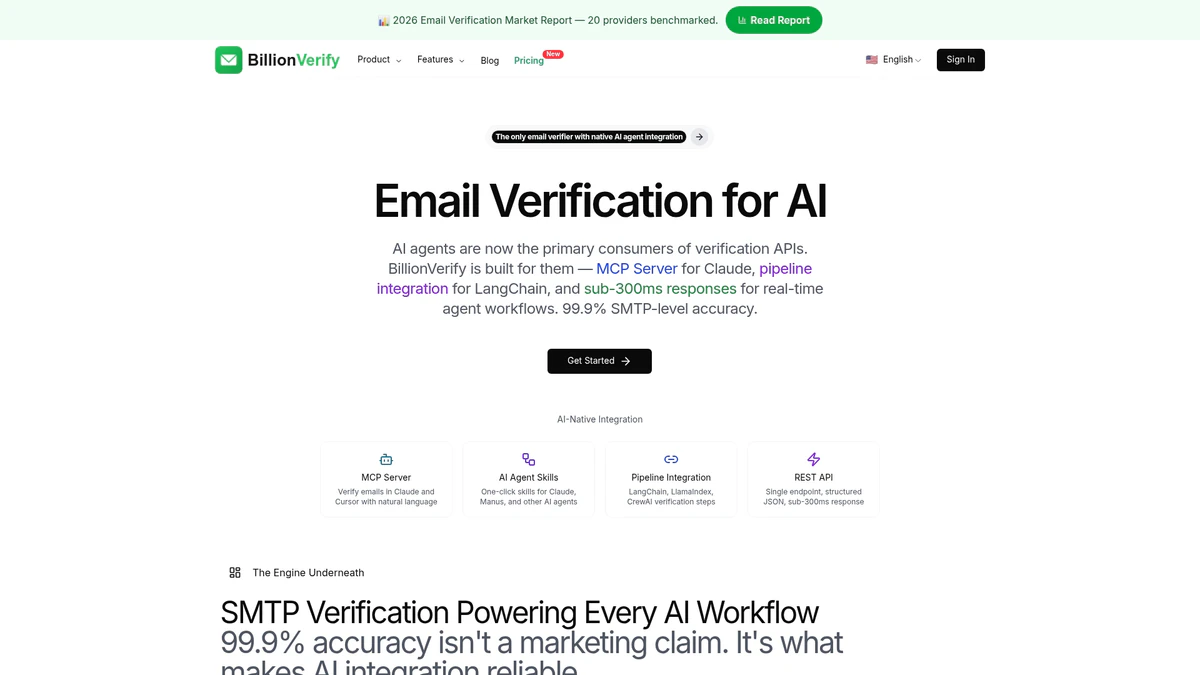
BillionVerify provides AI-powered, multi-layer email verification built for enterprise scale, processing millions of addresses per month with real-time and bulk API options. With integrations across 20 major ESPs and CRMs, SOC2-aligned security practices, and detection for disposable addresses, spam traps, catch-all domains, and role-based addresses, it gives marketing teams the accuracy and reliability they need. Start verifying today and protect every campaign from the ground up.
Frequently asked questions
What is an email verification API and how does it work?
An email verification API checks whether an address is valid and deliverable using layered technical checks including syntax, MX, and SMTP validation without sending an actual message. It returns a deliverability verdict in real time, allowing systems to act on the result instantly.
Why is low false positive rate important for enterprise marketing?
A low false positive rate ensures that valid contacts are not incorrectly suppressed, protecting your reachable audience and campaign ROI. False positive rates below 0.5% are considered the threshold for reliable enterprise-grade performance.
How do catch-all domains complicate email verification?
Catch-all domains accept all addresses regardless of whether the specific mailbox exists, making it impossible for standard SMTP checks to confirm deliverability. They represent 20% to 40% of B2B enterprise lists and require AI-assisted classification to handle accurately.
Can I use email verification APIs for real-time signup forms?
Yes, all major enterprise APIs support real-time validation with API response times under 500ms, enabling instant feedback at the point of signup. This prevents invalid addresses from entering your list before they cause deliverability problems.
What does SOC2 compliance mean for email verification APIs?
SOC2 compliance confirms that a provider meets rigorous security and data handling standards, which is a baseline requirement for many enterprise procurement processes. ZeroBounce and Emailable both carry SOC2 certification, with ZeroBounce also holding HIPAA compliance for healthcare-adjacent use cases.