



Most marketers underestimate how quickly bounce rates can damage campaign performance. Even a small increase in bounced emails can trigger a cascade of deliverability problems that silently destroy your sender reputation and sink entire marketing campaigns before you realize there's an issue. High email bounce rates damage sender reputation with ISPs like Google and Yahoo, leading to reduced inbox placement, spam filtering, and domain blacklisting for even valid emails. This guide clarifies what bounce rates mean, why they matter for your business, and how to improve them with practical, actionable strategies.
Key Takeaways
| Point | Details |
|---|---|
| Keep bounce rates under 2% | Staying below this threshold protects your sender reputation and ensures inbox placement. |
| Monitor and react fast | Real-time tracking and rapid action prevent bounces from escalating into major deliverability issues. |
| Focus on list quality | Regular list cleaning and verification are your best defense against harmful bounces. |
| Understand bounce types | Soft and hard bounces have different causes but both hurt campaigns if ignored. |
| Use professional tools | AI-driven verification solutions add another layer of protection for your campaigns. |
What is an email bounce rate and why does it matter?
Bounce rate is the percentage of emails that could not be delivered to the recipient's inbox. Understanding this metric is essential because it directly affects your ability to reach customers and maintain a healthy sender reputation with major email providers.
There are two primary types of bounces that every marketer needs to understand:
- Hard bounces: Permanent delivery failures caused by invalid email addresses, non-existent domains, or blocked recipients. These addresses will never accept your emails and should be removed immediately.
- Soft bounces: Temporary delivery failures due to full inboxes, server issues, or message size problems. While these may resolve on their own, repeated soft bounces can escalate into permanent problems.
ISPs like Google and Yahoo closely monitor bounce rates to determine inbox placement for your future campaigns. They use this metric as a primary signal to identify potential spam behavior and protect their users from unwanted messages. High email bounce rates damage sender reputation with these providers, which means your legitimate emails may never reach their intended recipients.
Bounce Rate Benchmarks
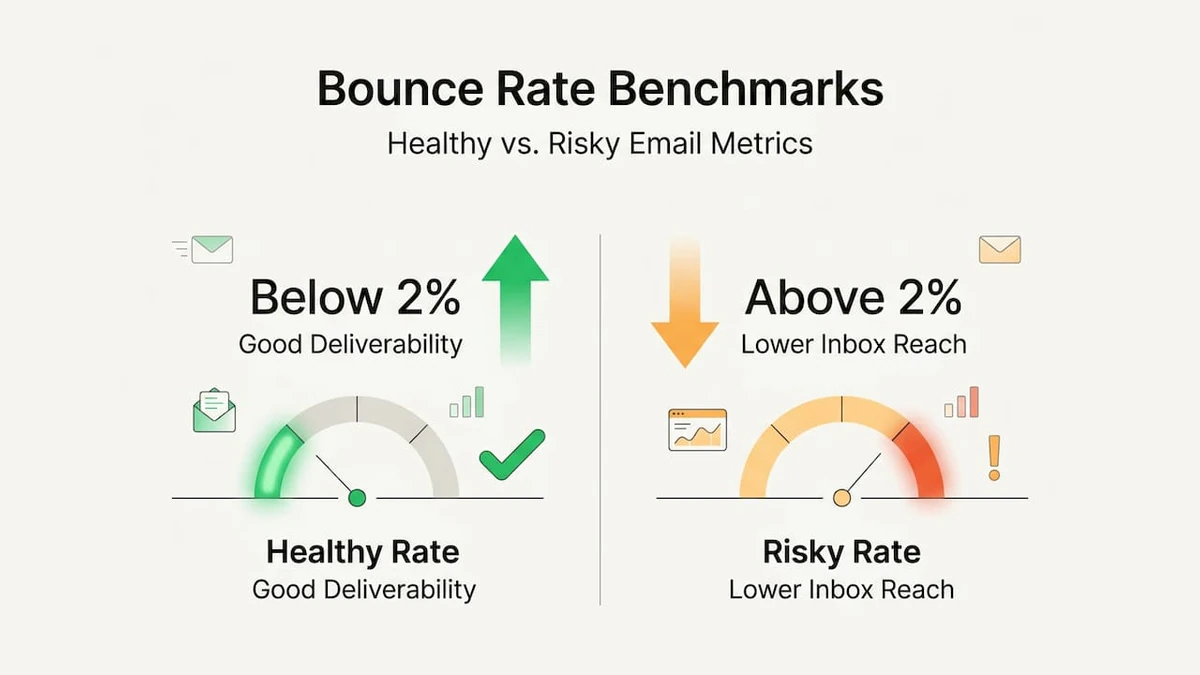
| Bounce Rate | Status | Impact on Deliverability |
|---|---|---|
| Below 2% | Healthy | Minimal impact, good sender reputation |
| 2-5% | Warning | Reputation at risk, inbox placement declining |
| Above 5% | Critical | Severe deliverability issues, potential blacklisting |
A healthy bounce rate is less than 2% of your total sends. Rates above 2% start to hurt your sender reputation, and anything above 5% represents a critical situation that requires immediate attention. For more context on how bounces affect your campaigns, explore our guide on email bounce explained and learn more about bounce rate in email.
How bounce rates impact sender reputation and campaign performance
Bounce rates are a primary signal to ISPs for potential spam behavior. When your campaigns generate high bounce rates, email providers interpret this as a sign that you're sending to unverified or purchased lists, which is a hallmark of spammers and low-quality senders.

High bounce rates can get all your emails sent to spam folders or lead to domain blacklisting, even for messages sent to valid, engaged subscribers. This creates a devastating ripple effect where your entire email program suffers because of poor list hygiene. The consequences extend beyond just the bounced messages themselves.
Campaign Performance Comparison
| Metric | Healthy Bounce Rate (<2%) | High Bounce Rate (>5%) |
|---|---|---|
| Inbox Placement | 85-95% | 30-50% |
| Open Rate | 18-25% | 5-12% |
| Click-Through Rate | 2.5-4% | 0.5-1.5% |
| Conversion Rate | 1.5-3% | 0.2-0.8% |
| Sender Reputation Score | 80-100 | 20-45 |
The data shows that >2% total bounce rate risks reputation drop, while >5% is critical and can permanently damage your ability to reach inboxes. The difference in campaign performance between healthy and high bounce rates is dramatic, affecting every metric that matters for your marketing ROI.
"The best time to address bounce issues is before a campaign launch, not after. Once your sender reputation drops, it can take months of perfect sending behavior to recover."
Pro Tip: Monitor your bounce rates by email provider (Gmail, Yahoo, Outlook) to identify provider-specific issues early. A sudden spike in bounces from one provider often indicates a deliverability problem that needs immediate investigation.
For strategies to improve your metrics, check out our article on how to reduce email bounce rate and explore proven email list cleaning strategies.
What causes bounce rates to spike? Common triggers you need to know
List quality is the number one driver of bounce rates. Old, purchased, or unverified lists are extremely risky because they contain high percentages of invalid addresses, spam traps, and abandoned accounts that will generate immediate bounces when you send campaigns.
Here are the most common causes of elevated bounce rates:
- Invalid email addresses: Typos during signup, fake addresses used to access gated content, or addresses that never existed in the first place.
- Role-based emails: Addresses like info@, sales@, or support@ that many organizations block or filter aggressively.
- Abandoned accounts: Email addresses that were once valid but have been inactive for months or years and are now closed.
- Domain issues: Expired domains, misconfigured DNS records, or domains flagged as suspicious by ISPs.
- Temporary problems escalating: Repeated soft bounces from the same domain, such as full inboxes on Gmail or Yahoo, can escalate to permanent suppression after just three consecutive attempts.
Most marketers miss subtle triggers like typo domains accumulating in their lists over time. A single character mistake (gmial.com instead of gmail.com) creates a hard bounce, and these errors compound when you're not actively cleaning your database.
"Edge case alert: Repeated soft bounces from major providers like Gmail and Yahoo can result in permanent suppression faster than you think. After three consecutive soft bounces from the same address, many ESPs will automatically move that contact to a suppression list, treating it as a hard bounce going forward."
Understanding these triggers helps you take preventive action before they damage your campaigns. Learn more about why email bounces happen and the importance of email list hygiene for long-term deliverability.
Best practices to keep your bounce rates low
Regularly verify and clean your email lists with automated tools designed to identify invalid addresses before you send campaigns. This proactive approach prevents bounces rather than reacting to them after the damage is done.
Here are the essential practices for maintaining healthy bounce rates:
- Implement double opt-in: Require new subscribers to confirm their email address before adding them to your active list. This simple step eliminates most typos and fake addresses.
- Remove bounced addresses immediately: After each campaign, segment out hard bounces and remove them from your database permanently. Never attempt to send to a hard bounce again.
- Re-verify soft bounces: Addresses that soft bounce should be verified before your next send. If they soft bounce repeatedly, treat them as hard bounces.
- Avoid purchased or scraped lists entirely: These lists are filled with spam traps, invalid addresses, and unengaged contacts that will destroy your sender reputation.
- Set engagement-based sunset policies: Remove subscribers who haven't opened or clicked in 6-12 months, as many of these addresses are likely abandoned.
- Use real-time verification at signup: Validate email addresses as users enter them on your forms to catch typos and invalid formats immediately.
A healthy bounce rate is less than 2%, and maintaining this standard requires consistent list hygiene practices, not occasional cleanups. The most successful email programs treat verification as an ongoing process, not a one-time project.
Pro Tip: Set up per-domain bounce monitoring to catch subtle deliverability issues by provider. If you notice Gmail bounces increasing while Yahoo remains stable, you may have a provider-specific reputation issue that needs targeted investigation.
Explore our guides on bulk email verification and email marketing best practices for more detailed strategies.
How to monitor and react to bounce rates in real time
Track bounce rates per campaign and per domain to spot trends quickly before they escalate into major deliverability problems. Real-time monitoring allows you to pause campaigns, investigate issues, and protect your sender reputation before significant damage occurs.
Follow these steps to establish effective bounce monitoring:
- Set up automated alerts: Configure your email platform to notify you immediately when bounce rates exceed your threshold (typically 2% for total bounces or 1% for hard bounces).
- Monitor by email provider: Track bounces separately for Gmail, Yahoo, Outlook, and other major providers to identify provider-specific issues.
- Investigate anomalies immediately: A sudden spike in bounces from a specific provider or domain segment indicates a problem that needs urgent attention.
- Pause campaigns when necessary: If bounce rates spike unexpectedly, pause your sends, identify the cause, and clean your list before resuming.
- Use feedback loops: Register for feedback loops with major ISPs to receive notifications when recipients mark your emails as spam, which often correlates with bounce issues.
- Review bounce reasons: Analyze the specific SMTP error codes in your bounce reports to understand whether you're dealing with invalid addresses, blocked domains, or temporary issues.
Repeat soft bounces can escalate to permanent suppression when monitored per domain, so tracking this metric by provider is essential for catching problems early. Gmail may treat repeated soft bounces differently than Yahoo, and your monitoring system should account for these variations.
React promptly when you identify issues. Clean your lists, address technical problems, and verify that your sending infrastructure is properly configured before resuming campaigns. The faster you respond to bounce rate increases, the less damage they'll cause to your long-term deliverability.
For comprehensive guidance, review our resources on email list management and email list cleaning tips.
Take your deliverability further with advanced verification
By proactively managing bounces, you're already ahead of most marketers who only react after their campaigns fail. If you want to automate and scale your approach, professional-grade verification tools can help you maintain consistently low bounce rates without manual intervention.
BillionVerify provides automated, AI-driven list cleaning and verification tools designed specifically for high-volume senders who need enterprise-grade accuracy. The platform detects disposable emails, spam traps, role-based addresses, catch-all domains, and risky domains before they damage your campaigns. With real-time verification, bulk processing, and seamless integration with over 20 major email marketing systems, you can complement your in-house monitoring with professional-grade solutions that scale with your business. Learn more or get started through BillionVerify's AI-first email verification platform.
Frequently asked questions
What is a good email bounce rate for e-commerce campaigns?
A healthy email bounce rate is generally below 2%; rates higher than 2% may threaten your sender reputation and reduce inbox placement for future campaigns.
How quickly can bad bounce rates impact deliverability?
Negative effects can appear almost immediately as ISPs respond quickly to spikes in bounce rates, potentially flagging your domain after just one or two campaigns with >2% bounce rates.
Are soft bounces as dangerous as hard bounces?
Repeated soft bounces can escalate to permanent suppression after just three attempts, especially when monitored per domain, making them nearly as dangerous as hard bounces if not addressed quickly.
Can bounced emails be fixed or recovered?
Hard bounces are permanent and those emails should be removed from your list immediately; some soft bounces may be reattempted but should be monitored closely and removed if they bounce repeatedly.
What tools help monitor or reduce bounce rates?
Top tools combine real-time monitoring and automated list cleaning, such as specialized providers that use AI to detect risk addresses, verify email validity, and integrate with your existing email marketing platforms.