


Most advice on this topic stops at “don't buy email accounts.” That's incomplete. Teams search for ways to buy email accounts in bulk because they want scale fast, they're under pressure to hit pipeline or campaign volume, and mailbox setup looks slower than acquiring accounts from a marketplace.
The problem isn't just that the tactic is risky. It's that people often mix up three very different things: buying accounts, buying contact lists, and provisioning mailboxes on infrastructure you control. Those choices don't have the same economics, the same technical profile, or the same failure mode. Treating them as interchangeable is where expensive mistakes start.
What It Means to Buy Email Accounts in Bulk
Buying email accounts in bulk usually means purchasing pre-created inboxes from a third party. In most cases, these are consumer accounts such as Gmail accounts, though the same logic applies to other mailbox types. The buyer is not purchasing audience consent or a verified relationship. They're purchasing access credentials to inboxes that were created elsewhere.
That distinction matters because an account is not the same as a lead, a subscriber, or a mailbox on infrastructure your team owns. It's a transferred identity, and the provenance is often unclear from the start.
Why the market exists
The demand makes sense when you look at email's sheer scale. A 2026 industry compilation estimates 4.73 billion email users worldwide and about 376.4 billion emails sent and received each day, which is why even minor list-quality problems can affect deliverability at huge scale according to Porch Group Media's email statistics compilation.
A market this large attracts shortcuts. If a team believes it can skip mailbox provisioning, skip warmup discipline, and skip data hygiene by acquiring more accounts, the temptation is obvious. The problem is that shortcut logic confuses access with legitimacy.
What buyers usually expect
Teams that explore this route are usually trying to solve one of these problems:
- Outbound volume pressure. Sales teams want more sending capacity without waiting for setup.
- Operational convenience. Pre-made accounts look easier than creating domains and mailboxes correctly.
- Replacement thinking. Burned accounts get treated like disposable inventory.
- Poor list quality upstream. Some teams chase more accounts when the underlying problem is weak data capture. A better starting point is a disciplined email list building guide that improves lead quality before sending ever begins.
Buying accounts feels like a scaling tactic. In practice, it often masks a setup problem or a data-quality problem.
If you're evaluating this seriously, use a stricter definition. Buying accounts means acquiring identities you didn't create and don't control at the provider level. That's not infrastructure. It's borrowed access with unstable trust.
Accounts vs Lists vs Provisioning A Critical Distinction
Teams get into trouble here because these three actions look similar on a budget sheet. Operationally, they are completely different.
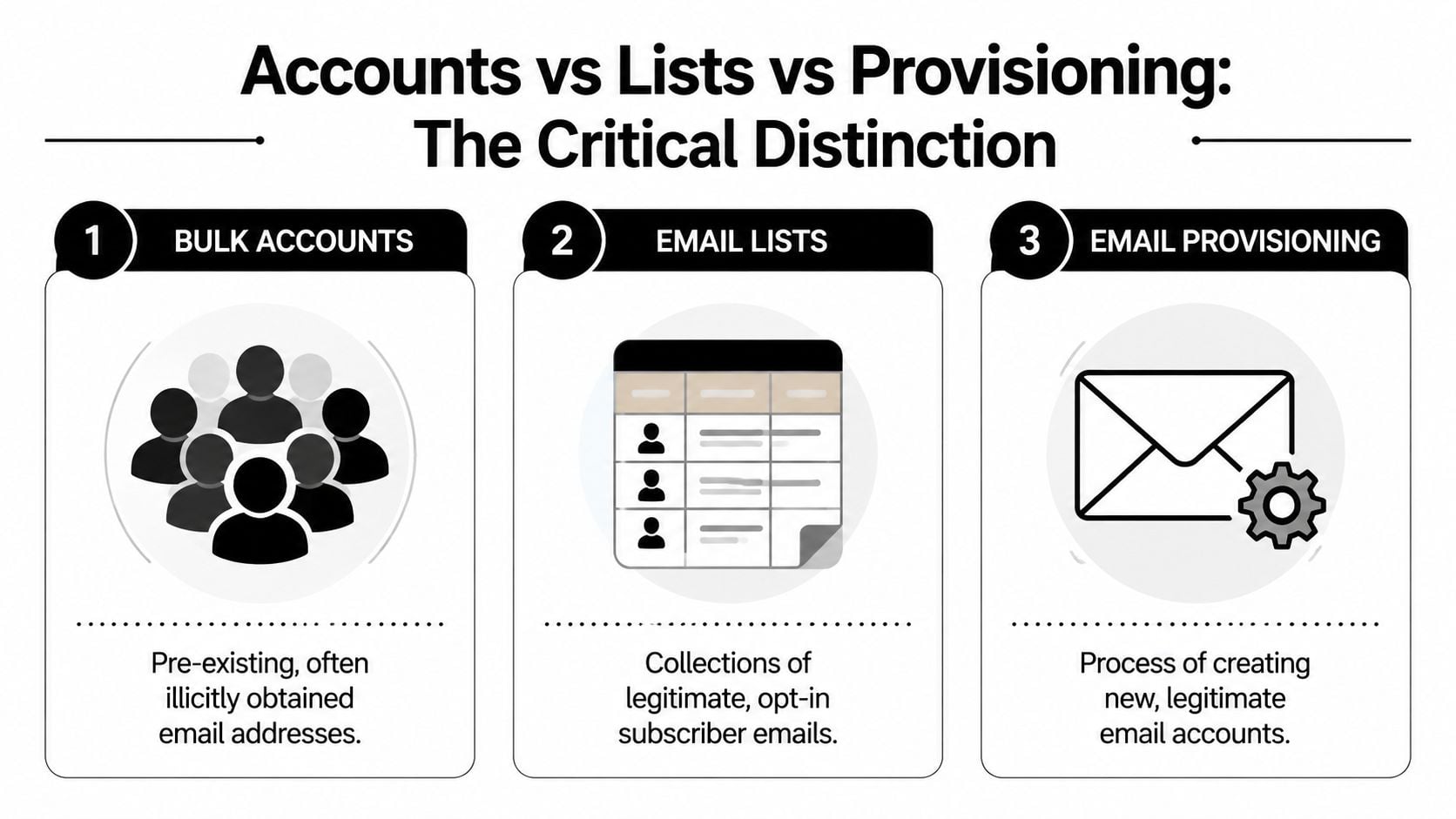
An account is a mailbox identity. A list is contact data. Provisioning is the process of creating and managing sending capacity on infrastructure your team controls. If a marketing team treats those as interchangeable, it usually buys the wrong thing and then tries to solve the fallout later with more volume, more domains, or more replacements.
Three actions that look similar but behave very differently
Buying bulk accounts means acquiring inboxes that were created elsewhere. You may get login credentials, recovery details, and a promise that the accounts are ready to send. What you do not get is clean provenance, provider trust, or reliable administrative control. For deliverability work, that distinction matters more than the inbox count.
Buying email lists means purchasing records about people, usually names, titles, companies, and email addresses. That creates a different risk set. You have a data quality and consent problem, not an account ownership problem. Cognism explains in its guide to buying email lists that pricing varies widely by targeting and record quality. Cost is easy to compare. Validity, permission, and response quality are harder to verify before sending.
Provisioning mailboxes means setting up new accounts on domains your organization owns, with admin access, authentication, routing rules, and lifecycle controls defined by your team. This is the only option that produces real sending infrastructure. If your systems also need to pass lead data, trigger campaigns, or sync mailbox activity across tools, a clear understanding of how email APIs support campaign workflows helps prevent setup mistakes upstream.
A simple framing works well in practice. Accounts are identities. Lists are audiences. Provisioning is infrastructure.
Practical rule: If your team cannot verify ownership, creation history, and ongoing admin control, it does not own sending capacity. It is operating on borrowed access.
Email acquisition methods compared
| Method | What You Get | Ownership & Control | Primary Risk |
|---|---|---|---|
| Bulk account buying | Login access to pre-created inboxes | Weak control, unclear origin, provider can challenge access | Suspension, access loss, trust failure |
| Email list buying | Contact records, often filtered by role or industry | You hold the data, but permission and freshness may be uncertain | Compliance exposure, low engagement, invalid contacts |
| Mailbox provisioning | New inboxes on domains you own | Strong administrative control and consistent reputation management | Configuration errors if setup and authentication are poor |
The hidden mistake is treating all three as procurement choices for the same problem. They solve different problems.
Buying accounts tries to purchase identity. Buying lists tries to purchase attention. Provisioning builds a controlled sending environment your team can improve over time. That last path takes more work at the start, but it gives marketing and outbound teams something they can defend, measure, and keep stable.
Why Buying Accounts Fails Deliverability and Legal Risks
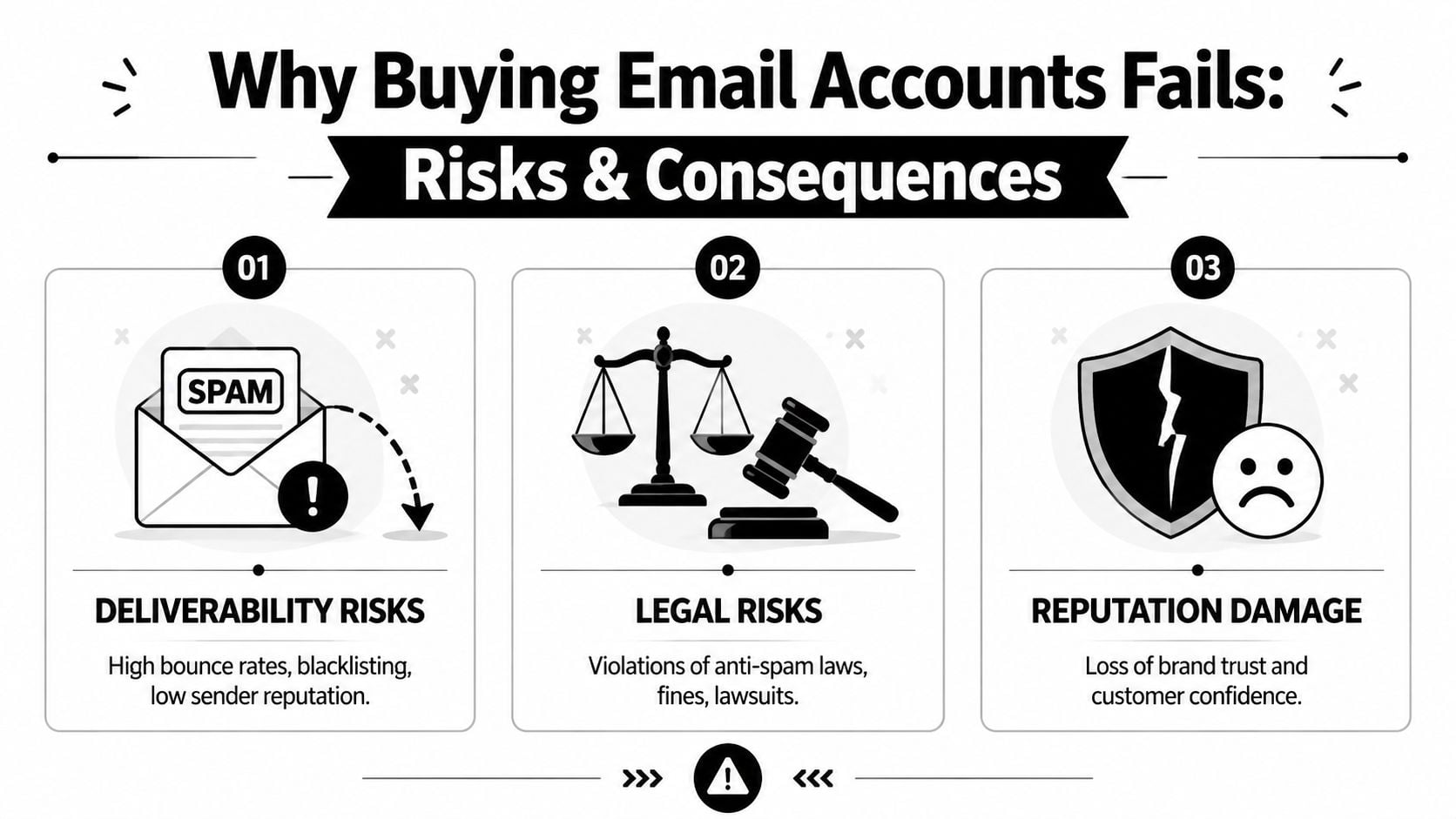
The failure usually starts before the first campaign finishes. Purchased consumer accounts carry unknown history, inconsistent creation patterns, and access behavior that can change abruptly once a new operator logs in from a different environment.
Technical failure starts first
One source discussing bulk Gmail account purchasing notes that third-party consumer account transfers create a high-risk trust problem because providers can flag suspicious access patterns for suspension or disablement. It also points to the stronger model of using owned domains with SPF, DKIM, and DMARC so sender reputation is tied to authenticated infrastructure rather than account count, as described in this discussion of bulk Gmail account risks and owned-domain authentication.
That aligns with what deliverability teams see operationally. The issue isn't only whether a message gets sent today. The bigger issue is whether the provider trusts the account tomorrow, whether linked services stay accessible, and whether reputation can accumulate instead of resetting.
Here's what breaks most often:
- Access continuity. The provider challenges or disables accounts after unusual login or transfer patterns.
- Reputation stability. Sending history tied to accounts you didn't create isn't something you can audit with confidence.
- Service dependency. If the mailbox touches calendars, storage, forwarding, or recovery paths, one suspension creates collateral problems.
Teams trying to salvage this setup often end up rebuilding on proper infrastructure anyway. A more useful path is to start with controlled domains and apply the deliverability basics from the beginning, including the practices covered in this email deliverability improvement guide.
Compliance and brand problems follow
Legal exposure doesn't arrive as a neat technical alert. It shows up when your team can't document how an address was sourced, why a message was sent, or who authorized the account setup model in the first place. Purchased consumer accounts don't solve consent. They only obscure it.
Brand damage is even simpler. If a prospect recognizes that your outreach is coming from unstable or suspicious infrastructure, trust drops before your copy has a chance to work.
If a sending tactic requires you to hide how the infrastructure was obtained, it's probably too fragile for a serious brand.
Buying accounts also creates messy internal governance. Security teams don't like unexplained credentials. RevOps teams can't model lifecycle ownership cleanly. Compliance teams inherit a paper trail they didn't approve.
The Professional Alternative A Scalable Send Infrastructure
Serious teams don't scale by buying identities. They scale by building controlled mailbox capacity on domains they own, then distributing sending activity across that architecture in a disciplined way.
What legitimate scale looks like
The cost model is straightforward. One cold-email workflow reference puts legitimate mailbox pricing at roughly $8 per Google Workspace mailbox, about $7 per Microsoft mailbox, and around $8.99 per GoDaddy mailbox, with no meaningful bulk discount in direct Microsoft pricing, as explained in this mailbox cost and infrastructure discussion on YouTube.
That's important because it changes the budgeting conversation. Instead of hunting for suspiciously cheap accounts, teams should budget for real subscriptions and optimize architecture. The same source notes a practical pattern of using 2 to 5 inboxes per domain. That's a planning decision, not a black-market procurement trick.
A practical architecture choice
A reliable setup usually includes:
Owned domains for sending
Separate operational sending from your core brand domain when appropriate. That gives your team cleaner control over reputation and risk isolation.Provisioned mailboxes with clear owners
Every inbox should have an accountable operator, documented use case, and access policy.Authenticated sending
Authentication isn't optional. It's the basis for trust and consistent reputation-building.Mailbox allocation by use case
Don't mix everything into one pool. Prospecting, transactional, lifecycle, and partner communication behave differently.Measured ramp-up
New infrastructure needs disciplined onboarding. Rushing volume into fresh mailboxes is one of the quickest ways to waste a clean setup.
If your team is comparing tools to support that stack, this email platform selection guide helps separate mailbox providers, delivery tools, and data-quality layers.
A controlled system takes longer to build than buying accounts. It also gives you what purchased accounts never can. Ownership, repeatability, auditability, and a reputation asset your team can protect.
Protecting Your Infrastructure with Email Verification
Good infrastructure still fails if you feed it bad addresses. Many teams overlook the underlying problem, believing they need more sending accounts when cleaner input and better gatekeeping are what is required.
Verification at the point of entry
The first defensive layer is real-time verification on forms, signup flows, product registrations, demos, and lead capture points. If a bad address never enters your CRM, your send infrastructure never has to absorb the cost later.
That means checking new addresses before they land in the database and flagging issues such as:
- Misspelled addresses that look valid to a human but won't route properly.
- Disposable emails that inflate lead counts and disappear when your team follows up.
- Role accounts that often don't represent a single engaged buyer.
- Catch-all patterns that need more careful handling than standard deliverable addresses.
For teams working through outbound operations, this guide on email deliverability for sales leaders is a useful companion read because it connects verification discipline directly to inboxing outcomes.
Bulk cleaning before every major send
The second layer is bulk verification of existing data. This matters most when your CRM has been collecting leads for a while, when you've imported old records, or when multiple acquisition channels feed one campaign audience.
A solid workflow looks like this:
Upload and classify
Review the list by deliverability status rather than treating every address as equally usable.Remove obvious hazards
Exclude invalid, disposable, and unwanted role-based records from campaign audiences.Segment uncertain records
Treat catch-all and ambiguous results differently from clearly valid contacts.Export for use by team
Sales, lifecycle, and paid acquisition teams shouldn't all pull from the same raw list without filtering.
In this context, BillionVerify fits naturally. It provides single checks, bulk list cleaning, and a fast real-time API, with SMTP-level verification, catch-all scoring, MX record checks, structured JSON responses, role-account filtering, and deliverability insights. Those functions matter because they let a team stop fake signups earlier and clean older datasets before they damage mailbox reputation. If you want the operational detail, this bulk email verification overview covers the workflow in more depth.
Clean data protects infrastructure. Verification isn't a reporting layer. It's a prevention layer.
Once a team sees verification this way, the urge to buy email accounts in bulk usually fades. The root issue wasn't a shortage of inboxes. It was a shortage of trustworthy addresses and a lack of process around how records entered the system.
Conclusion The Path to Sustainable Email Growth
Buying email accounts in bulk looks like an advantage. For most legitimate teams, it's borrowed time on infrastructure they don't control. The attraction is understandable. Fast access, low apparent friction, and the hope of immediate scale can look appealing when targets are rising.
But the trade-off is poor. Purchased accounts create trust problems at the provider level, operational problems for the team managing them, and reputational problems for the brand attached to them. Even when they appear to work briefly, they don't create a durable sending asset.
The stronger path is less dramatic and far more effective. Build mailbox capacity on owned domains. Authenticate it correctly. Assign clear use cases. Ramp it carefully. Then protect that infrastructure with email verification so weak addresses never get the chance to poison sender reputation.
That approach changes the economics. Instead of repeatedly replacing unstable accounts, your team invests in assets it controls. Instead of guessing which records are safe to email, you verify them before they enter automation or before they reach a campaign. Instead of chasing volume through shortcuts, you improve the quality of every send.
If your organization is still debating whether to buy accounts or build properly, the answer should be operational, not moral. One path creates hidden instability. The other creates a system your marketing, sales, compliance, and ops teams can all live with.
If you're moving away from risky account buying, start with the data layer. BillionVerify helps teams verify addresses at signup and clean existing lists before campaigns, which is exactly how you protect sender reputation while building sustainable email growth.