



Try the free tool: Check an address with BillionVerify's disposable email detection tool before it enters your signup flow or contact database. The result helps you decide whether to accept, review, or block the address.
Every business that collects email addresses faces a hidden threat: disposable email addresses. These temporary, throwaway email accounts are created specifically to avoid commitment, bypass registration requirements, or exploit promotional offers. For businesses relying on email verification and email validation to maintain list quality, understanding how to detect and block disposable emails is essential for protecting your sender reputation and ensuring genuine user engagement. For foundational concepts, see our complete guide to email verification.
What Are Disposable Email Addresses?
Disposable email addresses, also known as temporary emails, throwaway emails, fake email addresses, or burner emails, are email accounts created for short-term use. Unlike permanent email addresses from providers like Gmail, Outlook, or Yahoo, these temporary email addresses are designed to be abandoned after a single use or short period.
The concept behind disposable email services is simple: users want to access content, sign up for services, or receive one-time communications without revealing their real email address. While this serves legitimate privacy purposes, it creates significant challenges for businesses trying to build authentic customer relationships.
Common Names for Disposable Emails
The email verification industry uses various terms to describe these temporary accounts:
- Disposable email addresses (DEA) - The most common technical term
- Temporary email - Emphasizes the short lifespan
- Throwaway email - Highlights the intent to discard
- Fake email address - Though technically functional, not tied to real identity
- Burner email - Borrowed from "burner phone" terminology
- 10-minute mail - Named after popular time-limited services
- Trash mail - Emphasizes the disposable nature
- Anonymous email - Focuses on privacy aspect
- Single-use email - Describes the typical usage pattern
- Temp mail - Shortened form of temporary mail
Understanding these terms helps when researching email validator solutions or configuring your email checker tools to properly identify these addresses.
Why Users Create Disposable Email Accounts
Before implementing a disposable email checker, it's valuable to understand why users resort to temporary email addresses. This understanding helps balance security needs with user experience.
Legitimate Privacy Concerns
Many users create throwaway email accounts to protect their primary inbox from spam. When signing up for a website they don't fully trust, a temporary email address shields their real email from potential data breaches or aggressive marketing campaigns.
Avoiding Marketing Communications
Some users want to access content—like downloading a whitepaper or trying a free tool—without committing to ongoing email communications. Rather than unsubscribing later, they use a disposable email upfront.
Testing and Development
Developers and QA teams frequently use temporary email services to test registration flows, email delivery, and verification systems without creating numerous permanent test accounts.
Exploiting Promotional Offers
This represents the more problematic use case. Users create multiple fake email addresses to repeatedly claim free trials, promotional discounts, or referral bonuses. This directly impacts business revenue and distorts marketing metrics.
Bypassing Registration Requirements
Some users simply want quick access without creating a permanent account. They view registration as friction and use disposable emails as a workaround.
The Business Impact of Disposable Emails
Allowing disposable email addresses into your database creates cascading problems that affect multiple aspects of your business operations.
Degraded Email Deliverability
Internet Service Providers (ISPs) and email service providers monitor engagement metrics closely. When a significant portion of your list consists of abandoned disposable addresses, your open rates plummet. Low engagement signals to ISPs that your emails may be unwanted, potentially triggering spam folder placement for your entire sending domain.
Wasted Marketing Resources
Every email sent to a disposable address represents wasted resources. Email marketing platforms typically charge based on list size or send volume. Sending to addresses that will never be checked again means paying for zero return on investment.
Distorted Analytics and Metrics
Marketing decisions rely on accurate data. When disposable emails inflate your subscriber count but contribute zero engagement, your metrics become unreliable. Conversion rates, customer lifetime value calculations, and campaign performance all suffer from this data pollution.
Increased Bounce Rates
Many disposable email services automatically delete accounts after hours or days. When you send to these expired addresses, you receive hard bounces. High bounce rates damage your sender reputation and can lead to being blacklisted by major email providers.
Fraud and Abuse Risks
For businesses offering free trials, promotional credits, or referral programs, disposable emails enable systematic abuse. A single bad actor can create dozens of temporary addresses to repeatedly exploit offers intended for new customers.
Customer Support Burden
When users register with disposable emails and then need account recovery or support, they've already abandoned the email address. This creates orphaned accounts and frustrated users who can't access services they've paid for.
For a quick check before building rules, test a sample address with the disposable email detector. It provides a practical reference point for how temporary-email risk should appear in your registration workflow.
How Disposable Email Detection Works
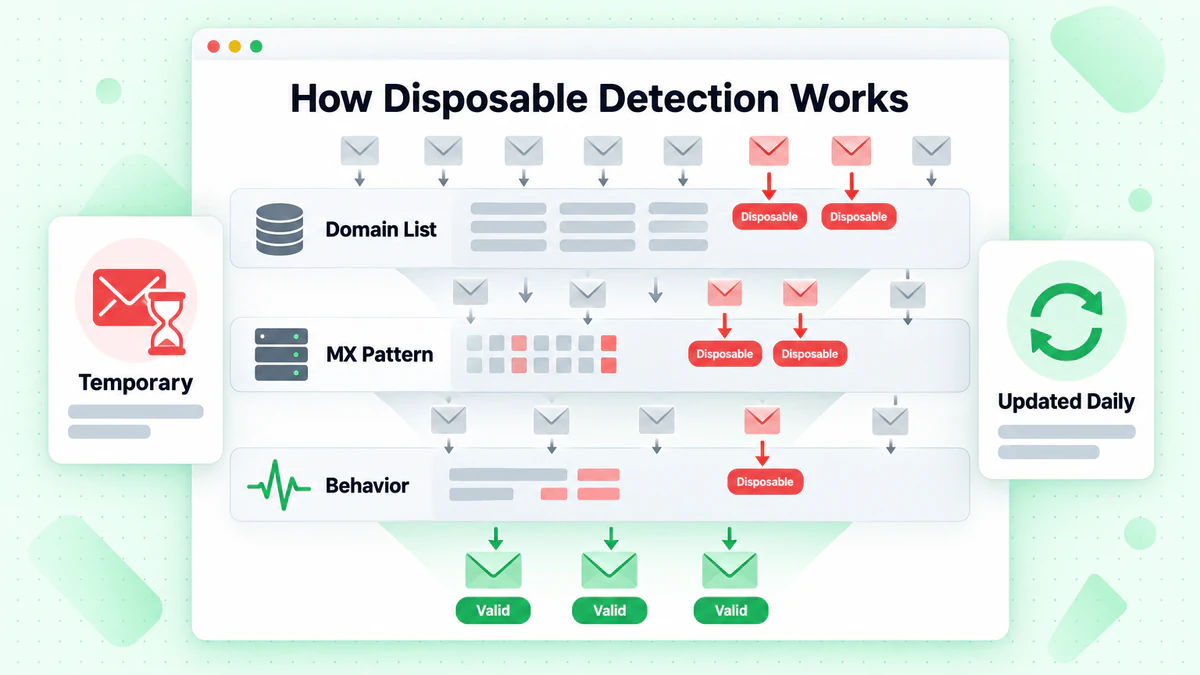
Effective email validation for disposable addresses requires multiple detection approaches working together. No single method catches everything, but a layered strategy provides comprehensive protection.
Domain-Based Detection
The most straightforward approach involves maintaining a database of known disposable email domains. Services like Mailinator, Guerrilla Mail, 10 Minute Mail, and TempMail operate on specific domains that can be identified and blocked.
However, this approach requires constant updates. New disposable email providers launch regularly, and existing services often add new domains to evade detection. A comprehensive email verification service maintains databases with thousands of known disposable domains, updating them continuously.
Pattern Recognition
Many disposable email services use predictable patterns in their domain names or email address structures. Machine learning algorithms can identify these patterns even for previously unknown domains. Common indicators include:
- Domains containing words like "temp," "trash," "throw," "disposable," or "fake"
- Recently registered domains with minimal web presence
- Domains that resolve to known disposable email service infrastructure
- Unusual TLD patterns common among disposable services
MX Record Analysis
Examining Mail Exchange (MX) records reveals how a domain handles email. Disposable email services often share infrastructure, meaning multiple disposable domains point to the same mail servers. By mapping these relationships, email checkers can identify new disposable domains based on their mail server configurations.
Behavioral Analysis
Some advanced email verification systems analyze signup patterns rather than just the email address itself. Rapid signups from the same IP address with different email addresses, or patterns consistent with automated abuse, can indicate disposable email usage even before the address is flagged.
API-Based Verification
Professional email verification APIs like BillionVerify combine all these methods into a single query. When you submit an email address, the service checks against domain databases, analyzes patterns, examines DNS records, and returns a comprehensive risk assessment including whether the address appears to be disposable.
Popular Disposable Email Providers
Understanding the landscape of disposable email services helps appreciate the scale of the detection challenge. Here are categories of providers your email validator must recognize:
Time-Limited Services
These create addresses that automatically expire after a set period:
- 10 Minute Mail - Addresses expire after 10 minutes
- Temp Mail - Configurable expiration periods
- Guerrilla Mail - One-hour default lifetime
- Mohmal - 45-minute email addresses
Persistent Anonymous Services
These provide longer-lasting but still anonymous addresses:
- Mailinator - Public inboxes anyone can access
- Maildrop - No registration required
- YOPmail - Addresses persist for 8 days
Custom Domain Services
Some services allow users to create addresses on custom or multiple domains, making detection harder:
- AnonAddy - Forwarding with custom aliases
- SimpleLogin - Email alias service
- 33Mail - Unlimited aliases on subdomain
Self-Hosted Solutions
Technical users can deploy their own disposable email infrastructure, creating unique detection challenges.
During implementation, use the free disposable email detection tool to spot-check addresses from real signup traffic. Those checks help confirm that your blocking policy catches risky domains without creating unnecessary friction for legitimate users.
Implementing Disposable Email Detection
For businesses ready to block temporary email addresses, several implementation strategies exist depending on technical resources and requirements.
Real-Time Verification at Registration
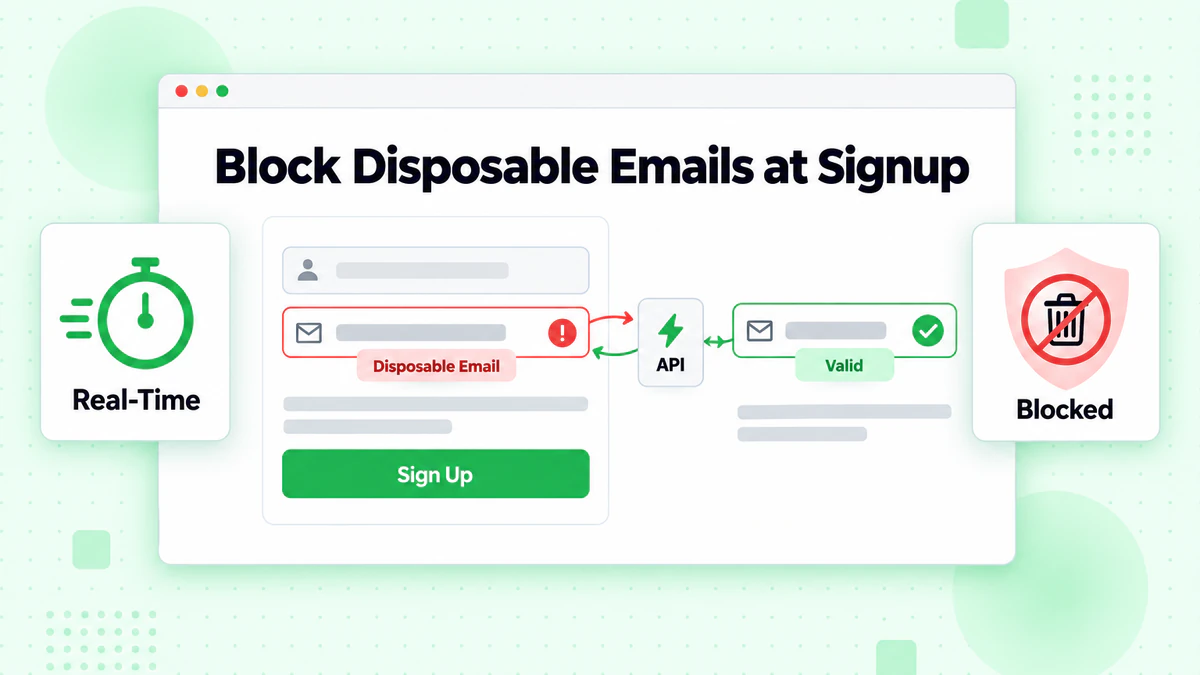
The most effective approach validates email addresses during the signup process, before they enter your database. When a user submits their email, an immediate API call to an email verification service checks for disposable status. If detected, the user receives an instant message requesting a permanent email address.
This approach offers the best user experience because feedback is immediate. Users don't complete a lengthy registration only to be rejected later. It also keeps your database clean from the start.
Batch Verification of Existing Lists
For businesses with established email lists, bulk email verification identifies disposable addresses already in your database. While you may choose not to immediately remove these contacts, flagging them allows for segmentation and different treatment in campaigns.
Webhook-Based Processing
For high-volume applications, asynchronous verification via webhooks provides scalability. The registration completes immediately, but the email undergoes verification in the background. If flagged as disposable, automated workflows can request verification or limit account capabilities.
Integration Examples
Here's a simplified example of checking for disposable emails using BillionVerify's email verification API:
async function checkDisposableEmail(email) {
  const response = await fetch('https://api.billionverify.com/v1/verify', {
    method: 'POST',
    headers: {
      'Authorization': 'Bearer YOUR_API_KEY',
      'Content-Type': 'application/json'
    },
    body: JSON.stringify({ email })
  });

  const result = await response.json();

  return {
    isDisposable: result.is_disposable,
    isValid: result.is_valid,
    riskScore: result.risk_score
  };
}
The response indicates not just disposable status but overall email validity and risk assessment, enabling nuanced handling based on your business rules.
Best Practices for Handling Disposable Emails
Detecting disposable emails is only half the challenge. How you respond to detection significantly impacts user experience and business outcomes.
Clear Communication
When blocking a disposable email address, explain why. A message like "Please use a permanent email address to create your account" is more helpful than a generic "Invalid email" error. Users understand the requirement and can comply rather than feeling frustrated.
Offer Alternatives
Some users have legitimate privacy concerns. Consider offering alternatives like social login options, phone number verification, or clear privacy commitments that address their hesitation to share a real email address.
Graduated Responses
Not all interactions require the same email quality. For downloading a free resource, you might accept disposable emails while tracking them differently. For paid accounts or services requiring communication, enforce permanent email requirements.
Consider the User Journey
Where in the user journey you verify email addresses matters. Checking at initial signup prevents waste, but re-verification before purchase or account upgrade catches users who initially used disposable addresses but are now ready to commit.
Maintain a Custom Blocklist
Beyond using an email verification service, maintain your own blocklist of domains that have caused problems for your specific business. This complements third-party detection with your own experience.
Monitor and Adapt
Disposable email services constantly evolve. Regularly review your bounce rates, engagement metrics, and abuse reports to identify new patterns. If a previously unknown disposable service starts appearing in your data, update your detection rules.
Disposable Email Detection vs. Other Verification
Understanding how disposable email detection fits within broader email validation helps build a comprehensive verification strategy.
Syntax Validation
Basic syntax checking confirms an email follows the correct format (local-part@domain.tld). While necessary, syntax validation alone won't catch disposable addresses that are technically valid.
Domain Verification
Checking that a domain exists and has valid MX records confirms email can be delivered. Disposable domains pass this check because they do receive email—just not for long.
SMTP Verification
SMTP handshake verification confirms the specific mailbox exists. Disposable addresses often pass this check at the moment of verification but become invalid later when the account expires.
Catch-All Detection
Identifying catch-all domains (which accept email to any address) is separate from disposable detection, though some overlap exists. Not all catch-all domains are disposable, and not all disposable addresses are on catch-all domains.
Role-Based Detection
Identifying role-based addresses (info@, support@, sales@) serves different purposes than disposable detection but should be part of comprehensive email verification.
The Evolution of Disposable Email Services
The disposable email landscape continues evolving, creating ongoing challenges for detection systems.
Increasing Sophistication
Early disposable services used obvious domains and basic functionality. Modern services offer API access, custom domains, email forwarding, and features that blur the line between disposable and legitimate email services.
Browser Extensions
Extensions that generate disposable addresses directly within signup forms make creation effortless. Users don't even need to visit a separate website, accelerating adoption.
Mobile Apps
Dedicated mobile apps for managing throwaway email addresses bring the functionality to smartphones, reaching users who might not discover web-based services.
Decentralized Options
Blockchain-based and decentralized email services add new complexity. These addresses may be technically permanent but share characteristics with disposable services in terms of user intent.
Domain Proliferation
Major disposable email providers continuously add new domains, sometimes hundreds per week. This domain rotation specifically targets detection systems, requiring email verification services to constantly update their databases.
Measuring Detection Effectiveness
How do you know if your disposable email detection is working? Key metrics provide insight into performance.
False Positive Rate
Legitimate users occasionally receive false positives when their valid email is incorrectly flagged as disposable. Monitor support requests and signup abandonment to identify potential false positive issues.
Detection Rate
Track the percentage of signups flagged as disposable over time. Sudden drops might indicate new disposable services evading detection. Unusual spikes could suggest an abuse campaign.
Bounce Rate Impact
After implementing detection, your bounce rates should decrease as fewer expired disposable addresses remain in your list. Track this metric to quantify the business impact.
Engagement Correlation
Compare engagement metrics between verified permanent addresses and any disposable addresses that weren't blocked. The difference illustrates the value of detection.
Abuse Reduction
For businesses with promotional offers, measure the reduction in obvious abuse patterns after implementing disposable email blocking.
When reviewing false positives or a sudden change in detection rate, recheck representative addresses with the disposable email checker. A repeatable manual check makes it easier to separate a rule problem from a genuinely new disposable provider.
BillionVerify's Disposable Email Detection
BillionVerify provides comprehensive disposable email detection as part of its email verification service. The platform maintains an extensive database of known disposable email domains, updated continuously to catch new services as they emerge.
Beyond simple domain matching, BillionVerify analyzes patterns, infrastructure relationships, and behavioral signals to identify disposable addresses that might evade basic detection. The email verification API returns clear indicators for disposable status along with confidence scores and additional risk factors.
For businesses requiring real-time email verification during signup, BillionVerify's low-latency API ensures instant feedback without slowing registration flows. Bulk verification capabilities handle existing lists of any size, identifying disposable addresses already in your database.
The combination of disposable detection with other email validation checks—syntax verification, domain validation, SMTP verification, and catch-all detection—provides complete email verification in a single API call.
Conclusion
Disposable email addresses represent a persistent challenge for any business collecting email contacts. These temporary emails, throwaway accounts, and fake email addresses undermine marketing efforts, distort metrics, enable fraud, and damage sender reputation.
Effective detection requires a multi-layered approach combining domain databases, pattern recognition, infrastructure analysis, and behavioral signals. Professional email verification services like BillionVerify maintain the comprehensive and constantly-updated detection capabilities that in-house solutions struggle to match.
Beyond detection, thoughtful handling of blocked addresses—with clear communication, alternative options, and graduated responses—balances security requirements with user experience.
As disposable email services continue evolving, your email validation strategy must evolve too. Regular monitoring, metric tracking, and partnership with a reliable email checker service ensures your email list quality remains high and your sender reputation stays protected.
Start implementing disposable email detection today to protect your email deliverability, reduce wasted resources, and build a database of genuinely engaged contacts who want to hear from you. For help choosing the right solution, see our best email verification service comparison.