



HR and recruiting teams invest significant resources building candidate databases—through job boards, career fairs, LinkedIn sourcing, and applicant tracking systems. But without systematic email verification, these databases decay rapidly, with 25-30% of candidate emails becoming invalid annually as people change jobs, switch email providers, or simply abandon old addresses.
This decay creates measurable problems: recruiters waste time reaching out to invalid addresses, qualified candidates miss opportunities when outreach bounces, and ATS databases become cluttered with unusable contact data. For organizations spending thousands of dollars per hire, the cost of poor email hygiene compounds quickly.
This guide provides practical strategies for HR professionals and recruiting teams to maintain clean candidate email lists, improve outreach effectiveness, and deliver better candidate experiences through systematic verification. For comprehensive recruiting communication strategies, see our recruitment email marketing guide.
Understanding HR Email Verification Challenges
HR and recruiting face unique email verification challenges distinct from marketing teams.
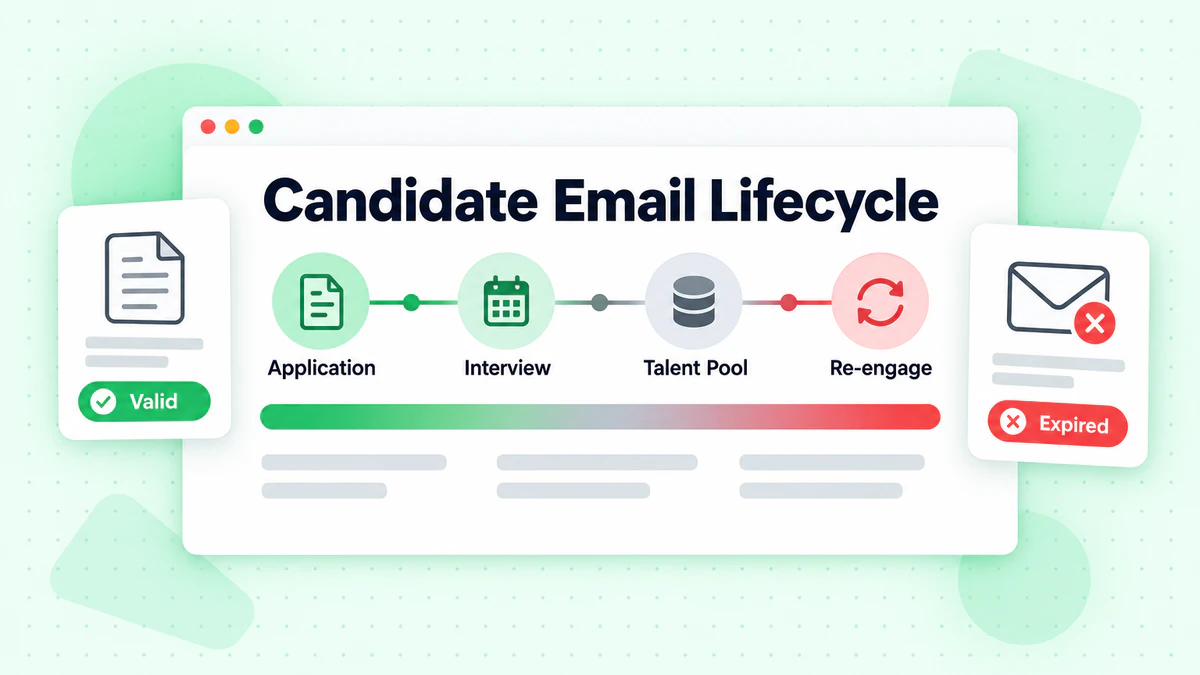
The Candidate Email Lifecycle
Candidate emails have predictable decay patterns:
Work Emails:
- Become invalid when candidates change jobs
- Average job tenure: 4.1 years (shorter for younger workers)
- No warning before deactivation
- 20-30% of work emails become invalid annually
Personal Emails:
- More stable but still change
- Platform migrations (e.g., AOL → Gmail)
- Privacy-conscious candidates use temporary addresses
- Shared household emails create confusion
Application-Created Emails:
- Created specifically for job search
- Often abandoned after finding employment
- May be temporary or disposable
- Higher than average invalid rate
Sources of Invalid Candidate Emails
Understanding how invalid emails enter your database helps prevention:
Collection Quality Issues:
- Typos on paper job fair forms
- Hurried online application entries
- Copy-paste errors from resumes
- Outdated resume database information
Database Decay:
- Job changes invalidate work emails
- Email provider switches
- Abandoned addresses
- Deceased candidates (in long-term databases)
Source Quality Variation:
- Job board leads: 15-20% invalid rate typical
- Career fair signups: 10-25% invalid (handwriting issues)
- LinkedIn sourcing: 10-15% invalid
- Resume databases: 20-40% invalid (age-dependent)
- Internal ATS (historical): 25-50%+ invalid
The Cost of Invalid Candidate Emails
Poor email hygiene impacts recruiting effectiveness:
Recruiter Productivity:
- Time wasted on failed outreach
- Follow-up attempts to invalid addresses
- Manual research to find correct contact
- Cluttered databases slow searches
Candidate Experience:
- Qualified candidates never receive outreach
- Missed application status updates
- Interview scheduling communication fails
- Offer letters don't arrive
Hiring Outcomes:
- Longer time-to-fill
- Reduced candidate pipeline
- Lost talent to competitors
- Higher cost-per-hire
Calculate Your Cost:
Recruiters: 5
Hours/week on failed outreach: 3 hours each
Total hours wasted: 15 hours/week
Average recruiter hourly cost: $50
Weekly waste: $750
Annual waste: $39,000
Email Verification Strategies for HR
Implement comprehensive verification approaches.
Real-Time Verification at Collection
Prevent invalid emails from entering your database:
Career Site Integration:
- API verification during application submission
- Instant feedback to applicants
- Suggested corrections for typos
- Block or flag invalid entries
Implementation Benefits:
- Prevents invalid data entry
- Improves applicant experience (immediate feedback)
- Reduces downstream cleanup needs
- Ensures communication throughout process
Job Fair and Event Collection:
- Mobile-friendly digital signup (fewer handwriting errors)
- Real-time verification on tablets/phones
- Confirmation email sent immediately
- Collect backup contact method
ATS Database Verification
Systematically verify existing candidate data:
When to Verify:
- Before major sourcing campaigns
- Prior to talent community launches
- Quarterly for active databases
- After significant time gaps (6+ months)
Batch Verification Process:
- Export candidate emails from ATS
- Remove duplicates and already-verified
- Submit for batch verification
- Process results back into ATS
- Flag or remove invalid entries
For comprehensive guidance on email verification, implement proven strategies across your recruiting operations.
Source-Based Verification
Different sources require different approaches:
Job Board Leads:
- Verify immediately upon receipt
- Job board data quality varies significantly
- Higher invalid rates than direct applications
- May need phone backup for high-value roles
LinkedIn Exports:
- Generally higher quality than job boards
- Verify before mass outreach campaigns
- Work emails may change even with same employer
- Cross-reference with public profiles
Resume Databases:
- Verify age of data before purchase
- Expect 20-40% invalid for older data
- Negotiate pricing based on verified volume
- Segment by verified status for outreach
Internal Historical Data:
- Highest decay in long-term storage
- Verify before reactivation campaigns
- Consider re-engagement before removal
- Archive rather than delete if possible
Integration with ATS and HR Systems
Connect verification to your HR technology stack:
Popular ATS Platforms:
- Greenhouse
- Lever
- Workday Recruiting
- iCIMS
- Taleo
Integration Options:
- API integration for real-time verification
- Batch processing via file export/import
- Webhook triggers for status changes
- Custom field storage for verification status
BillionVerify ATS Integration:
BillionVerify offers flexible integration options for HR systems:
Real-Time API:
- Sub-200ms verification response
- Direct integration with career sites
- Webhook notifications for results
- Comprehensive status codes
Batch Processing:
- High-volume processing capability
- CSV/Excel file support
- Scheduled verification jobs
- Result file with detailed status
Managing Verification Results
Handle different verification results appropriately.
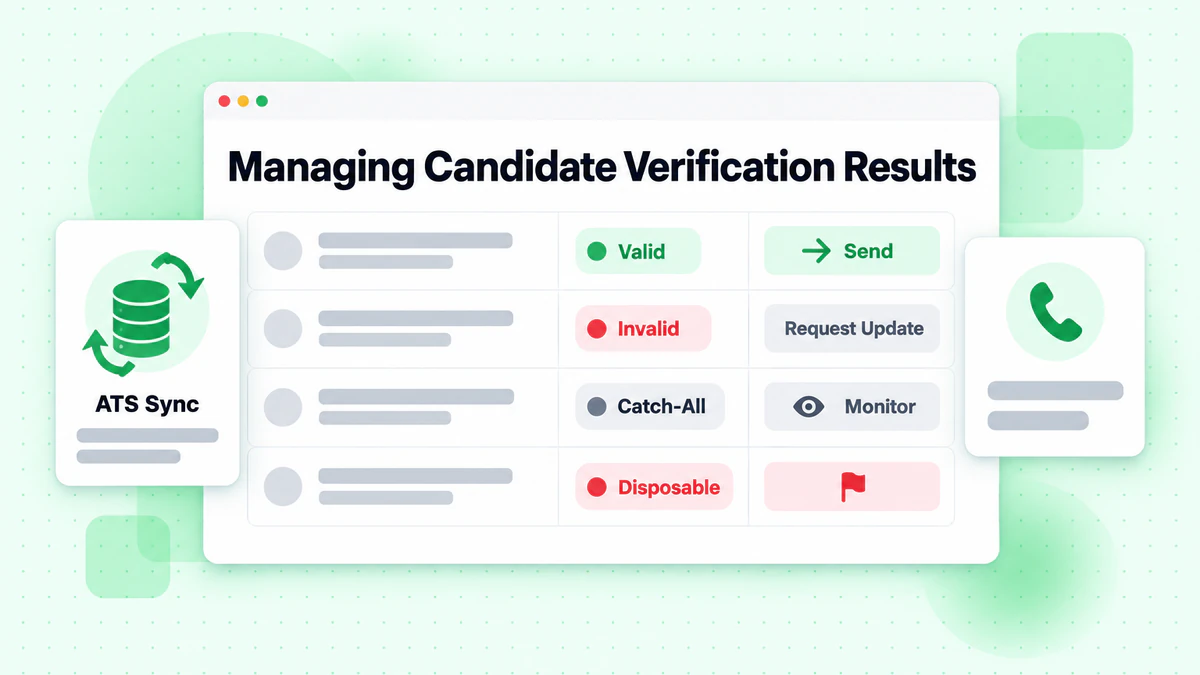
Result Categories and Actions
| Status | Meaning | Recommended Action |
|---|---|---|
| Valid | Address exists, accepts mail | Full communication eligibility |
| Invalid | Address doesn't exist | Remove or request update |
| Risky | May have delivery issues | Include but monitor, backup channel |
| Unknown | Verification inconclusive | Include with caution |
| Disposable | Temporary email service | Flag, request permanent address |
| Role-based | Generic address (careers@) | Flag, may need specific contact |
Invalid Email Processing
When emails verify as invalid:
Immediate Actions:
- Mark record as invalid in ATS
- Move to suppression list
- Trigger alternative contact workflow
- Document verification timestamp
Recovery Attempts:
- Phone call for high-value candidates
- LinkedIn InMail as backup
- Social media outreach
- Leave record for re-verification later
Data Hygiene:
- Don't permanently delete records
- Archive with verification history
- Flag for re-engagement if candidate surfaces
- Maintain audit trail
Disposable Email Handling
Temporary emails require special attention:
Common Disposable Domains:
- Guerrilla Mail, 10 Minute Mail, Temp Mail
- Mailinator and variants
- Many others (continuously growing)
HR Implications:
- Candidate may be privacy-conscious
- May indicate low commitment
- Communication will eventually fail
- Request permanent email at next opportunity
Response Strategy:
- Accept application (don't reject based on email type)
- Flag for recruiter awareness
- Request alternative email early in process
- Prioritize phone communication
Work Email Verification Nuances
Work emails have unique characteristics:
Corporate Email Systems:
- May not support verification queries
- Catch-all configurations common
- IT policies affect deliverability
- Consider timing (business hours)
Best Practices:
- Verify during business hours when possible
- Accept that some work emails are unverifiable
- Collect personal email as backup
- Monitor delivery success rates by domain
Building Verification Workflows
Implement systematic verification processes.
New Candidate Workflow
APPLICATION SUBMITTED:
→ Real-time email verification
→ If VALID: Continue normal process
→ If INVALID: Prompt for correction, collect phone
→ If RISKY/UNKNOWN: Flag for monitoring

CANDIDATE ADDED FROM SOURCING:
→ Verify before first outreach
→ If VALID: Proceed with outreach
→ If INVALID: Attempt LinkedIn/phone instead
→ Log verification result
Database Maintenance Workflow
QUARTERLY HYGIENE CYCLE:
Week 1:
- Export all candidate emails
- Submit for batch verification
- Begin processing results

Week 2:
- Update ATS with verification status
- Queue invalid emails for recovery attempt
- Flag risky emails for monitoring

Week 3:
- Execute recovery outreach (phone/LinkedIn)
- Process recovered contact updates
- Archive unrecoverable records

Week 4:
- Report on database health
- Plan next verification cycle
- Adjust processes based on learnings
Campaign-Based Verification
BEFORE SOURCING CAMPAIGN:
Day -7: Export target candidate list
Day -5: Submit for verification
Day -3: Process results
Day -2: Segment by verification status
Day -1: Update outreach lists
Day 0: Launch campaign with clean list
Compliance and Privacy Considerations
Navigate regulations affecting candidate data.
Data Privacy Regulations
GDPR (EU Candidates):
- Legitimate interest basis for verification
- Data minimization principles
- Right to deletion requests
- Third-party processing agreements
CCPA/CPRA (California):
- Data collection disclosure
- Right to deletion
- Do not sell requirements
- Access requests
General Best Practices:
- Clear privacy policy on data handling
- Secure data transmission
- Data retention limits
- Vendor compliance verification
HR-Specific Compliance
Equal Opportunity:
- Consistent verification for all candidates
- No selective verification based on protected classes
- Document verification practices
- Audit for disparate impact
Record Retention:
- Follow EEOC record retention requirements
- Maintain verification history
- Secure storage of candidate data
- Proper disposal procedures
Measuring Verification Success
Track metrics that demonstrate value.
Key Performance Indicators
List Quality Metrics:
- Verification pass rate by source
- Invalid rate over time
- Bounce rate before/after verification
- Database decay rate
Productivity Metrics:
- Recruiter time on failed outreach
- Response rates by verification status
- Time-to-first-contact improvements
- Manual research time saved
Understanding your email marketing metrics helps optimize recruiting communication effectiveness.
Business Metrics:
- Time-to-fill impact
- Cost-per-hire influence
- Candidate pipeline quality
- Source ROI by verification status
ROI Calculation
Before Verification:
- 10,000 candidate emails
- 25% invalid = 2,500 invalid
- Recruiter time wasted: 1,000 hours/year
- Cost @ $50/hour: $50,000

After Verification:
- Annual verification cost: $1,000
- Invalid emails identified: 2,500
- Recovery rate: 20% = 500 recovered
- Time saved: 800 hours
- Savings: $40,000

Net ROI: $39,000 (3,900%)
Technology and Integration
Select appropriate verification technology.
BillionVerify for HR
BillionVerify offers HR-focused features:
HR-Specific Capabilities:
- High-volume batch processing
- Real-time API for career sites
- ATS integration options
- Custom field mapping
Security and Compliance:
- SOC 2 certification
- Data encryption
- No data storage beyond verification
- GDPR-compliant processing
ATS Integration Best Practices
Greenhouse Integration:
- Webhook triggers on candidate creation
- Custom field for verification status
- Batch verification via API
- Automated workflow triggers
Lever Integration:
- API-based verification
- Custom stage integration
- Activity logging
- Team visibility into status
Workday Integration:
- SOAP/REST API connectivity
- Worker data integration
- Security role compliance
- Audit trail maintenance
Best Practices for HR Email Hygiene
Implement proven strategies for list maintenance.
Collection Best Practices
Digital Collection:
- Real-time validation with feedback
- Clear error messaging
- Mobile-friendly forms
- Email confirmation step
Event Collection:
- Tablet-based digital signup
- Immediate confirmation email
- Alternative contact capture
- Follow-up verification
Ongoing Maintenance
Regular Schedules:
- Weekly: Process bounces
- Monthly: Verify new additions
- Quarterly: Full database verification
- Annually: Deep clean and archive
Keep your databases clean by implementing regular email list cleaning practices.
Deliverability Optimization
Beyond verification, optimize for inbox placement:
Technical Requirements:
- Proper email authentication (SPF, DKIM, DMARC)
- Consistent sending practices
- Bounce processing
- Complaint handling
For comprehensive email deliverability guidance, implement industry best practices.
Common Challenges and Solutions
Address typical HR verification obstacles.
Challenge: High-Volume Database
Large candidate databases make verification expensive.
Solutions:
- Prioritize active candidates
- Segment by recency and engagement
- Verify before campaigns rather than entire database
- Archive truly outdated records
Challenge: Work Email Limitations
Work emails may not verify reliably.
Solutions:
- Collect personal email as backup
- Use multiple contact methods
- Accept some verification uncertainty
- Monitor delivery success rates
Challenge: ATS Integration Complexity
Technical integration can be challenging.
Solutions:
- Start with batch processing
- Use file export/import if API not available
- Work with ATS vendor support
- Consider middleware solutions
Challenge: Privacy Concerns
Candidates may be wary of email verification.
Solutions:
- Transparent privacy policies
- Explain verification purpose
- Secure data handling practices
- Honor deletion requests
Conclusion
HR email verification is essential for effective recruiting operations. In a competitive talent market, organizations that maintain clean candidate databases reach more qualified candidates, fill positions faster, and deliver better candidate experiences.
The math is straightforward: invalid emails waste recruiter time, miss qualified candidates, and increase cost-per-hire. Systematic verification eliminates these costs while improving every metric that matters to talent acquisition teams.
BillionVerify provides the verification infrastructure HR teams need to maintain clean candidate databases. With flexible integration options for major ATS platforms and high-volume batch processing, BillionVerify helps recruiting teams ensure their outreach reaches intended candidates. Start your free trial or view pricing.
Start by assessing your current database quality—what percentage of recent outreach bounced? Implement real-time verification for new applications and batch verification for existing data. Build systematic hygiene processes that maintain quality over time.
The investment in verification pays compound returns through improved recruiter productivity, better candidate experience, and faster hiring. In today's competitive talent market, clean data isn't optional—it's a competitive advantage that helps you win the candidates your organization needs to succeed.