



A well-crafted privacy policy is essential for email marketing compliance. It's not just a legal requirement under GDPR, CCPA, and other regulations—it's a trust-building document that tells subscribers how you'll handle their personal information. This guide covers everything you need to know about creating an effective email privacy policy, including required elements, template language, and implementation best practices.
Why Email Privacy Policies Matter
Understanding the importance of privacy policies helps prioritize getting them right.
Legal Requirements
GDPR (European Union): Privacy notices are mandatory, with specific required disclosures:
- Identity of data controller
- Purposes of processing
- Legal basis for processing
- Data retention periods
- Data subject rights
CCPA/CPRA (California): Notice at or before collection must include:
- Categories of personal information collected
- Purposes for collection
- Whether information is sold or shared
- Retention periods
CASL (Canada): Consent must be informed, requiring disclosure of:
- What messages will be sent
- Who is sending
- How to unsubscribe
Trust and Transparency
Beyond legal compliance, privacy policies build trust:
Subscriber Confidence: Clear policies reassure subscribers about data handling.
Brand Credibility: Transparency demonstrates respect for privacy.
Reduced Complaints: Informed subscribers are less likely to report spam.
Better Engagement: Trust leads to longer subscriber relationships.
Business Protection
Audit Defense: Documented policies demonstrate compliance efforts.
Dispute Resolution: Clear terms help resolve subscriber complaints.
Third-Party Requirements: Partners and platforms often require privacy policies.
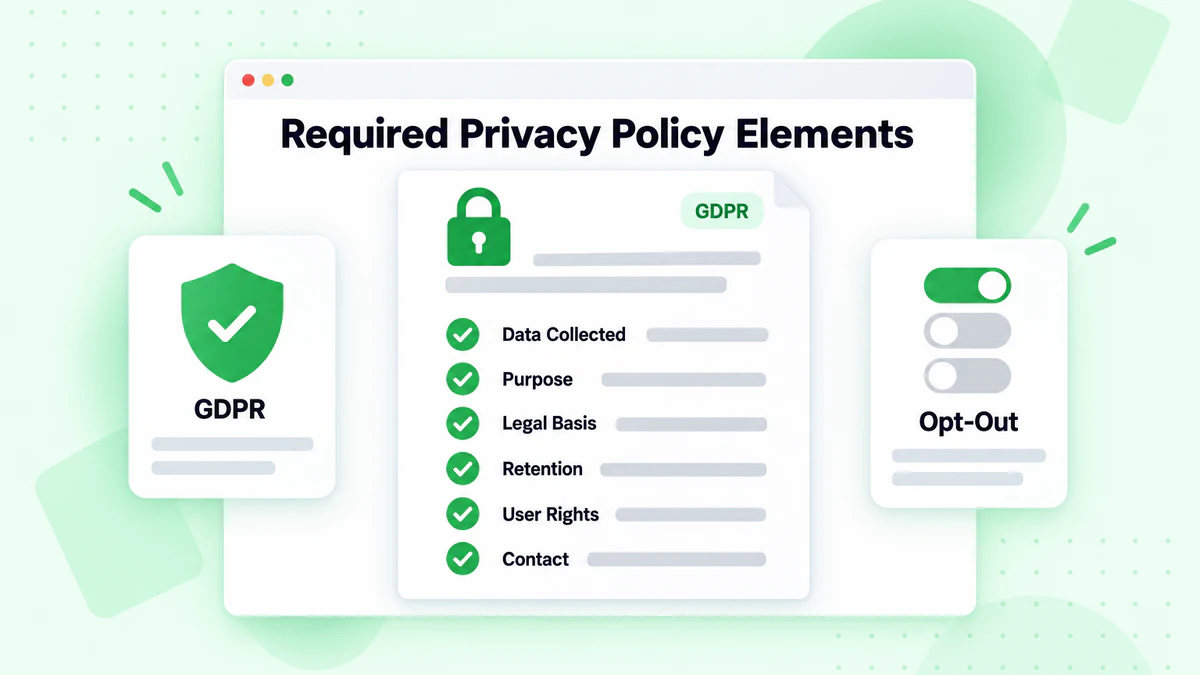
Required Privacy Policy Elements
Different regulations require different disclosures. Here's what to include.
GDPR Required Elements
Under GDPR Articles 13 and 14, you must provide:
1. Controller Identity and Contact:
- Organization name
- Address
- Contact details
- Data Protection Officer contact (if applicable)
- EU Representative contact (if applicable)
2. Purposes and Legal Basis:
- Why you collect email addresses
- Legal basis (consent, legitimate interest, etc.)
- For legitimate interest, what that interest is
3. Data Recipients:
- Categories of recipients (email service providers, analytics platforms)
- Third countries if data is transferred internationally
4. Data Retention:
- How long you keep subscriber data
- Criteria for determining retention periods
5. Data Subject Rights:
- Right to access
- Right to rectification
- Right to erasure
- Right to restrict processing
- Right to data portability
- Right to object
- Right to withdraw consent
- Right to lodge complaint with supervisory authority
6. Automated Decision Making:
- Whether profiling is used
- Logic involved
- Significance and consequences
CCPA/CPRA Required Elements
1. Categories of Personal Information: What you collect (identifiers, internet activity, etc.)
2. Sources: Where data comes from (directly, automatically, third parties)
3. Purposes: Why you collect and use the information
4. Categories of Third Parties: Who receives the information
5. Consumer Rights:
- Right to know
- Right to delete
- Right to correct (CPRA)
- Right to opt out of sale/sharing
- Right to limit sensitive data use
- Right to non-discrimination
6. How to Exercise Rights: Methods for submitting requests
7. Retention Periods (CPRA): How long each category is retained
CAN-SPAM and CASL Elements
While not requiring formal privacy policies, these laws require:
CAN-SPAM:
- Clear unsubscribe mechanism
- Physical postal address
CASL:
- Purpose of messages
- Sender identity
- Contact information
- Unsubscribe method
Privacy Policy Template for Email Marketing
Here's a template structure with example language. Customize for your specific practices.
Section 1: Introduction
Privacy Policy

Last Updated: [Date]

[Company Name] ("we," "us," or "our") respects your privacy
and is committed to protecting your personal information.
This Privacy Policy explains how we collect, use, disclose,
and protect information when you subscribe to our email
communications or interact with our services.

By providing your email address and subscribing to our
communications, you agree to this Privacy Policy. If you
do not agree, please do not subscribe or contact us to
unsubscribe.
Section 2: Information We Collect
Information We Collect

We collect the following types of personal information in
connection with our email marketing:

Information You Provide:
• Email address (required)
• Name (optional, for personalization)
• Company name and job title (optional)
• Preferences and interests you indicate

Information Collected Automatically:
• Email engagement data (opens, clicks, time of engagement)
• Device and browser information when interacting with emails
• IP address and approximate location
• Links clicked within our emails

Information from Third Parties:
• We may receive information from data enrichment services
  to better understand our subscribers
• Social media information if you connect accounts
Section 3: How We Use Your Information
How We Use Your Information

We use your personal information for the following purposes:

Email Communications:
• Sending newsletters, marketing emails, and promotional offers
• Sharing product updates and announcements
• Delivering educational content you've requested
• Responding to your inquiries

Personalization:
• Customizing email content based on your interests
• Recommending relevant products or services
• Tailoring send times for optimal engagement

Analytics and Improvement:
• Measuring email campaign performance
• Understanding subscriber preferences
• Improving our content and services
• Conducting A/B testing

Compliance and Security:
• Maintaining records for legal compliance
• Protecting against fraud and abuse
• Enforcing our terms and policies
Section 4: Legal Basis for Processing (GDPR)
Legal Basis for Processing

For subscribers in the European Union, we process your
personal information based on the following legal bases:

Consent:
We send marketing emails based on your explicit consent,
obtained when you subscribe. You may withdraw consent at
any time by unsubscribing.

Legitimate Interests:
We may process data for legitimate business interests,
including:
• Analyzing engagement to improve our content
• Protecting against fraud and security threats
• Maintaining and improving our services

We only rely on legitimate interests where the processing
is necessary and your rights and interests do not override
our legitimate purposes.

Legal Obligations:
We may process data to comply with legal requirements,
such as maintaining records for tax purposes or responding
to lawful requests from authorities.
Section 5: Data Sharing
How We Share Your Information

We may share your personal information with:

Service Providers:
• Email service providers who help us send and manage emails
• Analytics platforms that help us understand engagement
• Cloud storage providers that host our data
• Customer relationship management platforms

These providers are contractually obligated to protect your
data and use it only for the services they provide to us.

Business Transfers:
If we merge with or are acquired by another company, your
information may be transferred. We will notify you before
your information becomes subject to a different privacy
policy.

Legal Requirements:
We may disclose information if required by law, court order,
or government request, or to protect our rights, property,
or safety.

With Your Consent:
We will share information with other parties when you
specifically authorize us to do so.

We Do Not:
• Sell your personal information
• Rent your email address to third parties for their
  marketing purposes
• Share your data with unrelated parties for their
  independent use
Section 6: Data Retention
Data Retention

We retain your personal information for as long as:

• Your subscription is active
• Necessary to provide our services
• Required for legal, tax, or regulatory obligations
• Needed to resolve disputes or enforce agreements

Specifically:
• Active subscriber data: Retained while subscribed
• Engagement analytics: 3 years from collection
• Consent records: 7 years after relationship ends
• Suppression list: Indefinitely (to honor unsubscribe)

When data is no longer needed, we securely delete or
anonymize it.
Section 7: Your Rights
Your Privacy Rights

Depending on your location, you may have the following rights:

For All Subscribers:
• Unsubscribe from marketing emails at any time
• Update your email preferences
• Correct inaccurate personal information
• Request information about data we hold

For EU Residents (GDPR):
• Access your personal data
• Request correction of inaccurate data
• Request deletion ("right to be forgotten")
• Restrict processing of your data
• Receive your data in portable format
• Object to processing
• Withdraw consent at any time
• Lodge complaint with supervisory authority

For California Residents (CCPA/CPRA):
• Know what personal information we collect
• Know if we sell or share your information
• Opt out of sale or sharing
• Request deletion of your information
• Request correction of inaccurate information
• Non-discrimination for exercising rights

To Exercise Your Rights:
Email: privacy@[company].com
Online: [link to request form]
Phone: [phone number]

We will respond to requests within:
• 30 days for GDPR requests (extendable to 90 days)
• 45 days for CCPA requests (extendable to 90 days)
Section 8: Data Security
Data Security

We implement appropriate technical and organizational
measures to protect your personal information, including:

Technical Measures:
• Encryption of data in transit and at rest
• Access controls limiting who can view subscriber data
• Regular security assessments and testing
• Secure data centers with physical protections

Organizational Measures:
• Staff training on data protection
• Data handling policies and procedures
• Vendor security assessments
• Incident response procedures

While we strive to protect your data, no method of
transmission over the internet is 100% secure. We cannot
guarantee absolute security.
Section 9: International Data Transfers
International Data Transfers

Your information may be processed outside your country
of residence. We transfer data internationally using:

For EU Residents:
• Standard Contractual Clauses approved by the
  European Commission
• EU-US Data Privacy Framework (for US recipients
  certified under the framework)
• Other appropriate safeguards as required by law

We only transfer data to countries or organizations that
provide adequate protection for your personal information.
Section 10: Contact and Updates
Contact Us

For questions about this Privacy Policy or our data
practices, contact us:

[Company Name]
[Street Address]
[City, State/Province, Postal Code]
[Country]

Email: privacy@[company].com
Phone: [phone number]
Website: [website URL]

Data Protection Officer (if applicable):
[DPO Name]
dpo@[company].com

EU Representative (if applicable):
[Representative Name]
[Address]
eu-rep@[company].com


Changes to This Policy

We may update this Privacy Policy periodically. When we do:
• We'll post the updated policy on our website
• We'll update the "Last Updated" date
• For significant changes, we'll notify you by email

We encourage you to review this policy regularly.
Best Practices for Email Privacy Policies
Beyond required elements, these practices improve policy effectiveness.
Write for Your Audience
Use Plain Language:
- Avoid excessive legal jargon
- Explain technical terms
- Use short sentences and paragraphs
- Consider reading level
Be Specific:
- Don't just say "we collect information"
- Specify what information and why
- Give concrete examples
Be Honest:
- Don't overstate privacy protections
- Don't hide practices in fine print
- If you share data, say so clearly
Make It Accessible
Easy to Find:
- Link from website footer
- Link from email signup forms
- Include in email footer
- Make URL predictable (/privacy)
Easy to Read:
- Use headers and sections
- Consider table of contents for longer policies
- Highlight key points
- Offer summary version
Layered Approach: Consider a layered privacy notice:
- Short summary of key points
- Link to full detailed policy
- Answers common questions simply
Keep It Current
Regular Reviews:
- Review at least annually
- Update after process changes
- Revise when regulations change
- Check after new tool adoption
Version Control:
- Date each version
- Maintain archive of previous versions
- Track what changed and when
Notify Subscribers:
- Email about significant changes
- Give time to review before changes take effect
- Provide easy way to unsubscribe if they disagree
Privacy Policy for Email Forms
Your email signup forms need privacy disclosures too.
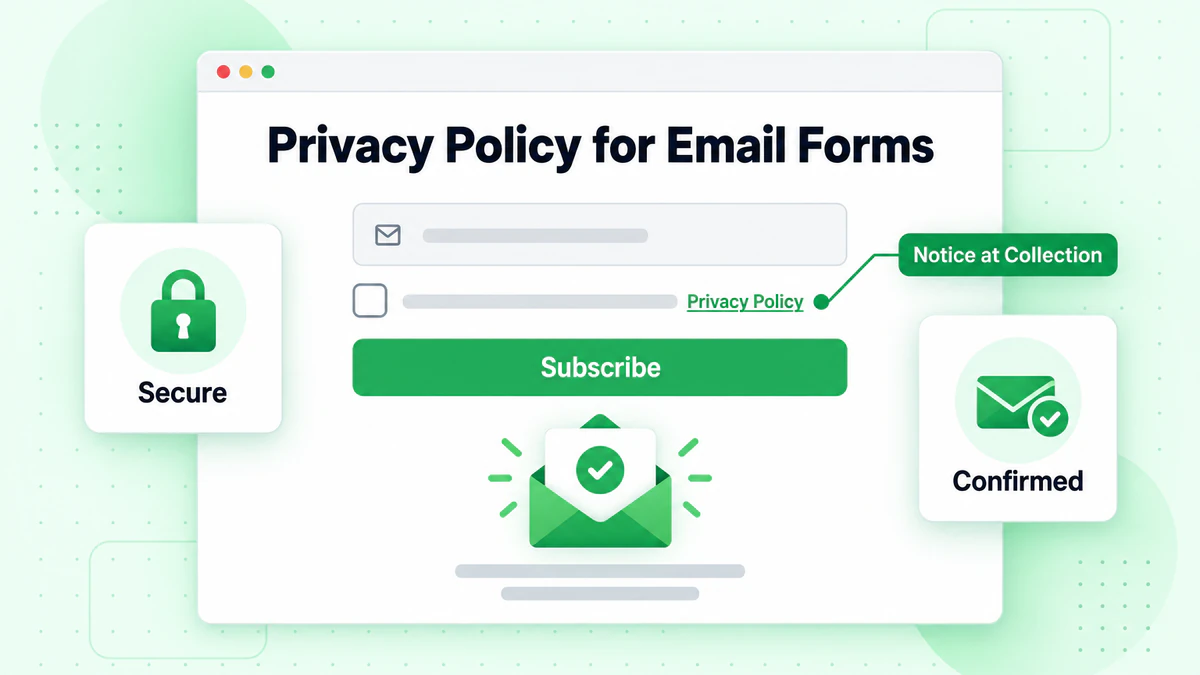
Notice at Collection
Required Information:
- What you're collecting
- How it will be used
- Link to full privacy policy
Example Form Disclosure:
Sign up for our newsletter

Email: [________________]
Name: [________________]

□ I agree to receive marketing emails from [Company],
  including tips, updates, and promotional offers.

By signing up, you agree to our [Privacy Policy]. We'll
use your email to send marketing communications. You can
unsubscribe at any time. We never sell your information.
Transparency Builds Trust
Be Upfront:
- Tell them exactly what they're signing up for
- Set accurate expectations about frequency
- Mention preference center options
Example:
Join 10,000+ marketers getting our weekly email tips.

What you'll receive:
• Weekly actionable strategies (every Tuesday)
• Monthly product updates
• Occasional promotional offers (max 2/month)

We take privacy seriously. Your data is never sold.
Read our [Privacy Policy].
Privacy Policy and Email Verification
Email verification supports privacy compliance.
Why Verification Matters for Privacy
Data Accuracy: GDPR requires keeping personal data accurate. Email verification confirms addresses are valid.
Preventing Unauthorized Collection: Verification blocks fake signups that could represent someone entering another person's email.
Supporting Consent: Double opt-in verification confirms the email owner actually wants to subscribe.
Disclosure in Privacy Policy
Include verification in your privacy policy:
Email Verification

To ensure the accuracy of our subscriber list and protect
against unauthorized signups, we verify email addresses
using [BillionVerify/third-party verification service].
This verification:

• Confirms the email address exists and is deliverable
• Helps prevent typos and invalid addresses
• Protects against spam signups
• Supports the accuracy of our records

Verification does not require sending emails to your
address; it validates the address format and domain.
BillionVerify and Privacy
BillionVerify's email verification supports privacy-compliant list management:
At Signup: Verify addresses are real before adding to your list.
Before Campaigns: Bulk verify existing lists to maintain accuracy.
Ongoing: Regular verification keeps your email list clean and accurate.
Common Privacy Policy Mistakes
Avoid these frequent errors.
Mistake 1: Copy-Paste Without Customization
The Problem: Using generic templates without adapting to your actual practices.
The Fix: Customize every section to reflect what you actually do. Generic policies may not cover your practices and may include claims you can't support.
Mistake 2: Outdated Information
The Problem: Policy doesn't reflect current tools, practices, or regulations.
The Fix: Review and update at least annually and after significant changes.
Mistake 3: Overpromising
The Problem: Claiming you never share data when you use email service providers.
The Fix: Be accurate. Service providers are data sharing. Explain the context.
Mistake 4: Hiding in Legalese
The Problem: Impenetrable legal language that nobody reads or understands.
The Fix: Write clearly. Use summaries. Organize logically.
Mistake 5: Missing Required Elements
The Problem: Leaving out elements required by GDPR, CCPA, or other regulations.
The Fix: Audit against checklists for each applicable regulation.
Mistake 6: Not Linking from Forms
The Problem: Having a privacy policy but not making it accessible from signup forms.
The Fix: Link to privacy policy from every data collection point.
Privacy Policy Maintenance
Keeping your privacy policy current and effective.
Annual Review Checklist
Regulation Updates:
- [ ] Check for new privacy law requirements
- [ ] Review enforcement guidance and rulings
- [ ] Assess new state/country laws
Practice Changes:
- [ ] New email marketing tools or providers
- [ ] Changed data sharing relationships
- [ ] New data collection points
- [ ] Modified retention periods
Policy Updates:
- [ ] Reflect any practice changes
- [ ] Update dates and contact information
- [ ] Verify all links work
- [ ] Review for clarity and accuracy
Communicating Changes
Significant Changes:
- Email subscribers about the update
- Highlight what changed
- Provide effective date
- Give time to review
Minor Changes:
- Update the policy
- Change "Last Updated" date
- Changes take effect immediately
Example Notification:
Subject: Updates to Our Privacy Policy

Hi [Name],

We've updated our Privacy Policy to:
• Add information about our new preference center
• Clarify data retention periods
• Include new contact information

The updated policy takes effect on [date]. You can review
it here: [link]

If you have questions, reply to this email or contact
privacy@[company].com.

To continue receiving our emails, no action is needed.
If you'd prefer to unsubscribe, [click here].
Conclusion
A well-crafted privacy policy is more than a legal requirement—it's a foundation for trust with your email subscribers. By clearly explaining what data you collect, how you use it, and what rights subscribers have, you demonstrate respect for privacy while meeting compliance obligations.
Key Takeaways:
Include All Required Elements: Cover GDPR, CCPA, and other applicable requirements for your subscriber base.
Write Clearly: Use plain language that subscribers can actually understand.
Be Accurate: Reflect your actual practices, not aspirational ones.
Make It Accessible: Link from every signup form and every email.
Keep It Current: Review regularly and update when practices or regulations change.
Support with Verification: Use email verification to maintain accurate, quality subscriber data.
Remember that your privacy policy is a living document. As your email marketing practices evolve and regulations change, your policy should evolve too. Regular reviews and updates demonstrate ongoing commitment to privacy compliance.
For comprehensive guidance on email marketing compliance, see our complete email compliance guide. Ensure your subscriber data is accurate with BillionVerify's email verification service.