



Email verification in healthcare isn't just about maintaining a clean list—it's about protecting patient privacy, ensuring critical health communications reach their intended recipients, and maintaining HIPAA compliance. When a test result notification bounces to an undeliverable address, a patient misses critical health information. When a password reset email goes to a mistyped address, patient data could be exposed.
Healthcare organizations face unique challenges when verifying patient email addresses. The industry's strict privacy requirements, the critical nature of health communications, and the diversity of patient populations all demand a specialized approach to email verification.
This guide explores how healthcare organizations can implement robust email verification systems that protect patient data, improve communication deliverability, and maintain compliance with healthcare regulations. For broader healthcare email strategies, see our comprehensive healthcare email marketing guide.
Why Email Verification Matters in Healthcare
The healthcare industry relies increasingly on email for patient communication. Understanding why verification is particularly critical in this sector helps prioritize investment in proper verification systems.
The Cost of Invalid Emails in Healthcare
Invalid email addresses create cascading problems throughout healthcare operations:
Missed Critical Communications:
- Test result notifications that never arrive
- Appointment reminders sent to inactive addresses
- Prescription renewal alerts lost to bounces
- Care coordination messages that never reach patients
HIPAA Compliance Risks:
- Bounce messages may contain protected health information (PHI)
- Emails reaching wrong recipients expose sensitive data
- Incomplete audit trails complicate compliance documentation
- Misdirected communications create potential breach scenarios
Financial Impact:
- Increased no-show rates from missed appointment reminders
- Higher call center volumes for communication failures
- Wasted resources on undeliverable messages
- Potential fines from HIPAA violations ($100 to $50,000 per incident)
Operational Inefficiency:
- Staff time spent tracking down valid contact information
- Delayed care from communication gaps
- Reduced patient portal adoption
- Lower patient satisfaction scores
Healthcare Email Verification Statistics
Research reveals the scope of email verification challenges in healthcare:
- 28% of email addresses become invalid within one year due to job changes, provider switches, and address updates
- 15-20% of patient email addresses collected at registration contain errors
- Healthcare organizations lose $2.50-$5 per invalid email in wasted communication costs
- 43% of patients report not receiving important health communications due to email issues
- Email verification can reduce bounce rates by up to 98% when implemented at point of collection (learn more about email verification best practices)
Types of Invalid Emails in Healthcare Settings
Understanding the categories of invalid emails helps healthcare organizations develop targeted verification strategies.
Syntax Errors and Typos
The most common source of invalid emails, particularly problematic when collected verbally or on paper forms:
Common Patterns:
- Missing @ symbol or domain extension
- Doubled letters (johnn@email.com)
- Transposed characters (gmail.ocm)
- Missing periods in domain (gmailcom)
- Extra spaces or characters
Healthcare-Specific Issues:
- Elderly patients unfamiliar with email formats
- Hurried collection during registration
- Illegible handwriting on paper forms
- Verbal miscommunication of addresses
Temporary and Disposable Emails
Some patients use temporary email addresses to avoid marketing communications:
Concerns for Healthcare:
- Critical health information sent to expired addresses
- Inability to maintain long-term patient communication
- Incomplete patient records
- Failed follow-up communications
Role-Based and Shared Emails
Business email addresses used for personal healthcare create verification challenges:
Examples:
- info@company.com
- sales@business.com
- admin@organization.com
Healthcare Risks:
- PHI potentially viewed by multiple employees
- No guarantee correct individual receives information
- Higher likelihood of unsubscribes or spam reports
Inactive and Abandoned Emails
Email addresses that were once valid but are no longer monitored:
Causes:
- Job changes resulting in lost work email access
- ISP switches abandoning old addresses
- Deceased patients
- Patients switching healthcare providers
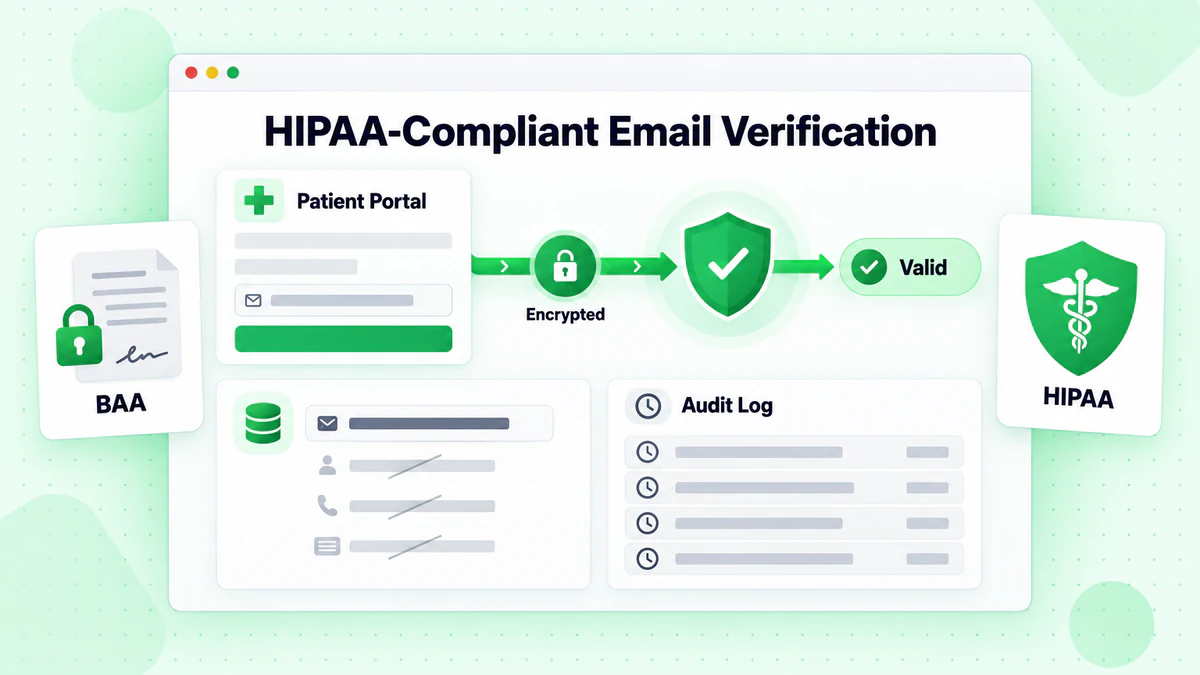
Implementing HIPAA-Compliant Email Verification
Healthcare email verification must balance thoroughness with privacy protection. Here's how to implement verification while maintaining HIPAA compliance.
Verification Methods for Healthcare
Different verification methods offer varying levels of accuracy and compliance suitability:
Syntax Validation:
- Checks email format against RFC standards
- No privacy concerns—no external connections
- Catches obvious typos and formatting errors
- Should be implemented at every collection point
Domain Verification:
- Confirms email domain exists and accepts mail
- Checks MX records for mail server configuration
- Identifies obviously invalid domains
- No PHI transmitted during check
SMTP Verification:
- Confirms mailbox existence without sending email
- Higher accuracy than domain-only verification
- No actual email delivered during verification
- Catches non-existent mailboxes
Email Ping/Response Verification:
- Sends verification email requiring patient action
- Highest accuracy but adds friction
- Required for double opt-in compliance
- Documents patient email ownership
Point-of-Collection Verification
The most effective verification happens when email addresses are first collected:
Registration Desk Implementation:
- Integrate real-time verification into registration software
- Provide immediate feedback on invalid addresses
- Allow patients to correct errors on the spot
- Train staff on verification importance and procedures
Patient Portal Registration:
- Verify email format as user types
- Display real-time validation messages
- Require email confirmation before account creation
- Provide clear error messages for invalid formats
Paper Form Collection:
- Design forms with clear email entry fields
- Include email format examples
- Implement manual verification before data entry
- Consider tablet-based collection to reduce errors
Phone Registration:
- Train staff on email spelling verification
- Use phonetic alphabet for clarity
- Repeat address back to patient
- Implement post-call verification
Batch Verification for Existing Lists
Healthcare organizations with existing patient email databases need systematic verification approaches:
Preparation Steps:
- Export email list without PHI (emails only)
- Select HIPAA-compliant verification provider
- Ensure Business Associate Agreement (BAA) is in place
- Document verification process for compliance records
Verification Process:
- Upload email-only file to verification service
- Process verification (typically hours for large lists)
- Download results with status classifications
- Match results back to patient records
Result Handling:
- Valid: No action needed
- Invalid: Flag for collection at next patient contact
- Risky/Unknown: Consider secondary verification methods
- Disposable: Flag for patient outreach to collect permanent address
Choosing a Healthcare-Compatible Email Verification Service
Not all verification services are suitable for healthcare use. Evaluation criteria should prioritize compliance and security.
Essential Compliance Requirements
Any verification provider used by healthcare organizations must meet specific standards:
Business Associate Agreement (BAA):
- Required by HIPAA for any vendor handling PHI
- Must specify security obligations
- Should define breach notification procedures
- Confirm BAA is signed before any data sharing
Security Certifications:
- SOC 2 Type II certification
- HITRUST CSF certification (preferred)
- Regular third-party security audits
- Documented security policies and procedures
Data Handling Practices:
- No email address storage beyond verification
- Encrypted data transmission (TLS 1.2+)
- Clear data retention and deletion policies
- Geographic data residency compliance
Technical Integration Requirements
Healthcare verification solutions should integrate with existing systems:
API Capabilities:
- Real-time verification for registration systems
- Batch processing for list hygiene
- Webhook support for automated workflows
- Comprehensive error handling
EHR/EMR Integration:
- Compatible with major healthcare platforms
- HL7/FHIR compatibility where applicable
- Proper authentication protocols
- Audit logging for all transactions
Patient Portal Integration:
- JavaScript-based front-end validation
- Server-side verification support
- Consistent user experience
- Mobile-responsive functionality
BillionVerify Healthcare Solution
BillionVerify offers healthcare-specific email verification designed for HIPAA-compliant environments:
Healthcare-Ready Features:
- HIPAA-compliant processing architecture
- No PHI storage or long-term data retention
- Business Associate Agreement available
- SOC 2 certified infrastructure
Integration Options:
- Real-time API for registration systems
- Batch verification for existing lists
- Custom integration support for healthcare platforms
- Direct EHR/EMR connectivity options
Verification Capabilities:
- Syntax and format validation
- Domain and MX record verification
- Mailbox existence confirmation
- Disposable email detection
- Role-based email flagging
Best Practices for Healthcare Email Verification
Implement these strategies to maximize verification effectiveness while maintaining compliance.
Verification at Every Touchpoint
Create multiple opportunities to verify and update patient email addresses:
Initial Registration:
- Verify during new patient intake
- Use real-time validation for immediate feedback
- Capture secondary email if available
- Document email verification status
Return Visits:
- Confirm existing email during check-in
- Update verification status with each confirmation
- Flag addresses with recent bounces
- Prompt for new email if needed
Portal Interactions:
- Re-verify when patients update profile
- Confirm email for password reset requests
- Validate new email before accepting changes
- Maintain audit trail of email changes
Communication Failures:
- Trigger verification workflow after bounces
- Flag patient records for follow-up
- Reach out via alternative channels
- Update records when valid email obtained
Verification Workflow Automation
Automate verification processes to ensure consistency:
New Patient Workflow:
- Email collected at registration
- Real-time verification performed
- Invalid addresses flagged for immediate correction
- Valid addresses confirmed in patient record
- Verification status documented
Bounce Processing Workflow:
- Bounce detected from email system
- Patient record flagged automatically
- Alternative communication triggered (SMS/phone)
- Re-verification scheduled for next contact
- New email collected and verified
Periodic Hygiene Workflow:
- Quarterly export of patient email list
- Batch verification performed
- Invalid addresses flagged in system
- outreach campaigns for email updates
- Results documented for compliance
Regular email list cleaning ensures your patient communication remains effective and compliant.
Staff Training and Protocols
Human factors significantly impact email verification success:
Registration Staff Training:
- Importance of accurate email collection
- Common error patterns to watch for
- How to use verification tools
- When to escalate verification issues
Clinical Staff Awareness:
- Understanding email verification's role in care
- Flagging communication concerns
- Updating patient contact information
- Patient privacy considerations
IT and Compliance Staff:
- Verification system administration
- Compliance documentation requirements
- Security monitoring responsibilities
- Incident response procedures
Handling Verification Results in Healthcare
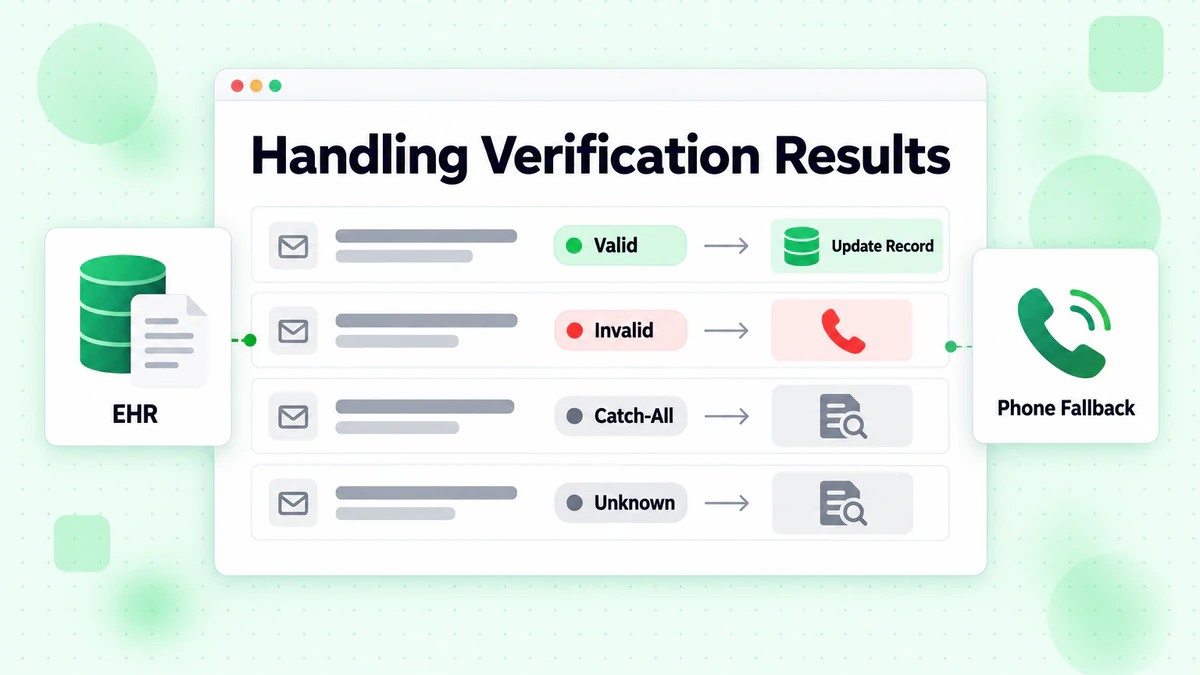
Different verification results require specific handling approaches in healthcare settings.
Valid Email Processing
When emails verify as valid:
- Update patient record with verification timestamp
- Enable all email communication preferences
- Document verification for compliance records
- Schedule next verification check
Invalid Email Processing
When emails fail verification:
- Flag patient record for email update needed
- Disable email-based communications temporarily
- Generate task for staff to collect updated email
- Use alternative channels for critical communications
- Document invalid status and remediation attempts
Risky/Unknown Email Handling
When verification returns uncertain results:
- Consider sending verification email to confirm
- Flag for review during next patient contact
- Monitor for bounces after sending
- Apply stricter sending frequency limits
- Document risk status and rationale
Disposable Email Management
When disposable emails are detected:
- Flag for collection of permanent address
- Explain importance of permanent email for health communications
- Consider sending critical communications via alternative channels
- Document disposable email detection
- Follow up to obtain permanent address
Measuring Email Verification Success
Track metrics to demonstrate verification program effectiveness and identify improvement opportunities. Understanding email marketing metrics helps optimize your healthcare communication strategy.
Key Performance Indicators
List Quality Metrics:
- Verification pass rate (target: >95%)
- New registration verification rate
- Bounce rate reduction
- Invalid email detection rate
Operational Metrics:
- Time to verify new addresses
- Staff compliance with verification protocols
- Re-verification completion rates
- Email update success rates
Business Impact Metrics:
- No-show rate changes
- Patient portal adoption
- Communication delivery rates
- Patient satisfaction with communications
Compliance Documentation
Maintain verification records for HIPAA compliance:
Required Documentation:
- Verification provider BAA
- Verification process procedures
- Staff training records
- System audit logs
- Incident reports and resolutions
Recommended Documentation:
- Verification result archives (without PHI)
- Quality improvement reports
- Vendor security assessments
- Compliance audit results
Integration with Healthcare Communication Systems
Email verification should integrate seamlessly with existing healthcare communication infrastructure.
EHR/EMR Integration
Connect verification with electronic health records:
Integration Benefits:
- Centralized patient contact management
- Real-time verification during registration
- Automatic flag updates for invalid emails
- Consistent data across systems
Implementation Considerations:
- API compatibility with major platforms
- Data mapping requirements
- User interface integration
- Workflow automation options
Patient Portal Integration
Ensure verification works within patient portals:
Portal Registration:
- Real-time verification during signup
- Clear error messaging for patients
- Alternative verification options
- Account activation workflows
Portal Maintenance:
- Verification for email change requests
- Self-service address correction
- Verification status visibility
- Communication preference management
Communication Platform Integration
Connect verification with email sending systems:
Pre-Send Verification:
- Verify before each email send
- Suppress sends to invalid addresses
- Route failures to alternative channels
- Log verification status
Bounce Processing:
- Automatic bounce detection
- Real-time patient record updates
- Triggered re-verification workflows
- Alternative communication activation
Common Healthcare Verification Challenges
Healthcare organizations face unique obstacles when implementing email verification.
Challenge: Patient Population Diversity
Healthcare serves patients of all ages, technical abilities, and language backgrounds.
Solution Strategies:
- Provide email format examples in multiple languages
- Train staff on patient communication techniques
- Offer assistance with email collection
- Consider alternative channels for non-email users
Challenge: Legacy System Integration
Many healthcare organizations run older systems with limited integration capabilities.
Solution Strategies:
- Explore batch processing options
- Consider middleware solutions
- Implement staged rollouts
- Document manual verification procedures
Challenge: High-Volume Registration
Busy healthcare facilities process thousands of registrations daily.
Solution Strategies:
- Implement automatic verification
- Optimize verification speed and reliability
- Design efficient verification workflows
- Monitor system performance closely
Challenge: Privacy Concerns
Patients may be reluctant to provide email addresses due to privacy concerns.
Solution Strategies:
- Clearly explain email usage policies
- Provide communication preference controls
- Ensure visible privacy protections
- Offer alternative communication options
Future of Email Verification in Healthcare
Emerging technologies and trends will shape healthcare email verification practices.
AI-Powered Verification
Artificial intelligence is enhancing verification capabilities:
- Predictive typo correction
- Pattern recognition for suspicious addresses
- Intelligent verification routing
- Automated workflow optimization
Enhanced Patient Matching
Verification integrating with patient matching:
- Multi-factor identity verification
- Cross-system email consistency checks
- Fraud detection integration
- Enhanced duplicate detection
Real-Time Communication Optimization
Verification feeding into communication systems:
- Dynamic channel selection
- Deliverability prediction
- Send time optimization
- Personalized communication preferences
Conclusion
Email verification is fundamental to effective healthcare communication. By implementing robust verification systems, healthcare organizations protect patient privacy, improve communication deliverability, and maintain HIPAA compliance.
Success requires a multi-layered approach: real-time verification at collection points, periodic batch verification of existing lists, and continuous monitoring of email deliverability. Integration with existing healthcare systems—EHRs, patient portals, and communication platforms—ensures verification becomes a seamless part of operations.
Healthcare organizations should prioritize verification providers that understand the industry's unique requirements. BillionVerify offers HIPAA-compliant verification specifically designed for healthcare use cases, with the security certifications and data handling practices required by medical organizations. Use our bulk email verification for patient databases or integrate our real-time API with patient registration systems. Start your free trial or view pricing.
Start by auditing current email collection and verification practices. Identify gaps where invalid emails enter your system and implement verification at those points. For existing patient lists, conduct batch verification to establish a clean baseline, then maintain list hygiene through ongoing verification processes.
Clean, verified email lists translate directly into better patient communication, improved health outcomes, and reduced compliance risk. In healthcare, email verification isn't just a marketing best practice—it's an essential component of quality patient care.