


Most advice on list growth gets one thing badly wrong. A bigger email list isn't automatically a better email list.
Teams celebrate new signups, imported leads, and CRM growth, then act surprised when open rates soften, bounce rates climb, and inbox placement gets harder. The problem usually isn't the creative or the cadence. It's the data. Email lists decay, forms attract junk submissions, and outbound pipelines fill with addresses that were never safe to mail in the first place.
That's why what is email verification is the wrong question if you treat it as a one-time cleanup task. Verification is really a control system for the entire lifecycle of email data. It starts at the moment someone types an address into a form, continues when AI agents and automation tools enrich or qualify that lead, and doesn't stop after the first campaign. If your team only verifies when performance drops, you're already late.
The Hidden Cost of a Growing Email List
The oldest myth in email marketing is that list size is a win by itself. It isn't. A large list full of abandoned accounts, typo domains, fake signups, and low-quality captures creates cost before it creates revenue.
A 2025 industry report analyzed nearly 1 billion email addresses across 23 sectors and found that only 80.94% of contacts were valid at the time of collection. That means nearly one in five records was already problematic before any natural list decay kicked in. In practice, that's why unverified databases generate sudden bounce spikes and reputation problems instead of predictable campaign performance.
Growth can hide decay
Marketing teams often read falling engagement as a content problem. Sales teams blame targeting. Operations teams suspect the ESP. Sometimes those issues are real, but bad address quality is the simpler explanation.
Historical industry data has also established that 80% of email bounces are preventable through pre-send verification, because verification can filter syntax errors, disposable domains, and other bad records before they ever hit the mail server. If you need a deeper look at the mechanics behind bounce risk, this guide on why bounce rates matter for campaign success is worth reading.
A bloated list doesn't give you more reach. It gives you more ways to miss the inbox.
Verification is a business control, not a cleanup chore
The teams that treat verification as a last-minute hygiene project usually stay reactive. They clean a list after damage appears, then repeat the same collection mistakes.
The better model is lifecycle-based. Verify at capture. Verify before send. Re-verify records that have been sitting in the CRM. This matters even more because the one-time-cleanup mindset breaks down fast. The DMA Annual Email Marketing Benchmark for 2025 found that 43% of subscriber lists contain invalid addresses within 6 months of collection, while only 15% of marketers perform regular re-verification cycles. That gap drives a documented 22% average increase in bounce rates and a 17% drop in campaign ROI year-over-year when lists aren't maintained continuously.
If your list is growing but your reliability is shrinking, you don't have a scale problem. You have a data hygiene problem.
How Email Verification Actually Works
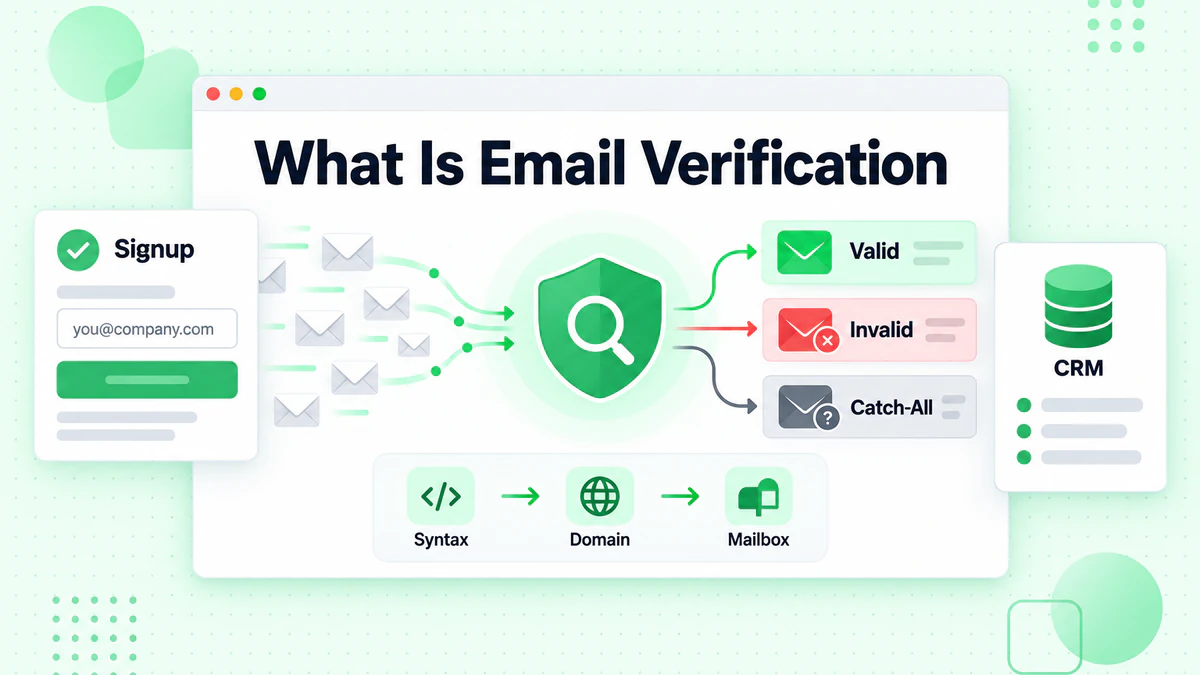
Email verification is a screening process, not a guessing game. It decides whether an address should enter your system, trigger a workflow, or get blocked before it can hurt deliverability, waste spend, or pollute CRM data.
It starts before any message is sent
A reliable workflow checks an address in layers. One pass is not enough, and a one-time list scrub is not enough either. Verification has to work at capture, at sync, and before send if you want clean inputs across signup forms, sales tools, CRMs, and AI-driven workflows.
- Syntax validation checks whether the email is formatted correctly.
- DNS validation confirms that the domain exists and is configured to receive mail.
- MX record checking verifies that the domain has mail exchange records.
- SMTP handshake simulation connects to the destination mail server and asks whether the mailbox exists.
- Classification returns a result such as valid, invalid, risky, catch-all, or unknown.
This is different from sending a test email. The service runs a protocol-level check without delivering a message. As noted earlier, BillionVerify describes the process as DNS and MX validation followed by an SMTP handshake to assess mailbox status.
For a more technical walk-through, the explanation in how email verification works covers the operational flow well.
What the result really tells you
The result is only useful if your systems can act on it.
Marketing teams need to suppress bad records before a campaign goes out. Developers need structured outputs they can plug into form validation, CRM rules, lead routing, and agent actions. If a verifier only returns a vague pass or fail, someone has to make manual decisions later, and that usually means bad records slip through.
| Result type | What it usually means | Practical action |
|---|---|---|
| Valid | Mailbox appears reachable and low risk | Accept and route normally |
| Invalid | Address is malformed, nonexistent, or undeliverable | Reject or suppress |
| Risky | Deliverable but questionable quality | Review, segment, or throttle |
| Catch-all | Domain accepts all mail, exact mailbox status is unclear | Score separately before outreach |
| Unknown | Server won't disclose enough information | Retry later or treat cautiously |
A modern verification setup turns those outputs into policy. Reject invalid addresses at signup. Flag risky records before they hit a nurture flow. Recheck older contacts before a major send. Feed the same logic into real-time APIs for forms and bots, then back it up with recurring hygiene jobs in the database. That lifecycle approach is what keeps verification useful after the first cleanup.
The Anatomy of a Modern Verification Service
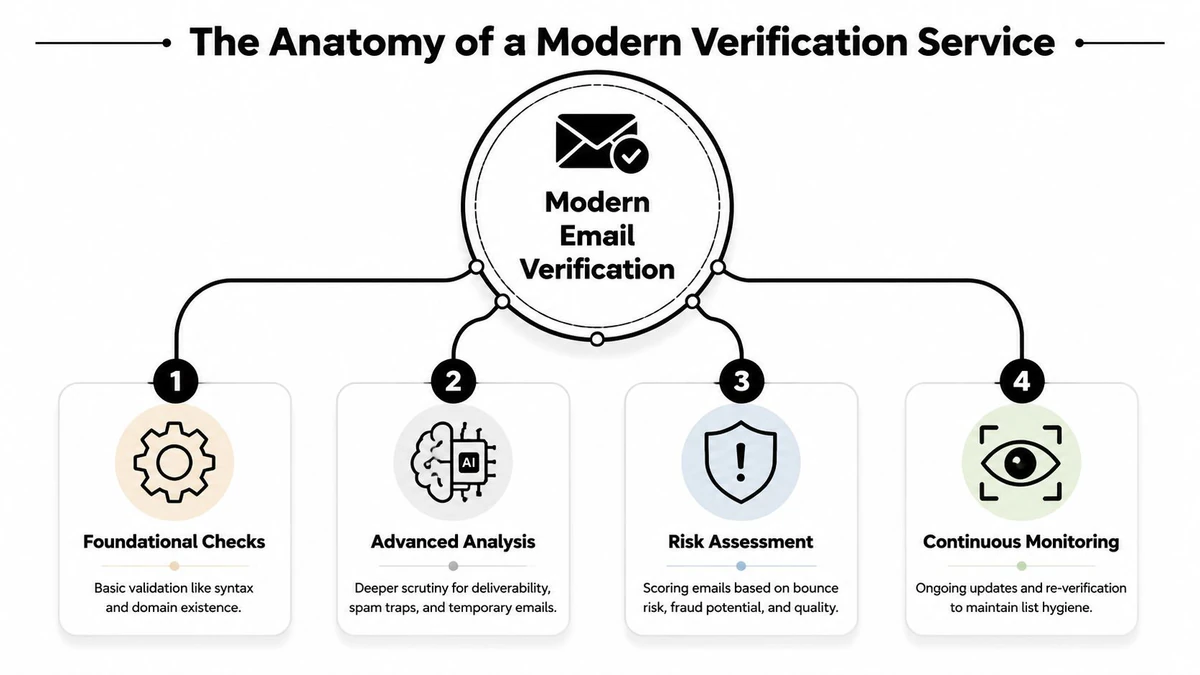
Basic mailbox existence checks aren't enough anymore. Modern verification has to answer a more useful question: even if this address can receive mail, should you send to it?
That changes the role of verification from technical validation to risk assessment.
Deliverable doesn't always mean safe
A lot of bad addresses are technically deliverable. That's why older tools miss problems that still hurt campaign performance.
Modern systems look for several categories that matter operationally:
- Disposable email addresses are temporary inboxes often used for abuse, low-intent trials, and fraudulent registrations.
- Role-based accounts like info@, sales@, and support@ usually represent groups, not named buyers, which makes engagement less reliable.
- Catch-all domains accept mail for many or all recipient names, so a successful server response doesn't always prove a person is behind the address.
- Spam trap and complainer risk matters because some addresses can damage your reputation even if the server technically accepts mail.
The practical value here is simple. You don't want the same treatment for a known good prospect, a temporary inbox, and a catch-all domain with ambiguous deliverability.
Why risk scoring matters
According to BillionVerify's email validation API overview, modern verification systems perform layered risk assessment by detecting disposable services, identifying catch-all domains, and flagging low-engagement role addresses. Filtering those segments helps teams reduce bounce rates to below 1% and protect sender reputation.
That's the difference between validation and intelligence.
Good verification doesn't stop at "exists." It tells you whether the address belongs in acquisition, nurture, transactional flows, or suppression.
For teams working with automation and agent-based pipelines, this gets even more important. Recent 2025 data shows 68% of enterprise SDRs now use AI agents for lead qualification, while 82% report integration failures due to poor API response structures from verification tools. When a verifier returns messy text instead of structured JSON with status, SMTP detail, MX context, and catch-all scoring, the automation layer breaks. The result isn't just developer frustration. It's fake signups slipping through and outbound systems acting on weak data.
A modern service should support three realities at once: high-speed lookups, nuanced classification, and outputs your systems can use.
Why Verification Is Non-Negotiable for Business Growth
A common perspective frames verification as risk reduction. That's true, but incomplete. Verification also protects revenue.
Every invalid address wastes spend somewhere. You paid to acquire the lead, store the record, route it into automation, and send to it. If the address bounces, that cost doesn't disappear. It compounds because mailbox providers use those failed delivery attempts to judge your future mail.
Bad data turns revenue work into reputation damage
The key threshold here is well established. Maintaining a bounce rate above 2% is tied to severe sender reputation damage, and rigorous verification has been shown to reduce bounce rates to below 1%, correlating with a 25% increase in overall campaign engagement and conversion rates compared to unverified lists. The business implication is obvious. Verification protects the channel while also helping the channel perform.
Once sender reputation slips, even your valid subscribers stop seeing your mail consistently. That's why the list-quality argument isn't academic. It affects launch performance, lifecycle email reliability, and outbound pipeline efficiency.
Verification changes unit economics
Here's where experienced teams think differently:
- Marketing teams use verification to stop paying for junk records and poor inbox placement.
- Sales teams use it to avoid burning domains on bad outbound targets.
- Product teams use it to block fake registrations before they pollute analytics and lifecycle messaging.
- Ops teams use it to keep CRM routing and segmentation trustworthy.
A clean list isn't just cleaner. It makes every downstream system more dependable.
If you want the financial framing, the breakdown in email verification ROI is useful because it connects bounce prevention directly to campaign efficiency and reputation preservation.
When verification is missing, teams think they're scaling outreach. In reality, they're scaling waste.
The mistake is waiting until deliverability drops hard enough to force action. By that point, you're no longer optimizing. You're repairing.
Practical Use Cases and Integration Workflows
A larger list does not fix weak acquisition. It usually hides it.
Verification pays off when it runs at the points where bad data enters, changes, and gets used. Teams that treat it as a quarterly cleanup project miss the bigger operational win. The modern model is lifecycle verification. Check the address at capture, recheck it before high-value sends, and keep CRM records clean as records age, sync, and get enriched by other systems.
Signup forms and AI agents
The first checkpoint is the form, checkout flow, trial signup, or lead capture endpoint. If an address is malformed, disposable, mistyped, or unlikely to accept mail, the cheapest time to handle it is before it reaches the database.
Real-time verification APIs matter here because they return machine-readable output that applications and automations can act on immediately. An AI agent routing inbound leads needs structured fields such as mailbox status, domain validity, catch-all signals, and SMTP response context. “Risky” as plain text is not enough. JSON that your app can parse, score, and route is.
Teams building this into product flows usually follow a bulk email verification workflow for capture and pre-send checks, then adapt the same logic for live API calls. The point is consistency. Marketing wants fewer bad contacts entering nurture. Engineering wants predictable status codes and low-friction integration. Both sides are solving the same problem.
Magnitude Marketing's lead qualification insights apply well outside real estate. Weak leads should be filtered before they reach sales queues, lifecycle campaigns, or AI scoring systems that assume the contact is real.
Bulk cleaning before campaigns
Batch verification still has a clear job. Before a product launch, migration, seasonal promotion, or outbound push, teams need a current read on list quality, not an old assumption based on when the contact was captured.
Useful bulk workflows usually include these outputs:
- Pre-send cleaning for newsletters, promotional campaigns, and re-engagement sends
- Segmented exports for valid, invalid, risky, catch-all, and role-based addresses
- Review queues for records that need suppression, throttling, or manual inspection
This work belongs in a verifier, not your ESP. An ESP is built to send mail. It is not built to diagnose whether a list should be mailed in the first place.
CRM hygiene as an ongoing workflow
The best implementation is not one workflow. It is a set of checkpoints tied to how records move through your stack.
| Workflow | Trigger | Why it matters |
|---|---|---|
| Point-of-entry check | Form submission or signup | Stops fake, malformed, or low-quality addresses before they enter the database |
| Pre-send recheck | Before campaigns or sequences | Finds records that went bad after initial capture |
| Sync-based hygiene | CRM or ESP updates | Keeps routing, segmentation, and suppression logic accurate across systems |
| Agent-driven qualification | AI enrichment or SDR workflows | Gives automations structured deliverability data they can use reliably |
BillionVerify fits this model as a factual example of a service teams can plug into both live capture flows and batch operations. In practice, that means one verification layer can support signup validation, CSV cleaning, CRM hygiene, and agent-based lead handling without turning data quality into a series of manual fixes.
The old playbook was one-time cleanup. The better playbook is continuous verification across capture, enrichment, sync, and send.
Choosing the Right Email Verification Provider
Most provider comparisons are too shallow. They talk about "accuracy" and "speed" in marketing language, then leave buyers to guess what those terms mean in production. That's how teams end up with a tool that catches typo domains but fails in real signup flows, or a bulk cleaner that can't support engineering use cases.
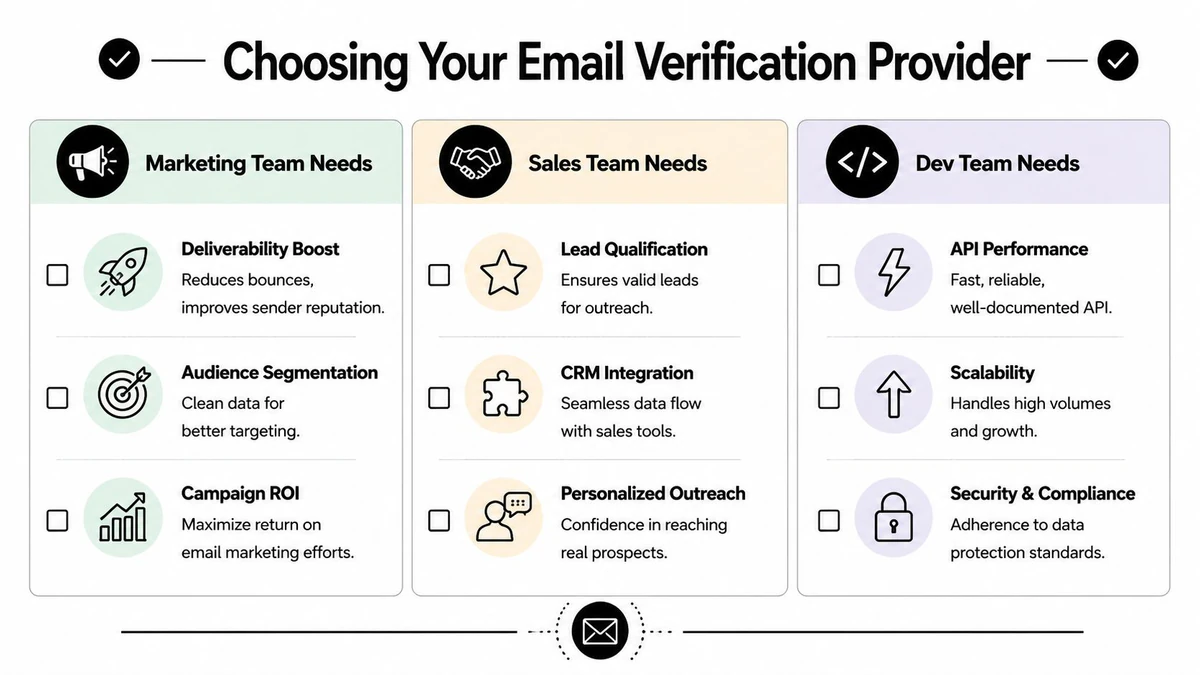
A better evaluation starts with the jobs your team needs done.
What marketing teams should test
If your main goal is campaign performance, don't stop at "valid or invalid" claims.
Use this checklist:
- Bulk workflow quality matters. Best-in-class list cleaning services process large CSV uploads, remove inactive addresses, detect spam traps, and identify role-based or catch-all domains. Providers that offer live progress tracking and export-ready filters can achieve 99% accuracy in detailed reporting and keep lists limited to active, valid addresses.
- Segmentation output should be usable immediately. You want exports that support suppression, retargeting, and cautious handling of ambiguous records.
- Pre-send practicality is critical. If the workflow is clumsy, your team won't run it consistently.
What sales and development teams can't ignore
Sales and development buyers should evaluate a different set of issues.
| Team | Non-negotiable capability | What to look for |
|---|---|---|
| Sales | Lead-quality filtering | Role account detection, disposable flags, and clear status categories |
| Development | API reliability | Fast response times, structured JSON, and predictable error handling |
| Operations | Ecosystem fit | Integrations with CRM, ESP, and automation tools |
| All teams | Risk visibility | Catch-all handling, SMTP context, and exportable classifications |
Some trade-offs are unavoidable. A provider may be excellent for batch cleanup and weak for real-time API use. Another may verify fast but return sparse data that limits automation. Some tools identify catch-all domains but don't help you score or operationalize them. Those gaps matter more than homepage positioning.
A verification provider isn't just a data vendor. It's part of your sending infrastructure.
If you're evaluating options, test the service on real records from multiple sources: recent signups, older CRM leads, role accounts, known disposable addresses, and domains that commonly behave as catch-alls. The quality of the output will tell you more than the sales copy.
Building a Culture of Data Hygiene
The most useful answer to what is email verification isn't "a tool that checks if an address is real." That's too narrow. Email verification is an ongoing discipline that protects sender reputation, supports campaign ROI, and keeps your systems from acting on junk data.
The outdated model is easy to spot. Teams import leads, run campaigns, watch performance drift, then order a cleanup. That cycle repeats because nothing changed at the point of capture or in the cadence of re-verification.
A healthier model is operational. Verify addresses in real time on forms. Re-verify before campaigns. Feed structured results into CRM logic, sales automation, and AI agent workflows. Treat address quality the same way you treat analytics integrity or payment fraud checks. It's a core business process.
The payoff isn't just fewer bounces. It's cleaner segmentation, better routing, more reliable reporting, and fewer preventable deliverability problems caused by your own database.
If you want email to stay a durable growth channel, don't treat verification as a repair tool. Treat it as maintenance.
If your team needs a practical way to verify addresses at signup, clean lists in bulk, and support structured outputs for automation, BillionVerify is built for that workflow. It fits best when you want email verification to be part of everyday operations instead of an occasional cleanup project.