



Building an effective email marketing program requires more than sending occasional campaigns. It demands a comprehensive strategy that aligns with business goals, understands audience needs, and creates systematic processes for consistent execution. This framework provides everything you need to build or rebuild your email marketing program from scratch.
The Strategic Foundation
Why strategy matters before tactics.
Strategy vs. Tactics
Strategy: The overarching plan that guides decisions
- What are we trying to achieve?
- Who are we trying to reach?
- How will we differentiate?
- What does success look like?
Tactics: The specific actions that execute strategy
- Which emails to send
- What content to include
- When to send
- How to segment
The Relationship: Tactics without strategy produce random activity. Strategy without tactics produces no results. You need both, but strategy comes first.
The Email Marketing Strategy Canvas
Nine Key Components:
- Business Objectives: What business goals does email support?
- Audience Segments: Who are we communicating with?
- Value Proposition: Why should they engage with our emails?
- Email Types: What kinds of emails will we send?
- Content Strategy: What will we say and share?
- Technology Stack: What tools will we use?
- Team and Process: Who does what and how?
- Metrics and Goals: How will we measure success?
- Optimization Plan: How will we improve over time?
Setting Business Objectives
Aligning email with business goals.
Common Email Marketing Objectives
Revenue Generation:
- Drive direct sales
- Support upsells and cross-sells
- Reduce churn
- Increase customer lifetime value
Engagement and Loyalty:
- Build brand awareness
- Nurture relationships
- Increase customer engagement
- Develop brand advocates
Lead Development:
- Capture leads
- Nurture prospects
- Qualify opportunities
- Support sales team
Customer Success:
- Onboard new customers
- Drive product adoption
- Provide support
- Gather feedback
SMART Goal Setting
Specific: Clearly defined outcomes Measurable: Quantifiable metrics Achievable: Realistic given resources Relevant: Aligned with business goals Time-bound: Clear deadlines
Example Goals:
Weak: "Improve email performance"
SMART: "Increase email-attributed revenue by 25% within 6 months by implementing segmented promotional campaigns and abandoned cart sequences"
Weak: "Get more subscribers"
SMART: "Grow email list by 10,000 qualified subscribers in Q1 through optimized website capture forms and lead magnet promotion"
Goal Hierarchy
Company Level: Increase annual revenue by $5M
Marketing Level: Generate $2M from email channel
Email Program Level:
- Promotional campaigns: $1M
- Automated sequences: $600K
- Retention programs: $400K
Campaign Level:
- Black Friday campaign: $200K
- Holiday sequence: $150K
- Monthly newsletters: $50K each
Audience Analysis
Understanding who you're emailing.
Building Audience Personas
Persona Components:
Demographics:
- Age range
- Location
- Income level
- Education
- Occupation
Psychographics:
- Values and beliefs
- Interests and hobbies
- Lifestyle choices
- Attitudes and opinions
Behaviors:
- Purchase patterns
- Content preferences
- Channel usage
- Decision-making process
Pain Points:
- Challenges they face
- Problems they need solved
- Frustrations with current solutions
Goals:
- What they're trying to achieve
- Desired outcomes
- Success metrics
Example Persona
Persona Name: Marketing Manager Maria
Demographics:
- Age: 28-35
- Location: Urban, US
- Education: Bachelor's degree
- Role: Marketing Manager at mid-size company
Psychographics:
- Values efficiency and results
- Career-focused, wants to advance
- Prefers data-driven decisions
- Active on LinkedIn and Twitter
Behaviors:
- Researches vendors online
- Reads industry blogs
- Attends webinars
- Influences purchase decisions
Pain Points:
- Too many tools to manage
- Proving marketing ROI
- Limited time and resources
- Keeping up with trends
Goals:
- Hit quarterly targets
- Get promoted within 2 years
- Build respected marketing program
- Stay current with best practices
Email Preferences:
- Prefers concise, scannable content
- Opens emails on mobile during commute
- Clicks on data and benchmarks
- Unsubscribes from salesy content
Segmentation Strategy
Basic Segments:
- Demographics (age, location, industry)
- Lifecycle stage (prospect, customer, churned)
- Purchase history (first-time, repeat, VIP)
Behavioral Segments:
- Engagement level (active, dormant, at-risk)
- Content preferences (topics, formats)
- Purchase behavior (categories, frequency)
Advanced Segments:
- Predictive segments (likely to buy, likely to churn)
- RFM segments (recency, frequency, monetary)
- Custom combinations
Segment Prioritization
Segment Value Matrix:
| Segment | Size | Value | Engagement | Priority |
|---|---|---|---|---|
| Active Buyers | 15% | High | High | 1 |
| Engaged Non-Buyers | 25% | Medium | High | 2 |
| Lapsed Buyers | 20% | High | Low | 3 |
| New Subscribers | 10% | Unknown | Medium | 4 |
| Dormant | 30% | Low | Low | 5 |
Value Proposition
Why subscribers should engage.
The Email Value Exchange
What Subscribers Give:
- Email address
- Attention
- Time
- Data (preferences, behavior)
- Trust
What You Must Provide:
- Relevant content
- Exclusive value
- Timely information
- Respect for preferences
- Easy opt-out
Content Value Types
Educational Value:
- How-to guides
- Industry insights
- Tips and tricks
- Best practices
Entertainment Value:
- Engaging stories
- Interesting content
- Brand personality
- Cultural relevance
Monetary Value:
- Discounts and deals
- Exclusive offers
- Early access
- Loyalty rewards
Utility Value:
- Useful tools
- Templates and resources
- Calculators
- Checklists
Social Value:
- Community access
- Expert connections
- Peer insights
- Status and recognition
Defining Your Value Proposition
Value Proposition Template:
"Our emails help [target audience] [achieve goal] by [key benefit/method], which means [outcome]."
Example: "Our emails help e-commerce marketers improve deliverability by sharing actionable verification strategies, which means more of their campaigns reach the inbox and drive revenue."
Communicating Value
On Signup Forms:
- Clear benefit statement
- Content preview
- Frequency disclosure
- Easy expectations
In Welcome Series:
- Reinforce value
- Set expectations
- Deliver immediate value
- Build anticipation
Throughout Program:
- Consistent value delivery
- Progressive value
- Surprise and delight
- Feedback loops
Email Types and Programs
What you'll send and when.
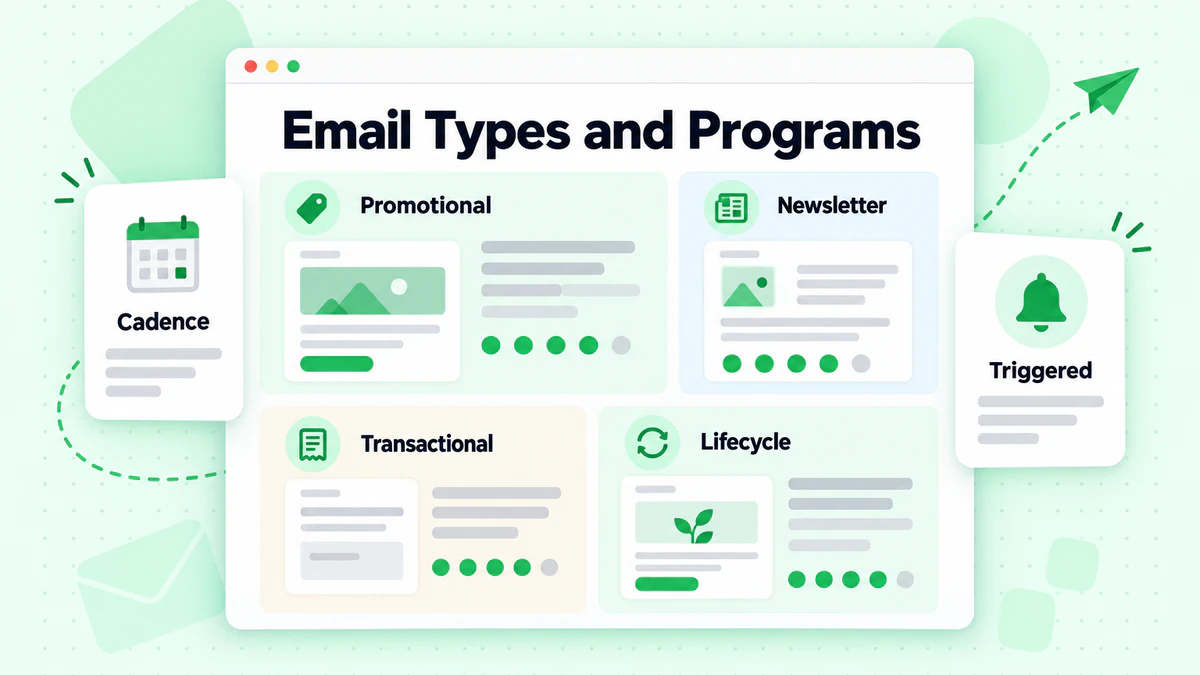
Core Email Categories
Promotional Emails: Purpose: Drive immediate action
- Sales announcements
- New product launches
- Limited-time offers
- Flash sales
Transactional Emails: Purpose: Complete transactions
- Order confirmations
- Shipping notifications
- Password resets
- Account updates
Triggered/Behavioral Emails: Purpose: Respond to actions
- Welcome sequences
- Abandoned cart
- Browse abandonment
- Re-engagement
Newsletter/Content Emails: Purpose: Maintain relationships
- Regular newsletters
- Content digests
- Company updates
- Industry news
Lifecycle Emails: Purpose: Guide customer journey
- Onboarding sequences
- Milestone celebrations
- Renewal reminders
- Win-back campaigns
Program Architecture
Essential Programs (Start Here):
| Program | Trigger | Goal |
|---|---|---|
| Welcome Series | New signup | Introduce, engage, convert |
| Order Confirmation | Purchase | Confirm, build trust |
| Abandoned Cart | Cart abandonment | Recover sales |
| Newsletter | Schedule | Maintain engagement |
Growth Programs (Phase 2):
| Program | Trigger | Goal |
|---|---|---|
| Post-Purchase | X days after order | Review, repeat, refer |
| Re-Engagement | Inactivity | Reactivate or clean |
| Browse Abandonment | Page views, no cart | Drive to cart |
| VIP Program | Purchase threshold | Reward, retain |
Advanced Programs (Phase 3):
| Program | Trigger | Goal |
|---|---|---|
| Predictive Campaigns | Score threshold | Optimize timing |
| Dynamic Content | Real-time behavior | Maximize relevance |
| Cross-Sell Engine | Purchase patterns | Increase AOV |
| Loyalty Automation | Point thresholds | Drive engagement |
Program Prioritization
Prioritization Criteria:
- Revenue impact
- Implementation effort
- Technical requirements
- Resource needs
- Time to value
Recommended Order:
- Welcome sequence (immediate value)
- Abandoned cart (high ROI)
- Regular newsletter (relationship building)
- Post-purchase (customer development)
- Re-engagement (list health)
- Additional programs (based on needs)
Content Strategy
What to say and how to say it.
Content Pillars
Define 3-5 Core Themes:
Example for Email Verification Service:
- Email Deliverability (technical best practices)
- List Health (cleaning and maintenance)
- Email Marketing Strategy (broader marketing)
- Industry Trends (news and benchmarks)
- Customer Success (case studies and tips)
Content Calendar
Planning Timeframes:
- Annual: Major campaigns and themes
- Quarterly: Campaign details and content themes
- Monthly: Specific content and assets
- Weekly: Final details and optimization
Content Calendar Template:
| Week | Campaign | Theme | Primary Email | Supporting |
|---|---|---|---|---|
| 1 | January Newsletter | New Year Strategy | Content digest | None |
| 2 | List Health Series | Deliverability | Educational | Blog post |
| 3 | Case Study Push | Customer Success | Case study | Landing page |
| 4 | Product Update | Features | Announcement | Video |
Content Creation Process
Step 1: Topic Selection
- Review content pillars
- Check calendar
- Analyze performance data
- Incorporate timely topics
Step 2: Content Development
- Research and outline
- Draft copy
- Design visuals
- Create assets
Step 3: Review and Approval
- Editorial review
- Brand compliance
- Legal review (if needed)
- Final approval
Step 4: Production
- Build in ESP
- Set up automation
- Test thoroughly
- Schedule or deploy
Brand Voice and Tone
Voice (consistent personality):
- Knowledgeable but accessible
- Friendly but professional
- Helpful and supportive
- Confident but not arrogant
Tone (adapts to situation):
- Welcome email: Warm, enthusiastic
- Error notification: Clear, apologetic
- Promotional: Exciting, urgent
- Educational: Informative, helpful
Style Guidelines:
- Sentence length: Varied, mostly short
- Paragraph length: 2-3 sentences max
- Language: Clear, jargon-free
- Formatting: Scannable, use headings
Technology Stack
Tools to power your program.
Core Technology Needs
Email Service Provider (ESP): Primary platform for sending and automation
Key Features:
- Email builder (drag-and-drop and code)
- Automation workflows
- Segmentation capabilities
- A/B testing
- Analytics and reporting
- Deliverability tools
Popular Options:
- Enterprise: Salesforce Marketing Cloud, Adobe Campaign, Oracle
- Mid-Market: Klaviyo, HubSpot, ActiveCampaign
- SMB: Mailchimp, ConvertKit, Drip
Supporting Technology
Data Integration:
- CRM connection
- E-commerce platform sync
- Website tracking
- Data warehouse
Enhancement Tools:
- Email verification (list hygiene)
- Deliverability monitoring
- Design tools
- Testing platforms
Analytics:
- Google Analytics integration
- Attribution tracking
- Customer data platform
- Business intelligence
Technology Selection Criteria
Evaluation Framework:
| Criteria | Weight | Considerations |
|---|---|---|
| Features | 25% | Current and future needs |
| Ease of use | 20% | Team capabilities |
| Integration | 20% | Existing tech stack |
| Scalability | 15% | Growth plans |
| Support | 10% | Help when needed |
| Price | 10% | Total cost of ownership |
Implementation Considerations
Before Selecting:
- Document requirements
- Get team input
- Request demos
- Check references
During Implementation:
- Plan migration carefully
- Test thoroughly
- Train team
- Document processes
After Launch:
- Monitor performance
- Optimize setup
- Expand usage
- Regular reviews
Team and Process
Who does what and how.
Team Structure
Solo Marketer:
- Owns entire program
- Prioritizes ruthlessly
- Uses templates and automation
- Outsources when possible
Small Team (2-3):
- Email Manager: Strategy, metrics, optimization
- Content/Design: Creative development
- Technical: Automation, integration
Larger Team:
- Director: Overall strategy
- Email Marketing Manager: Execution
- Automation Specialist: Technical
- Copywriter: Content
- Designer: Creative
- Analyst: Reporting
Process Design
Campaign Development Process:
Brief (Day 1)
    ↓
Content Development (Days 2-4)
    ↓
Design (Days 3-5)
    ↓
Build in ESP (Day 6)
    ↓
Review and QA (Day 7)
    ↓
Final Approval (Day 8)
    ↓
Schedule/Send (Day 9)
    ↓
Monitor and Report (Day 10+)
Quality Assurance
Pre-Send Checklist:
Content:
- [ ] Subject line tested
- [ ] Preview text included
- [ ] Copy proofread
- [ ] Links working
- [ ] CTA clear
Design:
- [ ] Mobile rendering checked
- [ ] Images have alt text
- [ ] Brand compliant
- [ ] Accessible design
Technical:
- [ ] List/segment correct
- [ ] Personalization working
- [ ] Tracking in place
- [ ] Suppression applied
Compliance:
- [ ] Unsubscribe working
- [ ] Physical address included
- [ ] Permission-based list
- [ ] Regulations followed
Collaboration and Communication
Regular Meetings:
- Weekly team standup
- Monthly performance review
- Quarterly strategy review
Documentation:
- Process documentation
- Style guides
- Template library
- Performance reports
Metrics and Goals
Measuring what matters.
Metric Framework
Tier 1: Business Metrics (Executive level)
- Revenue attributed to email
- Customer lifetime value impact
- Cost per acquisition
- ROI
Tier 2: Program Metrics (Manager level)
- List growth rate
- Overall engagement rates
- Conversion rates
- Deliverability metrics
Tier 3: Campaign Metrics (Specialist level)
- Open rates
- Click rates
- Unsubscribe rates
- Bounce rates
Key Performance Indicators
Essential KPIs:
| KPI | Calculation | Benchmark |
|---|---|---|
| Open Rate | Opens / Delivered | 20-30% |
| Click Rate | Clicks / Delivered | 2-5% |
| Click-to-Open | Clicks / Opens | 10-15% |
| Conversion Rate | Conversions / Sent | 1-5% |
| Unsubscribe Rate | Unsubs / Delivered | <0.5% |
| Bounce Rate | Bounces / Sent | <2% |
| List Growth | (New - Lost) / Total | 2-5%/month |
| Revenue per Email | Revenue / Emails Sent | Varies |
Goal Setting by Program
Welcome Series:
- Open rate: 50%+
- Click rate: 10%+
- Conversion: 15%+ (depending on goal)
Promotional Campaigns:
- Open rate: 20-30%
- Click rate: 2-5%
- Conversion: 1-5%
Newsletters:
- Open rate: 25%+
- Click rate: 3-5%
- Unsubscribe: <0.3%
Abandoned Cart:
- Open rate: 40%+
- Click rate: 10%+
- Recovery rate: 5-15%
Reporting Framework
Weekly Report:
- Sends and deliveries
- Engagement metrics
- Any issues/alerts
- Week-over-week trends
Monthly Report:
- Campaign performance summary
- Segment performance
- List health metrics
- Goal progress
- Key learnings
Quarterly Report:
- Strategic progress
- Channel performance
- ROI analysis
- Competitive analysis
- Next quarter plans
Optimization Plan
Continuous improvement system.
Testing Framework
What to Test:
High Impact:
- Subject lines
- Send timing
- Offer/CTA
- Segmentation
Medium Impact:
- Email length
- Design layout
- Personalization
- Content type
Lower Impact:
- Button color
- Image vs. no image
- Font choices
- Minor copy changes
Testing Process
Step 1: Hypothesis "Changing [variable] from [A] to [B] will improve [metric] because [reasoning]."
Step 2: Design
- Choose test type (A/B or multivariate)
- Determine sample size
- Set success criteria
- Plan timeline
Step 3: Execute
- Build test variants
- Run test
- Wait for statistical significance
- Document results
Step 4: Learn and Apply
- Analyze results
- Document learnings
- Apply winner broadly
- Plan next test
Optimization Calendar
Ongoing:
- Subject line testing (every send)
- Performance monitoring
- Quick fixes and adjustments
Monthly:
- Deep-dive analysis
- Segment testing
- Content experiments
- Process improvements
Quarterly:
- Strategy review
- Program assessment
- Technology evaluation
- Major tests
Annual:
- Full program audit
- Strategy refresh
- Goal resetting
- Technology review
Continuous Improvement Culture
Build Learning Systems:
- Document all tests and results
- Share learnings across team
- Build on previous insights
- Celebrate experiments (even failures)
Avoid Optimization Traps:
- Don't over-test small things
- Ensure statistical significance
- Consider long-term impact
- Balance testing with execution
Implementation Roadmap
Putting it all together.
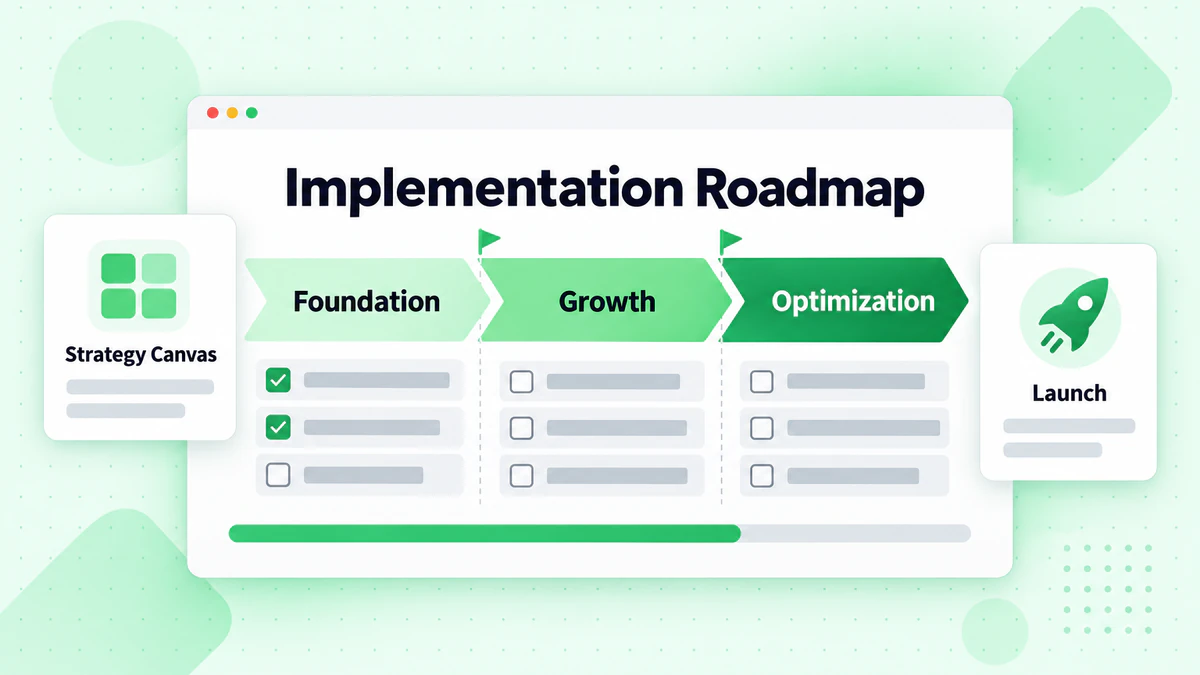
Phase 1: Foundation (Months 1-2)
Activities:
- Complete strategy canvas
- Set up technology
- Build essential templates
- Launch welcome sequence
- Establish baseline metrics
Deliverables:
- Strategy document
- ESP configured
- Welcome series live
- Basic reporting
Phase 2: Core Programs (Months 3-4)
Activities:
- Launch newsletter program
- Build abandoned cart sequence
- Implement basic segmentation
- Start testing program
Deliverables:
- Newsletter schedule
- Automated sequences
- Segment structure
- Testing roadmap
Phase 3: Optimization (Months 5-6)
Activities:
- Analyze performance
- Optimize existing programs
- Add secondary sequences
- Refine segmentation
Deliverables:
- Optimization reports
- Improved sequences
- Enhanced segmentation
- Documented learnings
Phase 4: Expansion (Months 7+)
Activities:
- Add advanced programs
- Implement personalization
- Integrate additional data
- Scale successful tests
Deliverables:
- New program launches
- Personalization live
- Advanced automation
- Mature program
Common Strategic Mistakes
Pitfalls to avoid.
Mistake 1: No Clear Strategy
Problem: Sending emails without purpose. Fix: Complete strategy canvas before tactics.
Mistake 2: Audience Assumptions
Problem: Guessing instead of knowing. Fix: Research, segment, and test.
Mistake 3: Technology Before Strategy
Problem: Buying tools without knowing needs. Fix: Define requirements before selecting.
Mistake 4: Volume Over Value
Problem: Sending more instead of better. Fix: Focus on relevance and engagement.
Mistake 5: No Measurement System
Problem: Flying blind on performance. Fix: Establish KPIs and regular reporting.
Mistake 6: Set and Forget
Problem: Not optimizing or updating. Fix: Build continuous improvement into process.
Strategy Checklist
Foundation
- [ ] Business objectives defined
- [ ] SMART goals set
- [ ] Audience personas created
- [ ] Segmentation strategy planned
- [ ] Value proposition articulated
Program Design
- [ ] Email types identified
- [ ] Programs prioritized
- [ ] Content pillars defined
- [ ] Content calendar created
- [ ] Brand voice documented
Technology and Team
- [ ] Technology requirements listed
- [ ] ESP selected
- [ ] Team roles defined
- [ ] Processes documented
- [ ] QA checklist created
Measurement
- [ ] KPIs identified
- [ ] Benchmarks set
- [ ] Reporting cadence established
- [ ] Testing framework defined
- [ ] Optimization plan created
Data Quality as Strategy
Why list health underpins everything.
Strategic Impact
Invalid Emails Undermine:
- Engagement metrics (skewed data)
- Deliverability (reputation damage)
- Revenue (wasted opportunities)
- Strategy (bad decisions from bad data)
Verification as Strategic Priority
Proactive Approach:
- Verify at capture with real-time verification (prevent bad data)
- Regular list cleaning (maintain health)
- Deliverability monitoring (catch issues)
- Ongoing hygiene (sustain quality)
Strategic Benefits:
- Accurate metrics for decisions
- Maximum inbox placement
- True engagement visibility
- Reliable revenue attribution
Conclusion
A comprehensive email marketing strategy provides the foundation for sustainable success. Without strategy, you're just sending emails. With strategy, you're building a systematic program that drives business results.
Key framework components:
- Start with objectives: Align email with business goals
- Understand your audience: Build personas, plan segments
- Define your value: Know why subscribers should engage
- Design your programs: Map email types to objectives
- Create content systems: Plan what you'll say
- Choose technology wisely: Tools should serve strategy
- Build capable teams: People and process matter
- Measure what matters: Track progress toward goals
- Optimize continuously: Never stop improving
Strategy only works when emails reach real inboxes. Building your program on a foundation of invalid email addresses undermines every strategic decision.
Ready to build your email strategy on clean data? Start with BillionVerify to ensure every email address in your program is valid and deliverable.
B2B and agency-focused email strategies benefit from verified contact data sourced from review sites like G2 and Clutch. See the B2B service providers guide for best practices on building accurate agency email lists from review platform data.