



Your email marketing campaigns generate opens and clicks, but revenue remains stagnant. The culprit is often poorly structured workflows that fail to engage subscribers at critical lifecycle moments. For e-commerce and SaaS marketers, mastering automated email workflows transforms sporadic campaigns into revenue engines that consistently drive conversions while maintaining strong deliverability. This guide walks you through building, executing, and verifying workflows that maximize ROI and inbox placement.
Key Takeaways
| Point | Details |
|---|---|
| Workflow driven revenue | Automated workflows that respond to subscriber behavior generate meaningful revenue even when overall email volume is low. |
| Vertical flow focus | Ecommerce relies on abandoned cart, welcome, post purchase, browse abandonment, and other critical flows while SaaS emphasizes trial onboarding and churn prevention. |
| Deliverability foundations | SPF DKIM and DMARC authentication are essential to reach inboxes and protect sender reputation. |
| Testing and hygiene optimization | Testing, segmentation, and clean subscriber lists improve performance and deliverability. |
| Prioritize high ROI flows | Start with the most impactful automations to fund and accelerate broader workflow development. |
Understanding email marketing workflows and key requirements
Email marketing workflows are automated sequences triggered by subscriber behavior or lifecycle stage, delivering timely messages that guide customers through purchasing journeys. Unlike broadcast campaigns sent to entire lists, workflows respond to individual actions, creating personalized experiences that drive higher engagement and conversion rates.
E-commerce businesses rely on seven essential automated flows generating 30-45% revenue despite representing a fraction of total sends. These workflows include welcome series for new subscribers, abandoned cart recovery sequences, post-purchase follow-ups, browse abandonment reminders, win-back campaigns for inactive customers, VIP and loyalty programs, and sunset flows to remove unengaged contacts. Each flow targets specific customer behaviors, creating opportunities to recover lost sales and build lasting relationships.
SaaS companies face different challenges requiring workflows that emphasize trial onboarding, activation, churn prevention, upsell and cross-sell. New trial users need structured onboarding sequences that demonstrate product value quickly. Activation workflows guide users to complete key actions that predict long-term retention. Churn prevention flows identify at-risk customers and re-engage them before cancellation. Expansion workflows introduce premium features to satisfied users ready to upgrade.
Regardless of vertical, email deliverability requires SPF, DKIM, DMARC authentication targeting inbox placement above 95%. These technical protocols verify your sending identity, protecting against spoofing while building trust with inbox providers. Without proper authentication, even perfectly crafted workflows land in spam folders, wasting creative effort and damaging sender reputation. Setting up authentication before launching workflows prevents deliverability disasters that take months to repair.
| Workflow Type | E-commerce Focus | SaaS Focus |
|---|---|---|
| Welcome | Product catalog introduction, first purchase discount | Feature tour, quick win setup |
| Activation | Abandoned cart recovery, browse reminders | Trial milestone completion, usage tips |
| Retention | Post-purchase cross-sell, loyalty rewards | Feature adoption, success stories |
| Win-back | Inactive customer re-engagement offers | Dormant user value reminders |
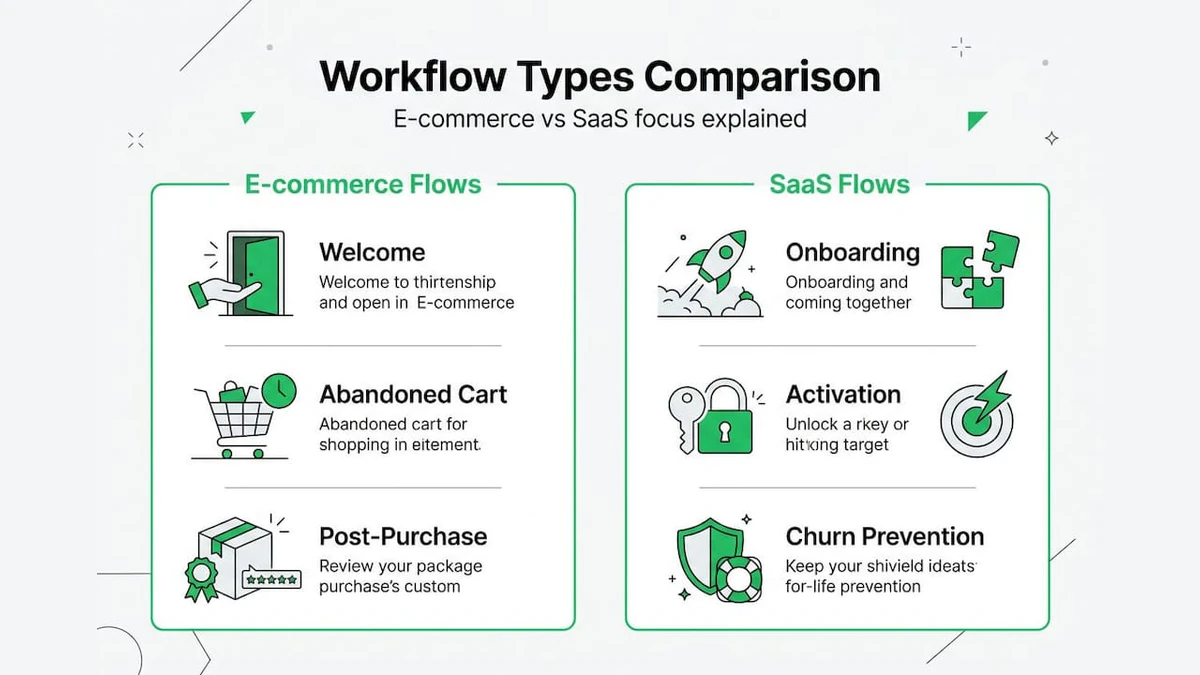
Understanding these foundational differences helps you prioritize workflows that align with your business model. E-commerce workflows optimize for transaction frequency and average order value, while SaaS workflows maximize product adoption and reduce churn. Both strategies share the common goal of moving subscribers through lifecycle stages that increase lifetime value. For deeper vertical-specific strategies, explore our e-commerce email marketing guide and SaaS email marketing guide.
Technical setup extends beyond authentication to include proper list management infrastructure. Implementing double opt-in confirmation, monitoring bounce and complaint rates, and maintaining clean subscriber data form the foundation for workflow success. These practices protect sender reputation while ensuring workflows reach engaged audiences. Review our email marketing best practices for higher deliverability to establish technical foundations before building complex automation.
How to prepare your email marketing workflows for optimal performance
Successful workflow execution begins with strategic preparation that prioritizes high-impact automations and establishes clean data foundations. Prioritize highest ROI flows first: e-commerce should launch abandoned cart recovery before browse abandonment, while SaaS must perfect trial onboarding before building expansion workflows. This focused approach delivers quick wins that fund additional automation development.
List hygiene practices form the second pillar of workflow preparation. Implementing double opt-in and monitoring bounces plus complaints maintains sender reputation by preventing spam trap hits and reducing invalid addresses. Regular list cleaning removes unengaged subscribers who drag down engagement metrics and trigger spam filters. Clean lists ensure workflows reach real humans interested in your messages, maximizing conversion potential while protecting deliverability.

Segmentation dramatically improves workflow performance by matching message content to subscriber characteristics and behaviors. Creating segments based on purchase history, engagement levels, product interests, and lifecycle stage allows you to tailor workflow messaging for maximum relevance. Segmented campaigns generate significantly higher revenue per recipient and transaction rates compared to generic broadcasts. Build segments before launching workflows to ensure proper targeting from day one.
Pro Tip: Start with three core segments (highly engaged, moderately engaged, at-risk) and expand as you gather performance data. Over-segmentation early creates complexity without proportional returns.
Platform selection impacts workflow capabilities and execution efficiency. Automation-first platforms excel for behavioral workflows with sophisticated trigger logic and conditional branching, making them ideal for complex e-commerce and SaaS sequences. Campaign-first platforms offer simpler automation suitable for newsletters and basic welcome series but lack advanced features needed for revenue-driving workflows. Choose platforms that match your workflow complexity requirements and integrate seamlessly with your CRM and analytics stack.
Essential preparation steps include:
- Audit existing email infrastructure for authentication completeness
- Document customer journey touchpoints requiring automated communication
- Map workflow triggers to specific subscriber actions and timeline delays
- Establish baseline metrics for bounce rates, complaints, and engagement
- Configure tracking parameters to measure workflow attribution accurately
Email authentication setup deserves dedicated attention during preparation. Verify SPF records include all sending IPs, configure DKIM signatures for message integrity, and implement DMARC policies that provide visibility into authentication failures. Test authentication using free tools before launching workflows to catch configuration errors that harm deliverability. Our email automation tools guide compares platforms based on authentication support and technical capabilities.
Data integration between your email platform and other business systems enables sophisticated workflow personalization. Connecting e-commerce platforms allows abandoned cart workflows to display actual cart contents. Integrating product usage data lets SaaS workflows respond to feature adoption patterns. Plan these integrations during preparation to avoid rebuilding workflows later when adding personalization capabilities. Learn more about maintaining clean data in our verify emails for deliverability resource.
Executing and optimizing email marketing workflows with testing and AI
Workflow execution follows a systematic process that combines strategic setup with continuous optimization. Follow these steps for successful implementation:
- Configure workflow triggers based on specific subscriber actions or time delays
- Design email templates with clear calls to action and mobile-responsive layouts
- Set up A/B tests for subject lines, send times, and content variations
- Establish monitoring dashboards tracking deliverability and engagement metrics
- Schedule regular reviews to identify optimization opportunities and fix issues
Testing workflows via A/B tests and deliverability tools improves performance by revealing what resonates with your audience. Test one variable at a time to isolate impact: subject line variations, email copy approaches, call-to-action placement, or send time windows. Run tests long enough to achieve statistical significance, typically requiring at least several hundred recipients per variation. Document winning tests and apply learnings across other workflows.
Seed testing and Google Postmaster Tools provide inbox placement insights unavailable through standard analytics. Seed testing sends workflow emails to addresses across major inbox providers, revealing which messages reach primary inboxes versus promotions tabs or spam folders. Postmaster Tools shows domain reputation, spam rates, and authentication status from Gmail's perspective. Monitor these tools weekly to catch deliverability problems before they impact campaign performance.
Pro Tip: Create a seed list with addresses at Gmail, Outlook, Yahoo, and Apple Mail to monitor inbox placement across the four major providers controlling most consumer inboxes.
AI enables predictive segmentation and send-time optimization by analyzing historical engagement patterns and predicting future behavior. Machine learning models identify subscribers likely to convert, churn, or engage at specific times, allowing you to prioritize high-value contacts and optimize delivery windows. AI-powered subject line generators suggest variations based on proven patterns, while content recommendation engines personalize product selections for each recipient.
Human oversight remains critical despite AI capabilities. Review AI-generated content for brand voice consistency, factual accuracy, and compliance with email regulations. Spam filters increasingly flag messages with obvious AI patterns, so edit suggestions to sound natural and authentic. Use AI as a productivity tool that augments human creativity rather than replacing strategic thinking and brand judgment.
| Optimization Approach | Manual Method | AI-Augmented Method |
|---|---|---|
| Segmentation | Rules-based on explicit attributes | Predictive models using behavioral patterns |
| Send Time | Fixed schedule or time zone adjustment | Individual-level prediction based on past opens |
| Content Selection | Marketer-chosen products or features | Recommendation engine trained on conversions |
| Subject Lines | Copywriter brainstorming variations | Generator suggesting options from pattern analysis |
Continuous monitoring identifies performance trends requiring workflow adjustments. Track open rates, click rates, conversion rates, and revenue per recipient weekly to spot declining engagement or emerging opportunities. Compare workflow performance against broadcast campaigns to quantify automation value. Set alerts for sudden metric changes that indicate deliverability problems or technical errors requiring immediate attention. Explore our email deliverability guide for comprehensive monitoring strategies.
Integration testing ensures workflows trigger correctly across all connected systems. Verify abandoned cart emails populate with accurate product data, trial expiration warnings calculate days remaining properly, and post-purchase sequences exclude customers who return items. Test workflows in staging environments before activating for live traffic to catch integration bugs that create poor customer experiences. For SaaS-specific workflow optimization, see our guide on how to improve email deliverability workflow for SaaS success.
Troubleshooting common mistakes and verifying email marketing workflow success
Workflow failures typically stem from preventable mistakes that harm sender reputation and deliverability. Common pitfalls include:
- Misaligned authentication records causing inbox providers to reject messages
- Sudden volume spikes triggering spam filters when launching multiple workflows simultaneously
- Sending to unengaged segments that generate low opens and high complaints
- Neglecting mobile optimization despite majority mobile email opens
- Using spam trigger words or excessive punctuation in subject lines
Gradual warm-up prevents volume-related deliverability problems when launching new workflows or sending from fresh IP addresses. Start by sending to your most engaged subscribers, then gradually expand to larger segments over two to four weeks. This approach builds positive sender reputation with inbox providers before reaching your full list. Rushing warm-up triggers spam filters that damage reputation for months afterward.
Verification steps confirm workflows meet deliverability and performance targets. Monitor bounce rates below 5%, complaint rates under 0.1%, and inbox placement above 95% as critical health indicators. Bounce rates exceeding 5% signal list quality problems requiring immediate cleaning. Complaint rates above 0.1% indicate messaging misalignment with subscriber expectations, demanding content review and segmentation refinement.
Successful workflow programs maintain bounce rates below 5%, complaint rates under 0.1%, and inbox placement above 95%. Missing these benchmarks damages sender reputation and reduces campaign ROI significantly.
Inbox placement testing reveals where your workflow emails actually land. Use seed testing services or manual checks across multiple inbox providers to verify messages reach primary inboxes rather than spam or promotions folders. Test after major workflow changes or when metrics suggest deliverability problems. Address placement issues immediately by reviewing authentication, content, and engagement patterns.
Continuous monitoring sustains workflow success over time as subscriber preferences and inbox provider algorithms evolve. Schedule monthly workflow audits reviewing performance metrics, testing results, and deliverability indicators. Update content and targeting based on audit findings to maintain relevance and engagement. Remove or revise underperforming workflows that fail to meet ROI targets after optimization attempts. For B2B SaaS marketers, our email deliverability best practices for B2B SaaS guide offers vertical-specific troubleshooting strategies.
Enhance your email marketing with BillionVerify solutions
Even perfectly designed workflows fail when poor list quality undermines deliverability and engagement. BillionVerify's AI-first email verification removes invalid addresses, spam traps, and risky domains before they damage your sender reputation. Our multi-layer verification technology detects disposable emails, role-based addresses, and catch-all domains that inflate list size while reducing campaign performance.
Integrating BillionVerify with your marketing platform enables continuous list hygiene that protects workflow effectiveness. Real-time API verification catches invalid addresses at signup, while bulk processing cleans existing lists before major campaigns. Supporting over 20 email marketing systems and CRMs, our platform fits seamlessly into your existing workflow infrastructure. Enterprise-grade processing handles millions of verifications monthly, scaling with your business growth while maintaining the high accuracy needed for optimal inbox placement and campaign ROI.
Frequently asked questions about email marketing workflows
What are the most effective email marketing workflows for e-commerce?
Abandoned cart recovery generates the highest ROI for most e-commerce businesses, followed by welcome series and post-purchase cross-sell sequences. Browse abandonment and win-back campaigns provide additional revenue opportunities. Focus on perfecting these core flows before expanding to advanced loyalty or VIP workflows.
How do I improve email deliverability rates for my campaigns?
Implement SPF, DKIM, and DMARC authentication, maintain clean lists through regular verification, and monitor bounce plus complaint rates closely. Warm up new IPs gradually, segment audiences for relevance, and test inbox placement regularly. Proper authentication and list hygiene typically improve deliverability from 70-80% to above 95%.
Which platform is best for automating email workflows for SaaS?
Automation-first platforms like ActiveCampaign, HubSpot, or Customer.io excel for SaaS workflows requiring sophisticated behavioral triggers and conditional logic. Choose based on your CRM integration needs, workflow complexity requirements, and team technical capabilities. Most SaaS companies need platforms supporting event-based triggers tied to product usage data.
How often should I clean my email list to maintain deliverability?
Verify your entire list quarterly and remove hard bounces immediately after each send. Implement real-time verification for new signups to prevent invalid addresses from entering your database. More frequent cleaning benefits high-volume senders or businesses experiencing deliverability problems. Consistent hygiene prevents reputation damage more effectively than periodic deep cleaning.
What role does AI play in optimizing email marketing workflows?
AI powers predictive segmentation identifying high-value subscribers, optimizes send times based on individual engagement patterns, and generates subject line variations from proven templates. Machine learning improves content recommendations and automates testing analysis. However, human oversight remains essential for brand consistency, regulatory compliance, and catching AI-generated content that triggers spam filters.