


Most advice about cold calling vs warm calling focuses on the call itself. Better opener. Better objection handling. Better tonality.
That's not where teams typically win.
The gap sits earlier in the process. A cold call fails because the rep reached the wrong person, at the wrong number, with no context. A warm call fails because the “warm-up” never reached the inbox, the engagement signal was weak, or marketing and SDRs labeled a lead as warm without a real threshold. The script matters. The data chain matters more.
Teams that treat cold and warm calling as competing ideologies usually build weak systems. Teams that treat them as two outcomes of the same data process usually build pipeline. If you already run email before calls, or plan to, your calling strategy is tied to list quality whether you admit it or not. That's why the mechanics behind cold email outreach belong in this conversation.
Rethinking the Calling Debate Beyond Cold vs Warm
“Cold calling is dead” is lazy advice. So is the idea that warm calling solves everything.
Cold calling still has a place because many teams need a way to reach accounts that haven't raised a hand yet. Warm calling outperforms it when the prior engagement is real. Both statements can be true at once. The mistake is turning the choice into a philosophy instead of an operating model.
The practical question is simpler. What level of context exists before the rep dials? If there's no signal, you're asking a rep to create attention from scratch. If there is signal, you're asking the rep to convert existing attention into a conversation. That difference affects targeting, staffing, pacing, and the entire sequence around the call.
Practical rule: Strong calling programs are built backward from data quality, not forward from scripting.
That's why the debate has shifted. Years ago, teams could get away with high-volume dialing off broad lists. Today, performance depends more on whether contact data is usable, whether engagement data is trustworthy, and whether the handoff between marketing and outbound is clean. Good sales leaders don't just ask, “Should we cold call or warm call?” They ask, “What process creates enough context to make the call worth placing?”
A rep can recover from a rough opener. A team can't recover from bad inputs at scale.
Defining the Battlefield Context and Prior Engagement
Cold calling is still the easiest part to define. It's a phone call to a prospect with no meaningful prior interaction with your company. The account may fit your ICP. The rep may have researched the contact. But from the buyer's perspective, the call arrives without an established thread.
Warm calling sounds simple too, but operationally it gets messy. It is typically defined as outreach after a prior action such as a form fill, webinar registration, content download, referral, email reply, or relevant website activity. That's directionally right. It still leaves one hard question unanswered: how much prior engagement is enough to count as warm?
The gray zone most teams ignore
That ambiguity matters because many teams over-credit warm calling results. A prospect who clicked one email months ago is not the same as a prospect who replied yesterday and visited a pricing page. One industry analysis makes that point clearly, noting that warm calling is often just faster lead follow-up and that teams rarely define the threshold well enough for scoring and handoff discipline. The same analysis notes that cold calls convert about 1% to 3% of live conversations into qualified meetings, while warm calls can convert 10% to 20% when prior engagement is strong, which is exactly why the definition matters so much (Amplemarket on warm vs cold calling definitions).
If you don't define warm precisely, three problems show up fast:
- Reporting breaks: SDR leaders think warm follow-up is performing better than it is.
- Routing gets sloppy: Reps chase weak signals that don't justify a call yet.
- Marketing and sales fight the wrong battle: One side says leads are bad, the other says follow-up is slow.
A workable definition for real teams
Use context, recency, and intent together. A lead is warm when the team can point to a recent action that suggests recognition and a plausible reason to talk now.
That usually means looking at:
- Source quality: Referral, demo inquiry, event attendance, reply, or a clear inbound action.
- Signal strength: One shallow interaction isn't the same as repeated engagement.
- Timing: Old engagement decays. Fresh engagement changes the call.
- Fit: Activity from the wrong persona doesn't make the lead warm for sales.
Your lead criteria should align with the broader sales cycle stages teams already manage, because a call is just one step in a larger movement from awareness to evaluation.
This is also where BillionVerify fits conceptually. It's a professional email verification service built to solve one problem: bad email data costs businesses money. That matters because a lot of “warm” outreach starts with email. If the contact never receives the email, the rep may think they're following up on engagement when they're really placing a cold call with false confidence.
A Head-to-Head Comparison of Performance and Resources
The most useful way to compare cold calling vs warm calling isn't by preference. It's by operating cost, conversion profile, and what each motion asks your team to do well.
The fastest way to see the trade-off
| Criteria | Cold Calling | Warm Calling |
|---|---|---|
| Starting context | No prior relationship or engagement | Prior interaction, inquiry, referral, or tracked activity |
| Conversion profile | Lower baseline conversion | Higher conversion when the signal is real |
| Rep workload | Heavy dial volume and repeated follow-up | More prep, less wasted conversation |
| Data dependency | Very sensitive to list quality and phone accuracy | Very sensitive to signal quality and follow-up timing |
| Buyer experience | Interruptive unless relevance is sharp | More natural because context already exists |
| Best use | New account penetration and top-of-funnel creation | Converting existing interest into meetings |
Cold calling works on volume and discipline. Warm calling works on sequencing and timing. They're different muscles.
One useful benchmark says warm calling often converts 15% to 30% or higher, potentially 15x more often than pure cold outreach in some cases, while the average cold-call conversion rate is 2.35%, or about 1 sale per 43 calls. The same benchmark notes top-performing cold-calling teams can reach 6% to 10% with better targeting and data quality (Superhuman Prospecting comparison data).
What the numbers mean operationally
Those numbers don't mean you should stop cold calling. They mean you should stop expecting cold calling to behave like lead follow-up.
For cold calling, the resource drain isn't just dialing. It's the combination of:
- List prep
- Bad numbers
- Low-context conversations
- More attempts before a live exchange
For warm calling, the work shifts earlier:
- Lead capture
- Email deliverability
- Scoring
- Fast routing
- Context-rich follow-up
Warm calling usually wins because the rep isn't introducing the topic for the first time. They're advancing a topic the prospect has already touched.
That's also why multichannel sequencing matters. If your team is deciding how calls should fit alongside email and social touches, this guide to cold outreach methods is useful because it frames channel choice as a sequencing problem, not a script problem.
For teams that train by example, this walkthrough is worth reviewing before you finalize your own talk tracks:
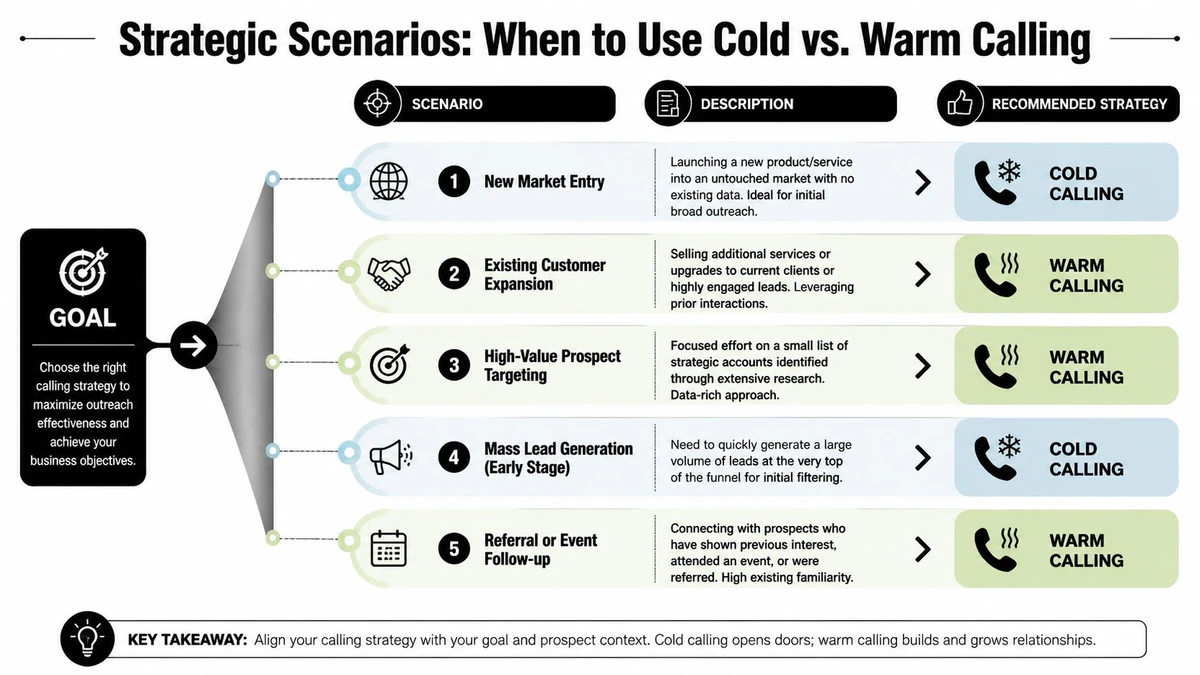
Strategic Scenarios When to Deploy Cold vs Warm Calling
The right calling motion depends on where the lead sits in the buying journey and what your team needs from the funnel right now.
When cold calling still earns its place
Cold calling belongs in situations where waiting for inbound would leave pipeline gaps.
Use it when:
- You're entering a new market: No installed audience, little brand familiarity, and limited engagement history.
- You sell a disruptive offer: Buyers may not be actively searching because they don't yet label the problem the way you do.
- You're working named accounts: A short list of strategic accounts can justify careful research and direct outreach even without prior engagement.
- You need top-of-funnel coverage: Cold calling can create conversations where nothing exists yet.
Cold calling is also useful when your marketing engine is still maturing. If content, paid acquisition, and inbound routing aren't yet dependable, outbound calls give leadership a direct way to pressure-test messaging and market fit.
That said, don't confuse activity with traction. Cold calling without account selection, call coaching, and sequence discipline becomes a morale problem fast.
When warm calling should get priority
Warm calling deserves priority when a buyer has already supplied a reason to call.
That includes:
- Inbound hand-raisers: Demo requests, relevant form submissions, or direct replies.
- Event follow-up: Webinar attendees, booth conversations, or registrants who engaged meaningfully.
- Past opportunity reactivation: Closed-lost deals, stalled evaluations, or prior conversations with a clear reason to revisit.
- Referral-based outreach: The prospect starts with borrowed trust.
Warm calling also fits expansion and cross-sell motions because the rep can build from existing history instead of opening from zero. In practice, these calls tend to feel less like interruption and more like continuation.
A simple way to think about it:
| Funnel position | Better fit |
|---|---|
| Early awareness with no signal | Cold calling |
| Mid-funnel interest with engagement context | Warm calling |
| Existing relationship or referral | Warm calling |
| New segment discovery | Cold calling |
Sales professionals often err by labeling every follow-up as warm. It isn't warm just because you touched the account before. It's warm when the buyer has given you context you can effectively use.
The Unseen Engine of Warm Calling Data Verification
Warm calling doesn't begin when the rep dials. It begins when the first message reaches the right inbox and creates a real signal.
That's the part many teams skip. They build a nurture track, push email before calls, then assume opens, clicks, and non-replies reflect intent. But if the underlying email data is weak, the warm-up layer is compromised before sales ever sees the lead.
Warm calling starts before the call
A solid benchmark on B2B calling operations shows connect rates around 8% to 12% with generic-database cold calling lists, rising to 15% to 22% with verified mobile direct-dial data. It also notes that verified data can roughly double connect rates versus generic lists, and teams using triple-verified data plus caller-ID hygiene and timing optimization can exceed 25% connect rates (Skipcall connect rate benchmarks).
That benchmark is about phone data, but the lesson is bigger than phones. Verification changes outcomes upstream. If your warm calling motion depends on email to create awareness first, then list quality shapes whether the later call is warm or just mislabeled cold outreach.
Common failure points look like this:
- Bad email in the CRM: The “warm-up” never lands.
- Role accounts and disposable signups: Marketing sees activity that won't become a real sales conversation.
- Weak segmentation: SDRs call on low-value actions that don't show real buying intent.
- Dirty records across systems: Marketing automation, CRM, and sales engagement tools disagree about who engaged.
Clean pre-call data does two jobs at once. It protects deliverability, and it protects sales from wasting follow-up effort on false warmth.
Where BillionVerify fits
For teams that warm prospects through email before calls, verification isn't optional admin work. It's part of outbound design.
BillionVerify's role is straightforward. It's an AI-first email verification platform designed to help teams verify addresses, clean bulk lists, support real-time API checks, return structured deliverability data, and remove risky or low-value records before outreach. That makes it relevant to SDR and marketing ops teams that need more confidence in the contact layer before they score engagement or trigger call tasks. If your team also enriches contacts from other identifiers, this related guide on how to look up an email by phone number is a useful operational companion.
What matters here isn't vendor branding. It's the sequence logic. A warm calling engine only works if:
- the contact record is valid,
- the first touch reaches the person,
- the engagement signal is trustworthy,
- the rep receives the lead while the context is still fresh.
Most calling problems blamed on reps are really process and data problems wearing a sales mask.
Sample Scripts and Outreach Sequences in Action
Scripts work when they reflect the reality of the lead. Most don't. Teams often write one talk track, swap in a few variables, and expect it to cover both cold and warm situations.
That creates awkward calls. The cold call sounds too assumptive. The warm call sounds strangely generic.
Cold call example
The goal of a cold call isn't to dump information. It's to earn enough attention for a short conversation or a clear next step.
Sample cold opener
“Hi [Name], this is [Rep] from [Company]. I know I'm calling out of the blue, so I'll keep it brief. We work with teams dealing with [specific problem]. I wanted to ask whether that's even on your radar right now, or if I caught you at the wrong time?”
Why it works:
- It acknowledges interruption
- It doesn't pretend there's a relationship
- It starts with relevance, not a company monologue
If they engage, move into a short diagnostic:
- Current process: “How are you handling that today?”
- Pain signal: “What tends to break first?”
- Next step: “If it makes sense, we can schedule a deeper conversation with the right person.”
Warm call example
A warm call should spend its first sentence using the context the buyer already gave you.
Sample warm opener
“Hi [Name], this is [Rep] from [Company]. You downloaded our [asset] and looked at [topic], so I wanted to follow up while it's still fresh. Usually when someone spends time there, they're trying to improve [problem area]. Was that the case for you, or were you researching for later?”
That opener works because it does three things fast:
- references the trigger,
- states a plausible reason for the call,
- leaves room for the prospect to correct the assumption.
If the prospect says yes, you can go narrower:
- Intent: “What prompted you to look into it now?”
- Urgency: “Is this something you're actively evaluating?”
- Buying path: “Who else is usually involved when this moves forward?”
On warm calls, the rep shouldn't waste time reintroducing the company if the prospect already knows why the topic matters.
Simple sequences that match the call type
Use different sequences for different starting points.
Cold sequence
- Day 1: Call with a direct, relevance-based opener.
- Day 1: Follow-up email with a short summary and clear reason to reply.
- Day 3: LinkedIn view or connection request if appropriate.
- Day 5: Second call focused on a business pain point.
- Later touch: Short breakup-style email or value add.
Warm sequence
- Trigger event: Lead engages with a form, email, webinar, or referral.
- Fast follow-up: Call while the action is recent.
- Context email: Recap what they engaged with and suggest a next step.
- Second touch: Call again if there was partial interest.
- Nurture or route: Move to AE, keep in marketing nurture, or recycle.
If your reps also use email as part of those sequences, these cold email templates for sales outreach can help tighten the written side so the message on the phone matches the message in the inbox.
How to Measure and Optimize Your Calling Strategy
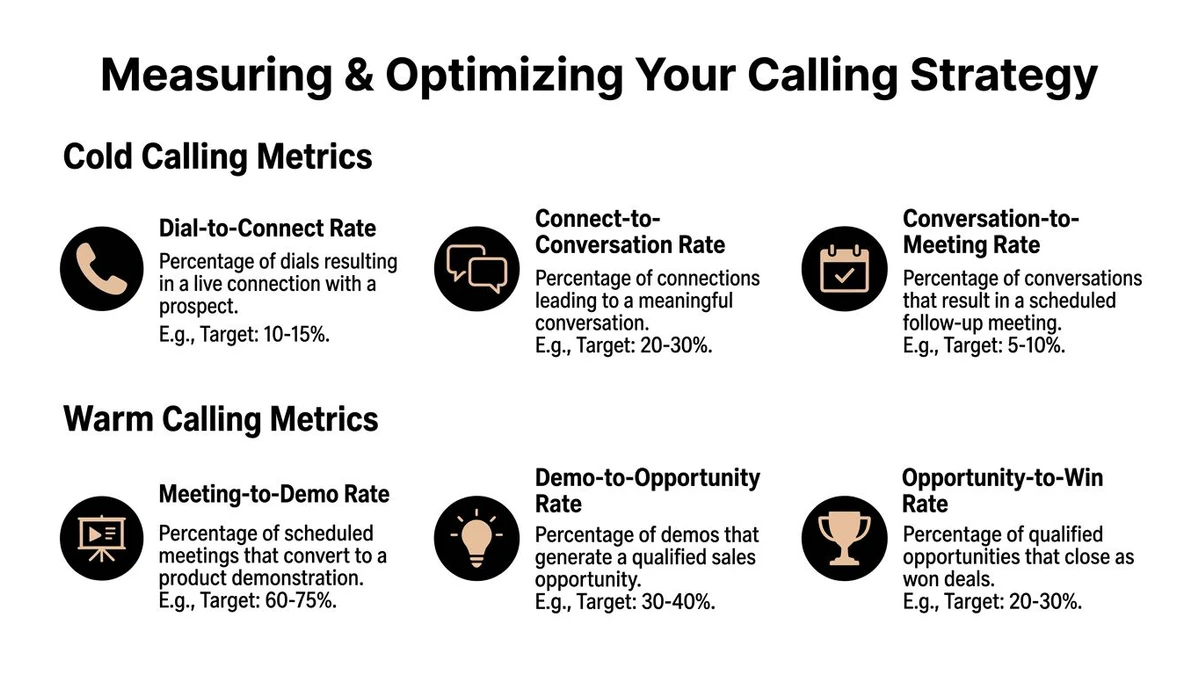
If you measure cold and warm calling with the same dashboard, you'll misread both.
Cold calling should be monitored for efficiency at the top of the funnel. Warm calling should be monitored for conversion quality and speed of follow-up. They serve different jobs, so they need different diagnostics.
What to track for cold calling
Focus on whether the team can reliably create conversations from a raw target list.
Track:
- Dial-to-connect rate: If this is weak, your phone data or dialing setup may be the issue.
- Connect-to-conversation rate: If connects happen but conversations die immediately, the opener or targeting may be off.
- Conversation-to-meeting rate: This tells you whether the rep is turning attention into a qualified next step.
- Attempts per account: Cold calling often needs persistence, so review whether reps quit too early or stay too long.
Your infrastructure matters too. If you're reviewing dialer setup, routing, and team workflow, these call centre software recommendations from Hosted Telecommunications are worth comparing against your current stack.
What to track for warm calling
Warm calling needs a tighter lens on responsiveness and downstream quality.
Watch:
- Lead-to-conversation rate: Are engaged leads turning into live exchanges?
- Conversation-to-meeting rate: This measures whether your context is strong enough to advance.
- Meeting quality: Sales should flag whether these meetings are qualified.
- Pipeline contribution: Warm calling should produce cleaner opportunities, not just faster meetings.
- Speed to follow-up: Delayed response weakens warm intent quickly.
When numbers slip, diagnose from the source of the signal. Low warm-call conversion may point to weak qualification, poor routing, or a value proposition that doesn't match the engagement trigger. Low cold-call connect rates usually point back to data hygiene, list construction, or calling infrastructure.
For teams already monitoring deliverability and list performance, these email marketing metrics help connect phone outcomes back to upstream email quality so sales and marketing can debug the same funnel together.
Good calling performance starts before the first dial. If your team warms prospects through email, lead forms, or automated sequences, cleaner data gives both marketing and SDRs a better shot at turning activity into real conversations. BillionVerify is one option for teams that want to verify email data before campaigns, reduce bad records in the pipeline, and build a warmer calling motion on more reliable contact inputs.