



Every B2B SaaS marketer knows the frustration when carefully crafted campaigns go unnoticed or land in spam folders. Keeping email lists clean is more than a technical chore—it is a vital part of delivering messages to real, engaged subscribers while protecting sender reputation. This guide breaks down bulk email cleaning and dispels common myths, helping you boost deliverability, maintain compliance, and keep your contact lists healthy.
Key Takeaways
| Point | Details |
|---|---|
| Importance of Email List Cleaning | Regular email list cleaning is essential for ensuring high deliverability and engagement rates. It protects sender reputation and complies with digital communication regulations. |
| Combatting Common Myths | Email list cleaning is not optional, and not all bulk emails are spam. Understanding these truths is crucial for effective marketing. |
| Risks of Neglecting List Hygiene | Ignoring list maintenance can lead to sender reputation damage, financial waste, and compliance violations, resulting in poor marketing performance. |
| Strategic Implementation | Implementing a multi-stage verification process combines automated checks with periodic reviews to maintain high-quality email databases. |
Defining Bulk Email Cleaning and Common Myths
Bulk email cleaning represents a strategic process of systematically removing invalid, outdated, or unengaged email addresses from marketing lists to enhance overall communication effectiveness. At its core, this practice ensures that marketing communications reach genuine, interested recipients while maintaining high deliverability standards.
The fundamental goal of bulk email cleaning goes beyond simple list maintenance. It involves distinguishing legitimate bulk communications from potentially harmful spam, protecting sender reputation and ensuring compliance with digital communication regulations. Marketers must understand that not all bulk emails are spam - the key distinction lies in recipient consent and engagement.
Several pervasive myths surround bulk email cleaning that can mislead marketing professionals:
- Myth 1: Email list cleaning is optional
- Myth 2: All bulk emails are considered spam
- Myth 3: List cleaning damages email list size
- Myth 4: One-time cleaning is sufficient
In reality, regular email list maintenance is crucial for several compelling reasons. Effective list cleaning helps organizations:
- Reduce email bounce rates
- Maintain high sender reputation
- Improve overall email engagement metrics
- Comply with data protection regulations
- Optimize marketing campaign performance
Companies that neglect email list hygiene risk significant drawbacks, including potential blacklisting by email service providers and decreased marketing effectiveness. Proactive list management is not just a technical task - it's a strategic business imperative.
Pro tip: Conduct email list cleaning at least quarterly to maintain optimal list health and maximize marketing ROI.
Core Functions and Workflow Explained
Bulk email cleaning is a sophisticated technical process involving multiple strategic steps designed to validate, purify, and optimize email marketing lists. At its core, the workflow encompasses comprehensive identification and removal of problematic email addresses that could potentially harm sender reputation and campaign performance.
The core functions of email list cleaning typically include several critical validation checks:
- Syntax Verification: Detecting and removing email addresses with incorrect formatting
- Domain Validation: Confirming legitimate and active email domains
- Disposable Email Detection: Identifying and filtering temporary or throwaway email addresses
- Role-Based Email Filtering: Removing generic emails like "admin@" or "support@"
- Catch-All Server Identification: Recognizing email servers that accept all incoming emails
The technical email automation workflow involves a systematic approach that combines algorithmic checks and real-time validation. Sophisticated email verification platforms utilize complex validation techniques that go beyond simple surface-level screening, incorporating multiple layers of verification to ensure maximum list accuracy.
A comprehensive email cleaning process typically follows a structured workflow:
- Initial list upload and preparation
- Syntax and format scanning
- Domain health assessment
- Email server communication verification
- Risk scoring and categorization
- Final list segmentation and cleaning
Advanced email verification technologies leverage machine learning and AI algorithms to continuously improve detection accuracy, distinguishing between genuinely problematic emails and those with minor, correctable issues. Intelligent cleaning systems can significantly reduce false positives while maintaining high standards of list hygiene.
Pro tip: Implement a multi-stage email verification process that combines automated checks with periodic manual review to maintain optimal list quality.
Types of Emails Identified and Removed
Email list cleaning involves a comprehensive process of identifying and eliminating various problematic email addresses that can negatively impact marketing campaign performance. Strategic email verification goes far beyond simple syntax checks, targeting multiple categories of potentially harmful contacts that could compromise sender reputation and deliverability.
The most critical types of emails typically identified and removed during email list cleaning processes include:
- Invalid Syntax Emails: Addresses with incorrect formatting or structural errors
- Disposable Email Addresses: Temporary accounts created for one-time use
- Role-Based Emails: Generic accounts like "admin@" or "support@"
- Inactive Subscriber Emails: Addresses with zero engagement over extended periods
- Duplicate Entries: Multiple identical email addresses in the same list
- Bounced Email Addresses: Consistently undeliverable contacts
- Spam Trap Emails: Deliberately created addresses to identify poor list hygiene
Technical validation involves multiple sophisticated checks to ensure comprehensive email list quality. Intelligent verification systems employ advanced algorithms that analyze email addresses across several critical dimensions, including domain health, server response, and historical engagement patterns.

Here's a summary comparing common email address issues and how cleaning addresses each:
| Email Issue Type | How Detected | Business Impact if Ignored |
|---|---|---|
| Invalid Syntax | Automated format checks | High bounce, lost deliverability |
| Disposable Address | Temporary domain lookup | Skewed engagement data |
| Role-Based Email | Pattern/keyword filters | Low personalization, spam hits |
| Inactive Subscriber | Engagement tracking | Reduced open/click rates |
| Spam Trap | Reputation monitoring | Possible blacklisting, penalties |
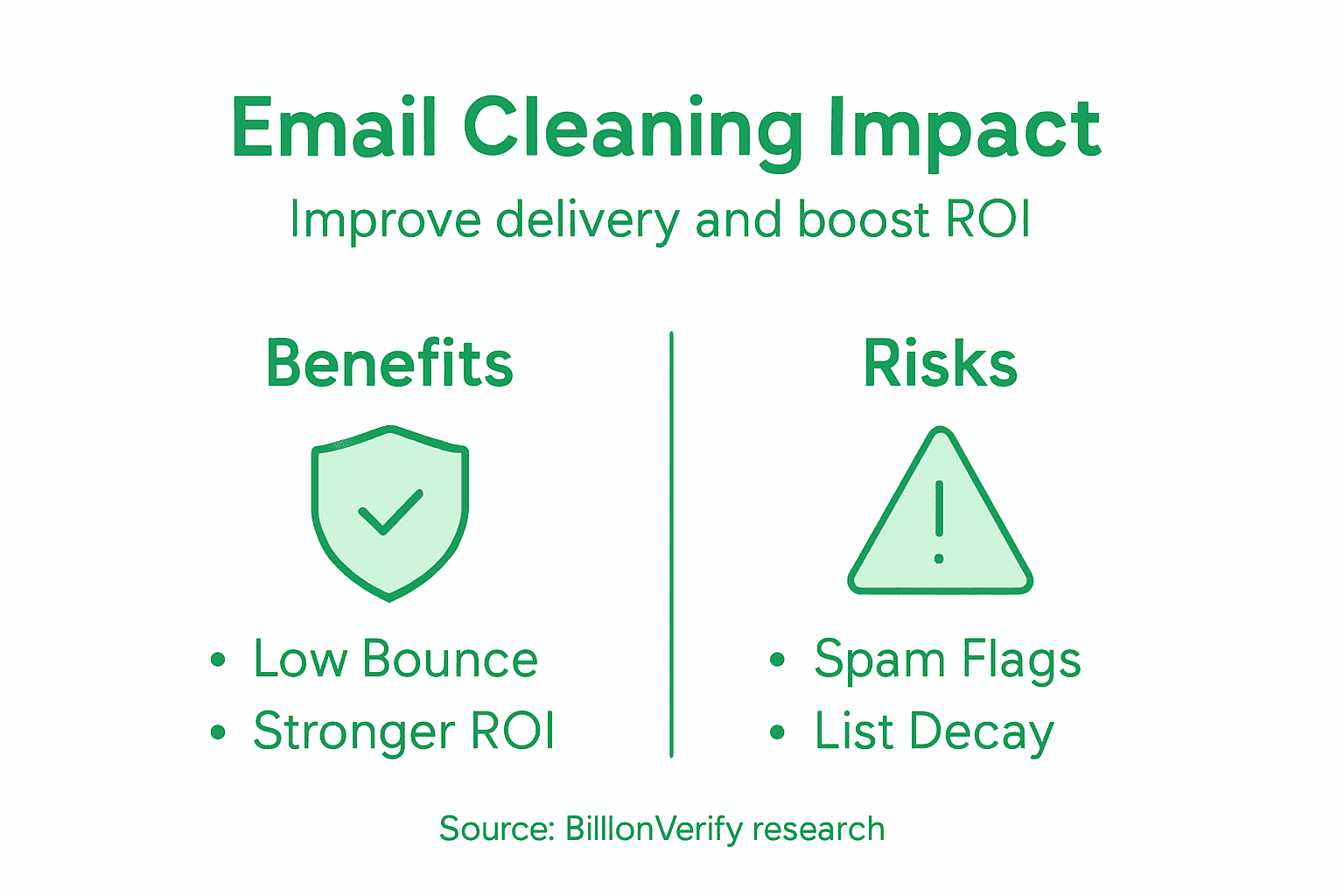
Marketers must understand that removing these problematic email addresses is not just about list size, but about maintaining high-quality communication channels. Strategically cleaning email lists directly impacts key performance metrics such as:
- Reducing email bounce rates
- Improving sender reputation scores
- Increasing overall campaign engagement
- Minimizing potential spam flagging
- Optimizing marketing resource allocation
High-performance email marketing requires a proactive approach to list management, treating email verification as an ongoing process rather than a one-time event. Advanced verification technologies now leverage machine learning to continuously refine detection mechanisms, helping businesses maintain pristine communication databases.
Pro tip: Implement automated email verification tools that provide real-time validation and periodic list health assessments to maintain optimal email list quality.
Real-World Uses for SaaS Marketing Teams
SaaS marketing teams leverage bulk email cleaning as a critical strategic tool to optimize their communication channels and maximize campaign performance. Email list hygiene has evolved from a peripheral activity to a core component of sophisticated digital marketing strategies, directly impacting customer acquisition and retention efforts.
The primary real-world applications of email verification for SaaS marketing teams include:
- Targeted Campaign Optimization: Removing unengaged or invalid contacts to improve audience segmentation
- Compliance Management: Ensuring adherence to global data protection regulations
- Reputation Protection: Maintaining high sender scores and avoiding spam filters
- Cost Efficiency: Reducing wasted marketing resources on non-responsive email addresses
- Performance Analytics: Generating more accurate engagement metrics
Companies implementing strategic email list cleaning can experience significant improvements in their marketing outcomes. Advanced verification processes enable SaaS teams to create more precise communication strategies by identifying and removing problematic email contacts.
Specific use cases for SaaS marketing teams demonstrate the transformative potential of email cleaning:
- Lead Qualification Refinement
- Account-Based Marketing Precision
- Customer Segmentation Enhancement
- Personalization Strategy Improvement
- Predictive Engagement Modeling
Intelligent email verification transforms raw contact data into a strategic asset, allowing marketing teams to develop more nuanced, targeted communication approaches. By systematically removing low-quality contacts, SaaS organizations can focus their efforts on genuinely interested potential customers.
Compare core benefits and risks for SaaS teams managing email lists:
| Practice | Main Benefit | Key Risk if Neglected |
|---|---|---|
| Regular List Cleaning | Higher deliverability, better campaigns | Budget waste, performance decline |
| Automated Verification | Real-time error catching, efficiency | Outdated contacts, compliance issues |
| Manual Review | Detects subtle list problems | Missed errors, data decay |
Pro tip: Integrate email verification as a continuous process, not a one-time event, to maintain consistently high-quality marketing databases.
Risks of Ignoring List Hygiene and Best Practices
Neglecting email list maintenance can devastate marketing performance and organizational reputation. Digital communication strategies require meticulous list management to prevent cascading negative consequences that extend far beyond simple email delivery challenges.
The most significant risks associated with poor email list hygiene include:
- Sender Reputation Damage: Increased likelihood of being marked as spam
- Financial Waste: Spending marketing budget on invalid contacts
- Compliance Violations: Potential legal risks from poor data management
- Engagement Rate Collapse: Dramatically reduced campaign effectiveness
- Analytics Distortion: Skewed performance metrics and misguided strategies
Email list cleaning practices reveal critical insights into preventing these substantial risks. Strategic verification acts as a protective mechanism, shielding organizations from potential digital communication pitfalls that can undermine marketing investments.
Marketers face multiple potential consequences when they ignore list hygiene:
- Permanent domain blacklisting
- Reduced email deliverability rates
- Increased marketing campaign costs
- Lower customer engagement potential
- Compromised data integrity
Proactive list management represents a fundamental defense mechanism against these risks. By implementing systematic email verification processes, organizations can maintain high-quality communication channels, protect their digital reputation, and optimize marketing resource allocation.
Pro tip: Develop a quarterly email list cleaning protocol that integrates automated verification with manual review to ensure comprehensive list hygiene.
Maximize Your Email Deliverability with Expert Bulk Email Cleaning
Maintaining a clean email list is no longer optional if you want to boost deliverability and increase your marketing ROI. This article highlights crucial challenges such as managing invalid emails, detecting disposable addresses, and protecting sender reputation through consistent bulk email cleaning. The risk of damaging your sender score or wasting marketing budget on unengaged contacts is real and can be avoided with strategic list hygiene.
With BillionVerify, you gain access to a trusted real-time email verification API and precise bulk list cleaning tools that eliminate problematic addresses like role-based emails and catch-all servers. Our advanced technology empowers SaaS marketing teams and businesses of all sizes to maintain high-quality lists, improve engagement, and safeguard your digital reputation effectively.
Take control of your email strategy today. Visit BillionVerify to start cleaning your email lists wisely and unlock the true potential of your bulk email campaigns now.
Frequently Asked Questions
What is bulk email cleaning?
Bulk email cleaning is the process of removing invalid, outdated, or unengaged email addresses from marketing lists to enhance communication effectiveness and maintain high deliverability standards.
Why is email list cleaning important for marketers?
Email list cleaning is essential for marketers as it helps reduce bounce rates, maintain sender reputation, improve engagement metrics, comply with regulations, and optimize overall marketing campaign performance.
How often should I conduct email list cleaning?
It is recommended to conduct email list cleaning at least quarterly to maintain optimal list health and maximize marketing ROI.
What types of problematic emails should be removed during the cleaning process?
During bulk email cleaning, problematic emails such as invalid syntax emails, disposable email addresses, role-based emails, inactive subscriber emails, duplicate entries, bounced addresses, and spam traps should be identified and removed.