



Sending the same email to everyone on your list is like shouting into a crowd—some people might hear you, but most will tune you out. Email segmentation transforms your marketing from mass broadcasting into targeted conversations that resonate with each subscriber's specific needs and interests.
What Is Email Segmentation?
Email segmentation is the practice of dividing your email list into smaller groups based on specific criteria. Instead of sending identical messages to everyone, you tailor content to match each segment's characteristics, behaviors, or preferences.
Why Segmentation Matters
The data is clear: segmented campaigns dramatically outperform non-segmented ones.
Performance Improvements from Segmentation:
- 14.3% higher open rates compared to non-segmented campaigns
- 100.9% higher click-through rates
- 760% increase in revenue from segmented campaigns
- Lower unsubscribe rates due to relevant content
The Core Principle
Segmentation works because it acknowledges a fundamental truth: your subscribers are not identical. They joined your list for different reasons, have different needs, and are at different stages of their relationship with your brand.
A new subscriber exploring your product needs different information than a long-time customer. A budget-conscious buyer responds to different messaging than a premium purchaser. Segmentation lets you honor these differences.
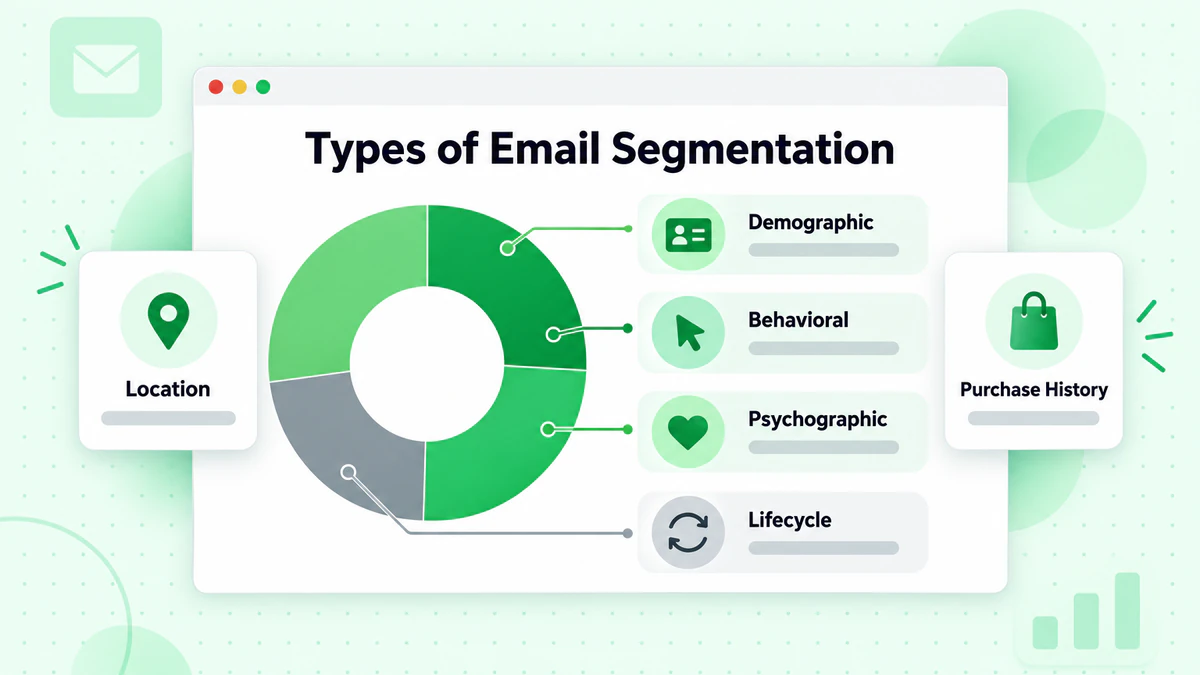
Types of Email Segmentation
Multiple segmentation approaches exist, each revealing different aspects of your subscribers.
Demographic Segmentation
Demographic segmentation divides subscribers by who they are—personal characteristics that define them.
Common Demographic Segments:
Age/Generation: Different generations have different communication preferences, interests, and purchasing behaviors.
Gender: Relevant for products or content that differ by gender.
Location: Geographic segmentation enables local events, regional offers, and timezone-appropriate sending.
Job Title/Role: Especially important in B2B, where decision-makers and implementers need different messaging.
Company Size: Enterprise clients have different needs than small businesses.
Industry: Industry-specific content demonstrates understanding of unique challenges.
Example Applications:
- Send winter product promotions only to cold-climate subscribers
- Target C-suite executives with ROI-focused messaging
- Adjust send times based on subscriber timezones
- Create industry-specific case studies
Behavioral Segmentation
Behavioral segmentation groups subscribers by what they do—their actions and interactions with your brand.
Email Engagement Behavior:
Open Activity: Segment by recency and frequency of opens.
- Active openers (opened in last 30 days)
- Declining engagement (opened recently but less frequently)
- Dormant (haven't opened in 90+ days)
Click Activity: Segment by link clicks, which indicate deeper engagement than opens.
- Frequent clickers
- Occasional clickers
- Non-clickers
Website Behavior:
Pages Visited: What they viewed reveals their interests.
- Product page visitors
- Pricing page visitors
- Blog readers
- Documentation users
Content Consumed: What they downloaded or read indicates topic interests.
Time on Site: Engagement depth signals purchase intent.
Purchase Behavior:
Purchase History: What they've bought guides recommendations.
- First-time buyers
- Repeat customers
- Category-specific purchasers
Purchase Frequency: How often they buy indicates loyalty level.
- One-time buyers
- Regular customers
- VIP/frequent purchasers
Purchase Value: Spending level segments customers by value.
- High-value customers
- Average-value customers
- Bargain seekers
Cart and Browse Abandonment: Items left behind signal interest.
Psychographic Segmentation
Psychographic segmentation groups subscribers by why they buy—their values, interests, and motivations.
Interest-Based Segments:
- Topic preferences indicated through clicks or preferences
- Product categories they engage with
- Content types they consume
Motivation-Based Segments:
- Price-sensitive vs. quality-focused
- Convenience-driven vs. experience-seeking
- Status-oriented vs. practical
Gathering Psychographic Data:
- Preference surveys during or after signup
- Tracking content engagement patterns
- Analyzing purchase motivations
- Monitoring social media activity
Lifecycle Segmentation
Lifecycle segmentation groups subscribers by their stage in the customer journey.
Typical Lifecycle Stages:
Subscribers: Signed up but haven't purchased.
- Need nurturing content
- Benefit from education
- Require trust-building
First-Time Buyers: Made initial purchase.
- Need onboarding support
- Open to cross-sell suggestions
- Critical retention window
Repeat Customers: Purchased multiple times.
- Loyalty-worthy
- Good referral candidates
- Interested in new products
Lapsed Customers: Previously purchased but inactive.
- Need re-engagement
- Respond to win-back offers
- Require understanding why they left
Advocates: Active promoters of your brand.
- Share referral opportunities
- Request testimonials
- Provide early access to new products
Engagement-Based Segmentation
Segment by how actively subscribers interact with your emails.
Engagement Tiers:
Highly Engaged: Open and click frequently.
- Safe to email more often
- Good candidates for feedback
- Priority for new offers
Moderately Engaged: Open sometimes, click occasionally.
- Standard sending frequency
- Test different content types
- Watch for declining engagement
Low Engagement: Rarely open, seldom click.
- Reduce frequency
- Try re-engagement campaigns
- Consider list cleaning
Unengaged: No activity for extended period.
- Send win-back series
- If no response, remove from list
- Verify email addresses before continuing
Building Effective Segments
Creating segments that drive results requires strategy, not just data.
Start with Your Goals
Different goals require different segmentation approaches.
If Your Goal Is:
- Increase revenue → Segment by purchase behavior and value
- Improve engagement → Segment by activity level
- Reduce churn → Segment by lifecycle stage
- Launch new product → Segment by interest and purchase history
Collect the Right Data
You can only segment by data you have. Build collection strategies.
Data Collection Methods:
At Signup:
- Ask 1-2 preference questions
- Capture source/referrer
- Note lead magnet chosen (indicates interest)
Progressive Profiling:
- Gradually collect more data over time
- Add questions in email surveys
- Track behavior to infer preferences
Implicit Data Collection:
- Email engagement tracking
- Website behavior monitoring
- Purchase history analysis
- Content consumption patterns
Explicit Data Collection:
- Preference center surveys
- Post-purchase feedback
- Account profile updates
- Direct subscriber questions
Ensure Segment Quality
Segments are only useful if they contain valid, deliverable addresses.
Quality Assurance Steps:
Verify Email Addresses: Use email verification to ensure segment members are real, deliverable addresses.
Remove Inactive Addresses: Unengaged subscribers who've been inactive for 6+ months may have abandoned those addresses.
Clean Before Segmenting: A segment full of invalid addresses can't perform well regardless of targeting accuracy.
Monitor Segment Health: Track deliverability metrics by segment to catch quality issues.
Balance Specificity and Scale
Too broad segments lack personalization; too narrow segments lack scale.
Finding the Right Balance:
- Start with broader segments (3-5 major groups)
- Test performance before creating sub-segments
- Ensure each segment has enough members for meaningful results
- Combine related micro-segments when scale is insufficient
Minimum Segment Sizes:
- For A/B testing: 1,000+ per variant for statistical significance
- For regular campaigns: 500+ for meaningful engagement data
- For targeted promotions: Depends on conversion value
Segmentation Strategies by Business Type
Different businesses benefit from different segmentation approaches.
E-commerce Segmentation
High-Value Segments for E-commerce:
Purchase Recency Segments:
- Bought in last 30 days → Cross-sell related products
- 31-90 days → Re-engagement with new arrivals
- 91-180 days → Win-back with incentive
- 180+ days → Re-activation campaign or removal
Category Affinity:
- Segment by most-purchased category
- Send relevant category updates
- Cross-sell complementary categories
Average Order Value:
- High AOV → Premium product features
- Medium AOV → Value bundles
- Low AOV → Clearance and deals
Cart Abandonment:
- Abandoned in last 24 hours → Urgent reminder
- 24-72 hours → Add incentive
- 72+ hours → Final chance with stronger offer
SaaS Segmentation
High-Value Segments for SaaS:
Trial Status:
- Active trial users → Feature education, support offers
- Inactive trial users → Re-engagement, use case inspiration
- Trial expiring soon → Conversion push, pricing discussion
Feature Usage:
- Power users → Advanced tips, beta access
- Light users → Core feature education
- Specific feature users → Related feature discovery
Plan Type:
- Free tier → Upgrade paths and benefits
- Paid tier → Retention, upsell to higher tiers
- Enterprise → Account management, custom solutions
Account Health:
- Healthy accounts → Expansion opportunities
- At-risk accounts → Proactive support
- New accounts → Onboarding optimization
B2B Segmentation
High-Value Segments for B2B:
Company Characteristics:
- Company size (SMB vs. enterprise)
- Industry vertical
- Technology stack
- Growth stage
Buying Stage:
- Awareness → Educational content
- Consideration → Comparison guides, case studies
- Decision → Demos, trials, pricing
Role in Purchase:
- Decision makers → ROI, business impact
- Influencers → Features, capabilities
- Users → Functionality, ease of use
Account Engagement:
- Multi-stakeholder engaged → Coordinated approach
- Single contact → Expand within account
- Inactive accounts → Re-engagement
Content/Media Segmentation
High-Value Segments for Publishers:
Content Preferences:
- By topic/category interest
- By content format (articles, videos, podcasts)
- By content depth (beginner vs. advanced)
Engagement Depth:
- Heavy consumers → Premium content, subscriptions
- Regular readers → Newsletter and updates
- Occasional visitors → Re-engagement with best content
Subscription Status:
- Free subscribers → Premium value demonstration
- Paid subscribers → Retention, additional products
- Churned → Win-back campaigns
Implementing Segmentation
Strategy without execution achieves nothing. Here's how to implement segmentation.
Step 1: Audit Your Data
Before segmenting, understand what data you have.
Data Audit Questions:
- What subscriber attributes do we collect?
- What behavioral data do we track?
- Is our data accurate and current?
- What data gaps prevent desired segmentation?
Common Data Sources:
- Email service provider
- CRM system
- E-commerce platform
- Website analytics
- Customer support systems
Step 2: Define Your Initial Segments
Start simple with 3-5 segments that clearly differ.
Simple Starting Segments:
- New subscribers (joined in last 30 days)
- Engaged non-buyers (active but no purchase)
- One-time buyers
- Repeat customers
- Inactive subscribers (no engagement in 90+ days)
Step 3: Create Segment Rules
Define clear, automated rules for segment membership.
Rule Types:
Static Segments: Fixed membership based on one-time criteria.
- Example: "Attended 2024 webinar"
Dynamic Segments: Membership changes as data updates.
- Example: "Purchased in last 30 days"
Combined Segments: Multiple criteria create specific groups.
- Example: "High-value customer AND interested in Product X"
Step 4: Develop Segment-Specific Content
Create content tailored to each segment's needs.
Content Customization Options:
Full Email Variants: Completely different emails per segment.
- Most personalized
- Most resource-intensive
- Best for widely different segments
Dynamic Content Blocks: Same email structure with swapped sections.
- Efficient production
- Good personalization
- Works well for moderate differences
Personalization Tokens: Same email with inserted personal elements.
- Easiest to implement
- Limited personalization
- Good starting point
Step 5: Test and Refine
Treat segmentation as ongoing optimization, not one-time setup.
Testing Approaches:
Segment vs. Non-Segmented: Does segmentation improve results?
Segment Definition Testing: Do different criteria create better segments?
Content Testing Within Segments: What content resonates with each segment?
Timing Testing by Segment: Do segments respond to different send times?
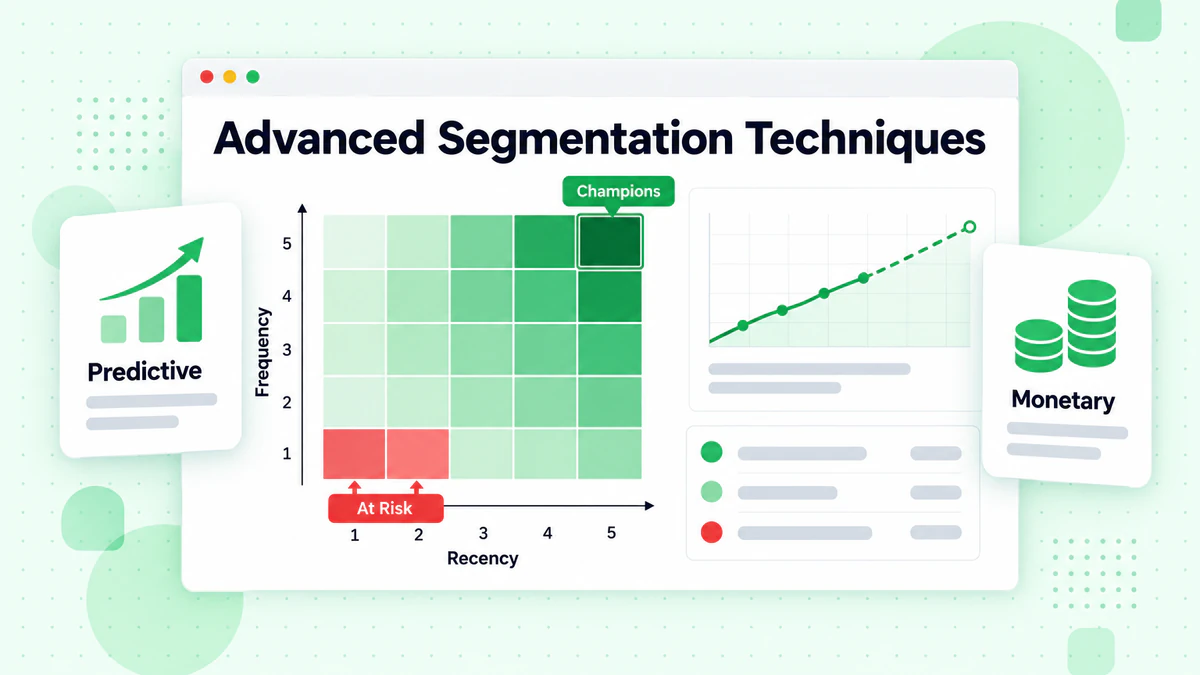
Advanced Segmentation Techniques
Once basic segmentation works, explore advanced approaches.
Predictive Segmentation
Use data patterns to predict future behavior.
Predictive Segment Types:
Likely to Purchase: Subscribers showing buying signals.
- High website activity
- Pricing page visits
- Cart additions
Likely to Churn: Customers showing disengagement signals.
- Declining email engagement
- Reduced product usage
- Support ticket patterns
High Lifetime Value Potential: Subscribers with characteristics of your best customers.
- Similar to top customer profiles
- High early engagement
- Quality acquisition source
RFM Segmentation
RFM (Recency, Frequency, Monetary) analysis creates powerful customer segments.
RFM Components:
- Recency: How recently did they purchase?
- Frequency: How often do they purchase?
- Monetary: How much do they spend?
RFM Segment Examples:
Champions (High R, High F, High M): Best customers.
- Reward and recognize
- Ask for referrals
- Provide early access
Loyal Customers (Medium R, High F, Medium M): Consistent buyers.
- Upsell higher-value products
- Provide loyalty perks
- Gather feedback
At Risk (Low R, High F, High M): Former best customers becoming inactive.
- Urgent re-engagement
- Personal outreach
- Special win-back offers
New Customers (High R, Low F, Variable M): Recent first purchase.
- Onboarding focus
- Cross-sell gently
- Encourage second purchase
Engagement Scoring
Create numeric engagement scores for sophisticated segmentation.
Building an Engagement Score:
Activity Points:
- Email open: +1 point
- Email click: +3 points
- Website visit: +2 points
- Product view: +3 points
- Cart addition: +5 points
- Purchase: +10 points
Time Decay: Recent activities count more.
- Activities this week: Full points
- Activities this month: 50% points
- Activities older than month: 25% points
Score-Based Segments:
- 80+ points: Highly engaged
- 40-79 points: Moderately engaged
- 10-39 points: Low engagement
- 0-9 points: Disengaged
Segmentation Mistakes to Avoid
Learn from common segmentation pitfalls.
Over-Segmentation
The Problem: Creating too many small segments that are difficult to manage and lack statistical significance.
The Fix: Start with broader segments; only create sub-segments when you have specific content for them and sufficient scale.
Static Segment Thinking
The Problem: Treating segments as permanent when subscribers' status changes.
The Fix: Use dynamic segments that update automatically based on current data.
Ignoring Segment Overlap
The Problem: Subscribers belonging to multiple segments receive conflicting or duplicate messages.
The Fix: Prioritize segments and set rules for handling overlap.
Data Quality Neglect
The Problem: Basing segmentation on outdated, incomplete, or invalid data.
The Fix: Regularly verify email addresses, clean data, and update subscriber information.
Segmenting Without Strategy
The Problem: Creating segments because you can, not because they serve a purpose.
The Fix: Each segment should have specific content and goals; if not, it's not needed.
Measuring Segmentation Success
Track these metrics to evaluate segmentation effectiveness.
Segment Performance Metrics
Compare Across Segments:
- Open rates by segment
- Click rates by segment
- Conversion rates by segment
- Revenue per subscriber by segment
- Unsubscribe rates by segment
Segmented vs. Non-Segmented
Compare Similar Campaigns:
- Segmented campaign performance
- Non-segmented (blast) performance
- Lift from segmentation
Segment Health Metrics
Monitor Segment Quality:
- Segment size trends
- Bounce rates by segment
- Engagement distribution within segments
- Segment membership churn
Getting Started with Segmentation
Ready to implement? Follow this action plan.
This Week
- Audit your current data: What segmentation is currently possible?
- Verify list quality: Clean your list with email verification before segmenting
- Identify your most obvious segment: What's the clearest division in your audience?
This Month
- Create 3-5 initial segments: Start simple with clear distinctions
- Develop segment-specific content: Create at least one tailored email per segment
- Test performance: Compare segmented vs. non-segmented results
Ongoing
- Expand segmentation: Add new segments as you gather more data
- Refine existing segments: Optimize based on performance data
- Maintain data quality: Regular verification and cleaning
- Test continuously: Never stop optimizing
Conclusion
Email segmentation transforms generic broadcasting into targeted conversations. By grouping subscribers based on demographics, behaviors, interests, and lifecycle stages, you can deliver relevant content that drives engagement and conversions.
Remember these key principles:
- Start simple: Begin with 3-5 clear segments before getting complex
- Use quality data: Verify email addresses to ensure segments contain real subscribers
- Match content to segments: Segmentation without tailored content provides no benefit
- Measure and optimize: Track performance by segment and continuously improve
- Keep segments dynamic: Update automatically as subscriber data changes
The most successful email marketers treat segmentation as an ongoing practice, not a one-time project. As you learn more about your subscribers, your segmentation becomes increasingly sophisticated and effective.
Ready to build high-performing segments on a foundation of verified emails? Start with BillionVerify to ensure your subscriber data is accurate and deliverable.
BillionVerify integrates directly with HubSpot, Mailchimp, and ActiveCampaign to keep contact lists clean automatically.