



Email remains the most effective digital channel for nonprofit fundraising, donor retention, and supporter engagement. Unlike commercial marketing, nonprofit emails build relationships around shared values and collective impact. This guide covers email strategies specifically designed for charitable organizations, from donor cultivation to advocacy campaigns.
The Nonprofit Email Difference
Understanding what makes nonprofit communications unique.
Mission-Driven Communication
Unlike Commercial Email:
- Not selling products—sharing impact
- Building community, not just customers
- Emotional connection to cause
- Long-term relationship focus
- Multiple engagement types (donate, volunteer, advocate)
Nonprofit Email Goals:
- Inspire and inform
- Cultivate donor relationships
- Drive fundraising
- Mobilize advocates
- Build community
Unique Challenges
Budget Constraints:
- Limited marketing resources
- Must justify every expense
- Need maximum efficiency
Multiple Audiences:
- Donors (various giving levels)
- Volunteers
- Beneficiaries
- Advocates
- Board members
- Partners
Sensitive Content:
- Stories of vulnerable populations
- Urgent needs without exploitation
- Balancing hope and need
- Donor fatigue management
Email Types for Nonprofits
Fundraising:
- Campaign appeals
- Year-end giving
- Matching gift opportunities
- Recurring donor asks
- Major gift cultivation
Engagement:
- Welcome series
- Impact updates
- Newsletters
- Thank you messages
- Anniversary recognition
Advocacy:
- Action alerts
- Petition requests
- Voter engagement
- Policy updates
Operational:
- Event invitations
- Volunteer coordination
- Receipt and confirmation
- Program updates
Building Your Nonprofit Email List
Growing and maintaining supporter lists.
Acquisition Strategies
Website Capture:
- Newsletter signup forms
- Resource downloads
- Impact updates subscription
- Event registration
Donation Process:
- Every donor should receive emails
- Opt-in for additional communications
- Ask about communication preferences
Events and In-Person:
- Event attendance lists (with permission)
- Volunteer signup
- Program participation
- Community gatherings
Social Media:
- Link to email signup
- Promote newsletter content
- Run signup campaigns
- Convert followers to subscribers
Lead Magnets for Nonprofits
Effective Offers:
- Impact report download
- Cause-specific guides
- Toolkit or resource collection
- Research reports
- Infographics
- Exclusive content access
Examples:
"Download our 2024 Impact Report"
"Free Guide: 10 Ways to Help [Cause]"
"Get our monthly action toolkit"
Permission and Consent
Best Practices:
- Clear opt-in language
- Explain what they'll receive
- Easy unsubscribe always
- Honor preferences immediately
- Document consent
Legal Compliance:
Donor Cultivation Emails
Nurturing relationships with supporters.
Welcome Series
Purpose: Introduce new supporters to your organization and mission
Email 1 (Immediate):
Subject: Welcome to [Organization Name]

Hi [Name],

Thank you for joining our community!

You're now part of [X] supporters working to
[mission statement].

Here's what you can expect:
• [Frequency] updates on our work
• Stories of impact from the field
• Opportunities to make a difference

[Link to learn more about our work]

Welcome to the family!

[Executive Director Name]
Email 2 (Day 3):
Subject: Why we do this work

Hi [Name],

I wanted to share why [Organization] exists.

[Story of founding or key moment]

Every day, our team works to [impact statement].
But we can't do it alone.

People like you make this work possible.

[Link to impact stories]

Thank you for being part of this,
[Name]
Email 3 (Day 7):
Subject: Meet someone you're helping

Hi [Name],

I'd like you to meet [Beneficiary Name/Story].

[Brief, respectful story of impact]

Your support of [Organization] helps people
like [Name] every day.

Thank you for making stories like this possible.

[Link to more impact stories]

Gratefully,
[Name]
Engagement Emails
Monthly Newsletter:
Subject: What you made possible this month

Hi [Name],

Here's what your support accomplished in [Month]:

IMPACT BY THE NUMBERS
• [Metric 1]
• [Metric 2]
• [Metric 3]

STORY OF THE MONTH
[Brief impact story with photo]

WHAT'S NEXT
[Upcoming initiatives or needs]

TAKE ACTION
[Optional: advocacy or volunteer ask]

Thank you for being part of this work.

[Signature]
Impact Update:
Subject: You did this: [Specific accomplishment]

Hi [Name],

Because of supporters like you, we just
[specific achievement].

[Details and context]

This wouldn't have happened without you.

[Share button] Share this news

Thank you,
[Name]
Donor Anniversary Recognition
First Anniversary:
Subject: One year of making a difference together

Hi [Name],

One year ago today, you joined our mission.

Since then, you've helped us:
• [Impact point 1]
• [Impact point 2]
• [Impact point 3]

Thank you for standing with us. Here's to
another year of impact together.

[Link to renew/upgrade commitment]

Gratefully,
[Name]
Fundraising Email Campaigns
Driving donations through email.
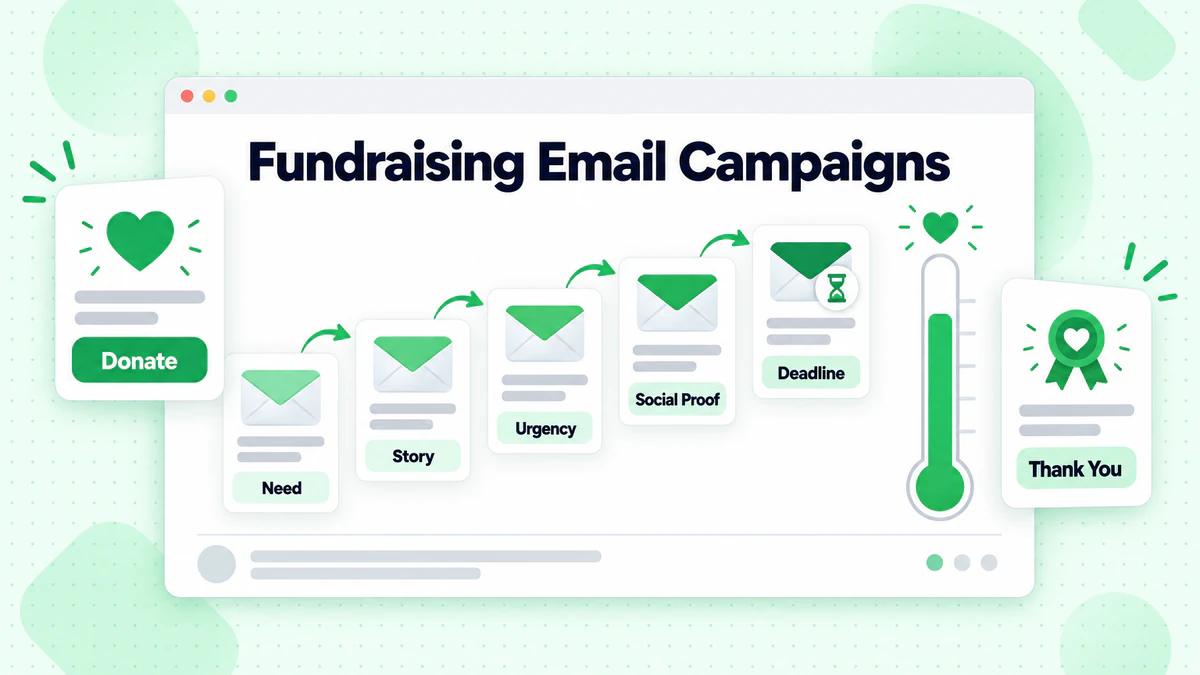
Campaign Structure
Standard Appeal Sequence:
Email 1: Introduce the campaign/need Email 2: Tell a story Email 3: Create urgency Email 4: Social proof Email 5: Final deadline
Fundraising Email Templates
Initial Appeal:
Subject: [Name], can you help?

Hi [Name],

Right now, [describe situation or need].

[Brief but compelling context]

Your gift of [$X] today can [specific impact].

[Donate Now button]

Every dollar matters. Every donor matters.
Will you help?

[Donation tiers if applicable]

Thank you for considering,
[Name]
Story-Based Appeal:
Subject: [Beneficiary Name]'s story

Hi [Name],

I want to tell you about [Beneficiary].

[Compelling story, told respectfully]

Today, [Beneficiary] is [positive outcome].
This was possible because of donors like you.

Right now, there are more people who need
our help. Will you give today?

[Donate Now button]

Thank you,
[Name]
Urgency Appeal:
Subject: 48 hours left to reach our goal

Hi [Name],

We're [X%] of the way to our goal of [amount].

With 48 hours left, we need [remaining amount]
to [what reaching goal enables].

Can you help us close the gap?

[Donate Now button]

Every gift brings us closer.

Thank you,
[Name]
Matching Gift Appeal:
Subject: Your gift = DOUBLE impact today

Hi [Name],

A generous donor will match every gift today,
dollar for dollar, up to [amount].

That means your $50 becomes $100.
Your $100 becomes $200.
Your $500 becomes $1,000.

[Donate Now button]

This match expires at midnight. Don't miss
this chance to double your impact.

Thank you,
[Name]
Year-End Fundraising
The Biggest Opportunity:
- 30% of annual giving happens in December
- 10% happens on December 31 alone
- Plan a comprehensive sequence
Year-End Sequence:
Early December: Set the stage Mid-December: Tell impact stories Week of Christmas: Giving Tuesday follow-up December 28-30: Urgency building December 31: Multiple emails (morning, afternoon, evening) January 1: Thank you and tax reminder
December 31 Final Email:
Subject: Hours left to make a difference in 2024

Hi [Name],

2024 is almost over. This is your last chance
to make a tax-deductible gift this year.

With your help, we can enter 2025 ready to
[mission impact].

[Donate Now button]

Thank you for everything you've done this year.
Let's finish strong.

Gratefully,
[Name]

P.S. All gifts postmarked by December 31 are
tax-deductible for 2024.
Recurring Giving
Monthly Donor Cultivation:
Subject: Join our [Monthly Giving Program Name]

Hi [Name],

What if you could make a difference every
single month?

Our [Program Name] members give automatically
each month, providing reliable support that
helps us plan ahead and do more.

For just $[X]/month, you can:
• [Impact of monthly giving]
• [Benefit to donor]
• [Community aspect]

[Become a Monthly Donor button]

Join [X] monthly donors making sustained
impact possible.

Thank you,
[Name]
Advocacy and Action Emails
Mobilizing supporters for change.
Action Alert Structure
Effective Action Emails:
- Clear subject line with action
- Brief context (why now)
- Specific ask (one action)
- Easy action (one click)
- Deadline (if applicable)
Action Alert Template:
Subject: ACTION NEEDED: [Specific ask]

Hi [Name],

[One sentence on why this matters now]

[Brief context - 2-3 sentences max]

TAKE ACTION NOW:
[Button: Sign the Petition / Email Your Rep / etc.]

This takes 30 seconds and makes a real difference.

[Optional: Current count of actions taken]

Thank you for raising your voice,
[Name]
Petition Campaigns
Launch Email:
Subject: Add your name: [Petition topic]

Hi [Name],

We're calling on [target] to [action].

[Brief explanation of why]

Will you add your name?

[Sign Now button]

[X] people have already signed. Join them.

[Name]
Follow-Up Email:
Subject: [X] signed—we need [Y] more

Hi [Name],

Thank you to everyone who's signed our petition.
We've reached [X] signatures!

But we need [Y] more to make our voice heard.

If you haven't signed yet, please add your name:
[Sign Now button]

Already signed? Share with friends:
[Share buttons]

Together, we can make a difference.

[Name]
Advocacy Campaign Sequence
Email 1: Introduce the issue Email 2: Share personal story Email 3: Action request Email 4: Progress update Email 5: Final push Email 6: Victory or next steps
Segmentation for Nonprofits
Tailoring messages to supporter types.
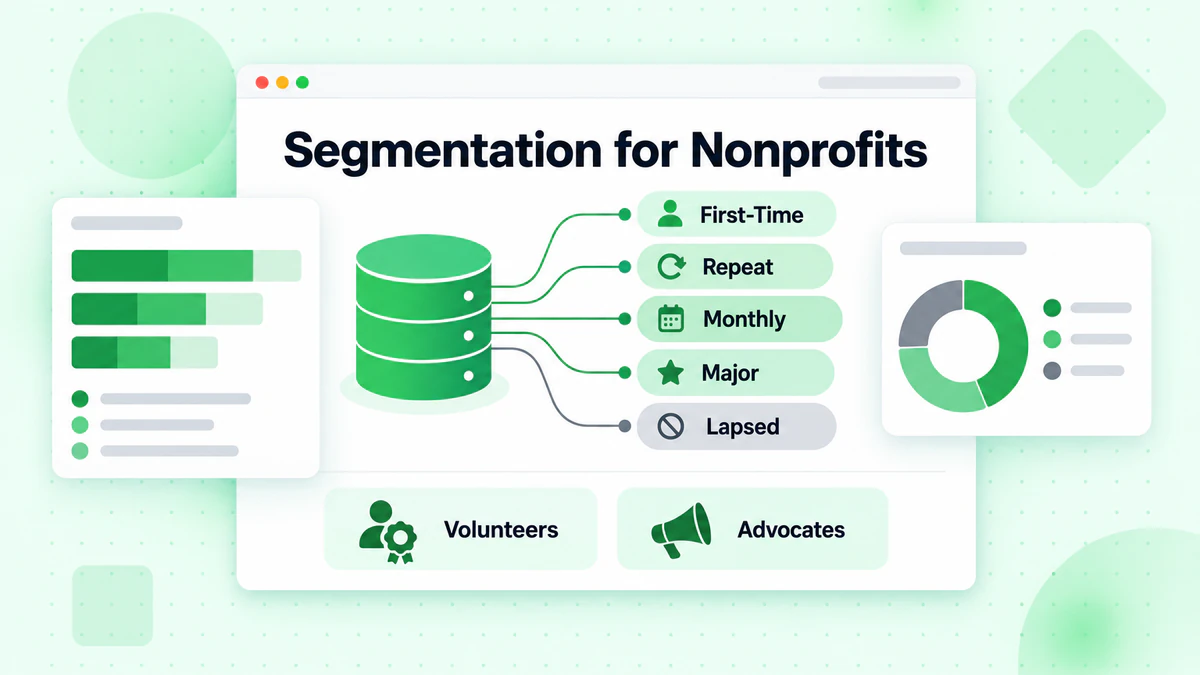
Key Segments
By Giving Level:
- Non-donors
- First-time donors
- Repeat donors
- Major donors
- Monthly donors
- Lapsed donors
By Engagement Type:
- Donors only
- Volunteers
- Advocates
- Event attendees
- Content engagers
By Relationship Length:
- New (under 1 year)
- Established (1-3 years)
- Long-term (3+ years)
- Lapsed (no activity 12+ months)
Segment-Specific Messaging
First-Time Donors:
- Heavy gratitude
- Impact of their specific gift
- Welcome to community
- Story of change they enabled
Monthly Donors:
- Special recognition
- Exclusive updates
- Behind-the-scenes access
- Early event access
Major Donors:
- Personal touches
- Direct access to leadership
- Detailed impact reporting
- Recognition opportunities
Lapsed Donors:
- Reconnection focus
- Update on what's changed
- New programs or impact
- Easy re-engagement path
Communication Preferences
Respect Preferences:
- Frequency preferences
- Content type preferences
- Communication channel
- Opt-down options (not just opt-out)
Preference Center:
Update your preferences:
□ Monthly newsletter
□ Fundraising appeals
□ Action alerts
□ Event invitations
□ Volunteer opportunities
Nonprofit Email Best Practices
Maximizing impact and engagement.
Subject Lines That Work
Effective Patterns:
- Personal: "Can you help, [Name]?"
- Story: "[Beneficiary]'s story"
- Impact: "You made this possible"
- Urgency: "24 hours to double your gift"
- Curiosity: "Something you should see"
Avoid:
- All caps
- Excessive punctuation
- Guilt-inducing language
- Misleading subjects
Email Design
Best Practices:
- Clean, simple design
- Mobile-optimized
- Clear hierarchy
- Minimal images (for deliverability)
- Easy-to-find CTA
Nonprofit Design Tips:
- Authentic photos (not stock)
- Consistent branding
- Accessible design
- Personal signatures
Storytelling in Email
Story Structure:
- Introduce the person/situation
- Describe the challenge
- Show the intervention
- Reveal the outcome
- Connect to reader's role
Story Guidelines:
- Dignity and respect
- Consent from subjects
- Hope alongside need
- Specific, not generic
- Show agency, not victimhood
Donation Ask Best Practices
Effective Asks:
- Specific amounts with impact
- Give options (tiers)
- Monthly option always
- Make it easy (few clicks)
- Mobile-friendly forms
Ask Amount Psychology:
$25 = provides [specific impact]
$50 = provides [specific impact]
$100 = provides [specific impact]
$250 = provides [specific impact]
Other: $_____
Thank You Emails
The most important emails you send.
Immediate Thank You
Automated Receipt (Immediate):
Subject: Thank you for your gift!

Hi [Name],

Thank you for your generous gift of $[Amount]
to [Organization Name].

YOUR IMPACT
Your gift will help us [specific impact].

TAX INFORMATION
Date: [Date]
Amount: $[Amount]
[Organization] is a 501(c)(3) nonprofit.
EIN: [Number]

Thank you for making our work possible.

[Signature]
Personal Follow-Up
Executive Thank You (Within 48 hours for significant gifts):
Subject: A personal thank you

Hi [Name],

I wanted to personally thank you for your
generous gift of $[Amount].

[Personal note about impact or current work]

Donors like you make everything we do possible.
I'm grateful for your partnership.

Thank you,
[Executive Director Name]
Impact Update
90-Day Impact Email:
Subject: Here's what your gift accomplished

Hi [Name],

Three months ago, you made a gift of $[Amount]
to [Organization].

Here's what's happened since:

[Specific impact updates]

Thank you for making this possible.

Gratefully,
[Name]
Measuring Nonprofit Email Success
Metrics that matter for mission.
Key Metrics
Engagement Metrics:
- Open rate (aim: 20-30%)
- Click rate (aim: 2-5%)
- Unsubscribe rate (keep under 0.5%)
Fundraising Metrics:
- Conversion rate (email to donation)
- Average gift from email
- Revenue per email sent
- Cost per dollar raised
Relationship Metrics:
- Donor retention rate
- Upgrade rate
- Monthly conversion rate
- Email contribution to overall fundraising
Nonprofit Benchmarks
By Email Type:
| Email Type | Open Rate | Click Rate |
|---|---|---|
| Welcome | 40-60% | 10-15% |
| Newsletter | 20-30% | 3-5% |
| Fundraising | 15-25% | 2-4% |
| Action Alert | 25-35% | 8-12% |
| Thank You | 50-70% | 5-10% |
Testing for Nonprofits
What to Test:
- Subject lines (story vs. ask)
- Ask amounts
- Story vs. statistics
- Send timing
- Sender name
- Email length
Common Nonprofit Mistakes
Pitfalls to avoid.
Mistake 1: Only Asking for Money
Problem: Every email is an appeal. Fix: Follow 3:1 ratio (3 engagement : 1 ask).
Mistake 2: Generic Messages
Problem: Same email to everyone. Fix: Segment and personalize.
Mistake 3: Weak Thank Yous
Problem: Automated receipts only. Fix: Multiple, meaningful thank yous.
Mistake 4: Ignoring Storytelling
Problem: Statistics without stories. Fix: Lead with stories, support with data.
Mistake 5: Inconsistent Sending
Problem: Only email when asking. Fix: Regular engagement cadence.
Mistake 6: Poor Mobile Experience
Problem: Emails don't work on phones. Fix: Mobile-first design.
Nonprofit Email Calendar
Planning your year.
Annual Calendar Framework
| Month | Focus | Key Campaigns |
|---|---|---|
| January | Renewal | Thank you, renewal ask |
| February | Awareness | Cause awareness month |
| March | Spring | Spring campaign |
| April | Volunteer | Volunteer month |
| May | Annual | Annual report release |
| June | Mid-Year | Mid-year update |
| July | Summer | Summer slump engagement |
| August | Back-to-School | Relevant programming |
| September | Fall | Fall campaign launch |
| October | Planning | Year-end preview |
| November | Giving Tuesday | GivingTuesday campaign |
| December | Year-End | Year-end campaign |
Key Dates
Universal:
- Giving Tuesday (Tuesday after Thanksgiving)
- Year-end (December 31)
- Tax deadline (April 15)
Cause-Specific:
- Awareness months
- International days
- Relevant policy dates
Data Quality for Nonprofits
Why list health matters for mission.
The Nonprofit Challenge
Limited Resources Mean:
- Every email must count
- Deliverability affects donations
- Invalid addresses waste limited budget
- Missed donors = missed mission funding
Verification Benefits
For Nonprofits:
- More appeals reach donors
- Better email deliverability = more donations
- Accurate metrics for reporting
- Lower email costs through list cleaning
Clean List Practices
Verify Regularly:
- Before major campaigns
- After list imports
- Quarterly maintenance
Remove Invalids:
- Hard bounces immediately
- Soft bounces after attempts
- Long-term unengaged
Conclusion
Nonprofit email marketing builds relationships that fund and further your mission. Success comes from authentic storytelling, genuine gratitude, and consistent engagement—not just asking for money.
Key nonprofit email principles:
- Lead with impact: Show supporters what they make possible
- Tell stories respectfully: Dignity and hope alongside need
- Thank abundantly: Gratitude is your most important email
- Segment thoughtfully: Different supporters need different messages
- Maintain consistent engagement: Don't only email when asking
Every invalid email address represents a supporter you can't reach and a donation you might miss. Implementing email verification helps nonprofits maximize their limited marketing budgets.
Combine your nonprofit email strategy with segmentation and email deliverability best practices to ensure your mission reaches more supporters. Ready to ensure your nonprofit emails reach every supporter? Start with BillionVerify to verify your donor list and maximize your fundraising impact.
Nonprofits expanding donor or volunteer outreach can discover local prospects through Chamber of Commerce directories and BBB listings. Verify every contact before adding them to campaigns to maintain list hygiene and protect your sender reputation.