
Nonprofit email marketing is the steady flow of appeals, thank-you notes, newsletters and action alerts that a charity sends to people who agreed to hear from it. The channel matters for money. In the 2026 edition of the M+R study, email accounted for 11% of online revenue in 2025, and the median fundraising email raised $54 for every thousand sent. Email marketing for nonprofits also carries duties that differ by country, from IRS receipts in the US to consent rules in the UK and Canada. This guide gathers the published numbers and rules in one place, then covers the supporter list, the core emails, the year-end rush and the address quality that decides whether any of it arrives.
The nonprofit email marketing best practices below rest on published data, and every figure comes from the organization named next to it, as read in November 2026. Vendors and regulators change their pages, so check the live source before you act. We have no connection with any vendor or agency mentioned here. BillionVerify is an email verification service, and the section on list quality explains where it fits. This is general information, not legal advice.
Key facts (checked November 2026):
- The M+R Benchmarks 2026 email chapter reports that email supplied 11% of all online revenue and that nonprofits raised $54 per 1,000 fundraising messages sent in 2025.
- The study's fundraising chapter shows 37% of 2025 online revenue arriving in December and 10% in the last week of the year.
- IRS Publication 1771 says a donor needs a written acknowledgment for any single gift of $250 or more, and that an email addressed to the donor counts.
- Canada's CASL regulations exclude messages from a registered charity whose primary purpose is fundraising from section 6 of the Act, which sets the consent rules.
- The UK ICO guidance on electronic mail marketing says the soft opt-in rule does not cover charity fundraising.
- Gmail's sender guidelines require SPF, DKIM, DMARC and a one-click unsubscribe link from senders of 5,000 or more messages a day.
How Nonprofit Email Differs From Commercial Email
Email marketing for nonprofit organizations asks for a gift, a signature, an hour or an opinion, not for a purchase. Supporters join for a cause, so the relationship matters more than any single transaction. The audience is mixed as well: donors at different giving levels, volunteers, advocates, board members, partners and the people the organization serves. Each group needs a different message, and a single person can sit in three of them at once.
The study shows how that mix looks in practice. A typical subscriber received 50 messages in 2025, and 31 of them were fundraising appeals. Nine were newsletters, two carried an advocacy action, and the rest were engagement or other messages. That works out to about a message a week, with wide gaps between sectors: Wildlife and Animal Welfare groups sent 108 per subscriber, more than twice the average.
Volume has a cost. The study found that 4% of subscribers at the start of 2025 became unreachable through bounces, and another 12% were lost to unsubscribes. Disaster and International Aid groups saw a 6% bounce rate and a 21% unsubscribe rate. A nonprofit email list needs constant replenishing and cleaning, which is why the list comes before any template in this guide.
The study reports medians, so treat its figures as a rough guide to what a typical send produces. The table compares the two message types it measured. Its example of 100,000 subscribers is an illustration, not a forecast.
| Measure | Fundraising email | Advocacy email |
|---|---|---|
| Click-through rate | 0.59% | 2.3% |
| Response rate | 0.05% | 1.4% |
| Result for a list of 100,000 | About 50 donations, about $5,400 | About 1,400 actions |
A signature costs the reader nothing and a gift costs money, so the gap in response is no surprise. Advocacy mail also feeds fundraising: 0.34% of people who took an action went on to donate on the page that followed.
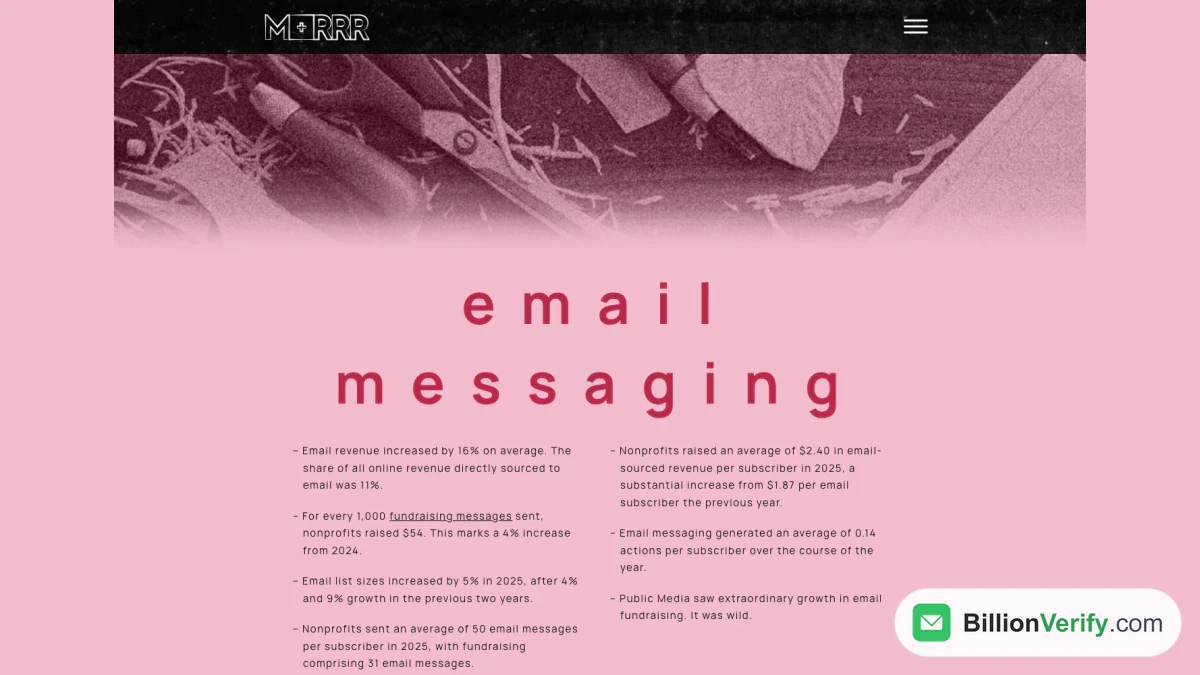
Screenshot: the opening findings of the email messaging chapter, with revenue per thousand fundraising messages sent, captured in November 2026.
Build a List You Are Allowed to Mail
Permission comes before every template. A nonprofit email list grown from consent holds up through the year-end fundraising rush, while a list assembled any other way brings complaints and bounces. Email lists grew by 5% in 2025 after 4% and 9% in the two years before, so growth is steady but slow, and each address added on purpose is worth protecting.
Where Supporters Join
Most addresses on a nonprofit email list arrive through donation forms, event registrations, volunteer sign-ups, petitions and the newsletter box on the website. Ask a clear question at each point: do you want updates by email? Say what the person will receive and how often. A donor who gives once has not necessarily agreed to a weekly newsletter, so keep the receipt separate and add an unticked opt-in box beside the gift form. Offers such as an annual impact report or a toolkit for the cause give visitors a reason to join before giving.
Consent Rules by Country
The rules differ, and fundraising often sits in a gap between consumer-marketing laws and charity rules. In the US, the FTC's CAN-SPAM guide defines a commercial message as one whose primary purpose is the commercial advertisement or promotion of a commercial product or service. The guide does not discuss donation appeals. A message that sells event tickets, merchandise or paid courses sits closer to that definition. Where the law applies, the guide requires honoring an opt-out within 10 business days and sets penalties of up to $53,088 per violating message, so following it everywhere is the simple policy. Our CAN-SPAM guide covers the requirements in detail.
Canada treats charities differently. The regulations under CASL say the Act's section 6, which holds the consent, identification and unsubscribe rules, does not apply to a message sent by or for a registered charity when its primary purpose is raising funds. A newsletter or event invitation has another primary purpose and gets no such exclusion, so consent still matters there. The CASL compliance guide explains the Act's wider scope.
The UK is stricter. The ICO says marketing emails need specific consent, such as a ticked opt-in box, and that the soft opt-in exception for existing customers does not apply to non-commercial promotions such as charity fundraising. It does not apply to new contacts from bought-in lists either. Supporters in the EU add GDPR to the picture, which the GDPR email marketing guide covers.
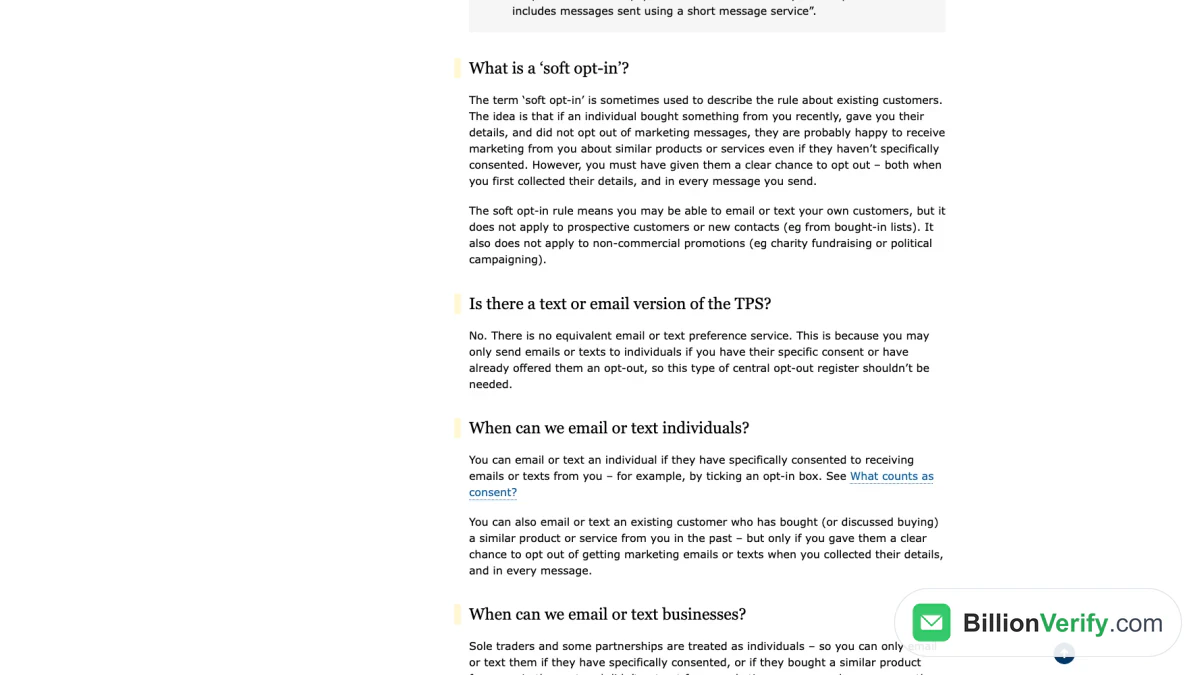
Screenshot: the ICO's explanation of the soft opt-in and its limits for charity fundraising, captured in Nov 2026.
Donors hold expectations of their own. The Donor Bill of Rights, written by the Association of Fundraising Professionals and three partner bodies, lists the right to appropriate acknowledgement and the right to have a name deleted from mailing lists an organization may intend to share. Honor both even where no law requires it.
Donor Cultivation Emails
Cultivation is the work between asks. A donor who hears from the organization only when money is needed learns to ignore the sender. The reliable fix is a short, planned series for new supporters, then a rhythm of regular newsletters and updates on what the money did. Our guide to welcome email sequences goes deeper on timing and structure.
The Welcome Series
Send the first message at once, so the person hears from you while the sign-up is fresh. A common pattern spreads three or four emails over about two weeks, and none of them asks for money in the first week. The table shows one way to plan it.
| Timing | Job | |
|---|---|---|
| Welcome | Right after sign-up | Thank the person, say how often you will write and link to a strong story |
| Why we exist | About day 3 | Share the founding story or mission and a concrete outcome, with no ask |
| Meet someone you help | About day 7 | Tell a short story, used with permission, and show what a typical gift makes possible |
| First invitation | About day 14 | Offer a low-barrier step such as a petition, a volunteer shift or a small first donation |
Newsletters and Impact Updates
A monthly newsletter fits the data, since the study counts nine newsletters per subscriber across a year. A dependable layout has four parts: the results of the month in a few numbers, a story, what comes next and an optional action. An impact update is shorter and arrives when something specific happened, such as a project finished or a goal reached. Lead with what supporters made possible and leave the request for later.
Stories need care. Names and photos of the people you serve should only appear with their permission, and the tone should respect them. Describe the need without turning a person into a prop. A giving anniversary email, sent a year after a first donation, is a natural place to say thanks and share what that year of support achieved.
Fundraising Emails and the Year-End Calendar
A nonprofit fundraising email asks for one thing, in a way that is easy to act on. It usually names a person or a situation in the first lines, shows a single donate button and repeats it near the end. It carries a deadline or a matching offer only when there is a real one. A sample structure for a year-end fundraising email looks like this:
Subject: Help [Name] have a warm winter

Hi [First name],

Last winter, [a specific story in two or three sentences].

This year, [the need in a sentence and what a donation will do].
Until December 31, a partner will match every donation, so your
$50 becomes $100.

[Give now]

Thank you for standing with us,
[Signer's name and role]
December and GivingTuesday
December carries a large share of the year's online giving. Nonprofits received 37% of all 2025 online revenue in December, and GivingTuesday fell within that month. The final seven days produced 10% of annual revenue and the last day alone produced 4%. GivingTuesday falls on December 1 in 2026. The table turns those dates into a planning calendar, with the rest of the year spent on relationships and list care.
| When | What to send |
|---|---|
| January | Tax acknowledgments and annual giving summaries |
| February to April | Newsletters, impact updates and welcome emails for new supporters |
| May to October | A mid-year appeal, event invitations and advocacy alerts as issues arise, plus a list verification pass |
| November | Stories that set up the case, an early matching announcement and a check of authentication records |
| December 1 | GivingTuesday launch and a same-day reminder |
| December 2 to 31 | The year-end fundraising email series, with a final-day reminder on December 31 |
Monthly Giving
Monthly donors supplied 27% of what nonprofits raised online, from 22% for the smallest nonprofits to 37% for the largest. They also last. Of new sustainers, 10% stop within two months, 81% are still giving after seven months and 71% after a full year. Send each new monthly donor a short onboarding series, remind them what the gift does, and make it easy to update a card when it expires. The chapter asks fundraisers to check how simple that update is for a donor.
Thank-You and Receipt Emails
A thank-you email costs almost nothing, and the retention data shows why it matters. Of new online donors from 2024, 24% gave again in 2025, against 66% for prior donors who had already given more than once. The weeks after a first gift therefore carry a lot of weight, and a warm, personal thank-you email sent within a day beats a form letter sent next month.
The tax receipt is a separate legal document, and email carries it well. The IRS written acknowledgment rules list what a statement for a gift of $250 or more must contain: the organization's name, the cash amount or a description of non-cash property, and a statement about any goods or services given in return. Publication 1771 adds that an organization can send the acknowledgment by email and can use a single annual summary for several gifts. It also notes that a charity which skips the acknowledgment incurs no penalty, but the donor cannot claim the deduction without it.
A different rule applies when the donor receives something in return. For a payment over $75 that is partly a gift and partly a purchase, such as a dinner ticket, the IRS page on quid pro quo contributions requires a written disclosure with a good-faith estimate of the value of what the donor got. The deductible part is the payment minus that value.
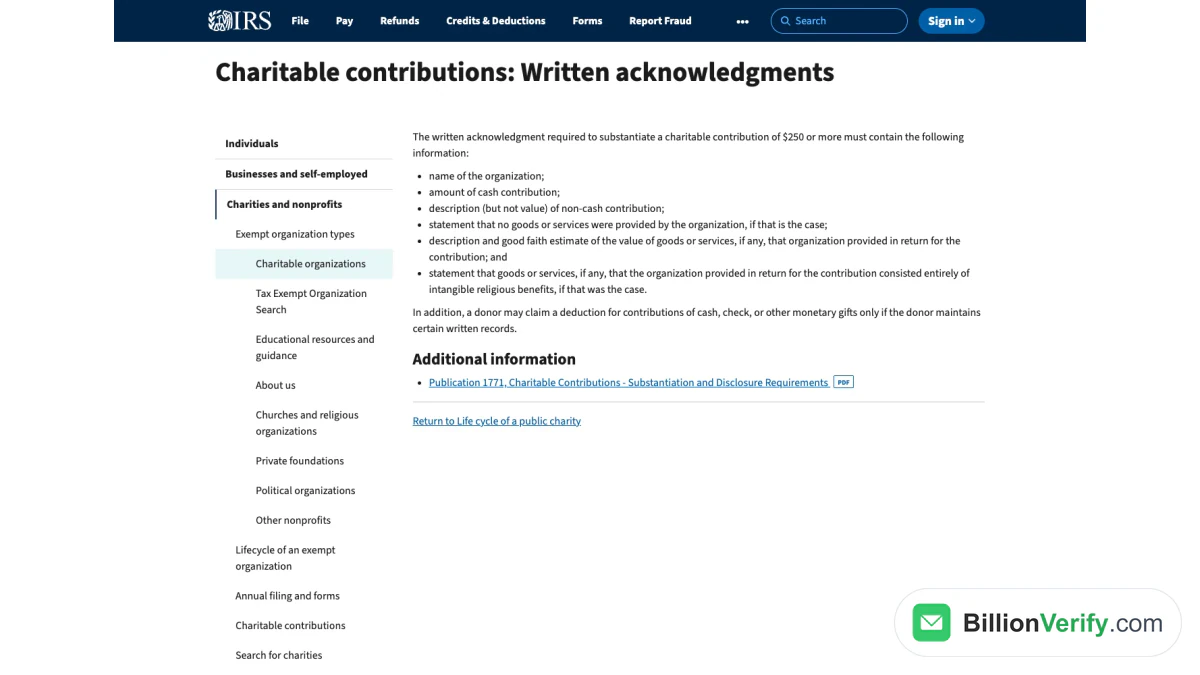
Screenshot: the IRS list of what a written acknowledgment of a $250 gift must contain, captured Nov 2026.
All of this assumes the receipt reaches an inbox. A mistyped address on a donation form means a donor who never sees the acknowledgment and is unable to claim it, however well the template is written. That is the strongest reason to check addresses at the point of entry, which the list quality section covers.
Advocacy and Action Emails
Advocacy mail asks supporters to sign, call or write to someone with power over the cause. The study counted two such messages in an average year of 50, and the response was strong: a click-through rate of 2.3% and a response rate of 1.4%. The format that works is short. Name the decision-maker, say what you want and by when, and offer a single button.
What happens after the action matters as much. Send a thank-you message that links to an optional donation page, then a follow-up that reports the outcome. Public petitions and action forms also attract typos and throwaway addresses, so checking the address before it joins your fundraising list protects your sender reputation for the appeals that follow.
Segment Your List and Respect Preferences
Sending the whole email list the same nonprofit fundraising email is the weakest option, because a monthly donor, a volunteer and a lapsed giver need different things. The study's definitions suggest a first split. A new donor made a first online gift in 2025 and none in the three years before, while a prior donor has a record of repeat gifts. Beyond that, split by giving type, volunteer status, advocacy history and event attendance. Our email segmentation guide covers the mechanics.
| Segment | What to change in the message |
|---|---|
| New donors | Thank sooner, explain impact, delay the next ask |
| Monthly donors | Report what the monthly gift funds and skip one-time appeals when possible |
| Lapsed donors | Reference the last gift and what happened since |
| Volunteers | Send shift reminders and stories from the field, with fewer financial asks |
| Advocates | Send action alerts and outcome reports, with an occasional invitation to give |
A preference center cuts unsubscribes. Gmail's guidelines suggest letting recipients review the lists they belong to and leave them separately, which suits a nonprofit that sends appeals, newsletters and alerts. A supporter who is tired of appeals can then keep the newsletter instead of leaving altogether.
Deliverability and List Quality
Good content does nothing if mail lands in spam or bounces. Email marketing for nonprofits faces two pressures at once: bursts of volume around GivingTuesday and December, and address lists that were typed by hand or inherited from old databases.
Sender Rules That Affect a Year-End Send
The three largest mailbox providers now set thresholds for high-volume senders. A single appeal to 20,000 subscribers is 20,000 messages in a day, so a charity can cross a 5,000 line on a send if enough supporters use the same provider.
| Provider | Threshold and requirements |
|---|---|
| Gmail | SPF or DKIM from every sender; at 5,000 or more daily messages also DMARC plus a one-click opt-out; spam rate below 0.10% and never reaching 0.30% |
| Yahoo | Bulk senders need a working list-unsubscribe header with one-click and a spam rate below 0.3%, per its sender best practices |
| Outlook | Domains sending over 5,000 emails a day need SPF, DKIM and DMARC, per Microsoft's announcement |
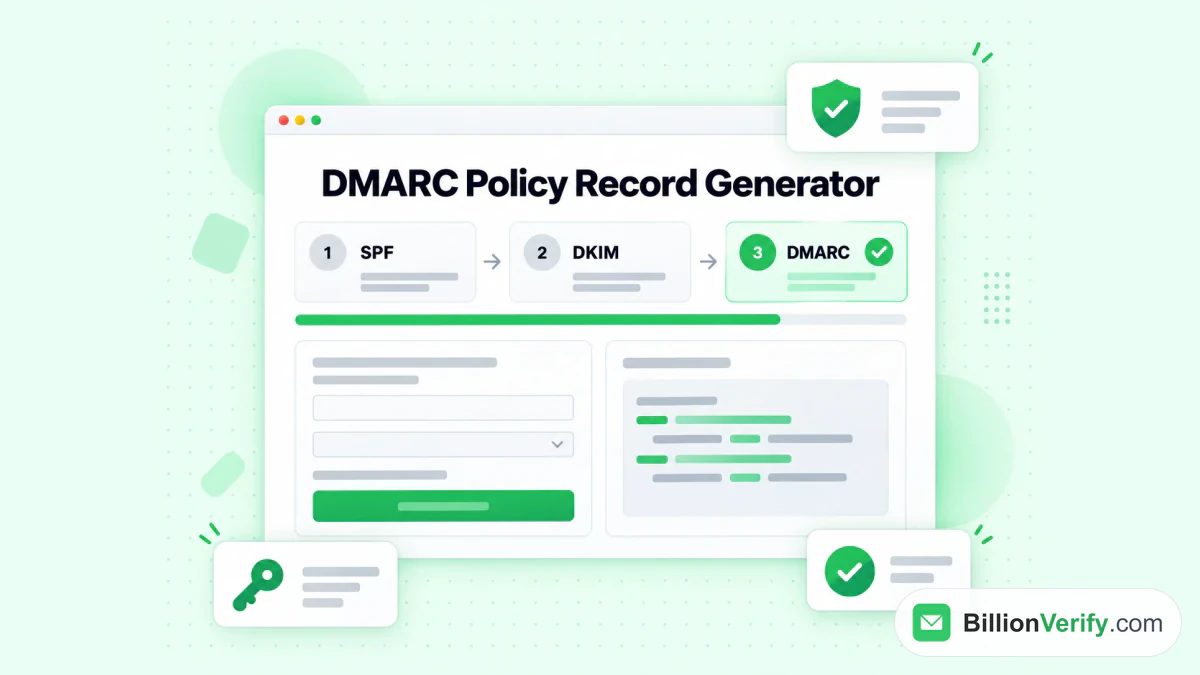
Microsoft says that non-compliant messages go to Junk first and may be rejected later. The method that Google and Yahoo mention is defined in RFC 8058, and most sending platforms add it for you once your domain is authenticated. To publish the records yourself, a DMARC generator builds the DNS entry, and the email deliverability test scores a real message for authentication, spam filters and blacklists.
Where Bad Addresses Come From
Supporter files collect bad addresses in predictable places. Donation forms and event registrations collect typos. Gala guest lists are often typed from paper. Petition and action forms attract throwaway addresses. Peer-to-peer fundraisers upload their own contacts, and old spreadsheets arrive in a CRM migration with years of stale entries. Gmail's guidelines mention automatically unsubscribing recipients who have multiple bounced messages, which is one more reason to remove dead addresses yourself.
BillionVerify checks an address against syntax, DNS, MX and SMTP, reports catch-all domains as their own category instead of calling them valid, and does not charge for unknown results. Every account gets 20 free credits on each day it is used, up to 600 a month, with no card needed. A volunteer can paste a donor address into BillionVerify to see whether the mailbox exists, and anyone can verify an email address for free when a form entry looks wrong. Before a year-end appeal, run the full email list through bulk email verification, and see the email list hygiene guide for a regular schedule.
Two smaller checks fit this work. A reverse email lookup helps when an unknown corporate address signs up and you want to see which organization sits behind it. A phone number validator checks numbers collected for text campaigns or event reminders.
Choosing Email Software and Nonprofit Discounts
Nonprofit email marketing software ranges from free plans to discounted paid tiers, and the terms change often. Free nonprofit email marketing is possible, but each free plan caps contacts or daily volume. The table lists what each site said in November 2026. Email marketing for nonprofits depends on fit more than price: pick a tool for its link to your donor database, its automation and its sending volume. Our email marketing software comparison lines up 12 platforms on features.
| Source | What its site says |
|---|---|
| Mailchimp | A 15% discount for nonprofits and charities, requested through its Billing team with your username and a link to your website; a Free plan for businesses with fewer than 250 contacts |
| HubSpot for Nonprofits | A 40% discount, arranged through sales, covering email, CRM and donor pipelines |
| Kit | A Free plan for up to 10,000 subscribers |
| Brevo | A free-forever plan, with up to 300 emails a day once the account is approved for sending |
| Google for Nonprofits | Google Workspace for Nonprofits and Google Ad Grants at no charge for eligible organizations, verified through Goodstack; it is not a platform for sending campaigns |
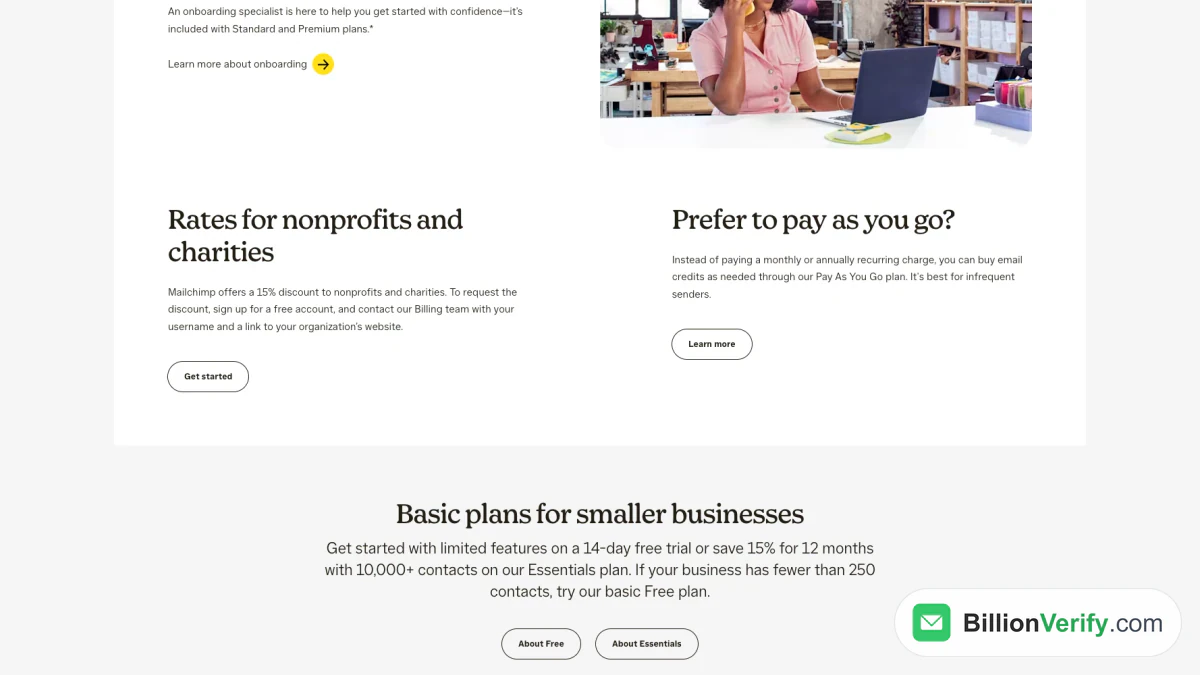
Screenshot: the Mailchimp pricing page section on rates for nonprofits and charities, captured on November 21, 2026.
Schools, Universities and Education Nonprofits
Email marketing for nonprofit organizations that run schools, and for schools that raise money, follows the same pattern with a different audience: prospective students, current students, parents, alumni and donors. Two points differ from a typical charity. First, US institutions that fall under the Family Educational Rights and Privacy Act must treat education records carefully. The FERPA regulations list an email address as directory information, and an institution may disclose directory information only after giving public notice and letting each student refuse. Check those flags before you use a student or alumni address for an appeal.
Second, school-issued addresses change often. Students move on, and an alumni list can lose reachable addresses between campaigns. Our guide to university email verification covers addresses on educational domains. Whatever the audience, the consent, receipt and deliverability rules above apply to the fundraising arm in the same way.
Measuring Nonprofit Email Results
The numbers that matter in nonprofit email marketing are the ones that connect to donations. Revenue for every thousand messages sent lets you compare one nonprofit fundraising email with the next, whatever the list size. Revenue per subscriber tells you what the list is worth. Retention, bounce and unsubscribe rates tell you whether the list is healthy. The table shows the study's medians for 2025 as a point of reference.
| Metric | Finding for 2025 |
|---|---|
| Revenue for every 1,000 emails sent | $54, up 4% from 2024 |
| Email revenue per subscriber for the year | $2.40, up from $1.87 |
| Subscribers lost to bounces | 4% of the starting list |
| Subscribers lost to unsubscribes | 12% of the starting list |
| One-time donor retention | 48% overall; new donors 24%, prior donors 66% |
| Monthly donors still giving after a year | 71% |
Open rates deserve caution. Apple's Mail Privacy Protection hides IP addresses and prevents senders from seeing whether an email was opened, although it does not extend to links. Judge appeals by clicks, donations and revenue, and use opens only to compare sends against each other.
Compare yourself with peers of your size. M+R sorts participants by annual online revenue, with Small meaning under $1,000,000, and it warns against comparing one edition with another because the participant pool changes each year. Its Benchmarks study draws on data from 180 nonprofits. Your own history is the best baseline: track the same measures for each campaign and see which way they move.
FAQs
How often should a nonprofit send email?
No fixed number fits every organization. The average of 50 messages per subscriber hides a wide spread by cause. A practical start is a newsletter each month plus appeals during campaign windows. Raise the frequency only for segments whose unsubscribe and complaint rates stay low.
Can a nonprofit email a purchased or rented list?
It is risky and often unlawful. The ICO notes that the soft opt-in gives no cover for people on bought-in lists, and Gmail's guidelines tell senders to mail only people who subscribed. The AFP's donor charter also lets donors ask to be removed from lists that may be shared. Build the list from consent instead.
Does a small nonprofit need to worry about Gmail's bulk sender rules?
Yes, in part. Google requires every sender to authenticate with SPF or DKIM when mailing personal Gmail accounts, and the stricter rules for DMARC plus one-click unsubscribe begin at 5,000 messages a day. A small list that grows or a successful GivingTuesday campaign can cross that line. Set up authentication early.
When should year-end receipts go out?
The IRS counts an acknowledgment as timely if the donor receives it on or before the earlier of the filing date of the donor's return or its due date, including extensions. Publication 1771 notes that charities typically send them by January 31. Send an acknowledgment for each large gift at once and a summary after year end.
Which metrics should a small nonprofit track first?
Start with donations per appeal, revenue per thousand messages sent, clicks, unsubscribes and bounces. These stay reliable when open tracking does not. Review them by segment as the list grows.
Do schools and universities qualify for nonprofit tool programs?
Not always. Google for Nonprofits excludes schools, academic institutions and universities, although the philanthropic arms of educational organizations are eligible. Each vendor sets its own rules, so ask its sales or billing team and send your registration details.