



Choosing the right Email Service Provider (ESP) is one of the most important decisions for your email marketing success. The wrong choice means fighting against limitations, overpaying for features you don't need, or outgrowing your platform too quickly. This comprehensive comparison analyzes the 15 best ESPs for 2025, helping you find the perfect match for your specific needs.
How We Evaluated ESPs
Our evaluation considers factors that matter most for real-world email marketing success.
Evaluation Criteria
Deliverability: How reliably emails reach the inbox. We consider infrastructure, authentication support, and reputation management.
Features: Automation capabilities, segmentation, personalization, analytics, and template options.
Ease of Use: Learning curve, interface design, and how quickly new users become productive.
Integrations: Native connections with CRM, e-commerce, and other business tools.
Pricing: Value at different scale points, hidden costs, and pricing transparency.
Support: Documentation quality, support channels, and responsiveness.
Scalability: How well the platform grows with your list and sending needs.
The 15 Best ESPs for 2025
1. Klaviyo
Best for: E-commerce businesses
Overview: Klaviyo has become the de facto standard for e-commerce email marketing. Its deep integrations with Shopify, WooCommerce, and other platforms, combined with powerful segmentation and predictive analytics, make it exceptional for online retail.
Key Features:
- Pre-built e-commerce automation flows
- Predictive analytics (LTV, churn risk, next order date)
- Deep Shopify integration with real-time sync
- SMS marketing included
- Advanced segmentation based on purchase behavior
Pricing:
- Free: Up to 250 contacts, 500 emails
- Email: Starts at $20/month for 251-500 contacts
- Email + SMS: Starts at $35/month
Pros:
- Unmatched e-commerce capabilities
- Excellent segmentation and personalization
- Strong deliverability
- Predictive analytics included
Cons:
- Expensive at scale
- Learning curve for advanced features
- Less suited for non-e-commerce
Best for: Shopify stores, direct-to-consumer brands, e-commerce businesses of all sizes.
2. Mailchimp
Best for: Small businesses and beginners
Overview: Mailchimp remains one of the most recognizable names in email marketing. While it's evolved into an all-in-one marketing platform, its core strength is still accessible email marketing for small businesses.
Key Features:
- User-friendly drag-and-drop editor
- Pre-designed templates library
- Basic automation workflows
- Landing page builder
- Social media integration
- Website builder included
Pricing:
- Free: Up to 500 contacts, 1,000 sends/month
- Essentials: Starting at $13/month
- Standard: Starting at $20/month
- Premium: Starting at $350/month
Pros:
- Extremely user-friendly
- Strong brand and market presence
- Good template library
- Broad integration ecosystem
Cons:
- Automation less sophisticated than competitors
- Pricing increased significantly in recent years
- Charges for unsubscribed contacts
- Limited advanced segmentation
Best for: Small businesses, non-profits, marketers wanting simplicity.
For detailed comparison, see Mailchimp vs SendGrid.
3. ActiveCampaign
Best for: Automation-focused small and mid-size businesses
Overview: ActiveCampaign offers some of the most powerful automation capabilities at its price point. Combined with built-in CRM functionality, it's excellent for businesses that want sophisticated workflows without enterprise pricing.
Key Features:
- Visual automation builder with conditional logic
- Built-in CRM with sales automation
- Predictive sending and content
- Site and event tracking
- Lead scoring
- Machine learning capabilities
Pricing:
- Lite: Starting at $29/month
- Plus: Starting at $49/month
- Professional: Starting at $149/month
- Enterprise: Custom pricing
Pros:
- Powerful automation at reasonable price
- CRM included
- Excellent deliverability
- Good customer support
Cons:
- Interface can be overwhelming
- Reporting could be stronger
- Mobile app limitations
Best for: B2B companies, service businesses, anyone prioritizing automation.
See our complete ActiveCampaign review.
4. HubSpot
Best for: B2B companies wanting all-in-one marketing
Overview: HubSpot's email marketing is part of a comprehensive marketing, sales, and service platform. For businesses already in the HubSpot ecosystem—or looking for unified tools—it's an excellent choice.
Key Features:
- Free CRM integration
- Full marketing hub (email, social, content)
- Sophisticated automation workflows
- Detailed analytics and attribution
- A/B testing with statistical significance
- Lead scoring and qualification
Pricing:
- Free: Basic email marketing
- Starter: Starting at $20/month
- Professional: Starting at $890/month
- Enterprise: Starting at $3,600/month
Pros:
- Unified marketing, sales, and service
- Free CRM included
- Excellent UX
- Strong education and community
Cons:
- Expensive for email-only needs
- Significant price jumps between tiers
- Can be complex to master
Best for: B2B companies, startups, businesses wanting unified platform.
See our HubSpot email marketing guide.
5. ConvertKit
Best for: Creators and content publishers
Overview: ConvertKit is purpose-built for creators—bloggers, podcasters, YouTubers, and course creators. Its focus on simplicity and deliverability makes it a favorite in the creator economy.
Key Features:
- Simple visual automation builder
- Creator-focused landing pages
- Subscriber tagging system
- Commerce features for selling digital products
- Newsletter referral program
- Creator network for discovery
Pricing:
- Free: Up to 1,000 subscribers
- Creator: Starting at $9/month
- Creator Pro: Starting at $25/month
Pros:
- Excellent deliverability
- Simple, focused interface
- Built for creator needs
- Good free tier
Cons:
- Limited design customization
- Basic analytics
- Not suited for e-commerce
Best for: Bloggers, podcasters, newsletter writers, course creators.
Compare in ConvertKit vs Mailchimp.
6. Brevo (formerly Sendinblue)
Best for: Budget-conscious businesses needing email + SMS
Overview: Brevo offers solid email marketing capabilities at very competitive prices. Its transactional email API combined with marketing features provides good value, especially for businesses also needing SMS.
Key Features:
- Email and SMS marketing combined
- Transactional email API
- CRM functionality included
- Chat and live chat features
- Landing pages and signup forms
- Marketing automation
Pricing:
- Free: 300 emails/day
- Starter: Starting at $25/month
- Business: Starting at $65/month
- Enterprise: Custom pricing
Pros:
- Excellent pricing
- Email + SMS + Chat in one platform
- Good transactional API
- CRM included
Cons:
- Automation less powerful than leaders
- Fewer integrations
- Interface less polished
Best for: Small businesses on a budget, those needing email + SMS.
Read our Brevo review.
7. SendGrid
Best for: Developers and transactional email
Overview: SendGrid, owned by Twilio, excels at transactional email and developer experience. Its marketing campaigns features have improved significantly, making it viable for both transactional and marketing needs.
Key Features:
- Powerful transactional email API
- Marketing campaigns platform
- Email validation built-in
- Dynamic templates
- Detailed analytics
- Excellent documentation
Pricing:
- Free: 100 emails/day
- Essentials: Starting at $19.95/month
- Pro: Starting at $89.95/month
- Premier: Custom pricing
Pros:
- Excellent for transactional email
- Strong deliverability
- Great developer experience
- Good scalability
Cons:
- Marketing features less mature than pure ESPs
- Interface less intuitive for non-developers
- Support can be slow
Best for: Developers, SaaS companies, those needing marketing + transactional.
8. Constant Contact
Best for: Local and small businesses
Overview: Constant Contact has been around since 1995 and remains popular with small, local businesses. Its simplicity and customer support make it accessible to non-technical users.
Key Features:
- Easy-to-use email builder
- Event marketing tools
- Social media integration
- Simple automation
- Phone support included
- E-commerce integrations
Pricing:
- Lite: Starting at $12/month
- Standard: Starting at $35/month
- Premium: Starting at $80/month
Pros:
- Very user-friendly
- Strong customer support (phone included)
- Event management features
- Good for beginners
Cons:
- Limited automation
- Pricing can get high
- Features less advanced than competitors
Best for: Local businesses, non-profits, small organizations.
9. Drip
Best for: Growing e-commerce brands
Overview: Drip focuses on e-commerce marketing automation, positioning itself as an alternative to Klaviyo. Its visual workflow builder and strong integrations make it compelling for online stores.
Key Features:
- Visual workflow builder
- E-commerce integrations (Shopify, WooCommerce)
- Behavior-based automation
- Revenue attribution
- SMS marketing
- Onsite campaigns
Pricing:
- Starting at $39/month for up to 2,500 contacts
- Scales based on contact count
Pros:
- Strong e-commerce focus
- Good visual automation builder
- Competitive pricing vs. Klaviyo
- Improving rapidly
Cons:
- Smaller ecosystem than Klaviyo
- Fewer predictive features
- Less brand recognition
Best for: E-commerce brands wanting Klaviyo alternative.
10. AWeber
Best for: Small businesses and solopreneurs
Overview: AWeber has been in email marketing since 1998. While not the most innovative, it's reliable, affordable, and easy to use—a solid choice for small businesses.
Key Features:
- Drag-and-drop email builder
- Pre-built automation templates
- Landing pages included
- Web push notifications
- Canva integration for design
- Free migration service
Pricing:
- Free: Up to 500 subscribers
- Lite: Starting at $12.50/month
- Plus: Starting at $20/month
- Unlimited: Starting at $899/month
Pros:
- Long track record
- Good deliverability
- Affordable
- Helpful customer support
Cons:
- Interface feels dated
- Automation less sophisticated
- Fewer integrations than competitors
Best for: Solopreneurs, small businesses, those valuing simplicity.
11. GetResponse
Best for: Marketing automation and webinars
Overview: GetResponse combines email marketing with webinar hosting, landing pages, and automation—making it unique for businesses that rely on webinars for marketing.
Key Features:
- Integrated webinar platform
- Advanced automation workflows
- Conversion funnel builder
- Website builder
- E-commerce tools
- Web push notifications
Pricing:
- Free: Up to 500 contacts
- Email Marketing: Starting at $19/month
- Marketing Automation: Starting at $59/month
- E-commerce Marketing: Starting at $119/month
Pros:
- Webinar platform included
- Strong automation
- Good value for features
- All-in-one approach
Cons:
- Webinar quality not enterprise-grade
- Interface can be complex
- Some features need higher tiers
Best for: Coaches, consultants, businesses using webinars.
12. MailerLite
Best for: Simple, affordable email marketing
Overview: MailerLite provides clean, simple email marketing at very competitive prices. It's an excellent choice for those who want core functionality without complexity.
Key Features:
- Clean drag-and-drop editor
- Landing pages and websites
- Basic automation
- Pop-ups and embedded forms
- Paid newsletter subscriptions
- Digital product sales
Pricing:
- Free: Up to 1,000 subscribers
- Growing Business: Starting at $10/month
- Advanced: Starting at $21/month
- Enterprise: Custom pricing
Pros:
- Very affordable
- Clean, modern interface
- Good deliverability
- Generous free tier
Cons:
- Limited advanced features
- Fewer integrations
- Basic automation
Best for: Startups, small businesses, those wanting simplicity.
13. Omnisend
Best for: E-commerce brands wanting omnichannel
Overview: Omnisend combines email, SMS, and push notifications in an e-commerce-focused platform. It's a strong Klaviyo alternative at lower price points.
Key Features:
- Email + SMS + push notifications
- Pre-built e-commerce automations
- Product recommendations
- Popups and forms
- Segmentation based on shopping behavior
- Good Shopify integration
Pricing:
- Free: Up to 250 contacts
- Standard: Starting at $16/month
- Pro: Starting at $59/month
Pros:
- Good omnichannel capabilities
- Strong e-commerce features
- More affordable than Klaviyo
- Easy to use
Cons:
- Less sophisticated than Klaviyo
- Fewer advanced analytics
- Smaller ecosystem
Best for: E-commerce on a budget, those wanting email + SMS.
14. Campaign Monitor
Best for: Agencies and brand-conscious teams
Overview: Campaign Monitor focuses on beautiful emails and brand consistency. Popular with agencies and design-focused teams, it offers strong template control and reseller options.
Key Features:
- Excellent email designer
- Template locking for brand control
- Agency-friendly features
- Visual journey builder
- Good analytics
- SMS via integrations
Pricing:
- Lite: Starting at $12/month
- Essentials: Starting at $29/month
- Premier: Starting at $159/month
Pros:
- Beautiful email design tools
- Brand consistency features
- Good for agencies
- Clean interface
Cons:
- Limited automation vs. competitors
- Pricing can escalate
- Fewer integrations
Best for: Agencies, design-focused brands, those prioritizing aesthetics.
15. Moosend
Best for: Affordable automation
Overview: Moosend offers solid automation capabilities at very competitive prices. It's particularly good for those who need marketing automation on a budget.
Key Features:
- Visual automation workflow builder
- E-commerce AI recommendations
- Landing pages and forms
- Real-time analytics
- Website tracking
- API access
Pricing:
- Free Trial: 30 days
- Pro: Starting at $9/month
- Enterprise: Custom pricing
Pros:
- Very affordable
- Good automation for the price
- AI product recommendations
- Unlimited emails on paid plans
Cons:
- Smaller company (acquired by Sitecore)
- Fewer integrations
- Less brand recognition
Best for: Budget-conscious businesses wanting automation.
Choosing Your ESP
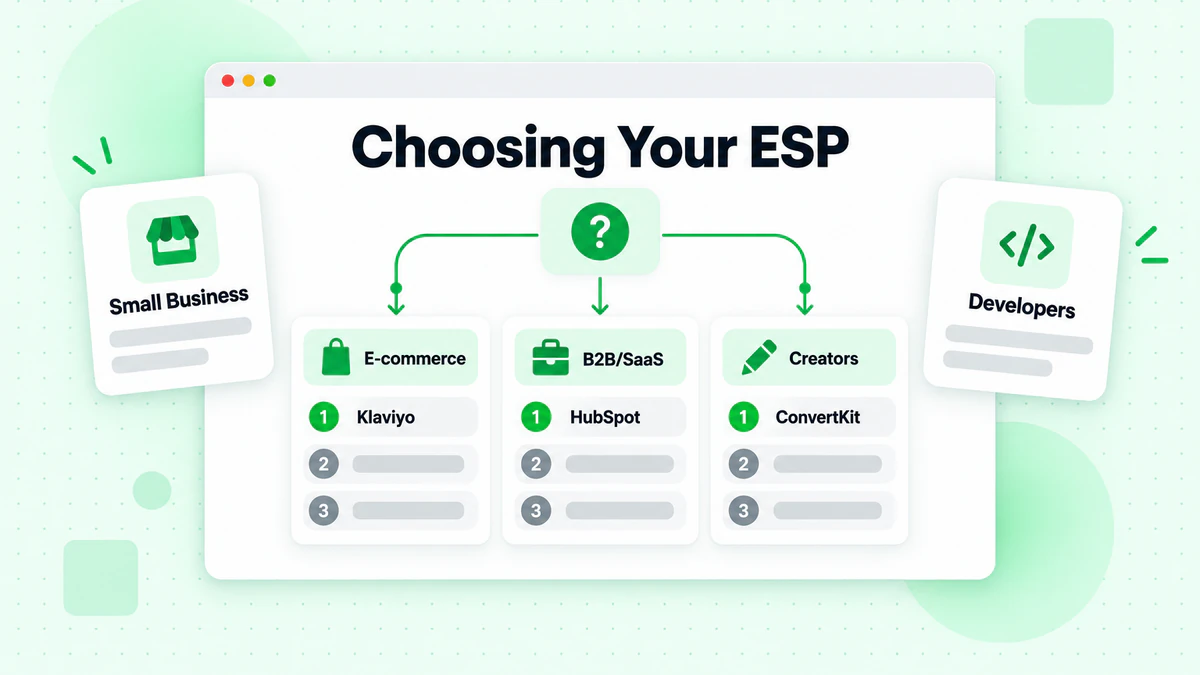
By Business Type
E-commerce:
- Klaviyo (best overall)
- Omnisend (budget alternative)
- Drip (growing alternative)
B2B/SaaS:
- HubSpot (all-in-one)
- ActiveCampaign (automation focus)
- SendGrid (developer needs)
Creators/Content:
- ConvertKit (best overall)
- MailerLite (budget option)
- AWeber (simple alternative)
Small Business:
- Mailchimp (most known)
- Brevo (best value)
- MailerLite (simplest)
By Budget
Free/Very Low Budget:
- MailerLite Free
- Mailchimp Free
- Brevo Free
$20-50/month:
- ConvertKit
- ActiveCampaign Lite
- MailerLite paid
$50-200/month:
- Klaviyo
- ActiveCampaign Plus
- HubSpot Starter
$200+/month:
- HubSpot Professional
- Klaviyo at scale
- ActiveCampaign Professional
By Priority
Best Deliverability: ConvertKit, ActiveCampaign, Klaviyo
Best Automation: ActiveCampaign, Klaviyo, HubSpot
Best Value: Brevo, MailerLite, Moosend
Best for Beginners: Mailchimp, Constant Contact, MailerLite
Best Support: Constant Contact, ConvertKit, ActiveCampaign
Maximizing ESP Performance
Regardless of which ESP you choose, follow these practices.
Maintain List Quality
Use email verification to:
- Verify addresses at signup
- Clean lists before migration
- Run regular bulk verification
- Remove invalid and risky addresses
Clean lists improve deliverability across all ESPs.
Optimize Authentication
Ensure proper setup of:
Most ESPs guide you through this, but verify it's correct.
Segment Effectively
Don't blast your entire list. Segment by:
- Engagement level
- Purchase behavior
- Demographics
- Interests and preferences
Test Continuously
A/B test:
- Subject lines
- Send times
- Content approaches
- CTAs
Monitor Performance
Track key metrics:
- Open rates (with privacy limitations)
- Click rates
- Conversions
- Bounces
- Unsubscribes
Conclusion
The best ESP depends entirely on your specific needs. E-commerce brands typically thrive with Klaviyo. B2B companies often prefer HubSpot or ActiveCampaign. Creators love ConvertKit's simplicity. Small businesses do well with Mailchimp or Brevo.
Key Takeaways:
Match to Your Needs: Don't choose based on popularity alone. Consider your specific requirements.
Consider Growth: Select a platform that can scale with you to avoid painful migrations.
Test Before Committing: Most ESPs offer free trials. Use them.
Don't Overpay: Start with what you need. Upgrade as requirements grow.
Prioritize Deliverability: Features don't matter if emails don't arrive. Verify your data with BillionVerify.
Factor in Integrations: Ensure your ESP connects with your other tools.
Whatever ESP you choose, maintain data quality through email verification. Clean lists perform better on every platform.
For more detailed tool comparisons, see: