
Great email copywriting is the difference between emails that convert and emails that get deleted. This comprehensive guide covers the principles, techniques, and frameworks for writing emails that engage readers and drive the actions you want.
The Fundamentals of Email Copywriting
Core principles that apply to all email writing.
Understanding Your Reader
They're Busy: Your reader has limited time and attention. Respect it.
They're Skeptical: They've seen countless marketing emails. Earn their trust.
They're Asking "What's In It For Me?": Every sentence should answer this question.
They're Distracted: Emails are read on phones, between meetings, while multitasking.
The Job of Email Copy
Get Opened: Subject line and preheader must compel the open.
Get Read: First lines must hook them to continue.
Get Clicked: Body must build to an irresistible action.
Build Relationship: Even selling emails should strengthen the connection.
Writing Mindset
Write to One Person: Use "you" and "your." Write like you're talking to a friend.
Be Specific: Vague claims are forgettable. Specific details are memorable.
Be Clear, Then Clever: Clarity always wins. Cleverness is optional.
Edit Ruthlessly: Cut everything that doesn't serve the goal.
Subject Lines That Get Opens
The most important 50 characters you'll write. For comprehensive strategies, see our email subject lines guide.
Subject Line Principles
Be Specific: "Your order shipped" beats "Order update"
Create Curiosity: Open a loop the reader wants to close
Promise Value: Make clear what they'll get by opening
Be Honest: Never mislead—it destroys trust
Keep It Short: 40-50 characters is ideal. Mobile cuts off longer lines.
Subject Line Formulas
The Direct Promise: "How to [achieve desired result]"
- "How to double your open rates in 30 days"
- "How to write emails people actually read"
The Question: "Are you making this [mistake]?"
- "Are you making this email mistake?"
- "Is your email list costing you money?"
The List: "[Number] ways to [achieve result]"
- "7 ways to write better subject lines"
- "5 email mistakes that hurt deliverability"
The Curiosity Gap: "The [thing] most [people] overlook"
- "The metric most email marketers ignore"
- "The word that kills email conversions"
The Personal Touch: "[Name], [personal reference]"
- "Sarah, your cart is waiting"
- "Quick question for you, Mike"
The Urgency (use sparingly): "[Time frame]: [opportunity/action]"
- "Ends tonight: 40% off everything"
- "Last chance to save your seat"
Subject Line Best Practices
Do:
- Test constantly
- Match subject to content
- Use sender name strategically
- Consider emoji carefully
- Write multiple options
Don't:
- Use ALL CAPS
- Overuse punctuation!!!
- Say "Newsletter" or "Update"
- Be misleading
- Use spam trigger words
Preheader Text
What It Is: The preview text that appears after the subject line.
How to Use It:
- Extend the subject line
- Add context or tease content
- Complement, don't repeat
Examples:
Subject: Your order has shipped
Preheader: Track your package and see delivery updates

Subject: The mistake that killed our campaign
Preheader: (And how we fixed it in 24 hours)

Subject: Quick question for you
Preheader: Reply takes 10 seconds
Opening Lines That Hook
The first line determines whether they keep reading.
Opening Strategies
The Personal Connection:
Hey [Name],

I noticed you downloaded our email marketing guide
last week. How's the implementation going?
The Pattern Interrupt:
Let me tell you about the worst email I ever sent.

It had a 2% open rate. Here's what I learned...
The Direct Value:
I'm going to share the exact subject line formula
that consistently gets us 40%+ open rates.

No fluff—just the framework and examples.
The Empathy Hook:
Writing emails that actually get read is hard.

I know because I used to send emails into the void
for months before figuring out what works.
The Timely Hook:
With the holiday season approaching,
your email strategy is about to be tested.

Here's how to stand out in crowded inboxes.
What to Avoid
Don't Start With:
- "I hope this email finds you well"
- "Just checking in"
- "As you know"
- Company news nobody asked for
- The word "I" (start with "you" instead)
Body Copy That Engages
Keeping readers hooked through the entire email.
Structure for Readability
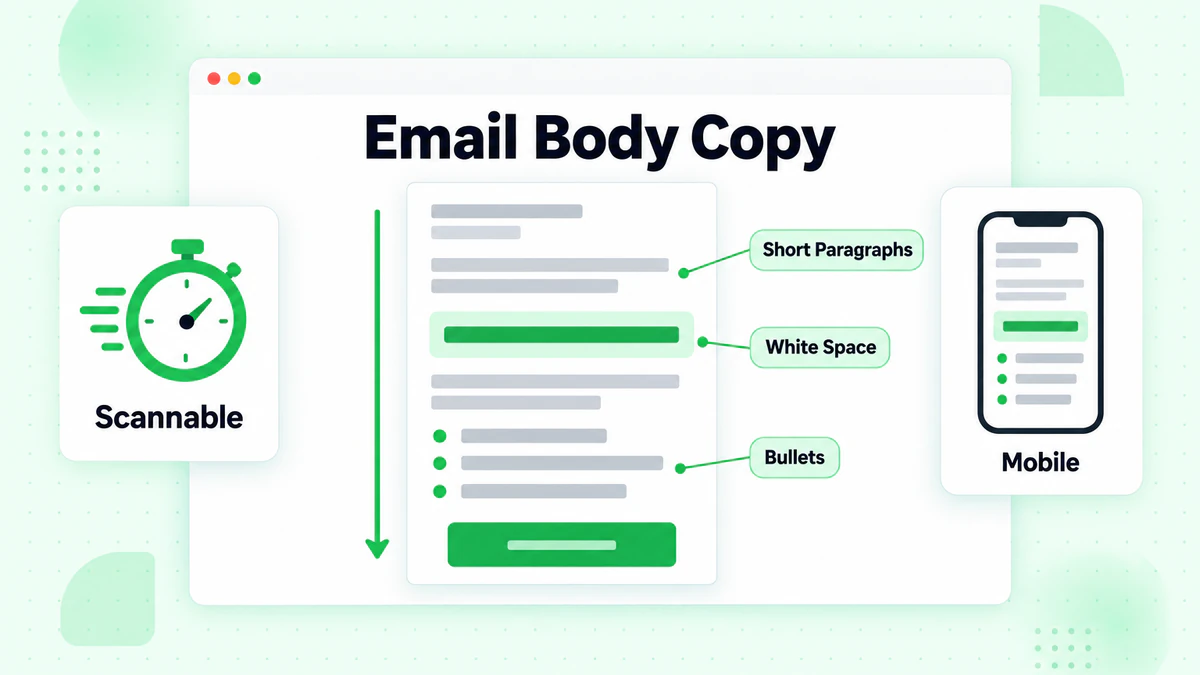
Short Paragraphs: 2-3 sentences maximum. One sentence is fine.
White Space: Let the email breathe. Dense text is hard to read.
Scannable Format: Use bullets, subheadings, bold text for key points.
Single Column: Especially for mobile. Simple is better.
Writing Techniques
The AIDA Framework:
- Attention: Hook them with the opening
- Interest: Build curiosity and engagement
- Desire: Make them want what you're offering
- Action: Tell them exactly what to do
The PAS Framework:
- Problem: Identify their pain point
- Agitation: Make them feel that pain
- Solution: Present your solution
The 4 Ps Framework:
- Promise: What they'll get
- Picture: Help them visualize the benefit
- Proof: Why they should believe you
- Push: Call to action
Example: PAS in Action
Subject: Why your emails aren't getting opened

Hey [Name],

You spend hours crafting the perfect email.
You hit send with confidence.

Then... crickets.

Low open rates. Minimal clicks. No conversions.

It's frustrating. You know your content is valuable.
But if nobody opens the email, nobody sees it.

The problem isn't your content. It's your subject lines.

After analyzing 10,000+ subject lines, we discovered
the 7 patterns that consistently get opens.

I put them all in a free guide:
"Subject Line Formulas That Work"

[Download the Free Guide →]

Takes 5 minutes to read. Could transform your results.

Best,
[Signature]
Tone and Voice
Professional but Human: Write like a smart friend, not a corporation.
Conversational: Use contractions. Write how people talk.
Confident but Not Arrogant: Be helpful, not preachy.
Consistent: Your voice should be recognizable across emails.
Power Words and Phrases
Words That Work:
- You, your (most powerful word)
- Free (use carefully)
- New
- Now
- Because (gives reason)
- Imagine
- Discover
Phrases That Engage:
- "Here's what I mean..."
- "Let me explain..."
- "The truth is..."
- "Here's the thing..."
- "Quick question..."
Calls to Action That Convert
Getting readers to take the next step. For optimization techniques, check our email CTA optimization guide.
CTA Principles
One Primary CTA: Don't confuse with multiple competing actions.
Be Specific: "Download the Guide" beats "Click Here"
Create Urgency: When genuine, urgency motivates action.
Reduce Friction: Make the action feel easy.
Repeat if Needed: In longer emails, multiple placements work.
CTA Formulas
Action + Benefit:
- "Get Your Free Guide"
- "Start Saving Time Today"
- "See Your Results"
First Person:
- "Send Me the Guide"
- "Yes, I Want In"
- "Show Me How"
Time-Focused:
- "Get Started in 2 Minutes"
- "Join in 30 Seconds"
- "See Results This Week"
Button vs. Text Link
Buttons:
- More visible
- Higher click rates for primary CTAs
- Mobile-friendly (larger tap target)
- Best for main action
Text Links:
- Multiple links within content
- Secondary actions
- More natural in conversational emails
- Good for longer emails
CTA Placement
Above the Fold: Readers who know what they want can act fast.
After Value: Once you've made the case, ask for action.
End of Email: Natural conclusion point.
Multiple Placements: For longer emails, repeat the CTA.
Email Types and Their Copy
Different emails need different approaches.
Welcome Emails
Goal: Set expectations, deliver value, start relationship.
Copy Approach:
- Warm, friendly tone
- Clear next steps
- Deliver any promised content
- Set expectations for future emails
Example Opening:
Welcome to [Brand], [Name]!

You just made a great decision.

Here's what happens next:

1. Check your inbox for [promised content]
2. In 3 days, I'll share [next value]
3. Every [frequency], you'll get [ongoing value]

First, let me tell you what makes [Brand] different...
Promotional Emails
Goal: Drive action (purchase, signup, etc.)
Copy Approach:
- Lead with the offer or benefit
- Create appropriate urgency
- Handle objections
- Clear, compelling CTA
Example Structure:
[Attention-grabbing subject]

[Hook that addresses pain or desire]

[The offer clearly stated]

[Key benefits - 3-5 bullet points]

[Social proof]

[Handle main objection]

[CTA with urgency if applicable]
Educational/Value Emails
Goal: Provide value, build trust, nurture relationship.
Copy Approach:
- Lead with the insight or lesson
- Practical, actionable advice
- Minimal selling (if any)
- Encourage engagement (replies, shares)
Example Opening:
I made an expensive mistake last month.

We changed our email send time from 10am to 2pm.

Open rates dropped 15%.

Here's what I learned (so you don't have to make the same mistake)...
Re-engagement Emails
Goal: Win back inactive subscribers.
Copy Approach:
- Acknowledge the absence
- Remind of value
- Offer something compelling
- Make it easy to stay or go
Example:
Subject: Should I stop emailing you?

Hey [Name],

I noticed you haven't opened our emails in a while.

No hard feelings—inboxes are crazy.

But I don't want to be noise in yours.

So here's the deal:

Click below if you still want to hear from us.
We'll send you [value/incentive] as a thank you.

[Yes, Keep Me Subscribed →]

If I don't hear from you, I'll remove you from the list
next week. You can always come back later.

Either way, thanks for being part of our community.

Best,
[Signature]
Transactional Emails
Goal: Confirm transaction, provide information, reduce anxiety.
Copy Approach:
- Clear, specific subject line
- Essential information first
- Reassuring tone
- Next steps clearly explained
Example:
Subject: Order #12345 confirmed - here's what's next

Thanks for your order, [Name]!

We're on it. Here's your confirmation:

Order #: 12345
Items: [List]
Total: $XX.XX

What happens next:
1. We'll prepare your order (1-2 business days)
2. You'll get a shipping notification with tracking
3. Your order arrives in [timeframe]

Questions? Reply to this email or call [number].

Thanks for shopping with us!
Personalization in Copy
Making emails feel written for one person.
Basic Personalization
First Name: The minimum—use it in subject and body.
Company Name: For B2B, reference their company.
Location: When relevant to the message.
Past Behavior: Reference their actions.
Advanced Personalization
Dynamic Content: Different content blocks based on subscriber attributes.
[IF industry = technology]
As a tech company, you know that...
[ELSE IF industry = healthcare]
In healthcare, compliance means...
[ELSE]
In your industry, the challenge is...
[END IF]
Behavioral References:
Since you downloaded our email marketing guide,
I thought you'd appreciate this advanced tip...
Purchase History:
You bought [Product] three months ago.
Here's how to get even more from it...
Personalization Don'ts
- Don't personalize with obviously wrong data
- Don't be creepy (too much personal detail)
- Don't let personalization break (show fallbacks)
- Don't sacrifice clarity for personalization
Email Copywriting for Different Audiences
Adapting your approach.
B2B Copywriting
Characteristics:
- Professional but not stiff
- Focus on business outcomes
- Multiple stakeholders
- Longer consideration cycles
Tips:
- Lead with business value
- Include data and proof
- Be specific about ROI
- Professional sign-off
Example Opening:
[Name],

Your team is probably spending 5+ hours a week
on tasks that could be automated.

That's 250+ hours a year—gone.

Here's how companies like [Similar Company]
got that time back...
B2C Copywriting
Characteristics:
- Casual, conversational
- Emotional appeals work
- Faster decisions
- Lifestyle focus
Tips:
- Be friendly and relatable
- Create emotional connection
- Social proof from real customers
- Visual-friendly content
Example Opening:
Hey [Name]!

Remember that feeling when you find the perfect
[product type]?

That moment when you just KNOW it's right?

We've got something that might give you that feeling...
Startup/Tech Audience
Characteristics:
- Skeptical of hype
- Value authenticity
- Quick to judge
- Community-minded
Tips:
- Be direct, no fluff
- Show you understand their world
- Share genuine insights
- Reference relevant context
Enterprise Audience
Characteristics:
- Risk-averse
- Need social proof
- Multiple approvers
- Formal processes
Tips:
- Lead with credibility
- Include case studies
- Address security/compliance
- Professional but not boring
Editing Your Email Copy
Turning good writing into great writing.
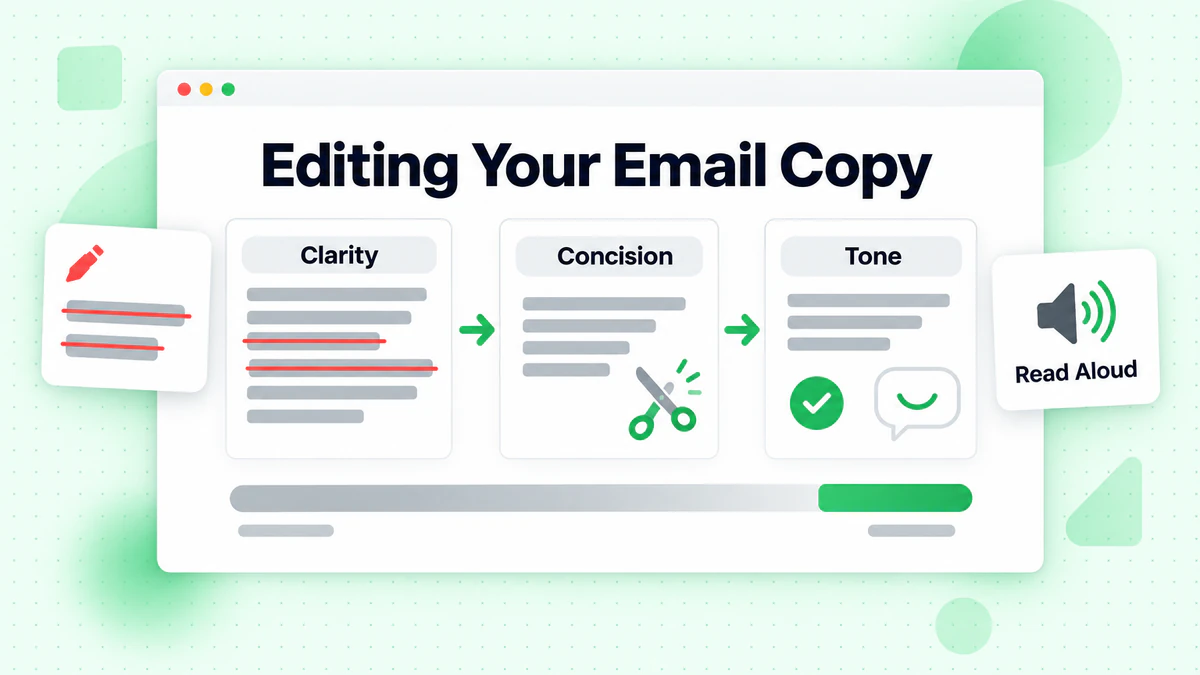
The Editing Process
First Pass: Clarity
- Is the message clear?
- Can it be misunderstood?
- Does every sentence serve the goal?
Second Pass: Concision
- Cut unnecessary words
- Remove redundant phrases
- Shorten sentences
Third Pass: Impact
- Strengthen weak words
- Add power where needed
- Check the flow
Fourth Pass: Details
- Check spelling and grammar
- Verify personalization
- Test all links
What to Cut
Filler Words:
- Just, really, very, quite
- Actually, basically, literally
- Simply, definitely, absolutely
Redundant Phrases:
- "In order to" → "To"
- "At this point in time" → "Now"
- "Due to the fact that" → "Because"
- "In the event that" → "If"
Throat-Clearing: Delete opening phrases that delay the point:
- "I wanted to reach out to let you know..."
- "I'm writing to tell you..."
- "I just wanted to quickly mention..."
Before and After
Before:
I just wanted to quickly reach out and let you know
that we've actually just launched a really exciting
new feature that I think you're definitely going to
find very useful for your business.
After:
We just launched a feature that'll save you
3 hours a week.
Testing Your Copy
Continuously improving through experimentation. Learn comprehensive testing strategies in our email testing and optimization guide and email AB testing guide.
What to Test
Subject Lines:
- Length (short vs. medium)
- Personalization (name vs. no name)
- Style (question vs. statement)
- Emoji (with vs. without)
Body Copy:
- Opening line approaches
- Length (short vs. detailed)
- Tone (formal vs. casual)
- Structure (paragraphs vs. bullets)
CTAs:
- Button text
- Placement
- Number of CTAs
- Design (button vs. link)
Testing Best Practices
Test One Element: Change one thing at a time for clear results.
Significant Sample: Ensure enough recipients for valid results.
Document Learnings: Build a knowledge base of what works.
Apply Winners: Actually implement successful tests.
Common Copywriting Mistakes
Avoid these pitfalls.
Mistake 1: Writing About Yourself
Problem: Too much "we did this" instead of "you'll get this." Fix: Flip every sentence to focus on the reader.
Mistake 2: Burying the Lead
Problem: Important information hidden in paragraph three. Fix: Put the most important thing first.
Mistake 3: Weak CTAs
Problem: "Click here" or unclear next steps. Fix: Specific, action-oriented CTA text.
Mistake 4: Wall of Text
Problem: Dense, unbroken paragraphs. Fix: Short paragraphs, white space, scannable format.
Mistake 5: Being Clever Over Clear
Problem: Jokes or wordplay that obscure the message. Fix: Clarity first, cleverness second.
Mistake 6: Generic Messages
Problem: Could be from any company to any person. Fix: Specific details, personalization, unique voice.
Email Copywriting Checklist
Before you send.
Subject Line
- [ ] Under 50 characters
- [ ] Specific and clear
- [ ] Creates curiosity or promises value
- [ ] Matches email content
- [ ] Tested alternative versions
Opening
- [ ] Hooks reader immediately
- [ ] Focused on reader (not you)
- [ ] Sets up the rest of the email
Body
- [ ] Clear, single message
- [ ] Benefits over features
- [ ] Short paragraphs
- [ ] Scannable format
- [ ] Consistent tone
CTA
- [ ] Clear, specific action
- [ ] Benefit-focused text
- [ ] Visible and clickable
- [ ] One primary CTA
Final Check
- [ ] Read aloud for flow
- [ ] Cut unnecessary words
- [ ] Checked all links
- [ ] Mobile preview reviewed
- [ ] Personalization tested
Copywriting and Deliverability
How your words affect whether emails arrive.
Spam Trigger Awareness
Words to Use Carefully:
- Free (overuse triggers filters)
- Guarantee, no risk
- Act now, limited time
- Winner, congratulations
Not Automatic Spam: Context matters. These words aren't banned, just overused in spam.
Best Practices
Natural Language: Write like a human, not a marketer.
Value-Focused: Valuable content rarely looks like spam.
Clean Formatting: Excessive caps, colors, and symbols trigger filters.
Valid Addresses: Can't read your great copy if emails bounce. Maintain email list hygiene and use email verification to ensure delivery.
Conclusion
Email copywriting is a skill that improves with practice. By understanding your reader, crafting compelling subject lines, writing engaging body copy, and creating clear CTAs, you'll write emails that actually get results.
Key copywriting principles:
- Reader first: Always focus on what's in it for them
- Clarity over cleverness: Be understood above all
- Specific beats generic: Details make copy memorable
- Edit ruthlessly: Cut everything unnecessary
- Test and learn: Continuously improve through data
Even the best copy fails if it doesn't reach the inbox. Invalid emails mean wasted writing and skewed metrics.
Ready to ensure your carefully crafted emails reach real subscribers? Start with BillionVerify to verify your list and maximize the impact of your email copywriting.
BillionVerify integrates directly with HubSpot, Mailchimp, and ActiveCampaign to keep contact lists clean automatically.