



University email lists present unique verification challenges that can devastate enrollment communication efforts. Student email addresses have among the highest churn rates of any category—with 25-30% of addresses becoming invalid annually as students graduate, transfer, or simply stop checking certain accounts.
For admissions offices, this email decay directly impacts enrollment outcomes. When yield communications bounce to invalid addresses, admitted students miss critical deadline information. When application reminders don't reach prospective students, conversion rates suffer. The cumulative effect of poor email hygiene can represent millions of dollars in lost tuition revenue.
This guide explores the specific challenges of university email verification and provides practical strategies for maintaining clean, deliverable email lists across recruitment, enrollment, and alumni communication. For broader email marketing strategies, see our education email marketing guide.
Understanding University Email Challenges
University email lists face problems distinct from typical marketing databases.
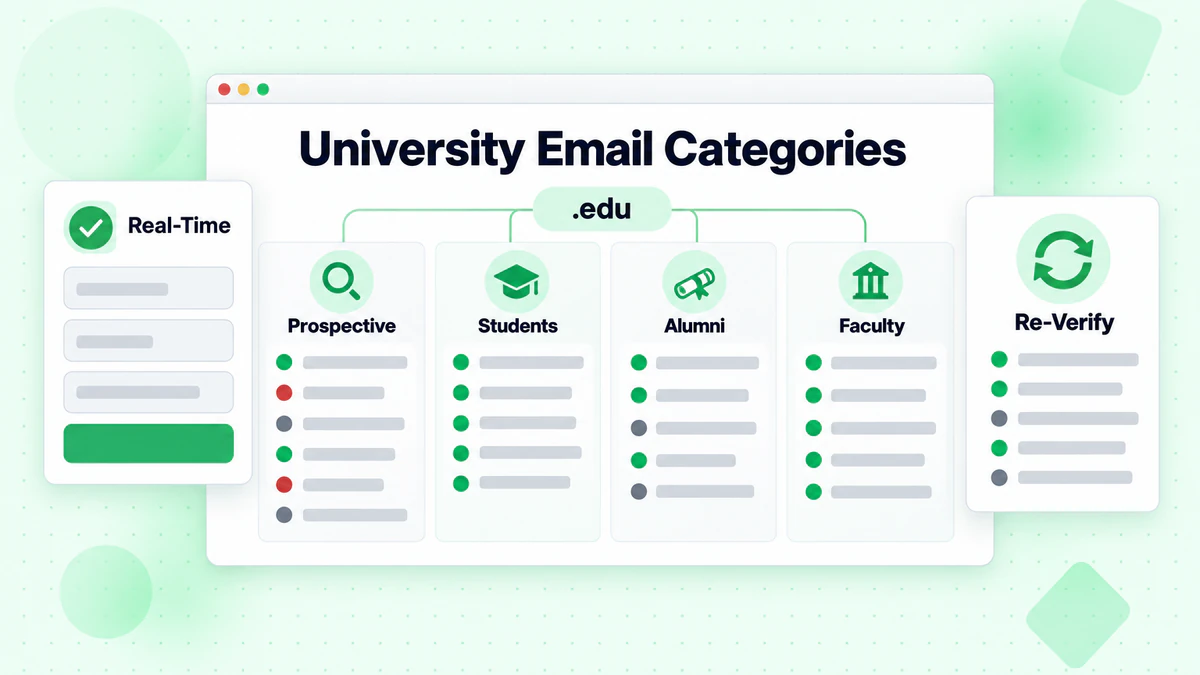
The .edu Email Ecosystem
University emails exist in a complex ecosystem:
Student-Provided Personal Emails:
- Gmail, Yahoo, Outlook, etc.
- Changed frequently (especially younger students)
- May be shared with parents
- Variable engagement patterns
University-Assigned .edu Emails:
- Assigned upon enrollment
- Deactivated after graduation (timing varies)
- Often forwarded to personal accounts
- Required for institutional systems
Application System Emails:
- Used during application process
- May differ from eventual student email
- Often temporary or created for purpose
- Rarely updated after admission
Alumni Emails:
- May retain .edu access (institution-dependent)
- Personal emails change over time
- Forwarding often breaks after graduation
- Decades of accumulated decay
Why University Emails Fail
Common reasons for university email invalidity:
Natural Lifecycle:
- Graduation ends .edu access
- Transfer students lose original .edu
- Dropped/suspended students lose access
- Account inactivity leads to deletion
Student Behavior:
- New email addresses created frequently
- Original email abandoned
- Privacy concerns drive email changes
- Platform migrations (AOL → Gmail → etc.)
Collection Problems:
- Typos on paper forms (college fairs)
- Intentional fake emails (information gathering)
- Shared family emails with unclear recipients
- Outdated data from purchased lists
Technical Issues:
- .edu domains with strict acceptance policies
- Overzealous spam filtering
- Forwarding rules that break
- Account quota exceeded
The Cost of Invalid University Emails
Poor email verification has measurable impacts:
Recruitment Impact:
- 15-20% of inquiry emails typically bounce
- Each invalid email = missed enrollment opportunity
- At $40,000+ lifetime student value, losses add up quickly
- Damaged sender reputation affects all communications
Yield Impact:
- Admitted student communications critical
- Missed deposit deadlines = melt
- Financial aid information delivery failures
- Orientation and housing communication gaps
Retention Impact:
- Current student communications fail
- Academic alerts don't reach students
- Support services underutilized
- Engagement suffers
Alumni Impact:
- Event invitations don't arrive
- Giving campaigns miss donors
- Career services underutilized
- Connection with institution weakens
University Email Verification Strategies
Implement comprehensive verification approaches.
Real-Time Verification at Collection
Verify emails the moment they're captured:
Web Form Integration:
- API-based real-time verification
- Instant feedback to applicants
- Prevents invalid entries before they enter system
- Improves user experience
Implementation Example:
// Real-time email verification on inquiry form
emailInput.addEventListener('blur', async () => {
  const email = emailInput.value;
  const result = await verifyEmail(email);

  if (result.status === 'invalid') {
    showError('Please enter a valid email address');
  } else if (result.status === 'risky') {
    showWarning('This email may have delivery issues');
  }
});
Application System Integration:
- Verify during application creation
- Flag suspicious emails for review
- Prevent ghost applications
- Ensure communication throughout process
Event Registration:
- Verify at campus visit signup
- Confirm college fair registrations
- Validate webinar attendee emails
- Catch typos in on-site collection
Batch Verification for Existing Lists
Regularly verify existing databases:
When to Run Batch Verification:
- Before major recruitment campaigns
- At the start of each recruitment cycle
- Prior to yield communication pushes
- Annually for alumni databases
- After list imports
Best Practices:
- Segment by source and age of data
- Verify and segment in one process
- Route results appropriately
- Document verification history
For comprehensive guidance on email verification, implement proven strategies across your institution.
.edu-Specific Verification Considerations
.edu addresses require special attention:
Challenges:
- Variable deactivation policies by institution
- Some schools allow lifetime access
- Technical configurations vary widely
- Verification timing matters (summer vs. academic year)
Verification Approach:
- Standard syntax and domain validation
- MX record verification
- Mailbox existence check (with caution)
- Institution-specific knowledge when available
Limitations:
- Some .edu servers don't support verification queries
- Catch-all configurations common
- Results may be less definitive than consumer emails
Integrating with University Systems
Connect verification to campus technology:
CRM Integration:
- Slate, Salesforce, Element451
- Automatic verification at record creation
- Batch verification workflows
- Result storage in CRM fields
SIS Integration:
- Student information system data
- Enrollment status correlation
- Multi-email preference management
- Communication preference tracking
Application System Integration:
- Common App, Coalition, institutional systems
- Pre-application verification
- Application completion tracking
- Decision communication delivery
Managing Different Email Categories
Different university email categories need different approaches.
Prospective Student Emails
Characteristics:
- High volume, high churn
- Mixed quality from various sources
- Critical for recruitment
- Time-sensitive communications
Verification Strategy:
- Real-time verification at capture
- Rapid follow-up verification for bulk sources
- Aggressive hygiene before campaigns
- Source-based quality tracking
Collection Best Practices:
- Digital collection when possible (fewer typos)
- Double opt-in for marketing communications
- Phone verification for high-value prospects
- Regular re-engagement campaigns to identify active addresses
Admitted Student Emails
Characteristics:
- Highest-stakes communications
- Deadline-driven content
- Mix of application and new emails
- Parent emails often involved
Verification Strategy:
- Verify immediately upon admission
- Re-verify before each major communication
- Multiple contact methods for critical messages
- Parent email backup when available
Best Practices:
- Request email confirmation during deposit
- Provide preference center for communication
- Use multiple channels for deadline reminders
- Track delivery confirmation for critical messages
Current Student .edu Emails
Characteristics:
- Institution-assigned addresses
- Generally reliable while enrolled
- May have forwarding configured
- Engagement varies
Verification Strategy:
- Initial verification at enrollment
- Annual re-verification
- Monitor bounce rates by cohort
- Track forwarding success
Best Practices:
- Encourage proper email configuration
- Monitor spam folder delivery
- Test critical communications
- Provide alternative contact methods
Alumni Emails
Characteristics:
- Decades of accumulated data
- High decay rate (30%+ over 5 years)
- Mix of .edu (if retained) and personal
- Varying engagement levels
Verification Strategy:
- Segment by graduation year (older = higher decay)
- Batch verify before major campaigns
- Progressive engagement to identify active addresses
- Regular email list cleaning cycles
Best Practices:
- Update campaigns to capture current emails
- Event registration as update opportunity
- Giving campaigns verify through engagement
- Accept that some addresses are permanently lost
Deliverability Optimization for Universities
Beyond verification, optimize for inbox placement.
Authentication for University Sending
Proper authentication protects sender reputation:
Technical Requirements:
- SPF records for all sending domains
- DKIM signing for authentication
- DMARC policy implementation
- Consistent sending infrastructure
For comprehensive email deliverability guidance, implement industry best practices.
Reputation Management
University sender reputation requires attention:
Best Practices:
- Consistent sending patterns
- Segmented lists by engagement
- Prompt bounce processing
- Complaint handling procedures
Common Problems:
- Bulk purchased list campaigns damage reputation
- Insufficient warm-up for new sending domains
- Inconsistent sending volumes
- Ignoring engagement signals
Content Considerations
University email content has deliverability implications:
Watch For:
- Financial aid information triggering spam filters
- Deadline urgency language flagged
- Image-heavy emails blocked
- Broken personalization tokens
Solutions:
- Test critical campaigns before sending
- Balance images with text
- Personalization quality assurance
- Plain text alternatives
Verification Workflow Implementation
Build systematic verification into university operations.
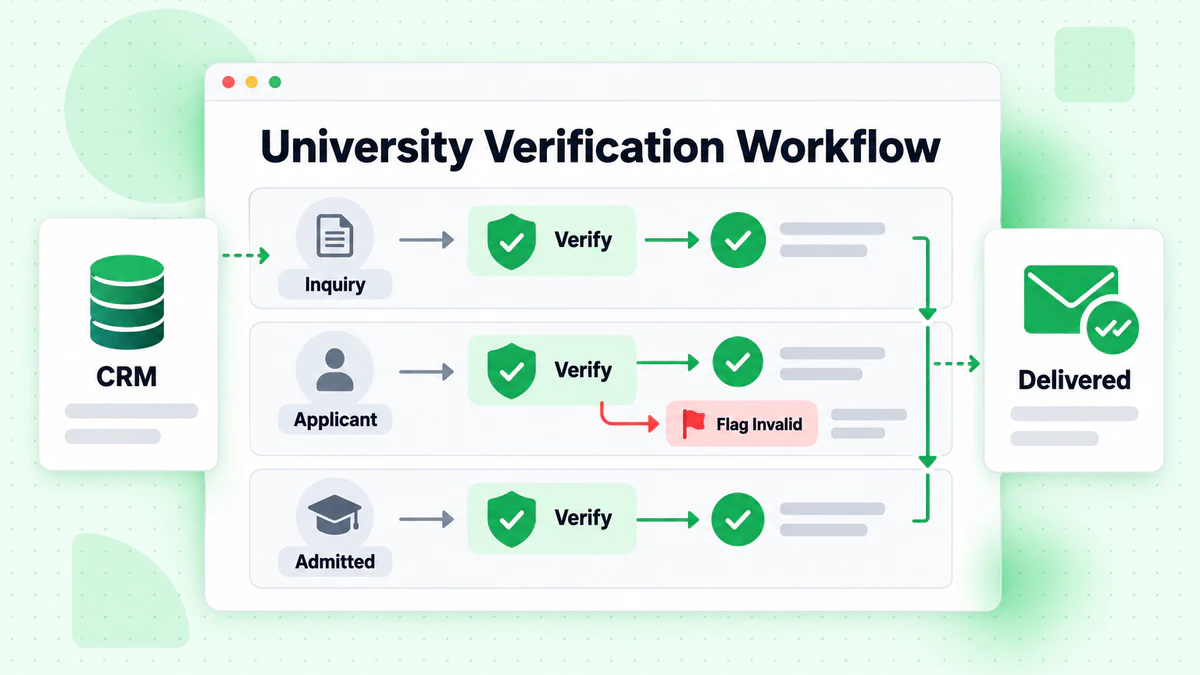
Recruitment Cycle Workflow
INQUIRY STAGE:
Capture → Real-time Verify → Store with Status →
Follow-up Based on Verification Result

APPLICANT STAGE:
Application Start → Verify →
Flag Invalid for Alternative Contact →
Monitor Application Communication Delivery

ADMITTED STAGE:
Admission → Re-verify → Update Record →
Multi-Channel for Critical Deadlines

DEPOSIT STAGE:
Deposit → Confirm Email → Request Update if Needed →
Transition to Student Communication
Annual List Hygiene Workflow
BEFORE RECRUITMENT CYCLE:
1. Export all prospect emails
2. Run batch verification
3. Segment by status (valid/invalid/risky)
4. Route invalid to alternative contact attempt
5. Mark unverifiable for reduced communication
6. Import results to CRM

QUARTERLY MAINTENANCE:
1. Verify new additions since last cycle
2. Re-verify engaged but unvalidated
3. Sunset consistently unengaged
4. Update verification timestamps
Result Handling
Different verification results require different actions:
| Result | Meaning | Action |
|---|---|---|
| Valid | Address exists and accepts mail | Continue communication |
| Invalid | Address doesn't exist | Remove or attempt update |
| Risky | May have delivery issues | Monitor closely, backup channel |
| Unknown | Verification inconclusive | Include but monitor |
| Disposable | Temporary email service | Flag for follow-up |
| Role-based | Generic address (info@) | Flag, may be acceptable |
Measuring Verification Success
Track metrics to demonstrate ROI.
Key Performance Indicators
List Quality Metrics:
- Verification pass rate by source
- Bounce rate before/after verification
- Invalid rate by collection method
- Time-to-verification
Business Impact Metrics:
- Application completion rates
- Yield rates by email validity status
- Communication delivery success
- Cost savings from reduced bounces
Understanding your email marketing metrics helps optimize verification investment.
Calculating ROI
University email verification ROI:
Annual Cost of Verification: $5,000
Emails Verified: 100,000

Before Verification:
- 20% invalid = 20,000 invalid emails
- Assume 1% of invalid would have enrolled
- Lost potential: 200 students
- Average tuition: $30,000
- Potential lost revenue: $6,000,000

After Verification:
- Invalid emails identified and corrected
- Alternative contact methods used
- Recovery rate of 10% = 20 students
- Recovered revenue: $600,000
- ROI: 11,900%
Even conservative assumptions show significant ROI. Learn more about email list building strategies to maximize your prospective student database.
Technology and Integration
Select appropriate verification technology.
BillionVerify for Education
BillionVerify offers education-specific features:
Education Features:
- .edu domain optimization
- High-volume batch processing
- Real-time API for applications
- CRM integrations (Slate, Salesforce)
Implementation Options:
- API integration for custom systems
- Batch upload for existing lists
- Scheduled verification workflows
- Webhook notifications for results
CRM Integration Best Practices
Connect verification with your student CRM:
Slate Integration:
- Verify at inquiry creation
- Store verification status in custom field
- Trigger workflows based on results
- Track verification history
Salesforce Integration:
- Education Cloud compatibility
- Process Builder automation
- Custom field mapping
- Campaign membership based on status
Application System Integration
Verify within application workflows:
Common App Considerations:
- Verification after data received
- Alternative contact for invalid emails
- Integration timing considerations
Institutional Application Systems:
- Real-time verification at submission
- Follow-up verification for started applications
- Alternative contact collection
Best Practices for University Email Hygiene
Implement proven strategies for list maintenance.
Collection Best Practices
Improve quality at the source:
Digital Collection:
- Real-time validation
- Clear error messaging
- Email confirmation step
- Mobile-friendly forms
Event Collection:
- Tablet-based signup (reduces handwriting errors)
- Immediate confirmation email
- Alternative contact capture
- Follow-up verification
Purchased Lists:
- Verify before import
- Source quality assessment
- Aggressive hygiene
- Track source performance
Ongoing Maintenance
Maintain list quality continuously:
Regular Schedules:
- Weekly: Process bounces
- Monthly: Verify new additions
- Quarterly: Full list verification
- Annually: Deep clean and sunset
Engagement-Based Hygiene:
- Monitor opens and clicks
- Re-engagement campaigns for dormant
- Sunset after extended inactivity
- Quality over quantity mindset
Documentation and Compliance
Maintain proper records:
Record Keeping:
- Verification dates and results
- Consent documentation
- Communication preferences
- Update history
FERPA Considerations:
- Protect student information
- Proper data handling
- Third-party compliance
- Documentation requirements
Common Challenges and Solutions
Address typical university verification obstacles.
Challenge: High Volume During Peak Periods
Application deadlines create massive verification demand.
Solutions:
- Schedule verification before peak
- Real-time verification for new submissions
- Prioritize by funnel stage
- Scale verification capacity
Challenge: .edu Deactivation Timing
Hard to predict when .edu addresses stop working.
Solutions:
- Don't rely solely on .edu
- Collect and verify personal email backup
- Monitor bounce patterns by graduation cohort
- Accept some uncertainty
Challenge: Legacy Data Quality
Decades of alumni data has accumulated errors.
Solutions:
- Start with engaged segments
- Progressive verification campaigns
- Accept permanent losses
- Focus on quality over quantity
Challenge: Multiple Email per Person
Students have application, personal, and .edu emails.
Solutions:
- Primary and secondary email fields
- Preference management
- Verify all, track deliverability
- Fall back to working addresses
Conclusion
University email verification is essential for effective enrollment communication and institutional advancement. The unique challenges of student email—high churn, lifecycle transitions, and mixed email types—require systematic verification approaches tailored to higher education needs.
Success requires verification at every touchpoint: real-time verification during collection, batch verification for existing lists, and ongoing hygiene maintenance. The investment pays significant returns through improved recruitment outcomes, better yield rates, and stronger alumni engagement.
BillionVerify provides the email verification infrastructure that universities need to maintain clean, deliverable lists across recruitment, enrollment, and advancement operations. With .edu-specific optimization and integration options for common higher education CRMs, BillionVerify helps institutions ensure critical communications reach students throughout their academic journey and beyond. Start your free trial or view pricing.
Start by assessing your current email quality across prospect, applicant, student, and alumni databases. Implement real-time verification for new collection and batch verification for existing lists. Build systematic hygiene processes that maintain list quality over time.
The institutions that master email verification build stronger enrollment pipelines, retain more students, and engage more alumni. In an era of declining enrollment and increasing competition, email verification isn't optional—it's essential infrastructure for institutional success.