



Finding valid email addresses never feels straightforward when campaigns rely on clean user lists. For SaaS marketing teams, neglected list hygiene quickly leads to higher bounce rates and lost revenue as invalid emails stack up. Email validation helps prevent these setbacks by catching typos, inactive accounts, and spam traps before your messages go out. This overview highlights the importance of a layered email validation strategy so your campaigns reach more inboxes and deliver stronger engagement.
Key Takeaways
| Point | Details |
|---|---|
| Importance of Email Validation | Email validation is essential for maintaining communication quality and sender reputation in SaaS marketing campaigns. |
| Types of Validation Methods | Various methods, such as syntax validation and SMTP validation, offer different levels of email address verification. |
| Risks of Invalid Emails | Invalid email addresses increase bounce rates and damage sender reputation, jeopardizing marketing effectiveness. |
| Best Practices | Implement real-time validation and regular list cleaning to ensure data integrity and enhance user engagement. |
Core Definition of Email Validation and Misconceptions
Email validation is a critical process for SaaS marketing teams to ensure high-quality communication channels and maintain list hygiene. At its core, email validation is a systematic approach to verifying the authenticity and deliverability of email addresses before sending marketing communications.
The technical process involves multiple sophisticated checks, including:
- Syntax validation: Ensuring the email address follows standard formatting rules
- Domain verification: Confirming the email's domain actually exists and can receive messages
- Mailbox detection: Determining whether the specific email address represents an active, reachable inbox
- Spam trap identification: Screening out potentially harmful or fraudulent email addresses
Many marketers mistakenly conflate email validation with email verification, but these are distinct processes. Email validation focuses on structural integrity while verification determines whether an actual recipient exists at that address.
The consequences of neglecting proper email validation can be severe for SaaS marketing campaigns. Unchecked email lists can result in:
- Increased bounce rates
- Damage to sender reputation
- Potential blacklisting by email service providers
- Reduced overall campaign effectiveness
Pro tip: Implement automated email validation processes before every major marketing campaign to ensure maximum deliverability and engagement.
Types of Email Validation and Key Distinctions
Email validation encompasses several sophisticated approaches designed to ensure the quality and reliability of email addresses in marketing databases. Real-time and bulk validation techniques represent the two primary methodological frameworks that SaaS marketing teams leverage to maintain clean communication channels.
The primary types of email validation include:
- Syntax Validation: Checking email address formatting against standard RFC protocols
- Domain Validation: Verifying the existence and configuration of email domain
- SMTP Validation: Connecting directly with mail servers to confirm address authenticity
- Disposable Email Detection: Identifying and filtering temporary or throwaway email addresses
- Role-Based Email Identification: Screening out generic addresses like "info@" or "support@" that typically indicate non-personal contacts
Each validation type serves a unique purpose in the comprehensive email hygiene process. Syntax validation ensures the basic structural integrity of an email address, while more advanced techniques like SMTP validation provide deeper verification by actively communicating with mail servers.
For SaaS marketing professionals, understanding these distinctions is crucial. Different validation methods offer varying levels of precision and computational complexity, which directly impact marketing list quality and campaign performance:
Here's a summary of email validation methods and their impact on SaaS marketing:
| Validation Method | Description | Impact on SaaS Marketing |
|---|---|---|
| Syntax Validation | Checks formatting rules for addresses | Prevents immediate entry errors |
| Domain Verification | Confirms domain is active and reachable | Reduces risk of bounced messages |
| SMTP Validation | Communicates with mail servers for confirmation | Maximizes deliverability |
| Disposable Email Detection | Identifies temporary or fake emails | Improves lead quality |
| Role-Based Identification | Filters generic addresses (e.g., info@) | Boosts personalization effectiveness |
- Basic syntax checks are quick but least comprehensive
- Domain verification provides moderate reliability
- SMTP validation offers the highest level of email address confirmation
- Comprehensive multi-step validation delivers the most accurate results
Pro tip: Implement a multi-layered email validation strategy that combines different validation techniques for maximum accuracy and deliverability.
How Email Validation Works for SaaS Marketing
Email validation for SaaS marketing represents a sophisticated process of maintaining high-quality communication databases through systematic screening and verification techniques. SaaS platforms proactively integrate email validation during critical user interaction points to ensure data integrity and optimize marketing communication effectiveness.
The comprehensive email validation workflow typically involves multiple strategic stages:
- Real-Time Validation: Immediate checks during user registration
- Format Verification: Ensuring correct email address structure
- Domain Authentication: Confirming legitimate and active email domains
- Deliverability Assessment: Evaluating potential email transmission risks
- Continuous Monitoring: Tracking email list health and engagement
Proactive validation serves multiple critical functions for SaaS marketing teams. By identifying and filtering problematic email addresses early, companies can significantly reduce bounce rates, protect sender reputation, and improve overall communication efficiency.
For most SaaS marketing teams, the email validation process follows a strategic sequence:
- Capture initial email address during sign-up
- Perform immediate syntax and domain checks
- Execute deeper verification through SMTP protocols
- Store verified email in marketing database
- Implement periodic re-verification and list cleaning
Pro tip: Implement an automated email validation workflow that integrates real-time verification with periodic list maintenance to maximize marketing communication effectiveness.
Real-Time vs Bulk Validation: Use Cases and ROI
Email validation strategies are crucial for SaaS marketing teams, with two primary approaches offering unique advantages. Real-time and bulk validation techniques represent complementary methods for maintaining high-quality communication databases and optimizing marketing performance.
The key differences between real-time and bulk validation include:
Real-Time Validation:
- Instant verification during user sign-up
- Catches typos and disposable emails immediately
- Improves user experience and data quality
- Prevents invalid email entries from entering the system
Bulk Validation:
- Periodic comprehensive list cleaning
- Removes outdated or inactive contacts
- Supports large-scale marketing database maintenance
- More cost-effective for extensive email lists
Strategic implementation of these validation methods can dramatically improve marketing outcomes. Real-time validation acts as a first line of defense, while bulk validation ensures ongoing list hygiene and communication effectiveness.

Compare real-time and bulk email validation strategies:
| Aspect | Real-Time Validation | Bulk Validation |
|---|---|---|
| Timing | At user sign-up immediately | Scheduled or periodic |
| Main Benefit | Stops bad data from entering | Cleans large lists efficiently |
| User Experience | Ensures seamless registration | No user interaction required |
| Typical Use Case | New users or form submissions | Legacy or growing datasets |
For SaaS marketing teams, the ROI of email validation is substantial and can be measured through:
- Reduced email bounce rates
- Improved sender reputation
- Lower marketing communication costs
- Enhanced audience engagement
- More accurate customer segmentation
Pro tip: Combine real-time and bulk validation strategies to create a comprehensive email list management approach that maximizes deliverability and marketing performance.
Risks of Invalid Emails for Deliverability and Reputation
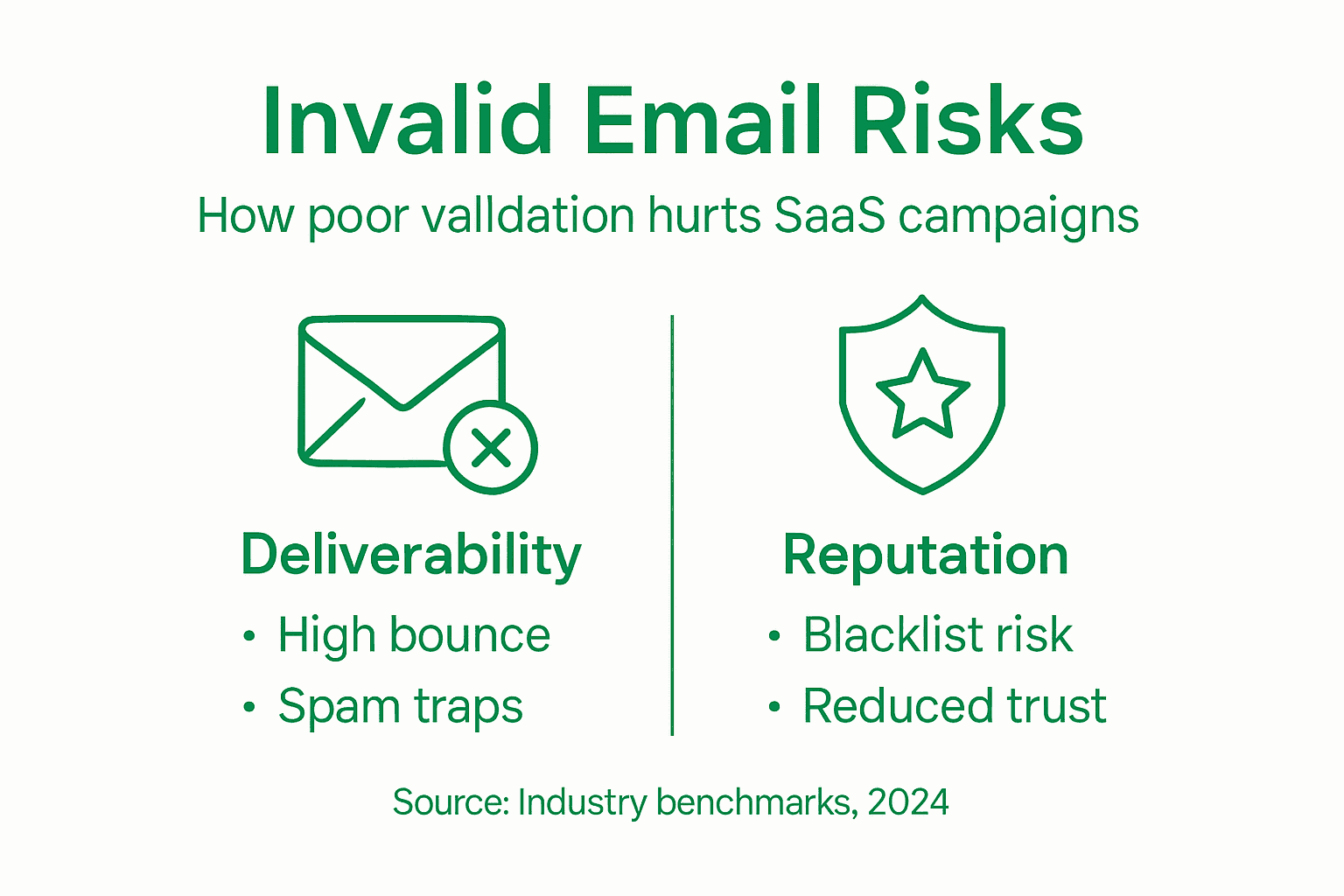
Invalid email addresses pose significant risks to SaaS marketing strategies, undermining communication effectiveness and brand reputation. Email deliverability risks can dramatically impact business performance by creating complex challenges for marketing teams and communication systems.
The primary risks associated with invalid emails include:
- Increased Bounce Rates: Signals poor list quality to email service providers
- Spam Trigger Mechanisms: Higher likelihood of messages being filtered
- Sender Reputation Damage: Potential blacklisting from email platforms
- Reduced Engagement Metrics: Lower open and click-through rates
- Potential Revenue Loss: Missed communication opportunities
Technical consequences of maintaining invalid email lists extend beyond simple communication failures. Internet Service Providers (ISPs) use sophisticated algorithms that continuously assess sender reputation, with invalid emails serving as critical negative signals that can compromise entire marketing infrastructure.
The most critical implications for SaaS businesses involve multiple interconnected performance metrics:
- Diminished user activation rates
- Reduced customer retention potential
- Increased customer acquisition costs
- Compromised marketing automation effectiveness
- Potential financial revenue reduction
Pro tip: Implement a comprehensive email validation strategy that combines real-time verification and periodic list cleaning to maintain optimal deliverability and protect sender reputation.
Best Practices and Common Mistakes in Email Validation
Email validation represents a critical defensive strategy for SaaS marketing teams seeking to maintain high-quality communication channels. Email verification best practices provide a comprehensive framework for protecting marketing infrastructure and ensuring effective audience engagement.
Key best practices for effective email validation include:
- Real-Time Validation: Implement instant verification during user sign-up
- Continuous List Maintenance: Regularly clean and update email databases
- Multi-Layer Verification: Use multiple validation techniques
- Privacy Compliance: Adhere to data protection regulations
- Metrics Tracking: Monitor email delivery and engagement performance
Common mistakes that SaaS marketers frequently encounter can significantly undermine email marketing effectiveness. These pitfalls range from technical oversights to strategic negligence in maintaining list quality and user engagement.
The most critical errors in email validation processes involve:
- Ignoring post-signup validation requirements
- Allowing disposable email addresses
- Neglecting role-based email filtering
- Failing to implement comprehensive verification protocols
- Overlooking privacy and compliance standards
Pro tip: Develop a holistic email validation strategy that combines automated real-time checks, periodic list cleaning, and continuous performance monitoring.
Strengthen Your SaaS Marketing with Precision Email Validation
Managing email deliverability and sender reputation remains a major challenge for SaaS marketers. As the article highlights, problems like role-based emails, disposable addresses, and invalid domains can severely increase bounce rates and reduce campaign effectiveness. To overcome these obstacles and safeguard your marketing ROI, adopting a comprehensive email validation solution is crucial.
BillionVerify offers advanced tools perfectly aligned with these needs, including real-time email verification API with 99.9% accuracy, disposable email detection, role-based email identification, and detailed reporting. By integrating BillionVerify’s bulk email list cleaning into your marketing workflow, you can eliminate low-quality addresses before they harm your sender reputation and engagement metrics.
Discover how BillionVerify helps SaaS teams validate every sign-up instantly and maintain pristine email lists over time. Don’t let invalid emails undermine your marketing success. Start improving your deliverability rates and protect your brand reputation now with BillionVerify.
Frequently Asked Questions
What is email validation and why is it important for SaaS marketing?
Email validation is the process of verifying the authenticity and deliverability of email addresses in marketing databases. It is crucial for SaaS marketing as it ensures high-quality communication channels, reduces bounce rates, protects sender reputation, and improves overall campaign effectiveness.
How does email validation differ from email verification?
Email validation focuses on the structural integrity and format of email addresses, while email verification determines whether an actual recipient exists at that address. Both processes are important, but they serve different purposes in maintaining a clean email list.
What are the main types of email validation techniques?
The primary types of email validation techniques include syntax validation, domain verification, SMTP validation, disposable email detection, and role-based email identification. Each technique plays a unique role in maintaining email list hygiene and ensuring message deliverability.
What are the risks of using invalid email addresses in SaaS marketing?
Using invalid email addresses can lead to increased bounce rates, damage to sender reputation, spam filtering, reduced engagement metrics, and potential revenue loss. These risks can severely impact the effectiveness of marketing strategies and overall business performance.