


Most B2B teams are still being told to generate more leads. That advice is usually wrong. If your CRM is full of unverified addresses, weak-fit contacts, and form-fill spam, more traffic only gives your SDRs a larger queue of bad work.
The core challenge lies in prioritization, response speed, and data hygiene. A widely used 2025 B2B benchmark places median website conversion at 2.9%, while average lead-to-customer conversion sits around 2.7% to 2.9%, depending on source and segment. The benchmark data makes the economics clear: traffic alone doesn't create revenue. Your team has to identify the few contacts worth immediate attention, verify that they can be reached, and route them before intent fades.
Stop Chasing More Leads and Start Prioritizing the Ones You Already Have
The popular volume-first playbook says to publish another gated guide, buy a larger list, and push every new contact to sales. That approach fails because it treats every record as equally valuable. A student using a personal address, a competitor researching your pricing, and a VP requesting a security review shouldn't enter the same queue.
A B2B sale lead should earn sales attention through a combination of fit, intent, reachability, and urgency. Start by removing obvious noise before a record reaches an SDR. Then rank the remaining contacts by company fit, seniority, buying behavior, and the strength of the source.
Practical rule: Don't reward your team for adding records. Reward them for creating qualified conversations from reachable, relevant contacts.
Cost makes this discipline unavoidable. Average B2B cost per lead was reported at $198 across industries in 2024, with the cited range running from $31 in e-commerce to $370 in healthcare. A separate 2026 benchmark places median B2B cost per lead at $213, with channel costs ranging from $98 for organic content and SEO to $487 for account-based marketing. The cost benchmarks show why poor data wastes more than rep time. It consumes acquisition budget before a salesperson even speaks to the prospect.
The three levers that matter
- Definition: Separate MQLs, SQLs, PQLs, nurture contacts, and disqualified records. If the labels are vague, routing will be vague too.
- Verification: Check whether an address can receive email before it enters an outbound sequence, CRM enrichment flow, or sales queue.
- Priority: Combine ICP fit with real buying behavior. A high-fit account with no intent can wait behind a moderate-fit account actively asking for implementation details.
The B2B Leads Email Verification workflow belongs before outreach, not after a campaign damages deliverability. Tightening the funnel often creates more usable pipeline from the same demand. Another eBook won't fix a queue filled with contacts nobody can reach.
What a B2B Sale Lead Actually Is in 2026
A B2B sale lead isn't just a person who submitted a form. It's a company or contact that matches your ideal customer profile and has shown a buying signal strong enough to justify a defined next action.
That definition has two parts. Firmographic fit tells you whether the account could benefit from your offer. Behavioral or product evidence tells you whether the contact is moving toward a buying conversation. Remove either part and your team will either chase curious visitors or ignore genuine demand.
MQL, SQL, and PQL at a Glance
| Lead Type | Signal Source | Qualifying Criteria | Funnel Entry |
|---|---|---|---|
| MQL | Gated content, webinar, pricing-page activity | Fits the ICP and shows meaningful marketing engagement, but hasn't confirmed an active sales need | Marketing nurture |
| SQL | Discovery call, demo reply, direct sales conversation | Sales confirms need, authority or influence, and a credible path to purchase | Sales pursuit |
| PQL | Trial activity, product usage, activation behavior | Uses the product in a way that indicates value realization and potential conversion | Product-led sales or success |
Consider three concrete examples. A director at a target company who downloads a pricing PDF is an MQL because the action suggests evaluation, but it doesn't prove readiness. A champion who replies to demo outreach and describes an internal workflow problem is an SQL because sales has evidence of an active conversation. A trial user who exceeds your activation threshold through meaningful product usage is a PQL because the product itself has supplied the buying signal.
The handoff should change the moment the lead type changes. MQLs need relevant education and monitored intent. SQLs need a rep, a meeting path, and fast context. PQLs need product-specific follow-up, such as help with an advanced workflow, usage review, or expansion discussion.
Write the definitions into the CRM
Don't let marketing and sales negotiate the meaning of “qualified” in every pipeline meeting. Put the criteria in the CRM, attach required fields to each status, and make disqualification reasons mandatory.
A useful operating model looks like this:
- Capture: Record source, company, role, domain, and consent context.
- Verify: Check reachability and data risk before enrichment or outreach.
- Score: Apply fit and intent rules.
- Route: Send the contact to sales, nurture, product, or suppression.
- Review: Compare progression by source and lead type.
Qualifying and Scoring Leads That Deserve a Rep's Time
Lead scoring should make a rep's day simpler, not produce a mysterious number nobody trusts. Use a small set of observable signals, agree on the meaning of each score, and connect thresholds to routing actions.
BANT remains useful for basic readiness: budget, authority, need, and timeline. CHAMP puts more weight on challenges and the business problem. MEDDIC is more appropriate for complex deals where metrics, economic buyers, decision criteria, decision processes, pain, and champions matter. These frameworks aren't competing religions. Use the lightest framework that matches your deal complexity.
Build the score from fit and behavior
A practical model can assign points for:
- Company fit: Employee count, industry, geography, and technology environment.
- Role relevance: Executive, VP, director, practitioner, student, or unknown role.
- Buying behavior: Pricing-page visits, repeat visits, demo requests, security reviews, and replies.
- Need evidence: A stated problem, implementation deadline, or request for commercial information.
- Negative signals: Competitor domains, disposable addresses, students, personal inboxes, and mismatched industries.
The point isn't to claim that every action predicts revenue. The point is to create a consistent priority order that sales and marketing can inspect and revise.
A worked scoring example
Take a 250-employee fintech VP who watched two demos and requested a security review. Suppose your agreed model assigns points as follows:
- Company size fit: 20 points
- Fintech industry fit: 18 points
- VP seniority: 15 points
- Two demo views: 15 points
- Security review request: 20 points
The total is 88 points. If your SQL threshold is 75 points, the CRM should route this lead to an AE, create an immediate task, and attach the activity history to the record. The rep shouldn't have to reconstruct why the contact qualified.
The deductions matter just as much. A competitor email, disposable address, student role, or missing company domain should lower the score or trigger disqualification. B2B lead verification methods help separate a contact's apparent fit from the quality of the underlying record.
BillionVerify is a professional email verification service built to solve one problem: bad email data costs businesses money. It can sit alongside your scoring logic, but verification doesn't replace qualification. A reachable contact can still be a poor prospect, and a perfect ICP match can still lack intent.
Channels and Tactics That Generate Real B2B Pipeline
No channel wins by default. Evaluate each source against cost per qualified lead, intent strength, and ICP fit, then invest where those three factors support your sales motion.
| Channel | Avg Cost per Qualified Lead | Intent Strength | ICP Fit | Best Use |
|---|---|---|---|---|
| Cold outbound | Variable by targeting and execution | Low to high, depending on trigger | High when account lists are disciplined | Target-account creation and event-triggered outreach |
| Inbound content and SEO | Often efficient over time, with costs varying by production effort | Medium to high | Strong when content matches buyer problems | Capturing researchers and building category authority |
| Partnerships and integrations | Variable, often relationship-dependent | High when the partner shares active customers | High with a complementary ecosystem | Warm introductions and co-selling |
| Events | Variable and resource-intensive | High during relevant conversations | Strong when attendee selection is controlled | Trust-building and complex product evaluation |
| Paid demand generation | Variable by audience, offer, and bidding environment | Medium | Adjustable, but easily diluted | Testing offers and reaching defined segments |
| Product-led signups | Variable by product and acquisition path | High after meaningful usage | Depends on activation and account fit | Converting users who have already experienced value |
For a mid-market SaaS company, I'd start with a 60/30/10 mix of outbound, inbound, and partnerships. That is an operating recommendation, not a universal law. Outbound gives the team control over target accounts, inbound compounds useful education, and partnerships add borrowed trust.
Cold volume is not a strategy. A small, verified list tied to a real trigger beats a large file with generic messaging. Branded display can support awareness, but it rarely deserves the same priority as a channel that gives sales identifiable accounts and observable intent.
Teams building a channel dashboard should also define the operational measures behind acquisition, not just lead totals. The resource on B2B lead gen agency KPIs is useful for framing that measurement discussion. For outbound teams, document your cold email marketing strategies alongside source quality, verification status, reply quality, and SQL creation.
Nurturing and Routing Leads With Speed and Context
A RevOps leader at a SaaS company with 200 to 1,000 employees should not receive the same sequence as a small-business founder or a product-led user. The workflow below is a practical 14-day template. It works because every touch has a reason, and every reply changes the route.
Days 1 through 3
Start with a verified work email and a LinkedIn connection. The opening should reference a relevant company event, such as a recent funding round or tool migration, then connect that event to a specific RevOps problem.
Don't send a product catalogue. Ask a focused question about the operational issue your team can help investigate. If the contact replies, the SDR should respond within five minutes. A lead-response study summarizes widely cited research showing about 100 times higher contact odds and 21 times higher qualification odds for responses under five minutes compared with waiting 30 minutes. The same source reports average B2B first-response times around 42 to 47 hours, which is an avoidable process failure.
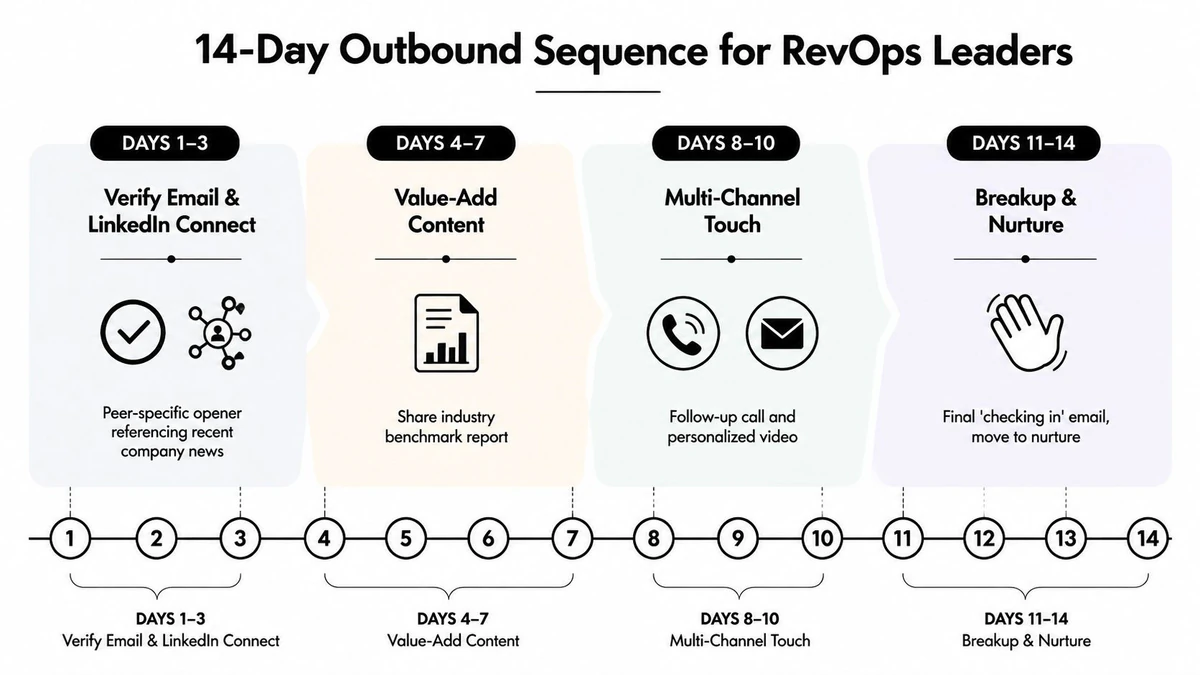
Days 4 through 7
Follow up with a case study or benchmark tied to the prospect's stack. If the account uses the systems your product integrates with, mention the relevant workflow rather than dropping a generic customer story. HubSpot should route replies by persona, account ownership, and region, while the CRM record should show the source, verification result, recent activity, and stated problem.
Days 8 through 10
Use a multi-channel touch, such as a call, a concise email, or a personalized video. Remove bounced leads before the next send. Don't keep retrying an address that has already failed. Recycle non-responders into a re-engagement list with a clear reason for future contact.
Days 11 through 14
Send a soft breakup email that makes the next step easy. A positive reply goes to the SDR or AE. A useful but non-urgent response enters nurture. No response ends the active sequence instead of generating endless automated noise.
The sequence is only half the system. Routing speed and context determine whether a good lead becomes a meeting. A verified record with a clear trigger, persona, and activity history gives the rep something relevant to say immediately.
How Email Verification Protects Every Stage of the Funnel
Email verification isn't a cosmetic cleanup task. It controls whether your lead capture, enrichment, outreach, and CRM reporting operate on usable records.
Run the checks in order, and apply them at the stage where they prevent the most waste.
Start with the SMTP handshake
An SMTP-level check queries the mail server about whether a mailbox appears to exist. That makes it more useful than a format check, which only confirms that an address looks syntactically correct. Provider policies, greylisting, and catch-all behavior can still limit certainty, so a sound system returns risk states instead of pretending every result is a simple yes or no. SMTP verification guidance explains this server-level approach and its limitations.
Use the result before sending a sequence and before allowing a newly submitted address into an automated sales workflow. If the mailbox can't be confirmed, route it for review or suppression.
Confirm the MX infrastructure
A domain without MX records can't receive email. An MX check therefore tests whether the domain has mail infrastructure configured, not whether the specific person still works there. Email verification process guidance describes MX checking as a hard infrastructure test.
Run it during form capture and before CRM synchronization. This blocks records that look valid but can't deliver by design.
Flag catch-all domains
Catch-all domains accept SMTP probes for every address on the domain. That means a verification service can't reliably confirm whether an individual mailbox exists. Industry guidance puts catch-all domains at roughly 15% to 25% of B2B domains. Catch-all verification guidance explains why these addresses should be flagged as risky rather than marked confirmed.
Don't treat a catch-all result as an automatic green light. Use controlled sending, stronger engagement filters, and a lower priority until the contact demonstrates real interaction.
Filter disposable and risky addresses
Disposable domains and unsuitable role addresses create bad routing and weak personalization. Remove them from outbound sequences, block them during product registration where appropriate, and preserve the reason for suppression in your CRM.
Deliverability guidance commonly recommends keeping hard bounces at or below 1% and complaints at or below 0.3%. Email list hygiene guidance connects those thresholds to removing invalid, disposable, and risky addresses before campaigns. Use how to verify email addresses as the operating reference for placing these checks into capture, pre-send, and pre-sync workflows.
KPIs and Common Pitfalls to Watch in Your Pipeline
A dashboard is useful only when each metric triggers a decision. Track the movement between stages, then assign an owner and a corrective action before the next review.
Five Pipeline KPIs and the Workflow Change They Demand
| KPI | Healthy Range | Red Flag | Workflow Change to Make |
|---|---|---|---|
| MQL-to-SQL conversion rate | Your agreed internal benchmark | Below 15% indicates likely misalignment | Rebuild the score, tighten ICP fields, and inspect source quality |
| SQL-to-opportunity conversion | Stable progression by source and segment | Qualified leads stall after handoff | Audit discovery, routing, and response context |
| Pipeline velocity | Improving without sacrificing quality | Deals move slowly or depend on end-of-period pushes | Review deal size, win rate, stage duration, and bottlenecks |
| Opportunity-to-close rate | Consistent for comparable segments | Opportunities close inconsistently | Inspect qualification, competitive positioning, and next-step discipline |
| Cost per SQL | Declining or justified by deal economics | Acquisition cost rises without better conversion | Cut weak sources and improve targeting or verification |
The MQL-to-SQL rate is usually the cleanest signal that marketing and sales disagree about lead quality. If it falls below 15%, don't tell SDRs to work harder. Check whether the form attracts the wrong people, whether the score rewards vanity firmographics, and whether verification happens before routing.
SQL-to-opportunity conversion tests the handoff. If qualified contacts fail to become opportunities, the problem may be slow response, weak discovery, poor account context, or a definition of SQL that's too loose. Pipeline velocity then shows whether the entire system is moving, because it reflects deal size, win rate, and cycle length together.
Review standard: Every red KPI needs a named workflow change. A metric without an action is decoration.
Common failures repeat across teams:
- Letting marketing-owned leads age: Enforce the under-five-minute response SLA for high-intent submissions.
- Scoring titles instead of intent: Reduce the weight of job title and increase the weight of meaningful behavior.
- Reporting activity volume: Replace emails sent and calls made with qualified meetings, opportunities, and revenue progression.
- Ignoring deliverability: Verify before campaigns, monitor bounces, and suppress risky records before sender reputation suffers.
A 30 Day Plan to Turn Your B2B Sale Lead Engine Around
Don't launch another campaign until the operating system is fixed. A month is enough to audit the database, define the handoffs, and put a controlled acquisition motion into production.
Week 1 focuses on data hygiene
Audit every capture point, including forms, imports, event lists, product registration, and outbound uploads. Integrate verification before records reach sequences or CRM enrichment, purge hard bounces and inappropriate role addresses, and tag the existing database by ICP fit.
Keep the result visible. Each contact should show verification status, source, segment, owner, and suppression reason. If a record can't be explained, it shouldn't be prioritized.
Week 2 rebuilds scoring
Write explicit MQL, SQL, and PQL definitions. Then rebuild scoring around buying intent, account fit, role relevance, and negative signals. Set the SQL threshold, document who owns each route, and create a feedback field so reps can mark false positives and missed opportunities.
Don't let the model become permanent by accident. Review the first decisions with sales and marketing together.
Week 3 tightens acquisition and routing
Choose one channel mix using the cost, intent, and fit lens. Launch a verified list or controlled inbound workflow, then enforce a five-minute response SLA for high-priority leads. HubSpot, Salesforce, or another CRM should route by persona, territory, account owner, and urgency without manual triage.
Before importing a cold list, browse cold email list hygiene tips and document the suppression rules your team will apply.
Week 4 measures and locks the process
Compare the five KPIs with your pre-audit baseline. Review MQL-to-SQL conversion, SQL-to-opportunity movement, pipeline velocity, opportunity-to-close performance, and cost per SQL. Then lock verification triggers, routing rules, follow-up cadences, and disqualification reasons into standard operating procedure.
The choice is straightforward. You can buy more traffic and feed the same broken funnel, or you can make every existing contact more reachable, relevant, and actionable. Start the audit today, verify the database before the next send, and assign an owner to every high-intent B2B sale lead.
BillionVerify offers professional email verification for identifying bad email data before it costs your sales team time, including server-level checks that support cleaner capture, list preparation, and outreach workflows. Visit BillionVerify to review how its verification service can fit into your B2B lead routing and data-hygiene process.