



You're in the Monday meeting, the dashboard says one story, the income statement says another, and the CRM is confidently waving a third number around like it's the truth. Marketing says the campaign performed, finance says the revenue didn't hold, and ops is stuck explaining why the “sales” total got smaller after refunds, discounts, and other deductions did their usual damage.
That's the difference between gross and net sales in real life. Gross sales is the full transaction value before customer-related deductions. Net sales is what remains after those deductions are taken out, which is why it's usually the more decision-useful number when you care about revenue you can keep (Investopedia, HiBob).
| Metric | What it measures | Why teams care |
|---|---|---|
| Gross sales | Total invoice or transaction value before deductions | Shows demand, volume, and top-of-funnel activity |
| Net sales | Amount left after returns, discounts, and allowances | Shows realizable revenue and growth quality |
| The gap | The deduction bridge between the two | Shows how much of the booked value survives reality |
Why Gross and Net Sales Confuse Even Experienced Teams
A finance lead opens the Monday review and finds a CRM total that is higher than the revenue line. Marketing is staring at a campaign dashboard with its own count, while finance is looking at the income statement, which has no interest in optimism. The confusion starts there. The math is not hard. The problem is that different systems are measuring different stages of the same sale, and dirty CRM records, undeliverable emails, and ghost signups can make the gap look even wider than it really is.
Gross sales is the full invoice or transaction value before customer deductions. Net sales is the amount left after returns, discounts, and allowances are removed. That difference explains why gross sales can look healthy while net sales gives a more honest picture of what the business kept (HiBob, Investopedia).
The simple definition that actually holds up
Gross sales answers a demand question, how much value hit the books before anything was taken back or reduced. Net sales answers a retention question, how much of that value survived the customer's right to return, negotiate, or receive a concession. Accounting rules make the split necessary because reported revenue has to separate the top-line amount from the deductions that come off it, and U.S. GAAP guidance under ASC 606 centers on the amount expected to be received after variable consideration (Investopedia).
That is why the same business can look strong in one report and merely decent in another. Gross sales tells you the market responded. Net sales tells you whether the business kept the value.
If your numbers flow from marketing systems into finance, the guide to email marketing basics is a useful reminder that bad contact data can distort the sale before it ever reaches the ledger.
Practical rule: if the number is meant to describe demand, gross sales fits. If the number is meant to describe retained revenue, net sales is the safer default.
The hard part is that teams use these terms loosely. One person means invoice value, another means booked revenue after refunds, and a third person includes shipping or fees. A clean formula turns into a messy meeting fast.
Gross Sales, Net Sales, and the Formulas Behind Them
A finance team can explain the math in one line. The harder part is making sure everyone is talking about the same line.
Start with gross sales
Gross sales is the starting figure, the total sold value before deductions. In practice, that can mean units sold multiplied by list price, or the total invoiced value for a period. It is the first number people pull when they want to measure order activity, demand, or overall volume, and it can look healthy even when later deductions are waiting in the wings.
The bridge to net sales is where the comparison starts. Net sales is gross sales minus the deductions the business recognizes, usually returns, discounts, and allowances. That simple formula is easy to say and easy to misapply, especially when CRM records are dirty, email lists include undeliverable addresses, or ghost signups inflate the gross side before finance has a chance to clean the tape. If the input data is bloated, the gross number grows first, then the deductions grow with it.
Gross sales counts what was booked. Net sales counts what survived.
A clean way to see the gap is to tie the accounting concept to reporting hygiene. The Everglow Prosperity GST guide is a useful reminder that tax and sales figures can sit next to each other without meaning the same thing, which is exactly why teams need clear labels before they compare numbers.
A worked order example
Metorik's example makes the bridge easier to hold in your head. If an order totals $80, gross sales for that order stay $80 even if deductions show up later. Metorik also notes that refunds, taxes, shipping, and fees can be deducted depending on the reporting context (Metorik).
Here is the arithmetic using that style of order, with the deductions called out plainly:
- Gross sales: $80
- Discount: $10
- Partial refund: $5
- Allowance: $2
- Net sales: $63
The math is just $80 minus $10 minus $5 minus $2. No mystery there. The core decision is less mathematical and more operational: which deductions belong in your definition of net sales, and which ones your team is only used to seeing on a dashboard.
A company-level bridge
Scale the same logic up to the company level. A seller with $50 million in gross sales and a 12% deduction rate would report $44 million in net sales. That means $6 million never becomes usable revenue. The gross figure still matters because it shows commercial activity, but the net figure is what finance can defend when the conversation turns to growth, margin, or planning.
That gap is also where bad data shows up. If the source records are messy, the deductions are often messy too, and the bridge between gross and net starts to wobble. A sales team may celebrate bookings, then finance discovers half the list was never reachable or never real in the first place. The arithmetic still works. The inputs do not.
What Actually Gets Deducted to Get From Gross to Net
A gross sale can look clean on paper and still shrink fast once the deductions are applied. The textbook starting point is returns, discounts, and allowances, which AccountingTools uses as the core bridge from gross sales to net sales. That is the accounting view. The operational view is messier, because dirty CRM records, undeliverable emails, and ghost signups can make the gross number look healthier than the business really is, then widen the gap when reversals and corrections show up later.
The core three deductions
Sales returns are the simplest deduction to picture. The customer sends the product back, the sale is reversed, and the revenue falls away. Sales discounts are the price cuts tied to early payment, promotional terms, or a deal structure. Sales allowances are reductions for damaged, non-conforming, or otherwise imperfect goods when the customer keeps the item but pays less.
Those three are the standard deductions finance teams expect to see in the path from gross sales to net sales. They are also the easiest to explain to non-finance teams because each one has a direct business reason attached to it.
The broader commerce view
Some commerce systems also subtract taxes, shipping, fees, and platform commissions. That is why the answer changes depending on whether the report is describing accounting revenue or order-level cash collection (Salesforce). A dashboard can include those items and still be internally consistent, but it is no longer the same thing as a financial statement line.
For the tax piece, the Everglow Prosperity GST guide is useful because it shows how tax treatment can sit beside the sales number rather than inside it. That distinction matters when a marketing team is reading campaign results and finance is reconciling revenue.
A practical note from the operations side, email data quality affects the bridge too. If lead lists are full of invalid addresses or fake signups, the top line of activity looks stronger than it should, then later returns, unsubscribes, and cleanup costs make the net view harder to defend. The guide to email marketing analytics is helpful here because it keeps the measurement side tied to the quality of the inputs, which is where the reporting gap usually starts.
| Deduction | What It Represents | Typical Reporting Location |
|---|---|---|
| Returns | Money refunded after a purchase comes back | Income statement or returns report |
| Discounts | Reduced price from promotion or commercial terms | Income statement, promo report, or order receipt |
| Allowances | Price concession for damaged or non-conforming goods | Finance records or customer service adjustment log |
| Taxes | Amount collected on behalf of the tax authority | Order-level receipt or tax report |
| Shipping | Delivery charge billed to the customer | E-commerce dashboard or receipt |
| Fees | Processing or platform charges | Order-level receipt or platform settlement report |
| Commissions | Marketplace or partner take rate | Settlement or platform report |
BillionVerify is a professional email verification service built to solve one problem, bad email data costs businesses money. In a gross-to-net process, that kind of data problem shows up twice, first as inflated activity, then as messy cleanup that makes deductions harder to interpret.
The useful habit is simple. Write down which deductions your team nets out, and where each one lives in the reporting stack. If that policy is vague, people will keep comparing numbers that look similar and mean different things.
How Gross and Net Sales Change the KPIs You Actually Track
A campaign can look strong in the dashboard and still leave finance asking what happened. That mismatch usually starts with gross sales, which captures activity before returns, discounts, concessions, and other reductions show up, while net sales reflects what the business keeps after those adjustments.
Gross sales feeds the top of the funnel
Gross sales is the starting point for metrics like order count, average order value, and list size. It shows how much activity a campaign generated before customer behavior changed the outcome. That makes gross sales a better fit for demand generation and sales activity than for judging business quality (Zendesk).
Net sales belongs in the conversation when the question is profitability, realized revenue, or financial health. It works with gross margin analysis and how refund behavior affects outcomes, because it already includes the reversals and concessions that gross sales leaves out (HiBob, Apollo).
Which KPI belongs to which side
A marketer who reports only gross sales during a promotion can make the campaign look better than it really is. The campaign may have produced plenty of orders, but if refunds and concessions rise later, finance will push back with the net view and ask what stuck. That pushback is not hostility. It is the difference between activity and retained value.
The guide to email marketing analytics helps here because campaign measurement gets cleaner when list quality, deliverability, and downstream revenue are read together. Dirty CRM records, undeliverable emails, and ghost signups can inflate gross sales activity on the front end, then show up later as returns, chargebacks, or cleanup that widens the gap to net sales.
Gross sales tells you whether people showed up. Net sales tells you whether the business kept enough of the result to matter.
Use this mapping when you decide what belongs in a review:
- Order count: gross-based
- Average order value: usually gross-based at the order level
- Market reach: gross-based
- Actual profitability: net-based
- Marketing ROI: net-based
- Financial health: net-based
That split matters more when refund or chargeback rates rise. Gross can stay flattering while net drifts lower, and that drift is usually the number finance remembers.
Where the Gap Really Comes From and Common Mistakes to Avoid
A gross-to-net gap often gets treated like a tidy accounting footnote. In practice, it usually starts much earlier, with messy source data that slipped through the handoff between marketing, sales, and finance. If the input records are dirty, the output rarely behaves itself.
Bad data widens the gap before finance ever sees it
Duplicate contacts can create duplicate orders, which inflates gross totals until one of those orders is refunded, corrected, or both. Invalid and disposable email addresses can lead to failed deliveries, chargebacks, and awkward customer follow-up. Role accounts should never have been on the campaign list in the first place, and stale CRM records often make the gross side look healthier than the retained side really is.
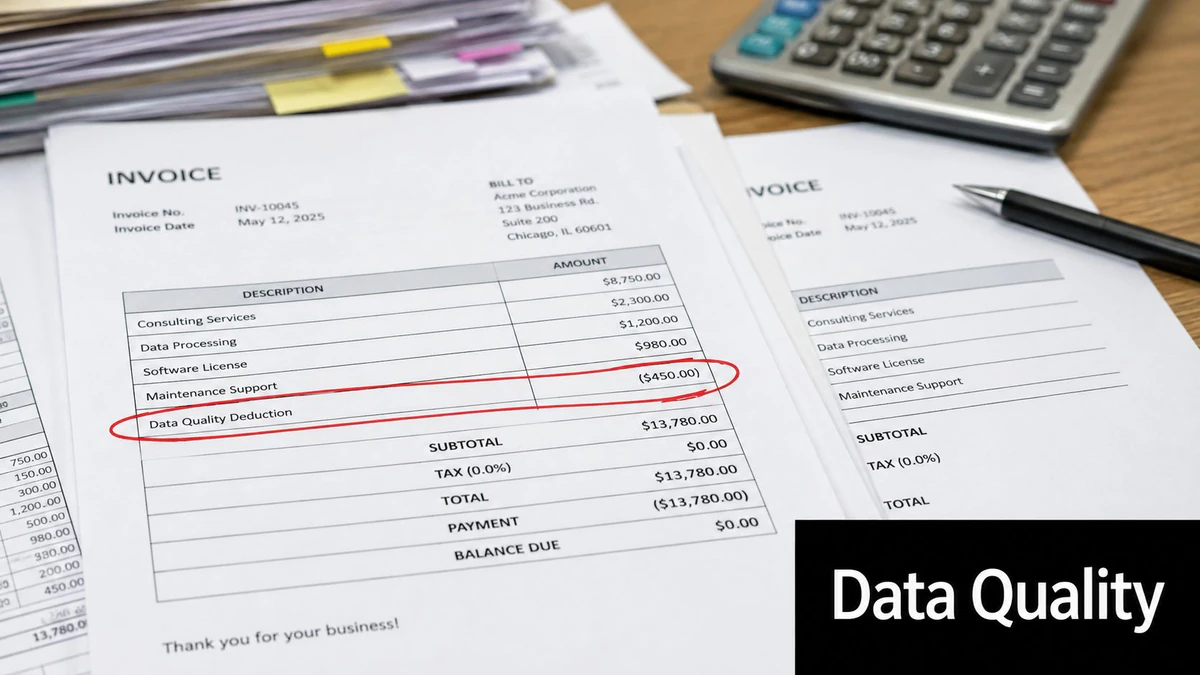
A simple invoice review makes the point clearly. The A close-up view of a business invoice highlighting a data quality deduction line item with a red circle. image shows how one deduction line can sit there and change the story. That is why the gap matters. Sometimes it reflects normal commercial activity. Sometimes it reflects poor hygiene.
The four mistakes that break the bridge
- Mixing order-platform totals with accounting revenue. The checkout screen and the income statement do not measure the same thing.
- Applying inconsistent deduction windows. If returns are captured in one period and discounts in another, the bridge becomes noisy fast.
- Ignoring tax and shipping in the netting step. That is fine if the policy says so. It is a mess if nobody agreed on it.
- Double-counting refunded orders. This one is especially popular because it makes both gross and net look wrong at the same time.
If you have ever had to fix common bank reconciliation errors, the pattern will feel familiar. The problem usually is not the discrepancy itself. It is the lack of a clean rule for what should have happened to the transaction at each stage.
Clean data beats heroic reconciliation
The upstream fix is boring, and that is why it works. If the contact list is cleaner, the campaign starts with fewer bad addresses, fewer undeliverable sends, and fewer records that later become accounting noise. If the list is messy, finance spends more time explaining the spread than managing the revenue.
To optimise email send timing properly, you also need to know the list is real before timing even matters. Otherwise, you are just sending faster to the wrong people.
Reconciling Gross and Net Sales and Keeping the Numbers Clean
A practical reconciliation doesn't need a six-month project plan. It needs one week, a shared definition, and enough discipline to stop the same data from being argued about twice.

A one-week cleanup plan
Start by writing a one-line deduction policy. Decide what gets netted, and write it down where finance, marketing, and ops can all see it. Then reconcile CRM order totals against the income statement for the last two closed periods and measure the gap instead of arguing about it.
After that, clean the contact list before the next campaign. Verify emails, remove role accounts, and flag disposable domains so fewer bad records enter the funnel in the first place. That's where a tool like BillionVerify fits naturally, because it verifies email data at signup or before a send, and it integrates with tools such as Mailchimp, HubSpot, Salesforce, and Klaviyo.
The final move is simple but important. Put real-time verification at signup so bad records don't become future deductions, future complaints, or future reconciliation work.
What to hand your operations lead
- Define the deduction policy: spell out what counts as gross and what gets netted.
- Reconcile the last two closed periods: compare platform totals with accounting revenue and note the spread.
- Clean the source list: verify, de-duplicate, and remove risky addresses before the next send.
- Block bad data at capture: make signup-time verification part of the workflow, not an afterthought.
The how cleans lists page is a useful internal reference if the team needs a practical starting point for list hygiene and pre-campaign cleanup. Once the list is cleaner, the gross-to-net gap usually gets easier to explain, because less of it is caused by preventable noise.
Which Number to Lead With and When to Use Each
Use net sales when the conversation is about board reporting, margin analysis, campaign ROI, or growth quality. Use gross sales when the conversation is about demand generation, funnel volume, or sales activity before deductions. If the goal is to measure whether the market responded, gross is the right lens. If the goal is to measure whether the business kept the value, net wins.
Gross sales measures whether the market is responding, net sales measures whether the business is keeping the value.
A good rule is painfully simple. Lead with gross when you're talking about reach. Lead with net when you're talking about money you can keep.
If you're sanity-checking campaign context, it also helps to check email marketing benchmarks for campaigns so you don't mistake noisy data for real performance.
The three actions that close the gap most reliably are the ones teams keep postponing. Define the deduction policy. Reconcile monthly. Verify contact data at the point of capture. Do those three consistently and the gross-to-net bridge stops looking like a mystery and starts looking like a process.
If you're tired of watching bad email data widen the gap between activity and real revenue, BillionVerify is built for that cleanup work. It verifies addresses before they pollute your CRM, campaign reports, and signup flow, which makes gross and net conversations a lot less chaotic. Visit BillionVerify to see how cleaner email data can support cleaner revenue reporting.