


Most guest post outreach advice still starts in the wrong place. It starts with templates, subject lines, or topic ideas.
That's backwards.
The first constraint in modern guest post outreach is trust. Editors are dealing with crowded inboxes, polished AI-generated pitches, paid placement requests, and generic “love your blog” emails that look interchangeable. If your process doesn't protect sender reputation, qualify prospects hard, and make each pitch feel clearly useful, you won't scale anything worth keeping.
The playbook that works now treats guest posting as a distribution and relationship channel, not a cheap link drop. That changes how you build lists, how you write, how you follow up, and how you measure success. It also changes what counts as foundational work. Email verification belongs at the start of the workflow, not at the end, because a clean list protects deliverability before you burn domain trust on bad data.
Redefining Guest Post Outreach for an AI World
Guest post outreach is one of the easiest channels to cheapen.
Treat it like bulk link acquisition, and the results follow fast. Reply quality drops, editorial trust disappears, and your domain starts carrying the cost of sending messages that were never a fit to begin with. In an inbox filled with AI-assisted outreach, volume is no longer a competitive edge. It is often the signal that gets you ignored.
Pressbay makes the editorial side of that problem clear in its analysis of guest post email templates. Editors are seeing more generic pitches, which raises the bar for relevance, brevity, and credibility.
The old volume model breaks first
The failure usually starts before anyone reads the pitch.
Outreach underperforms when teams send to weak-fit publications, route messages to generic inboxes, tolerate avoidable bounces, and rely on copy that sounds machine-shaped. The immediate cost is poor response quality. The longer-term cost is worse. Sender reputation slips, future placement gets harder, and the campaign produces a spreadsheet full of sends instead of a pipeline of real publishing relationships.
I have seen this trade-off enough times to treat it as a rule. A campaign with fewer, verified, well-matched contacts will outperform a larger list padded with uncertain prospects and risky addresses. The smaller list looks less impressive at the top of the funnel. It usually produces better meetings, better placements, and less cleanup later.
Practical rule: If an editor could swap out the company name in your email and send the same pitch to ten similar sites, the pitch is too generic to earn attention.
The stronger operating model uses AI as support, not as a substitute for judgment. Research can be faster. Segmentation can be tighter. Drafting can be quicker. But the parts that decide outcomes are still human. Topic fit, editorial relevance, byline credibility, and whether the email should be sent from your domain in the first place.
The modern purpose of guest post outreach
Guest posting still contributes to SEO. The teams getting the best return treat it as more than a link tactic.
A strong placement does four jobs at once. It earns referral visibility with the right audience, creates a direct relationship with an editor, gives your team a reusable distribution asset, and strengthens brand authority in a publication your buyers already trust. That mix matters more now because AI has made content production cheap. Distribution and trust are the scarce parts.
HubSpot's overview of guest blogging for SEO reflects the same shift. Guest contributions work best when they are tied to relevance, authority, and audience reach rather than raw placement count.
That changes the questions a serious outreach team asks before a campaign goes live:
- Audience fit: Will this publication reach people who can buy, influence, or amplify our message?
- Editorial fit: Can we contribute something specific that matches how this site already publishes?
- Reputation risk: Is this contact and domain worth sending to from our email infrastructure?
- Distribution value: If the article goes live, can both sides get more reach from it after publication?
The reputation question belongs early in the process, not after the list is built. Mailbox providers are paying closer attention to sending patterns that look automated or low trust. BillionVerify explains that shift well in its piece on the Gmail Gemini era's effect on cold email deliverability. For guest post outreach, that means email verification is not admin work. It protects inbox placement, preserves domain health, and keeps ROI from getting destroyed before the first editor replies.
Building a High-Quality Prospect List
A weak list makes good writing irrelevant. If the site isn't a fit, doesn't reach the right audience, or only wants payment, your pitch quality won't save the campaign.
Respona reports that 3 out of 4 sites with a “Write for Us” page ask for payment, that the average guest post cost is $295 when bought directly and $461 through a vendor, and that a typical guest post may bring only 50-200 visitors in the first month before dropping to 5-20 visitors per month after that in its guest post outreach benchmarks. Those numbers force a stricter prospecting standard. You can't treat every accepting site as a win.
Start with fit, not availability
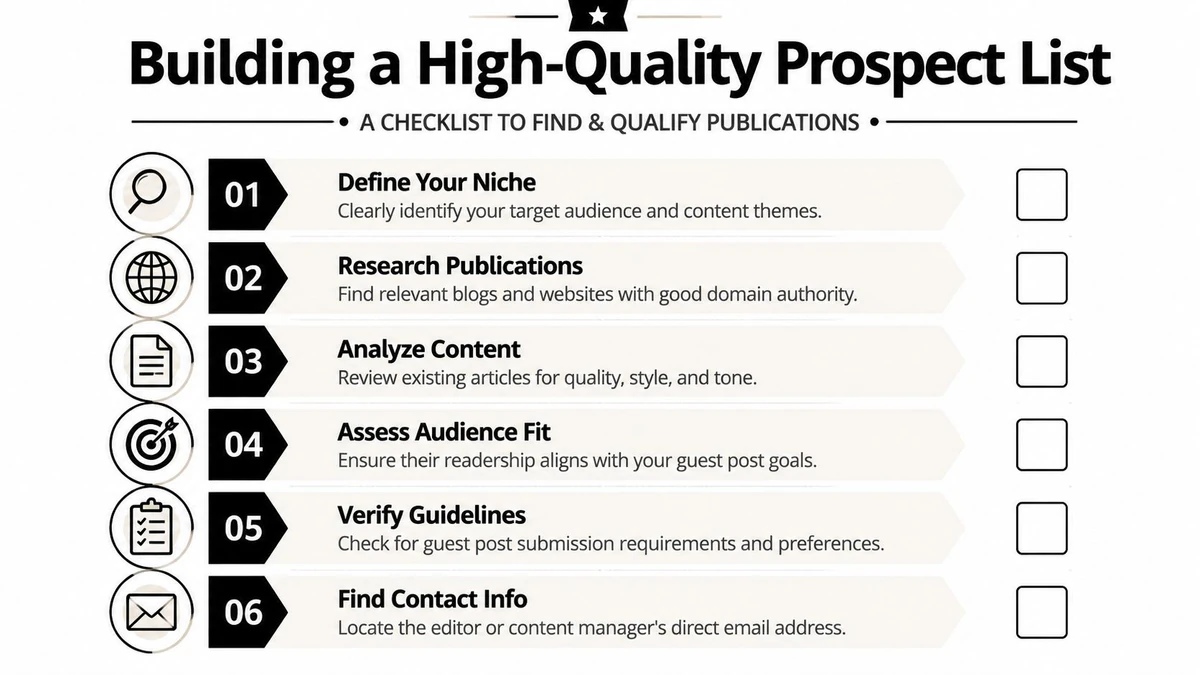
The first filter is niche fit. Don't begin with “who accepts guest posts.” Begin with “who publishes for the audience we need.”
That changes prospecting behavior. You stop collecting every site with a contributor page and start looking for signs that the publication already covers adjacent topics, publishes external expertise, and has a readership aligned with your offer.
A simple qualification pass should include:
- Niche relevance. The site should sit close enough to your category that your expertise feels natural there.
- Editorial quality. Read recent articles. Check whether posts are edited, specific, and useful.
- Audience match. The readers should resemble the people you sell to, recruit, or influence.
- Promotion potential. You should be able to help distribute the post after publication.
Qualify like a media buyer
Once a site passes the relevance check, inspect it like you're allocating budget, because that's what you're doing with team time.
Look at search visibility trends, topic coverage, outbound link patterns, and whether the site feels built for readers or for placements. If every article looks like it exists to host a backlink, move on.
A short decision table helps:
| Signal | Good sign | Red flag |
|---|---|---|
| Content quality | Original, edited, audience-specific | Thin listicles and vague advice |
| Topic alignment | Clear overlap with your expertise | Broad publishing with no niche depth |
| Outbound links | Selective and relevant | Constant promotional linking |
| Contributor model | Named experts and editorial standards | Obvious placement marketplace behavior |
| Contact path | Real editor or content lead | Only anonymous forms and vague inboxes |
BillionVerify is a professional email verification service built to solve one problem: bad email data costs businesses money.
If your research starts with incomplete contact records, tools and workflows that help uncover direct contact details can save time. A practical example is using methods described in this guide on how to look up an email by phone number when a publication's public details are sparse.
Find a real editor, not just an inbox
Generic inboxes still have a place, but they shouldn't be your first choice. A specific editor, content manager, or marketing lead gives your pitch a better chance because it arrives with context.
The contact is part of the qualification, not a data-entry task.
When teams rush this step, they send strong ideas to weak addresses. Then they blame the pitch. In practice, a large share of outreach problems are routing problems.
My rule is simple: if I can't tell who owns the blog or content function, the site stays unprioritized until I can. A smaller list with accountable contacts beats a bigger sheet full of “info@” and “contact@” addresses every time.
Securing Deliverability with Email Verification
Most outreach teams talk about personalization as the lever that matters most. It matters, but it comes after a more basic requirement. Your email has to arrive.
That's why verification is not cleanup work. It's a pre-send control. If your prospect file includes invalid addresses, stale contacts, disposable emails, or risky catch-alls, you're feeding bounces into the exact domain reputation you depend on for future outreach.
Bad addresses waste more than one send
A bounced pitch doesn't only waste that email. It can lower trust in your sending infrastructure and contaminate later campaigns that target good contacts. That's why experienced teams verify before first touch, after enrichment, and again before larger sends if the list has aged.
This matters even more in guest post outreach because the lists are usually hand-built and mixed. You're pulling contacts from bylines, company pages, LinkedIn research, old CRM notes, and enrichment tools. That creates variability. Verification reduces it.
A clean outreach list protects the campaign you're launching and the campaigns you haven't launched yet.
How verification fits into the workflow
The operational sequence should be simple:
- Build the list from qualified publications and named contacts.
- Normalize the data so names, domains, and roles are consistent.
- Verify every address before any sequence starts.
- Segment the results into safe, risky, and excluded groups.
- Send only to the approved segment and hold the rest for manual review.
If you need verification inside your broader outbound stack, an API-based workflow is often cleaner than periodic manual uploads. The implementation patterns in this overview of an email validation API are useful for teams that want verification embedded in prospecting and sequencing workflows rather than treated as a separate task.
What to remove before outreach starts
Not every verified-looking address deserves to be mailed. Good outreach operations separate technical validity from strategic quality.
Filter aggressively before send:
- Invalid addresses should be removed outright. There's no upside in retrying dead data.
- Role accounts like editor@, info@, and contact@ need judgment. Keep them only when you can't identify a real owner and the publication clearly routes submissions through that inbox.
- Disposable or low-trust addresses should stay out of editorial outreach. They signal poor contact quality.
- Catch-all domains deserve a separate review lane. They may work, but they carry more uncertainty and should not be mixed blindly into the main send group.
Disciplined teams set themselves apart. They don't assume all found emails are usable. They create a sendable subset and protect it. That one habit improves reply quality because the list itself gets sharper before copywriting even begins.
Crafting Personalized Pitches That Get Replies
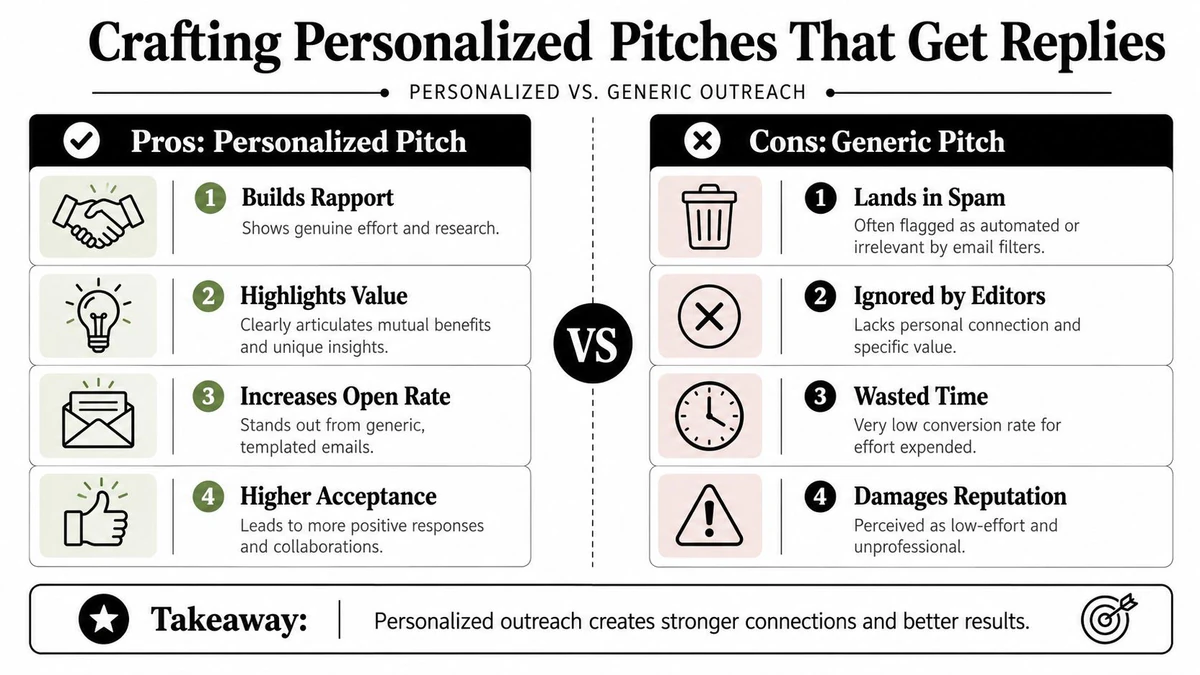
Once the list is clean, brevity starts to matter. Editors don't need your life story, your full article draft, or five paragraphs of praise.
Semrush recommends keeping the initial pitch to around 100-150 words and warns that weak personalization, missing writing samples, and failing to explain audience benefit all hurt acceptance odds in its guest posting guidance. That lines up with what works in practice. Short wins when short carries substance.
Keep the first pitch short and useful
The job of the first email is not to prove everything. It's to earn consideration.
A strong pitch usually contains four parts:
- One line of real personalization tied to a recent article, editorial angle, or gap in coverage.
- A compact value proposition that tells the editor why you're credible to write this.
- A specific topic idea or small set of ideas matched to the publication's audience.
- A low-friction close that makes replying easy.
That last part matters. Don't ask an editor to review a full deck, comment on a huge outline, and schedule a call. Ask whether one of the ideas fits their calendar.
For teams that want to sharpen this further, NotionSender's piece on achieving desired email outcomes is useful because it frames email as a response design problem, not just a writing exercise.
A related skill is tailoring tone and detail to the contact without sounding mechanical. That's where these email personalization strategies are helpful.
A better structure than generic flattery
The worst pitches all sound polite and empty. They compliment the site, announce expertise, and ask if guest posts are accepted. Nothing in the message tells the editor why this author, this idea, and this audience fit together.
Use this structure instead:
| Part | What to say | What to avoid |
|---|---|---|
| Opening | Reference a specific article, category, or missing angle | Generic praise like “I love your blog” |
| Credibility | Mention a few relevant credentials or writing samples | Long biography paragraphs |
| Idea | Offer concrete topics matched to the publication | Broad topics any site could publish |
| Benefit | Show why readers would care | Focusing only on your backlink goals |
| Close | Ask a simple yes/no or preference question | Open-ended asks that create work |
Here's a practical reminder before the example:
If the editor has to infer the reader benefit, the pitch is too vague.
Later in the section, use this walkthrough to see the difference in tone and structure.
Before and after
Weak version
Hi, I came across your site and really enjoyed the content. I'm a professional writer and would love to contribute a guest post. I can write about marketing, SEO, sales, productivity, startups, and more. Let me know if you accept contributions.
Why it fails: no fit, no angle, no audience benefit, no proof.
Improved version
Hi [Name], I noticed your recent coverage focused on content distribution and in-house editorial workflows. I didn't see a piece that breaks down how outreach teams qualify publication targets before pitching.
I lead content marketing programs for brands that use guest contributions as a distribution channel, and I can contribute a practical article on one of these angles: qualifying editorial-fit sites, building a clean outreach list, or protecting deliverability before outreach starts. I can also share published samples if helpful.
Would one of those be relevant for your editorial calendar?
Short. Specific. Easy to route. Easy to answer.
Implementing a Scalable Outreach and Tracking System
Outreach breaks when it lives in scattered tabs, inbox memory, and partial spreadsheets. A guest post program only scales when every prospect moves through a visible pipeline.
That structure matters because reply rates in guest post outreach commonly sit around 3%-5%, and one recommended follow-up cadence is day 4-5, day 8-10, and day 14, according to Growth for Local's workflow guide. With numbers like that, inconsistency is expensive. If you fail to follow up, forget status notes, or double-contact a publication, you lose outcomes you already paid for in research time.
Track the campaign like a pipeline
You don't need a complicated CRM to manage this well. A spreadsheet can work if the fields are disciplined and the ownership is clear.
At minimum, track:
- Publication and URL so the site is easy to review before every touch.
- Primary contact and backup contact so the campaign doesn't stall if one route fails.
- Pitch angle submitted so you don't resend recycled ideas.
- Status stage such as researched, verified, pitched, follow-up one, follow-up two, accepted, declined, published.
- Notes for editorial preferences, response tone, and content requirements.
The key isn't software sophistication. It's process consistency.
Use a fixed follow-up rhythm
A lot of teams either under-follow or over-follow. Both errors come from not having a default schedule.
Use a fixed cadence and treat it as policy. That keeps the work professional and removes emotion from the process. If someone hasn't replied, the next action should already be known.
A clean outreach rhythm looks like this:
- Initial send with the short value-led pitch.
- First follow-up that keeps the email thread alive and lightly restates the relevant idea.
- Second follow-up that offers a final easy out or alternate topic.
- Close the record if there's still no response.
If you're coordinating larger campaigns, operational systems around sequencing matter. Teams managing recurring outreach often borrow ideas from broader email automation tools so reminders, ownership, and status changes don't depend on memory.
What teams should review every week
A weekly review prevents list decay and process drift. Keep it brief and factual.
Review three buckets:
- Pipeline hygiene. Are there stale records with no next step?
- Message quality. Are replies indicating confusion, low fit, or weak positioning?
- Prospect quality. Are accepted placements coming from the kinds of sites you want more of?
This is also where agencies separate output from effectiveness. Sending more pitches is not progress if the list quality is slipping. A smaller, better-managed pipeline usually beats a larger one that nobody audits.
Measuring the True ROI of Your Guest Post Program
Teams that report guest post performance by link count usually end up scaling the wrong work. A published article is only useful if it reaches the right audience, sends qualified traffic, strengthens publisher relationships, or influences pipeline.
That standard matters more now because AI has made low-effort content and templated outreach cheap. The advantage comes from running guest posting like a real distribution channel with clear feedback loops, not like a volume-based link buying substitute.
Stop reporting link count as the outcome
A placement can look good on a spreadsheet and still produce little business value. The site may have weak editorial standards, the audience may be a poor fit, or the article may send visits that never convert.
Use two reporting buckets instead. One shows whether the program is operating efficiently. The other shows whether the placements contribute to growth.
This keeps teams from confusing output with return.
The Metrics That Matter
Track ROI in layers:
- Outreach efficiency. Monitor delivery rate, open rate, reply rate, and placement rate to find breakdowns in targeting, messaging, or list quality.
- Placement quality. Review whether the site matches your audience, brand standards, and distribution goals.
- Referral performance. Use UTM-tagged links in author bios or in-content mentions to see which placements bring engaged sessions, not empty clicks.
- Conversion influence. Measure whether referral visitors subscribe, book demos, start trials, purchase, or complete the next step your team cares about.
- Relationship value. Record which editors accept follow-up ideas, refer you to other publications, or invite recurring contributions.
The relationship metric gets ignored too often. In practice, repeat access to a trusted editor usually outperforms one-off wins from a larger but less relevant site. It lowers acquisition cost over time and gives your team a more predictable publishing pipeline.
A simple way to review performance is to compare placements by three questions. Did this site reach the right people? Did it drive a meaningful action? Did it create another opening for distribution?
If the answer is no across all three, the link has little ROI regardless of domain metrics.
Teams that want cleaner attribution should also set up consistent campaign tagging and referral reporting in analytics. Google's Campaign URL Builder documentation is a useful reference for standardizing UTM parameters across placements.
Protecting ROI starts before the first pitch goes out. Bad contact data leads to bounces, weaker inbox placement, and distorted performance data, which makes channel reporting less trustworthy. BillionVerify fits at the front of that workflow by helping teams verify outreach addresses before campaigns go live, remove risky records from prospect files, and protect deliverability while they scale relationship-driven outreach.