


Most advice on how to build an email list still starts with volume. Add a popup. Offer a discount. Push harder on traffic. That advice is incomplete.
A large list with weak signup controls can become a deliverability problem before it becomes a revenue asset. Email is still the biggest direct digital channel, with 4.4 billion active users worldwide according to Twilio's email list guide. But reach alone doesn't make a list valuable. What matters is whether the addresses are valid, the people want your emails, and your sending reputation stays intact.
That's the part many brands learn too late. New inbox rules have made list quality a growth issue, not just an ops issue. If bad addresses enter your database on day one, every campaign after that gets harder.
TL;DR: If you want to learn how to build an email list that drives revenue, start with subscriber fit, signup intent, and real-time verification. Growth tactics matter. Data quality matters first.
Rethinking Growth The Case for Quality Over Quantity
List growth gets too much credit. Inbox placement decides whether list growth produces revenue or waste, and recent mailbox provider changes have made that trade-off harder to ignore. A large file filled with weak-fit subscribers, typoed addresses, role accounts, and inactive contacts does not give you scale. It gives you bad signals, lower deliverability, and a more expensive program.
I've seen the decline show up in a predictable sequence. A team adds a paid lead source or loosens form controls to hit a signup goal. Two weeks later, welcome series performance looks uneven. A month later, more campaigns land in spam or promotions, reply rates fall, and the team starts spending more to replace names that never had real intent. By the time someone calls it a deliverability problem, the root cause was acquisition quality.
That distinction matters. Email verification is not a cleanup project for later. It is part of list-building strategy from day one, because every bad address accepted at signup can hurt engagement metrics, distort reporting, and put pressure on sender reputation.
A smaller list with valid, interested subscribers will usually produce better inbox placement and more revenue per send than a larger list padded with low-intent or invalid contacts.
There is also an operating cost to bad list growth. Bloated databases make segmentation weaker, testing less reliable, and automations less useful because the inputs are flawed from the start. Teams end up optimizing subject lines and send times when the core problem sits at the point of capture.
The practical order is simple. Relevance first. Accuracy second. Volume third. That is how teams build a list that can keep performing under stricter provider scrutiny.
For a clearer framework on what separates a healthy file from a risky one, BillionVerify's guide to email list quality fundamentals is a useful reference.
Your Strategic Blueprint Before Collecting a Single Email
List growth gets expensive fast when strategy comes second. A signup form can generate names within hours. Fixing weak-fit subscribers, poor engagement, and avoidable deliverability issues takes months.
A strong list starts with three decisions made before launch. Who belongs on the list. What exchange makes subscribing worth it. Which rules protect list quality at the point of capture.
Define the subscriber you actually want
Start with the outcome. If this list performs well six months from now, who is on it, and what are they trying to get done?
“Small business owners” is too broad to guide acquisition. “Ecommerce operators trying to improve repeat purchase revenue before Q4” is specific enough to shape the offer, the form copy, and the welcome sequence. That specificity also protects deliverability, because it filters out casual signups who were never likely to engage.
Use a working profile with four parts:
- Role or buying context: founder, lifecycle marketer, SDR, merchandiser, operations lead
- Immediate pain point: the problem they want solved now
- Expected value: what would make this subscription worth keeping
- Probable next step: read, reply, book a demo, start a trial, make a purchase
Teams often overlook a crucial trade-off. Broader targeting usually lowers acquisition friction, but it also lowers downstream engagement. Tighter targeting reduces raw signup volume and usually improves opens, clicks, replies, and conversion quality.
Build the offer before you build the form
People do not subscribe because a form exists. They subscribe because the offer matches a current need.
“Join our newsletter” is weak unless the brand already has strong demand or a loyal audience. In practice, one clear promise works better. A teardown. A template. A buyer's guide. A product-specific discount. A short email course. The format matters less than the relevance.
Good offers also set expectations. A weekly teardown attracts a different subscriber than a coupon. A benchmark report attracts a different subscriber than general updates. If the offer and the email program are disconnected, the list may grow, but the first campaign after signup often underperforms because the subscriber wanted the asset, not the relationship.
TL;DR: Build the value proposition first. The form only captures demand that already exists.
A simple test helps here. If the incentive would appeal to anyone with an email address, it is probably too broad to bring in your best subscribers.
Set quality rules before launch
Before sending traffic to any form, decide what qualifies as a valid signup and how that subscriber enters the list.
The basics matter. Consent should be explicit. The welcome flow should fire immediately. Quality metrics should sit next to growth metrics from day one. That means watching complaint rate, early engagement, unsubscribe behavior, and invalid addresses, not just total subscriber count.
Double opt-in is one of the clearest trade-offs to make up front. It usually reduces total confirmed signups. It also filters out typos, low-intent submissions, and some automated abuse. For high-value B2B forms, regulated industries, or any program already under inbox placement pressure, that trade is often worth it.
Verification belongs in the same planning conversation. Treating it as a cleanup step later is how bad records get normalized into the database, the welcome series, and your reporting. Adding email verification during signup lets you screen risky or invalid addresses before they affect sender reputation.
Key Takeaways
- Define the subscriber by intent, not broad demographics.
- Build the offer before designing the form.
- Choose your trade-offs early. Less friction gets more signups. Better filtering gets a healthier list.
- Set capture rules before launch so invalid or low-quality addresses do not enter your ESP in the first place.
Planning slows the first week of list growth. It usually improves every month after that.
High-Impact Channels to Attract Ideal Subscribers
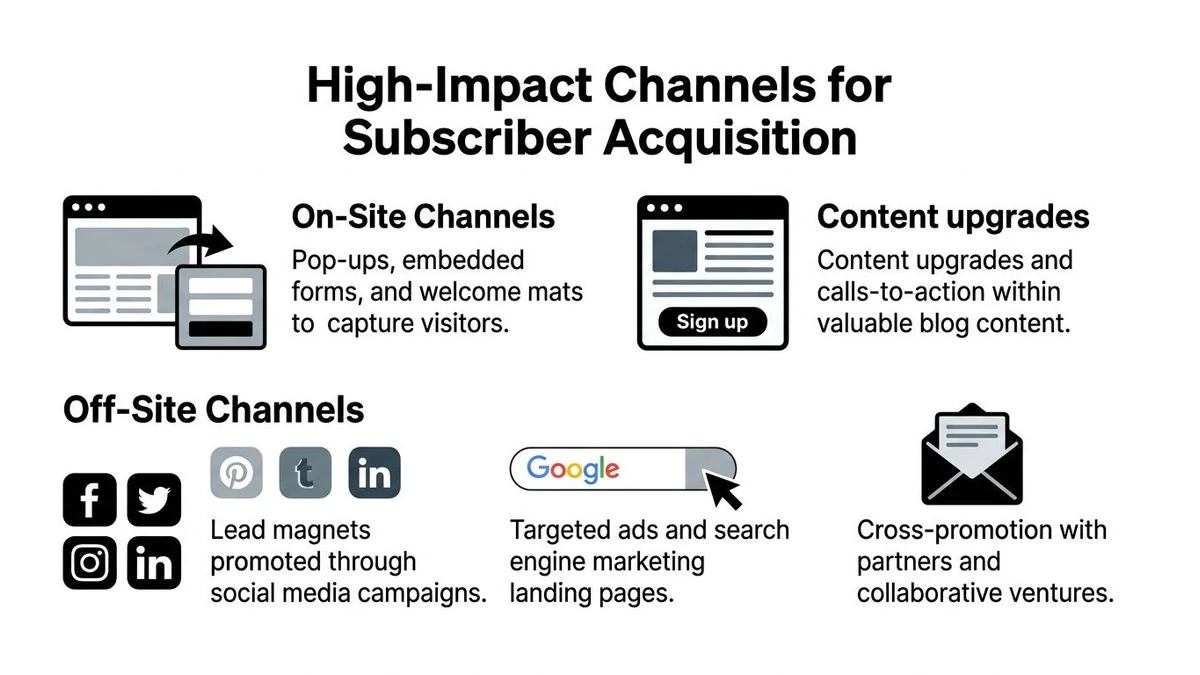
Channel choice shapes list quality long before a welcome email goes out. A popup, webinar, referral, or guest article can all add names to the database, but they do not create the same downstream results. The difference shows up later in open rates, complaint rates, conversion, and inbox placement.
That matters more now because mailbox providers are less forgiving of weak acquisition. If a channel brings in typo-filled, low-intent, or disposable addresses, the problem starts on day one. List growth and deliverability are tied together. For a useful refresher on why this connection matters, see this 2026 guide for marketers.
On-site channels give you the fastest feedback
On-site capture works because intent is already present. The visitor chose to spend time on your site, which makes the signup context clearer and easier to match with an offer.
The strongest on-site options are usually:
- Timed popups: Best on pages where interest is already visible and the offer matches the page topic.
- Embedded forms: Strong inside blog posts, resource hubs, and product education pages.
- Exit-intent offers: Useful when the offer is specific enough to keep a qualified visitor from leaving empty-handed.
- Checkout or account creation opt-ins: Effective when consent is optional, visible, and separate from transactional messaging.
Timing matters. So does restraint. A popup shown the second a visitor lands often gets impressions without trust. A popup triggered after the visitor scrolls, spends time on the page, or reaches the end of an article usually brings in fewer accidental signups and more people who will engage after the first email.
Embedded forms often convert at a lower raw rate than aggressive overlays. I still like them for quality-focused programs because context does part of the qualification for you. A reader who finishes an article about email onboarding and then requests a related checklist is giving a stronger intent signal than someone who enters a discount popup on the homepage.
Off-site channels bring borrowed trust
Off-site channels work best when your own traffic is still limited or when you need access to a very specific audience. The upside is reach. The trade-off is control. You depend on the partner, platform, or event to frame the offer well enough that the click still carries intent.
A few options stand out:
- Webinars: Strong for education-heavy offers and B2B buying journeys where people need more context before subscribing.
- Referral programs: Good when your current list is healthy enough that subscribers will recommend you without dragging in low-fit contacts for a reward.
- Guest content and partnerships: Effective when the host audience closely matches the subscriber profile you defined earlier.
Guest posting works well for newer sites because relevance matters more than scale early on. A well-placed article on a trusted industry publication can outperform broader traffic sources if the call to subscribe is tightly aligned with the reader's problem. If that channel is part of your plan, this practical guide to guest post outreach covers the process well.
One caution. Referral and co-marketing programs can pollute a list fast if incentives outweigh intent. If someone signs up only to claim a reward, skip a verification check, or grab a one-time download, that contact can hurt more than help.
TL;DR
Pick channels based on intent quality, not signup volume alone. On-site capture usually gives you the fastest testing loop. Off-site channels can produce stronger subscribers when audience fit is tight. In both cases, the acquisition source should support deliverability from the start, not create cleanup work later.
A simple channel comparison
| Channel | Effort | Cost profile | Lead quality |
|---|---|---|---|
| Timed popup | Low to medium | Usually low | Mixed, depends on page intent and offer match |
| Embedded content form | Medium | Usually low | Often stronger because context pre-qualifies the signup |
| Webinar | Medium to high | Medium | High intent when the topic is specific |
| Referral program | Medium | Incentive-based | High trust if incentives are controlled carefully |
| Guest partnership | High | Variable | Strong when audience fit is tight |
Key Takeaways
- The best acquisition channel is the one that preserves intent after the click.
- On-site forms are easier to test and improve because behavior data is immediate.
- Off-site channels can outperform your own traffic when the audience match is precise.
- Quality problems often start at capture. A weak source adds invalid, disengaged, or risky contacts before your first campaign sends.
- Treat channel strategy and verification as part of the same growth system. That is how you build a list that keeps reaching the inbox.
Designing a Frictionless Signup and Onboarding Flow
A signup flow should feel easy, clear, and credible. If the form feels confusing or the first email feels generic, people start disengaging immediately. That drop in trust is hard to reverse.
Cut friction in the form itself
Good signup UX is usually simple. Ask for the least information you need to start the relationship. In many cases, that means email first and additional details later.
A few design choices matter more than often realized:
- Keep the form short: Every extra field adds hesitation.
- Use one obvious CTA: “Get the checklist” is stronger than “Submit.”
- Explain the value plainly: Tell people what they'll receive and how often.
- Support trust signals: Privacy language, brand consistency, and clear consent copy reduce uncertainty.
Avoid forms that feel like mini applications. They depress conversion and usually don't improve list quality enough to justify the loss.
Use onboarding to confirm value and intent
The first emails should do three jobs. Confirm the subscription. Deliver what was promised. Set expectations for what comes next.
That sequence determines whether the subscriber becomes active or drifts into silence. A strong welcome message is direct, useful, and aligned with the signup promise. If the person asked for a template, don't bury it under brand copy. Deliver it immediately, then show the next logical action.
A practical onboarding flow often includes:
- Confirmation email: Reinforces the action they just took.
- Delivery email: Gives them the lead magnet or access promised.
- Orientation email: Explains what kinds of emails they'll get.
- Next-step email: Moves them toward a product, resource, reply, or preference setting.
If you want examples of how to structure those first messages, this guide on welcome email sequences is worth reviewing.
One operational detail belongs here too. BillionVerify is a professional email verification service built to solve one problem: bad email data costs businesses money. In a signup flow, that matters because your onboarding sequence only works if the address is valid and able to receive the email you just sent.
A signup is not complete when the form submits. It's complete when the welcome email reaches a real person who wanted it.
The Critical Step: Real-Time Verification and Hygiene
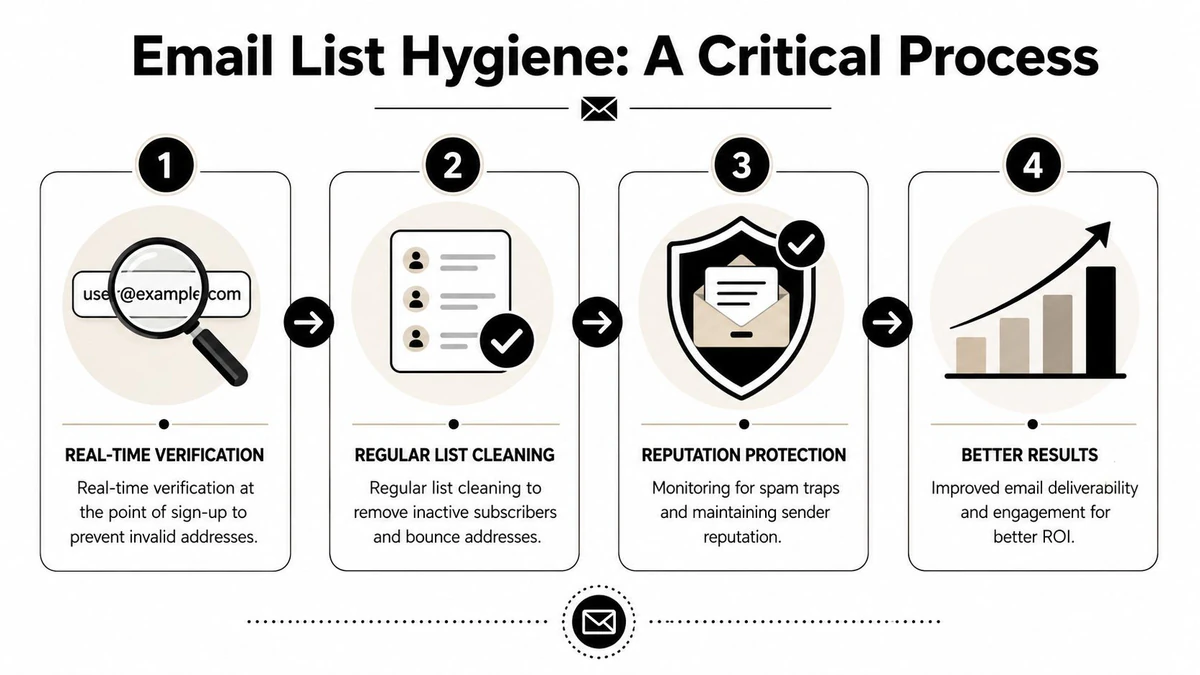
List growth breaks down at the point of capture, not six months later during a database cleanup. If bad addresses enter your form unchecked, they distort every metric that follows, from welcome-series engagement to campaign revenue and sender reputation.
TL;DR
Real-time verification belongs in your acquisition stack from day one. Recent mailbox provider enforcement from Google and Yahoo raised the cost of accepting bad data, because bounces and low-quality signups now create faster deliverability problems. A larger list does not help if inbox placement falls. A cleaner list does.
Why acquisition and hygiene now belong in the same system
For years, teams treated verification as periodic maintenance. That approach made sense when deliverability issues built slowly and bulk cleaning could catch up later. It is a poor fit now.
Google and Yahoo have pushed senders toward tighter standards around authentication, spam complaints, and bounce control. That changes the economics of list building. Every invalid signup accepted at the form level creates avoidable risk before the first campaign even sends. For broader context on why inbox placement now deserves operating-level attention, this 2026 guide for marketers from The AI CMO is a useful overview.
The practical implication is simple. Verification is not a cleanup task that supports growth. It is part of the growth system itself.
Here's a quick walkthrough of the hygiene workflow in practice:
What a real-time verification layer should check
A good verifier does more than reject typos. It helps decide whether an address is safe to accept, risky enough to flag, or better left out of the database entirely.
The checks worth implementing include:
- Syntax and domain validation: Catch malformed addresses and domains that cannot receive mail.
- MX and SMTP checks: Confirm whether the destination server is configured to accept email.
- Disposable address detection: Filter temporary inboxes that inflate subscriber counts and depress engagement.
- Role account detection: Flag addresses like info@, support@, and sales@ when individual-level intent matters.
- Catch-all and risk scoring: Separate clearly valid records from uncertain ones so your team can choose whether to allow, block, or segment them.
That screening changes the role of verification. It stops being maintenance and starts acting as quality control for acquisition.
A practical gatekeeping workflow
If the goal is a list that can scale without dragging down deliverability, the setup should be strict enough to block obvious junk and flexible enough to preserve legitimate leads.
Use this workflow:
- Run verification before the form submits fully. Catch bad inputs while the user can still correct them.
- Reject invalid and disposable addresses immediately. There is little upside in storing records you already know are low value.
- Flag risky cases instead of blocking all of them. Catch-all domains and role accounts may still be useful in some B2B or support-led contexts.
- Pass only accepted records into your ESP or CRM. Bad data should not flow downstream.
- Keep periodic list cleaning in place. Real-time checks reduce new problems, but old records still decay over time.
I have seen teams spend heavily on lead generation while ignoring this step, then blame subject lines or content when results sag. The problem started earlier. The form admitted too many addresses that were never going to become reachable, engaged subscribers.
If you want the implementation details, BillionVerify's guide to real-time email verification explains how to set up checks at the point of capture.
Key takeaway
A signup should count only when the address is valid, reachable, and worth mailing. Treat verification as a growth filter from the first form you publish, and you protect both list quality and inbox placement while the list is still small enough to control.
Advanced Strategies to Nurture and Grow Your List
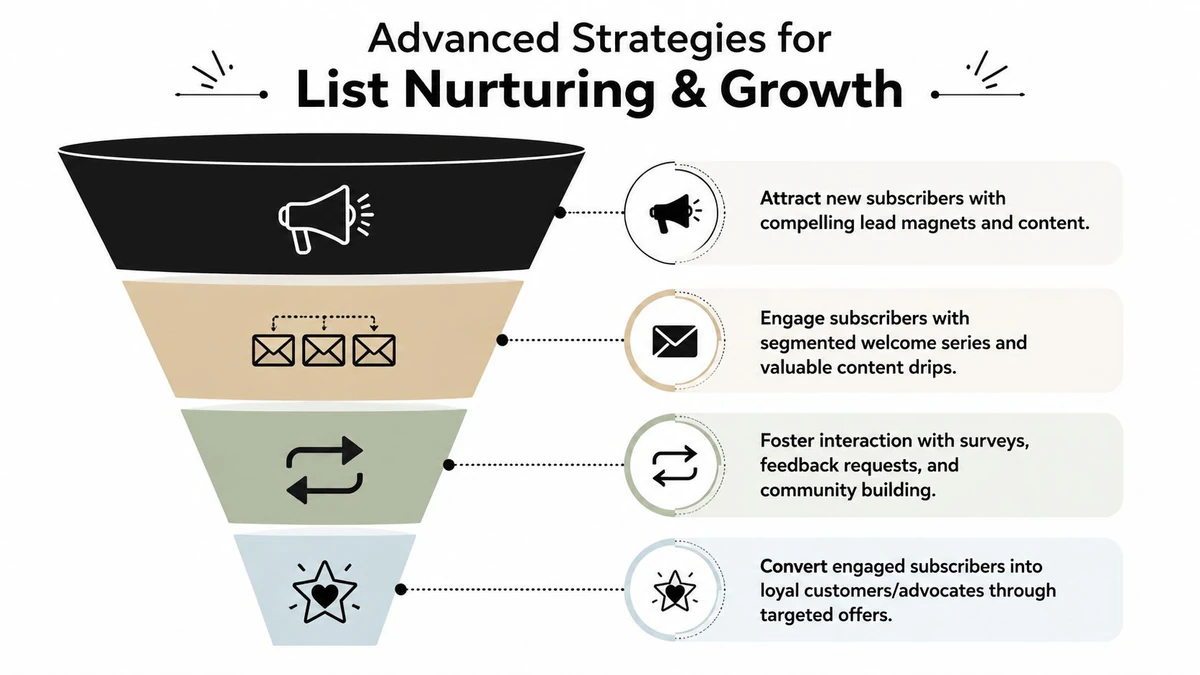
Once the list is clean and permission-based, the next gains come from relevance. Many programs falter at this point. They keep sending the same newsletter to everyone and wonder why engagement stalls.
Segmentation changes list economics
Not every subscriber should receive the same message. People sign up from different pages, with different motives, at different stages of readiness. Segmentation lets you respect that reality.
LinkedIn research shared in this segmentation-focused post reports that segmenting by demographics, behavior, or engagement improves click-through rates by 15 to 25% and reduces unsubscribe rates by up to 18% when personalized content is delivered consistently.
That's a meaningful shift because it improves both engagement and retention.
Useful segments include:
- Source-based segments: Subscribers from webinars, blog content, checkout, or referrals.
- Behavioral segments: Openers, clickers, repeat visitors, inactive subscribers.
- Interest segments: Product category, topic preference, use case, role.
- Lifecycle segments: New leads, active prospects, customers, lapsed buyers.
Key takeaway: Segmentation works best when it changes the message, not just the label on the contact record.
If your team needs a broader framework for moving subscribers from early interest to sales readiness, these lead nurturing best practices from Cloud Present are a practical companion.
Re-engagement and referrals compound quality
List growth isn't just acquisition. It's also deciding who still belongs on the list and who should be reactivated or removed.
Re-engagement campaigns are useful when subscribers have gone quiet but still match your audience. A direct “still want these emails?” sequence, preference update prompt, or best-content recap can recover valuable contacts without forcing another acquisition cycle. The goal is not to keep everyone forever. The goal is to preserve a responsive audience.
Referral growth is the other compounding lever. The verified data shows that organic list-building strategies built around lead magnets, loyalty programs, and referrals can produce stronger long-term engagement than cold acquisition, and referral-driven subscribers often arrive with better trust and fit, as noted in the earlier verified dataset. That matches what experienced email teams see in practice. Warm introductions usually beat rented attention.
A mature list grows best when you do three things repeatedly:
- Send content people can act on
- Create paths for subscribers to self-identify interests
- Remove or suppress contacts who no longer engage
That's how a list becomes more valuable over time instead of just larger.
Conclusion Your List Is Your Biggest Asset
The best answer to how to build an email list is not “collect more emails.” It's “build a system that earns the right subscribers and protects deliverability from the start.”
That means defining who belongs on the list before launch. It means using channels that attract intent instead of empty volume. It means reducing friction in the signup and welcome flow so new subscribers get immediate value. And it means treating verification and hygiene as part of acquisition, not as a cleanup task for later.
A healthy email list gives you something most channels can't: direct access to people who asked to hear from you. That only stays true when the list is accurate, engaged, and maintained with discipline.
If you build for quality first, the upside compounds. Better inbox placement. Cleaner reporting. Stronger engagement. More reliable revenue from an audience you own.
If bad email data is getting in the way of list growth, BillionVerify gives marketing, sales, and product teams a way to verify addresses before they damage deliverability, pollute CRM data, or waste campaign spend.