


Free software isn't interchangeable with reliable list hygiene. A format check can catch a typo, but it won't tell you whether the domain has usable MX records, how an SMTP server responds, or whether an address is disposable, role-based, catch-all, or merely uncertain. Before uploading a list, assess SMTP-level accuracy, bulk-processing workflow, deliverability signals, integrations, export controls, and the point where a free tier stops fitting your volume. This focused review examines BillionVerify against those criteria, with practical guidance for marketers, sales teams, developers, and agencies. For broader list-maintenance context, see this stale contacts suppression guide.
1. BillionVerify
BillionVerify is a professional email verification service built to solve one problem: bad email data costs businesses money. That positioning matters because bulk validation isn't just a pre-send convenience. Invalid, disposable, or poorly understood addresses can waste campaign capacity, distort CRM data, and expose a sender to avoidable bounce and reputation risk.
The platform is relevant to several workflows rather than only one-off list cleaning. Marketing teams can upload a CSV, sales teams can clean prospect data, product teams can check addresses during signup, and developers can connect verification to an application through an API. The important evaluation question isn't whether a dashboard exists. It's whether the result is detailed enough to support a defensible decision about each address.
What BillionVerify checks
A useful bulk verifier should move beyond syntax. Email verification platforms commonly examine syntax, domain existence, MX records, and SMTP responses, then classify addresses that may be valid but risky, including catch-all, disposable, and role-based accounts. That layered approach is described in this explanation of how verification results are evaluated.
BillionVerify's publisher information describes structured deliverability data, including status, SMTP results, MX records, catch-all scoring, and deliverability insights. That structure is more actionable than a simple valid or invalid column. A marketing operator can separate addresses that should be suppressed immediately from those that need review, while a developer can use a machine-readable response in an automated flow.
The distinction matters most for uncertain records. A catch-all domain may accept mail for addresses that haven't been independently confirmed. A disposable address may work temporarily but have limited value for a long-term relationship. Role accounts such as admin@, support@, and info@ may reach an organization, yet behave differently from an individual subscriber. Verification systems commonly flag disposable domains because they're associated with one-time signups, while role accounts receive separate treatment because they represent functions rather than people, as explained in this guide to disposable and role-based email detection.
Practical rule: Don't treat every non-invalid result as equally safe. Use the returned status and supporting signals to decide what to suppress, what to test, and what to retain for a specific campaign.
Bulk CSV cleaning and export control
The bulk workflow is where many free tools become inconvenient. BillionVerify supports CSV uploads with live progress, notifications, and export-ready filters. Those details address the practical sequence most teams follow: export a list from a CRM or email platform, upload it, wait for processing, filter the results, and import the cleaned file into the next system.
The filter stage deserves as much attention as the upload stage. A report that only gives one final verdict forces teams to make broad decisions. Structured results let operators create separate working sets for deliverable addresses, invalid records, disposable domains, role accounts, catch-all results, and unknown or risky outcomes. That supports a more cautious policy than deleting every address that isn't immediately classified as deliverable.
For example, a campaign to existing customers may justify retaining some role-based or catch-all addresses for manual review. A cold outbound sequence may need a stricter suppression policy. A product signup flow may block disposable addresses while allowing a role account if the product is intended for teams. The software can provide the signals, but the business rule still belongs to the team using the data.
BillionVerify's BillionVerify bulk verification workflow is therefore best assessed with a representative file, not a tiny list of perfectly formatted addresses. Include records from different domains, known duplicates, role accounts, disposable addresses, and older CRM imports. Then inspect whether the output preserves the fields your operations team needs and whether the filters produce files that can be used without manual reconstruction.
API, integrations, and real-time checks
Bulk cleaning solves a backlog. It doesn't prevent the next bad address from entering the database. BillionVerify also provides real-time API verification, which gives product and engineering teams a way to check an address at registration or at another point of data capture. That changes the workflow from periodic repair to prevention.
The platform's publisher information describes structured JSON responses containing verification status, SMTP results, MX records, catch-all scoring, and deliverability insights. JSON is useful when an application needs to apply its own logic. A signup form might reject clearly invalid or disposable addresses, flag uncertain results for review, and accept a deliverable result without requiring a person to download a file.
Integrations extend that model into existing marketing and revenue systems. BillionVerify lists connections with Mailchimp, SendGrid, HubSpot, Salesforce, Klaviyo, Zapier, and Make, among others. Those names matter because a verifier is only operationally useful if the cleaned result can reach the system where campaigns, sequences, or customer records live.
A verifier should fit the system that owns the contact record, not create another isolated spreadsheet.
Agencies have an additional workflow requirement. BillionVerify provides a whitelabel portal, allowing agencies to present branded verification services to clients. That can reduce the friction of sending client data through an agency's internal process, although agencies should still review permissions, retention, exports, and client-specific data-handling requirements before operationalizing it.
Accuracy, speed, and the limits of “free”
The strongest product claim supplied for BillionVerify is 99.9% SMTP-level accuracy across single checks, bulk list cleaning, and its real-time API. That figure comes from the publisher's product information, so it should be treated as a claim to test against your own data rather than as a guarantee for every mailbox provider, domain type, or ambiguous address.
Independent benchmark evidence shows why testing matters. A 2026 test of 9,901 difficult records reported 98.02% accuracy for the top scorer, compared with 68.38% to 86.06% for lower performers, while another benchmark used 8,000 hard addresses specifically to expose cases where standard SMTP checks fail. Those figures are reported in the independent email verification benchmark. They don't establish BillionVerify's position in that test, but they demonstrate that tool performance can vary materially on difficult records.
Speed should be measured alongside accuracy. A fast result that collapses many records into unknown or risky categories may create more work than a slower, more informative run. Test the same representative sample through the normal upload path, record processing time, inspect the returned fields, and check whether export filters preserve the distinctions your team needs.
Free access also requires a volume calculation. A comparison of free validation APIs found that many providers offer around 100 free verifications per month, while some offer 50 free calls per month or cap bulk validation at 100 per day. Larger lists often move to paid tiers costing roughly $24 to $64 per 10,000 emails, depending on the tool, according to this free email validation comparison. BillionVerify's publisher information states that it offers a free tier with no credit card required, but the supplied product details don't specify its quota, reset schedule, or export restrictions.
That missing information is a reason to test rather than assume. Another 2026 comparison found recurring free-tier patterns such as 100 verifications per month, 25 per day, or 100 one-time credits, with no tool offering unlimited free bulk validation. The free bulk validation comparison reinforces the operational point: a free tier may be useful for evaluation or small, occasional jobs, but it may not support a recurring CRM-cleaning program.
Who should use BillionVerify
BillionVerify is a sensible candidate for teams that want one service to cover CSV cleaning, API validation, structured deliverability signals, and integrations. It fits marketers preparing a campaign, sales operations teams maintaining prospect records, SaaS teams blocking poor signups, and agencies handling multiple client workflows.
It isn't enough to choose it because the word free appears in the offer. Upload a representative list, inspect every returned status, test the filters, measure processing speed, and confirm that the output fits your CRM or email platform. Then determine whether the available quota supports your actual cadence. If you clean a list once, a free tier may be adequate. If contacts enter continuously or several teams share the workflow, throughput, automation, and predictable access will matter more than the initial price.
BillionVerify: Free Bulk Email Verifier Summary
| Product | Core features | Accuracy & performance | Value & Pricing | Target audience | Unique selling points |
|---|---|---|---|---|---|
| BillionVerify 🏆 | ✨ Bulk list cleaning; real‑time API; SMTP & MX checks; JSON results; CSV imports/exports | ★★★★★ 99.9% SMTP‑level accuracy; high throughput; low latency | 💰 Free tier (no CC); pay‑as‑you‑go; far cheaper than legacy options | 👥 Sales & marketing, growth teams, agencies, product/security teams | ✨ Whitelabel portal; native MCP Server AI support; integrations (Mailchimp, SendGrid, HubSpot, Salesforce, Klaviyo, Zapier); deliverability insights |
Choose a Verification Workflow That Scales
BillionVerify makes the most sense when email verification needs to become part of an operating workflow, not just a one-time file repair. Its relevant capabilities include bulk CSV cleaning, real-time API checks, structured SMTP and MX data, catch-all scoring, export filters, CRM and marketing integrations, and support for automated flows. Those features can serve marketing, sales, product, agency, and operations teams, but the free tier still needs to be judged against real usage.
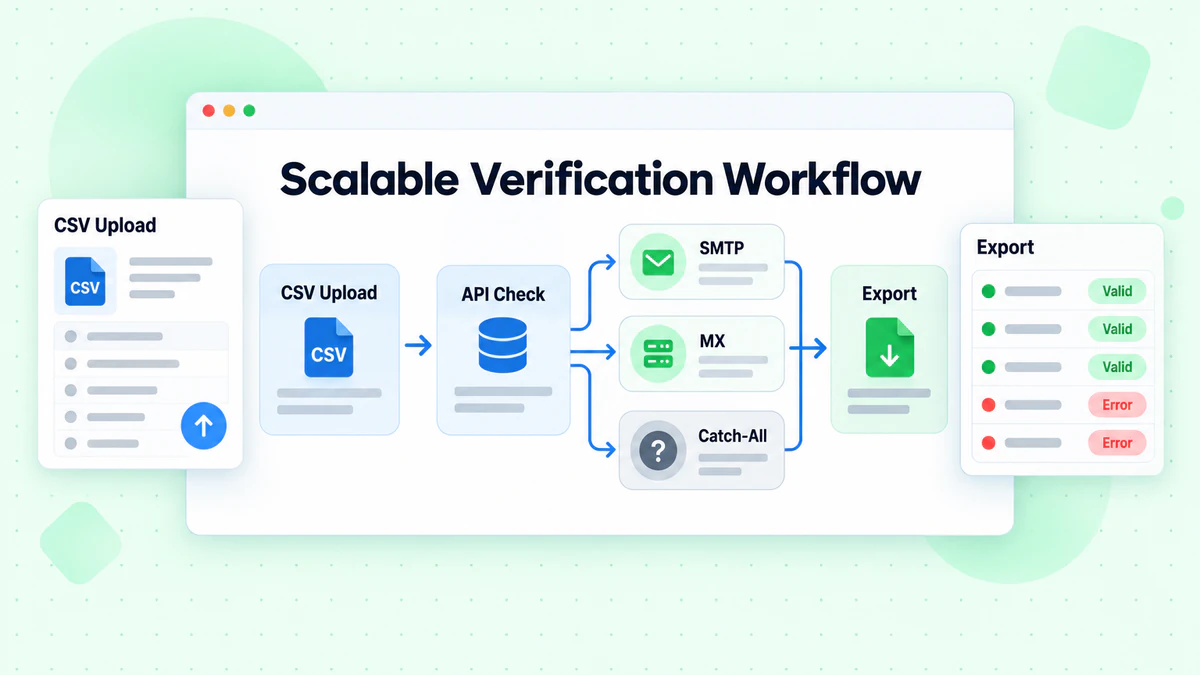
Use a representative list rather than a tidy sample. Inspect the returned statuses, supporting fields, and filters. Confirm the required CRM, ESP, API, Zapier, or Make connection. Measure processing speed and review bounce-related outcomes after applying your suppression policy. Finally, check whether the free allocation supports ongoing usage, including repeat cleaning and new-address validation, rather than only the first upload.
The broader lesson is simple. Cost shouldn't be evaluated in isolation. A free verifier that produces unclear results or forces fragmented manual work may consume more operational time, while an inaccurate decision can expose a sender to unnecessary reputation risk. Pair verification with disciplined campaign tracking and consistent data conventions, just as you would standardize campaign attribution with a bulk UTM generator.
BillionVerify offers bulk CSV verification, real-time API checks, structured deliverability data, and connections for marketing and CRM workflows. Use it as a practical way to evaluate whether free bulk email verifier software can protect list quality without disrupting your team's process. Visit BillionVerify and test the workflow against the kinds of addresses your team manages.