


Most advice about a business email list is backward. It treats list growth as the goal and list quality as cleanup work for later. That approach creates avoidable risk.
A large list with weak data doesn't give marketing or sales more reach. It gives them more failure points. Teams spend time writing campaigns, loading contacts into a platform, warming domains, and coordinating launches, only to discover that bad addresses, role accounts, and stale records drag down results before the message has a fair chance to perform. The problem usually isn't creative. It's the file.
That matters because email is still too important to run on bad inputs. The global number of email users is projected to reach 4.73 billion in 2026, but only about 83% of emails successfully reach the destination mailbox, meaning 17% face deliverability failures tied to invalid addresses or spam filtering, according to BlueMail Media's international email data. A list that isn't verified isn't an asset yet. It's unconfirmed inventory.
The operational mistake is treating verification as a final polish step. In practice, verification is what turns a raw list into something a team can safely use. Without that discipline, you risk higher bounce rates, weaker sender reputation, and wasted spend across media, automation, and SDR workflows. That's why I treat list hygiene as a core data operation, not a marketing afterthought.
If your team is still measuring success by how many addresses sit in the CRM, it helps to revisit why data cleaning matters for email performance. The value of a business email list isn't created at acquisition. It's realized through verification, filtering, and ongoing maintenance.
Introduction Why Your Business Email List Is a Liability
The most common mistake in email operations is assuming every new address adds value. It doesn't. An address only becomes valuable when your team can trust it, segment it, and send to it without damaging deliverability.
A neglected business email list creates hidden costs fast. Marketing pays to send to records that won't respond. Sales reps sequence contacts that never existed or were never appropriate for outreach. Ops teams then spend time untangling why engagement dropped, why bounce rates climbed, or why a domain suddenly needs repair work.
Practical rule: If you haven't verified the list, you don't know the list.
Most list-building advice falls short. It celebrates lead magnets, forms, events, and exports from third-party providers, but it skips the step that determines whether any of that data is usable. Teams end up celebrating acquisition volume while carrying a deliverability problem into every campaign.
The more mature view is simpler. A business email list is a live data asset with decay built in. Records age. People change jobs. Shared inboxes get routed differently. Temporary addresses disappear. That means list quality isn't a one-time project. It's an operating standard.
Treating verification as optional leads to the wrong behavior. Teams keep old contacts because deleting names feels like losing opportunity. In reality, keeping bad records often destroys more value than removing them. Clean lists send clearer signals. They produce more trustworthy engagement metrics. They also let you judge copy, offer, and timing on their own merits.
What Defines a High-Quality Business Email List
A high-quality business email list gives your team confidence. Confidence that the address is real, the person is relevant, the record is current, and the contact can be reached without creating avoidable risk for your domain.
List size matters far less than list reliability.
Permission sets the ceiling on performance
Permission is the first filter because it shapes everything that follows. Open rates, complaint rates, unsubscribes, and reply quality all improve when the recipient had a clear reason to expect your message.
That standard is simple in practice:
- Opt-in records fit ongoing marketing programs when consent is documented.
- Double opt-in records give stronger proof of intent and confirm the address itself.
- Third-party sourced records can support prospecting, but they need tighter controls, narrower targeting, and verification before any send.
Teams often blur the line between "we found this contact" and "this person agreed to hear from us." Those are different conditions with different operational consequences. A sourced contact may still be useful for sales, but it should not be treated like a subscriber.
For a closer look at the signals that separate usable records from risky ones, see this guide on email list quality.
Accuracy determines whether the list can be used at all
Bad data is not a minor cleanliness issue. It affects delivery, reporting, rep productivity, and how much trust leadership can place in campaign results.
A strong business list includes more than an email field. It should have current company information, role data, source history, consent status where applicable, and enough context to decide whether the contact belongs in a campaign before a single email goes out. If your team cannot answer basic questions about fit, the list is not ready for production use.
Recency matters too. People change companies, departments, and responsibilities constantly. Generic inboxes get reassigned. Old records drift out of sync with reality, which means a list can look healthy in a spreadsheet while underperforming the moment you send.
Usability depends on structure, not just data presence
A record can be valid and still be operationally weak.
If job titles are inconsistent, industries are missing, country fields are messy, or naming conventions change across systems, segmentation breaks down fast. Sales cannot route accounts cleanly. Marketing cannot suppress the wrong audiences with confidence. Analytics then reports on a distorted sample.
That is why format discipline matters. Standardized fields, clear source tagging, and consistent account-level enrichment make the list usable across teams instead of trapping it inside one tool.
If you are improving list capture on your own site, tactical changes to forms and signup flows can help. This guide on increasing email subscribers using Divi is a practical example of how capture quality starts before the record ever reaches your database.
Segmentation quality reflects list quality
Segmentation is often treated as a campaign skill. It is really a data quality test.
A useful business email list lets your team exclude as confidently as it includes. That means removing student signups from enterprise campaigns, filtering out shared inboxes from executive outreach, separating customers from prospects, and suppressing stale records before they distort performance. If the underlying records are weak, segmentation turns into guesswork dressed up as strategy.
Compliance also becomes easier when the list is clean and well-structured. Consent records are easier to trace. Unsubscribe handling is easier to enforce. Suppression logic holds up under pressure. Teams that keep those controls tight usually see better deliverability because they stop mailing contacts who were never a fit in the first place.
Strategic Approaches to Building Your List
There isn't one way to build a business email list. The right approach depends on how quickly you need volume, how much control you want over data quality, and how strict your deliverability standards are. In practice, a mix of inbound, outbound, and partner-led acquisition is commonly used.
Inbound gives you cleaner intent signals
Inbound is slower, but the signal quality is better. People who download a guide, register for a webinar, subscribe through content, or request a demo usually give you a clearer reason to contact them.
That doesn't mean every inbound lead is good. Website forms still attract typos, bots, personal inboxes, and low-intent signups. But compared with other channels, inbound usually starts with better permission and stronger context.
A few approaches consistently make sense:
- Content-led capture works when the asset solves a specific problem instead of offering generic value.
- Webinars and event registration help because the topic itself pre-qualifies interest.
- On-site form optimization matters more than teams think. If you're refining capture flows on a site built with Divi, this guide on increasing email subscribers using Divi is a useful tactical reference.
Outbound is faster but less forgiving
Outbound gives sales teams speed. It also exposes every weakness in your data process. If you source contact records from vendors, enrichment tools, or scraped datasets, you're working with data that may be relevant but not yet safe to send.
That means the bar for filtering has to be higher. Remove obvious role accounts, isolate catch-all domains for review, and don't treat all sourced records as campaign-ready. Outbound works when list qualification is strict and messaging is narrow.
One useful way to think about tooling here is operational, not promotional. BillionVerify is a professional email verification service built to solve one problem: bad email data costs businesses money.
Partnerships can work when ownership is clear
Partnerships sit between inbound and outbound. Co-hosted webinars, newsletter swaps, affiliate relationships, and event collaborations can produce relevant contacts fast, but only when consent and follow-up expectations are explicit.
Here, many teams get sloppy. They assume a partner-generated lead carries the same permission standard as a direct signup. Often it doesn't. If the contact expected one brand and hears from two, complaints go up and trust drops.
A simple comparison helps:
| Approach | Main strength | Main trade-off | Data quality starting point |
|---|---|---|---|
| Inbound | Better intent and context | Slower to scale | Usually strongest |
| Outbound | Fast access to prospects | Highest verification burden | Often mixed |
| Partnerships | Shared audience access | Consent can be ambiguous | Varies by execution |
The pattern is consistent. The faster you acquire data, the more rigor you need before using it.
The Non-Negotiable Role of Email Verification
Unverified data doesn't just reduce campaign efficiency. It puts the whole sending program at risk.
Business email data decays continuously. According to Business.com's email list research, 32% of all business emails go invalid annually, 15% of B2B campaigns fail due to poor data quality, and modern ISPs like Google and Microsoft block senders with bounce rates above 2%. That's not a minor optimization issue. That's a delivery threshold.
Bad data breaks deliverability before messaging matters
Teams often diagnose email performance in the wrong order. They review subject lines, CTA placement, send times, and offer structure before they confirm the recipient file is healthy. If the list is compromised, those tests don't mean much.
Bad records create several problems at once:
- Hard bounces tell mailbox providers your sending practices aren't well controlled.
- Role-based addresses such as info@ or support@ rarely behave like named decision-maker inboxes.
- Disposable or temporary emails introduce noise into both marketing and product signup flows.
- Outdated contacts distort reporting because non-engagement may reflect data decay, not message quality.
A weak list makes good creative look bad.
This is why verification should happen before campaign planning is finalized, not after the sequence is already built and approved. If the data isn't clean, the launch calendar is premature.
Verification is really reputation management
Teams often describe verification as list cleaning. That's too narrow. The actual job is protecting sender reputation so future campaigns can reach real inboxes.
A proper verification workflow checks whether an address is deliverable, whether the mailbox exists, whether the domain can receive mail, and whether the record should be excluded due to risk signals. It also helps teams separate usable records from questionable ones instead of forcing a binary keep-or-delete decision on the entire file.
If your team needs the technical baseline, this overview of how email verification works is a practical starting point.
The trade-off is simple. Verification adds process. Skipping it adds risk. In every mature email program I've seen, the first option is cheaper.
A Step-by-Step Workflow for Email List Cleaning
A reliable cleaning process has three parts. Clean the existing file before sending. Block bad records at entry. Re-check the database on a schedule so decay doesn't rebuild the problem.
Phase one bulk cleaning before any send
Start with the list you already have. Export the relevant segment from your CRM or email platform as CSV, then run it through a verifier before the campaign is approved for launch.
The point of bulk cleaning isn't only to remove obvious invalids. It's to classify the file so your team can make deliberate decisions. Separate valid addresses from invalid, catch-all, disposable, and role-based accounts. That structure lets marketing and sales decide what to suppress, what to route to a lower-risk sequence, and what to exclude entirely.
BillionVerify fits this workflow because it supports bulk checks and returns statuses teams can filter before export. It also performs direct mailbox existence queries via real-time SMTP checks. In a benchmark, BillionVerify achieved 99.9% accuracy at the SMTP level, outperforming 19 other providers, according to Comparateur-IA's review of email verification providers.
A practical triage model looks like this:
- Sendable now includes clearly valid business contacts that match the campaign.
- Review before use includes catch-all results or addresses that need manual context.
- Suppress includes invalid, disposable, and irrelevant role-based records.
Phase two real-time checks at the point of entry
Bulk cleaning fixes yesterday's problem. Real-time verification prevents tomorrow's.
Any form that accepts an email address should validate it before the record hits your CRM, product database, or email platform. That applies to newsletter signups, gated content forms, demo requests, account creation, and event registration. If the entry point isn't protected, your team is rebuilding bad data every day.
This short demo is useful if you're designing the process in a modern stack:
Real-time checks are especially valuable for product and ops teams because they stop fake signups, typo domains, and temporary inboxes before those records trigger onboarding emails or sales alerts.
Phase three ongoing hygiene as a recurring process
No list stays clean. People switch companies. Shared inboxes get retired. Old segments become risky if nobody rechecks them.
That means list hygiene needs an owner and a cadence. Some teams review by campaign. Others review by source, lifecycle stage, or CRM age. The exact schedule matters less than consistency. The rule is simple: re-verify before large sends, after major imports, and whenever a list has sat untouched long enough to decay.
Treat list cleaning like revenue protection. Once it's part of operations, campaign performance becomes easier to trust.
Advanced Segmentation and Measuring ROI
Clean data doesn't just reduce risk. It improves targeting. Once a business email list has been verified and classified, segmentation gets more precise because you're no longer building campaigns around unreliable records.
Use verification outputs to shape segments
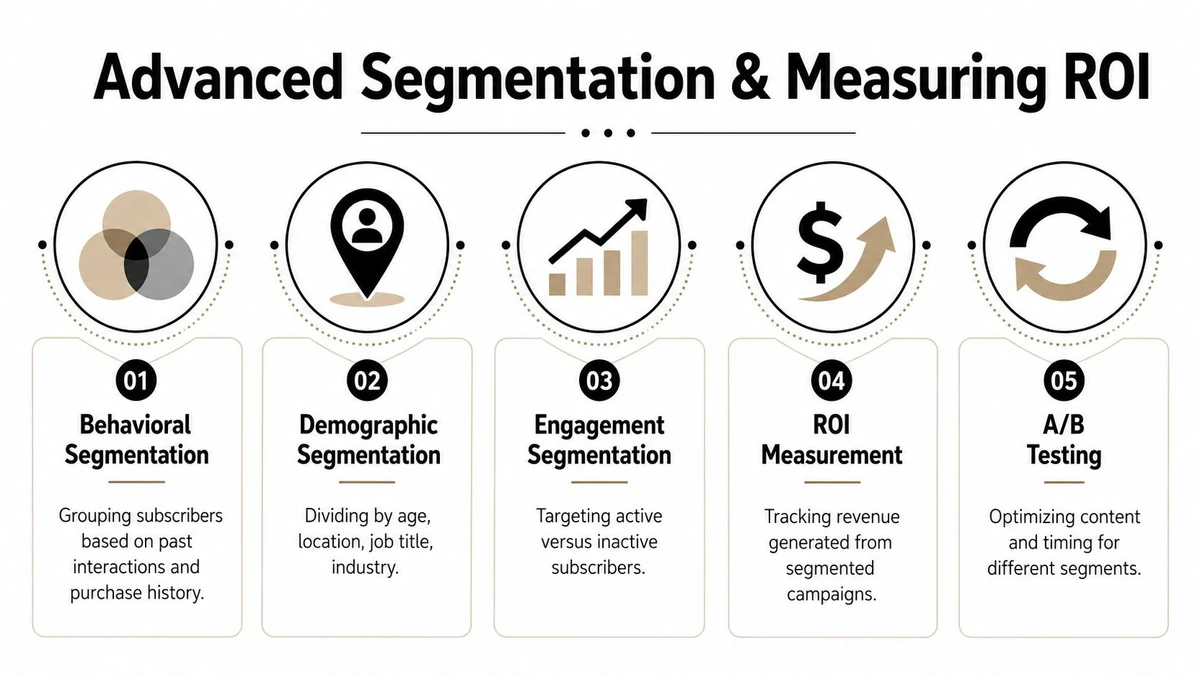
Segmentation often begins with firmographics first. Industry, job title, company size, and geography are useful, but they aren't enough on their own. Verification adds a second layer that improves execution.
For example, you can build safer and more relevant audiences by:
- Excluding role accounts from personalized outbound so reps focus on named contacts instead of shared inboxes.
- Separating catch-all results into a lower-risk review pool instead of sending them through the main campaign.
- Filtering disposable addresses from lead scoring and lifecycle reporting.
- Combining profile depth with status data so a high-fit contact is still suppressed if deliverability signals are poor.
That matters because email remains a strong revenue channel. Email marketing delivers an average ROI of $36 for every $1 spent, and 50.7% of consumers purchase something from a marketing email at least once per month, according to Porch Group Media's email marketing statistics.
For teams building more refined audience logic, this guide to email segmentation strategy is a useful operational companion.
Tie cleaner data to financial outcomes
The easiest way to justify verification is to stop treating it as a hygiene cost and start measuring it as a performance input.
Use a simple before-and-after framework:
| Metric | Before cleaning | After cleaning | Business meaning |
|---|---|---|---|
| Bounce trend | Higher and less predictable | Lower and more stable | Better sender protection |
| Deliverability confidence | Unclear | Stronger | Better testing conditions |
| Engagement quality | Noisy | More trustworthy | Cleaner reporting |
| Conversion efficiency | Hard to diagnose | Easier to attribute | Better budget decisions |
You don't need invented uplift numbers to see the impact. When fewer bad records absorb send volume, performance data becomes more credible. Marketing can judge creative with less noise. Sales can focus on contacts that are more likely to be reachable. Ops can trust that CRM growth reflects usable records instead of accumulation.
Your Team's Business Email List Playbook
A business email list stays valuable when teams manage it like shared infrastructure. Marketing owns campaign strategy, sales owns outreach discipline, and ops owns data rules. If no one defines the standard, the CRM fills up and quality drifts.
The operating checklist
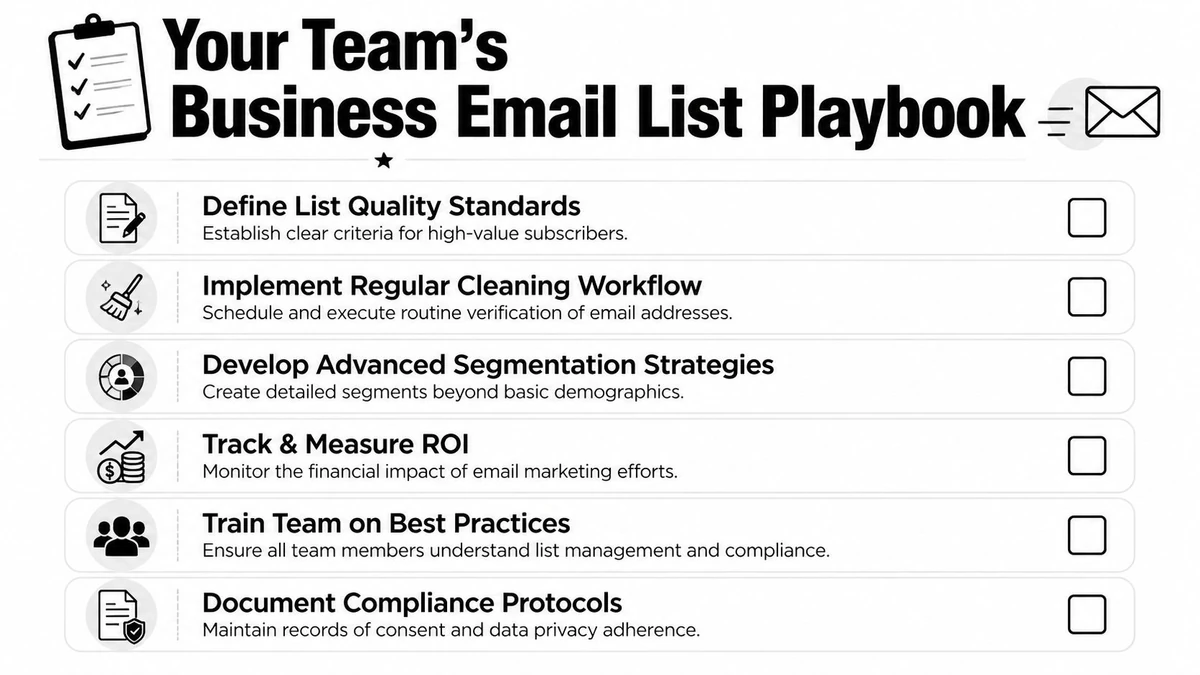
Use this as a working standard, not a one-time audit.
- Define acceptable records. Decide what counts as campaign-ready. Named contacts, consent status, relevant firmographics, and verified deliverability should all be part of the rule.
- Verify every new entry. Implement real-time SMTP-level verification with catch-all scoring and MX record validation. That approach can reduce bounce rates to below 1%, according to Bookyourdata's guidance on verification.
- Separate marketing from prospecting logic. Subscriber consent and sourced outbound contacts should not be mixed into the same operating bucket.
- Suppress risky categories. Role accounts, disposable emails, and stale imports should be filtered before campaign build, not after results disappoint.
- Document compliance handling. Keep a clear record of consent, source, unsubscribe processing, and ownership across systems.
- Review list health routinely. Re-check older segments and imported files before they re-enter active rotation.
Make ownership explicit across teams
The playbook only works when responsibility is visible.
Marketing should own segmentation and send eligibility. Sales should own sourcing discipline and suppression rules for outbound. Operations or RevOps should own verification workflows, CRM field governance, and list hygiene triggers. If your team runs ecommerce or retention programs, specialized guidance can help too. This resource on how to optimize email campaigns for Shopify stores is relevant when list quality and campaign execution need to work together.
The core principle doesn't change. Smaller, cleaner lists outperform larger, uncertain ones because the team can trust what it's sending and why it's sending it.
A clean list gives every email a fair chance to work. If your team wants to verify contacts before campaigns, filter risky records, and turn raw data into a safer sending audience, BillionVerify is a practical option to evaluate.