



Sending a campaign only to see it bounce back can be more than frustrating for any Email Marketing Manager at a global B2B SaaS company. Invalid email formats—whether through a missing top-level domain or misplaced characters—undermine your efforts before your message even lands. Email syntax validation acts as a critical gatekeeper, catching flawed addresses and shielding your deliverability and sender reputation. Discover how clear, thorough validation can streamline your contact lists and make every send count.
Key Takeaways
| Point | Details |
|---|---|
| Importance of Email Syntax Validation | Validating email syntax is vital for maintaining effective communication in digital marketing and preventing delivery issues. |
| Types of Syntax Errors | Common email syntax errors include misplaced symbols, invalid characters, and missing domain components, which can hinder communication. |
| Impact on Deliverability | Proper validation techniques enhance email deliverability by reducing bounce rates and protecting sender reputation with internet service providers. |
| Risks of Poor Validation | Inadequate syntax validation can result in high bounce rates, wasted resources, and degraded campaign effectiveness, necessitating robust validation protocols. |
Email Syntax Validation Explained Clearly
Email syntax validation is a critical process for ensuring high-quality communication channels in digital marketing and business operations. At its core, this technique involves rigorously checking whether an email address meets the fundamental structural requirements for valid electronic communication. Precise email format validation helps organizations maintain clean contact lists and reduce potential communication failures.
The fundamental components of email syntax validation include examining several key structural elements:
- Presence of a local part (username) before the '@' symbol
- Inclusion of a valid '@' symbol
- Existence of a properly formatted domain name
- Compliance with standard email address construction rules
Understanding these components helps marketers and technical professionals create robust email verification systems. Email syntax validation goes beyond simple string matching, incorporating complex rules that ensure an email address could potentially exist and receive communications.
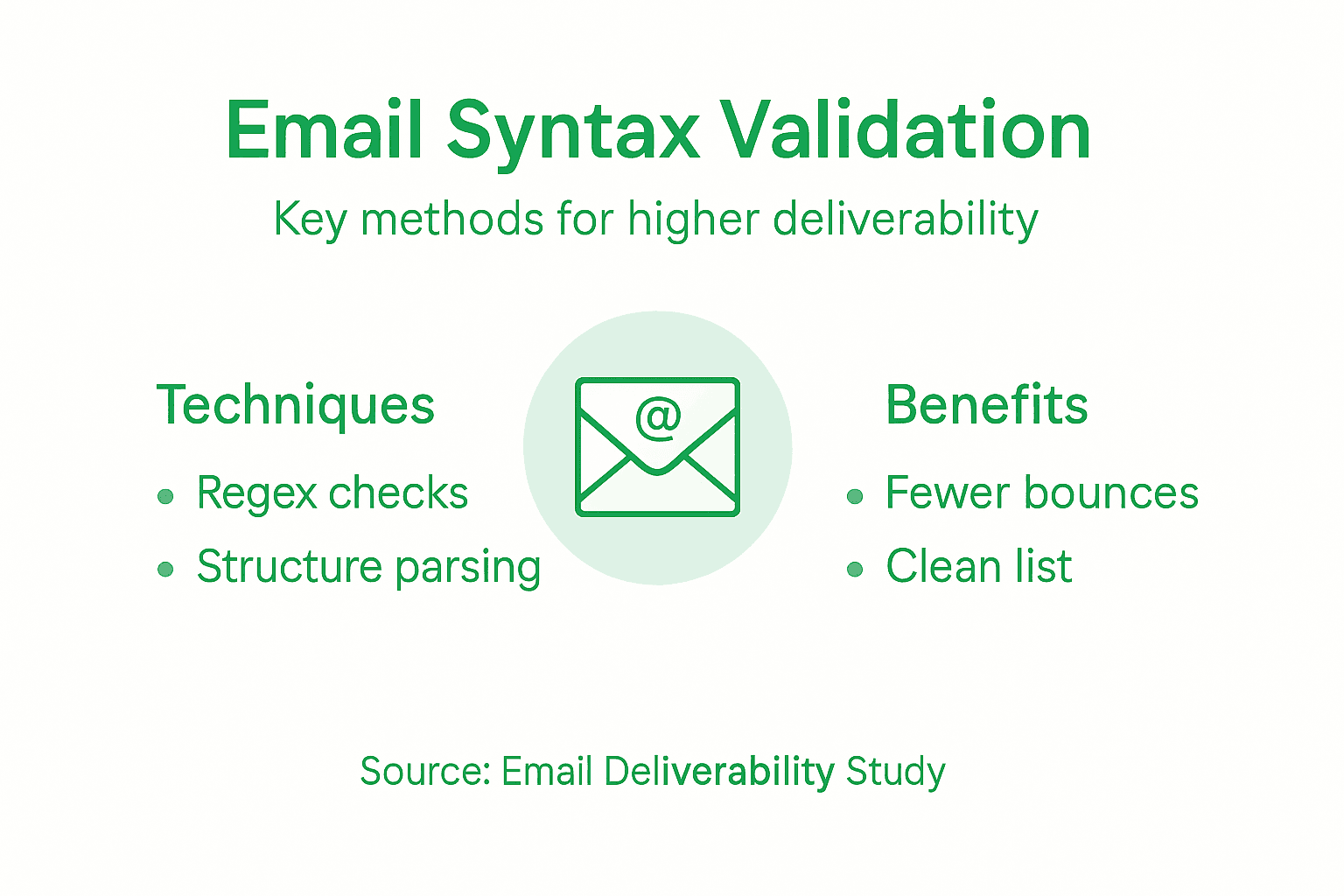
Validation techniques often leverage sophisticated methods like regular expressions and grammatical parsing to assess email address integrity. Rigorous syntactic validation approaches can dramatically improve email list quality by filtering out malformed or incorrectly structured addresses before they enter communication systems.
Pro tip: Implement multi-stage email validation that checks syntax first, then performs additional verification steps to ensure maximum email list accuracy.
The following table highlights how different email syntax validation methods compare and their impact on business operations:
| Validation Method | Complexity | Typical Use Case | Business Impact |
|---|---|---|---|
| Basic Regex Matching | Low | Initial screening | Filters obvious invalid emails |
| Advanced Parsing | Medium | Ensuring structural compliance | Reduces list errors |
| Multi-Stage Validation | High | Comprehensive verification steps | Maximizes data quality |
| Real-Time Filtering | High | Immediate input validation | Minimizes bounce rates |
Types of Invalid Email Syntax and Formats
Email addresses can become invalid through various syntactical errors that compromise their structural integrity and communication potential. Common email format problems can emerge from multiple points in the address construction, creating significant challenges for digital communication systems.
The most frequent types of invalid email syntax include:
- Prefix errors like starting or ending with a period
- Inclusion of unauthorized special characters
- Consecutive periods within the username
- Missing or improperly formatted top-level domains
- Incorrect placement of the '@' symbol
- Domain names with invalid character sequences
Prefix-related syntax errors often occur when users inadvertently include problematic characters or structural mistakes. These can range from simple typos to more complex formatting issues that render an email address fundamentally undeliverable. For instance, email addresses cannot start or end with a period, nor can they contain consecutive periods, which automatically invalidate the syntax.

Domain-related syntax problems represent another critical category of email address invalidity. These issues might involve missing top-level domains, incorrect domain name structures, or the use of prohibited characters within the domain portion of the email address. Advanced syntax validation techniques help identify these complex structural problems before they enter communication systems.
Pro tip: Implement automated syntax validation rules that check for multiple structural criteria simultaneously to catch potential email address formatting errors early in the collection process.
How Syntax Checks Improve Email Deliverability
Email syntax validation serves as a critical first line of defense in maintaining high-quality communication channels and protecting sender reputation. Email deliverability strategies require sophisticated validation mechanisms that go beyond simple character matching to ensure comprehensive email address integrity.
The primary ways syntax checks enhance email deliverability include:
- Preventing invalid email addresses from entering marketing databases
- Reducing bounce rates and associated sender reputation damage
- Filtering out potentially malicious or fake email addresses
- Minimizing unnecessary communication attempts to non-existent addresses
- Protecting email infrastructure from potential spam and security risks
Syntax validation acts as a fundamental filter that eliminates problematic email addresses before they can impact overall communication effectiveness. By catching structural errors early, organizations can significantly reduce the number of undeliverable messages that might negatively influence their sender reputation with internet service providers (ISPs).
Moreover, comprehensive syntax checks help marketers maintain clean email lists by identifying potential issues such as incomplete domains, improper character usage, and formatting inconsistencies. Email deliverability troubleshooting becomes more effective when organizations implement robust syntax validation protocols that catch potential communication barriers before they become systemic problems.
Pro tip: Integrate real-time syntax validation into your email collection processes to automatically filter out invalid addresses and maintain a high-quality contact database.
Role-Based and Disposable Address Detection
Role-based and disposable email addresses represent significant challenges in email marketing and communication strategies. Email validation best practices emphasize the critical importance of identifying and filtering these problematic email types to maintain communication quality and engagement.
Key characteristics of role-based and disposable email addresses include:
- Generic addresses like admin@, support@, or sales@ that represent departments
- Temporary email addresses created for single-use purposes
- Emails with domains specifically designed for generating disposable addresses
- Addresses that lack individual personalization
- High-risk communication channels with minimal individual accountability
Disposable email detection serves as a crucial mechanism for protecting marketing databases and communication channels. These addresses typically have short lifespans and provide minimal engagement potential, making them ineffective for sustained marketing efforts. Disposable email detection helps organizations filter out low-quality contact information before it enters their primary communication systems.
Comprehensive email validation requires sophisticated detection mechanisms that can identify role-based and disposable addresses through advanced pattern recognition and domain analysis. By systematically screening these email types, businesses can significantly improve their communication efficiency, reduce bounce rates, and maintain higher-quality contact lists that drive meaningful engagement.
Pro tip: Implement multi-layered email validation protocols that specifically target role-based and disposable email addresses to enhance overall communication quality and marketing effectiveness.
Risks of Poor Syntax Validation in Campaigns
Poor email syntax validation can create significant challenges for digital marketing campaigns, undermining communication effectiveness and organizational reputation. Email validation risks expose businesses to substantial operational and reputational challenges that can dramatically impact marketing performance.
The primary risks associated with inadequate syntax validation include:
- Exponentially increasing email bounce rates
- Damaging sender reputation with internet service providers
- Wasting marketing resources on invalid email addresses
- Reducing overall campaign engagement metrics
- Potentially triggering spam filter mechanisms
- Compromising data quality in marketing databases
Sender reputation suffers dramatically when organizations fail to implement robust email syntax validation protocols. Internet service providers closely monitor bounce rates and email interaction patterns, penalizing senders who consistently attempt to contact invalid or non-existent email addresses. Verify Emails for Deliverability becomes crucial in maintaining communication integrity and preventing potential blacklisting.
Moreover, poor syntax validation can lead to significant financial losses by consuming marketing budgets on ineffective communication attempts. Organizations might spend considerable resources designing, creating, and distributing campaigns that never reach actual recipients, resulting in diminished return on investment and reduced marketing effectiveness.
Below is a summary of major risks related to weak email syntax validation for marketing campaigns:
| Risk Factor | Short-Term Effect | Long-Term Consequence |
|---|---|---|
| High Bounce Rates | Wasted resources | ISP reputation damage |
| Invalid Database Entries | Ineffective targeting | Poor engagement metrics |
| Fake Address Acceptance | Security exposures | Increased spam risk |
Pro tip: Implement automated, real-time email syntax validation mechanisms that continuously clean and validate your contact database to minimize communication risks and maximize campaign performance.
Elevate Your Email Deliverability with Precise Syntax Validation
The article highlights the crucial challenge of maintaining clean email lists through thorough email syntax validation to reduce bounce rates and protect sender reputation. If you want to eliminate invalid email formats, catch disposable and role-based addresses, and boost your campaign success, you need more than basic checks. BillionVerify offers advanced solutions designed to tackle these exact pain points with real-time verification and comprehensive bulk cleaning.

Discover how our real-time email verification API with 99.9% accuracy and specialized features like disposable email detection and role-based email identification can transform your marketing efforts. Act now to safeguard your sender reputation, minimize bounce rates, and ensure your messages land in the inbox every time. Visit BillionVerify and make your email validation strategy unstoppable.
Frequently Asked Questions
What is email syntax validation?
Email syntax validation is the process of checking if an email address meets the structural requirements for valid electronic communication, ensuring that it can potentially exist and receive messages.
Why is email syntax validation important for deliverability rates?
Email syntax validation helps prevent invalid addresses from entering your marketing database, reduces bounce rates, protects sender reputation, and ultimately increases the effectiveness of email campaigns.
What are common syntax errors that can invalidate an email address?
Common syntax errors include missing or misplaced '@' symbols, consecutive periods in the username, improper top-level domains, and the presence of unauthorized special characters.
How can I implement effective email syntax validation in my campaigns?
To implement effective email syntax validation, consider using automated tools that perform multi-stage validation to check the email structure in real-time, filtering out invalid addresses before they affect your communication efforts.