



Healthcare organizations face a unique challenge in email marketing: balancing effective patient communication with strict regulatory compliance. Unlike retail or B2B marketers who can freely experiment with personalization and automation, healthcare marketers must navigate HIPAA regulations, state privacy laws, and patient trust considerations with every email they send.
The stakes are high. A single compliance violation can result in fines ranging from $100 to $50,000 per incident, with annual maximums reaching $1.5 million per violation category. Beyond financial penalties, healthcare organizations risk losing patient trust—the foundation of effective care delivery.
Yet despite these challenges, email remains the most effective digital communication channel for healthcare. Studies show that 93% of patients prefer to receive appointment reminders via email, and healthcare email campaigns achieve an average open rate of 21.48%—significantly higher than the cross-industry average of 17.92%.
This comprehensive guide will walk you through everything you need to know about healthcare email marketing, from HIPAA compliance fundamentals to advanced patient engagement strategies that drive better health outcomes while protecting patient privacy. For specialized healthcare sectors, see our medical practice email marketing and email verification for healthcare guides.
Understanding HIPAA Requirements for Email Marketing
The Health Insurance Portability and Accountability Act (HIPAA) establishes the framework for protecting patient health information (PHI) in all communications, including email. Understanding these requirements is essential before launching any healthcare email campaign.
What Constitutes Protected Health Information
PHI includes any information that can identify a patient and relates to their health condition, healthcare provision, or payment for healthcare services. In email marketing context, this includes:
Direct Identifiers:
- Patient names combined with health information
- Medical record numbers
- Health plan beneficiary numbers
- Social Security numbers
- Email addresses linked to health data
- Appointment details with specific conditions
Indirect Identifiers:
- Geographic data smaller than a state
- Dates directly related to an individual (birth date, admission date)
- Phone numbers and fax numbers
- Account numbers
- Certificate/license numbers
- Device identifiers and serial numbers
The HIPAA Email Marketing Framework
HIPAA doesn't prohibit email marketing—it establishes safeguards for how patient information can be used in marketing communications.
Marketing vs. Healthcare Operations:
Under HIPAA, not all patient communications are considered "marketing." Treatment-related communications, appointment reminders, and care coordination messages fall under "healthcare operations" and don't require explicit marketing consent. However, communications promoting services for which the covered entity receives third-party compensation do require patient authorization.
The Authorization Requirement:
For marketing emails that don't qualify as healthcare operations, HIPAA requires:
- Written authorization from the patient
- Clear description of the information to be used
- Name of the entity receiving the information
- Purpose of the disclosure
- Authorization expiration date
- Patient's right to revoke authorization
Technical Safeguards for HIPAA-Compliant Email
Implementing proper technical safeguards is mandatory for any healthcare email program:
Encryption Requirements:
- All emails containing PHI must be encrypted in transit
- Use TLS 1.2 or higher for email transmission
- Consider end-to-end encryption for sensitive communications
- Implement encryption at rest for stored email data
Access Controls:
- Role-based access to email marketing systems
- Unique user identification for all staff
- Automatic logoff after inactivity periods
- Audit trails for all email activities
Email Platform Considerations:
- Ensure your ESP (Email Service Provider) offers a Business Associate Agreement (BAA)
- Verify the platform's HIPAA compliance certifications
- Confirm data center security standards (SOC 2, HITRUST)
- Review the provider's breach notification procedures
Building a HIPAA-Compliant Email List
The foundation of successful healthcare email marketing is a clean, compliant, and engaged subscriber list. Before implementing any email strategy, ensure your list building practices align with both HIPAA requirements and email marketing best practices.
Consent Collection Best Practices
Healthcare email marketing requires more rigorous consent collection than other industries:
Explicit Opt-In Requirements:
- Use clear, unambiguous language about email communications
- Separate marketing consent from treatment consent
- Document when, where, and how consent was obtained
- Provide specific descriptions of email types patients will receive
Patient Portal Integration:
- Integrate email preferences into patient portal registration
- Allow granular control over communication types
- Enable easy preference updates at any time
- Sync preferences across all communication channels
Paper Form Considerations:
- Design intake forms with dedicated email marketing sections
- Ensure forms clearly distinguish marketing from care communications
- Train staff on proper consent collection procedures
- Maintain physical records according to retention requirements
Email Verification for Healthcare Organizations
Before adding any email address to your marketing list, verify your email addresses to ensure accuracy and deliverability. Invalid emails create multiple problems for healthcare organizations:
Compliance Risks:
- Emails sent to wrong addresses could inadvertently expose PHI
- Bounce-back messages may contain patient information
- Invalid addresses complicate audit trails and documentation
Deliverability Impact:
- High bounce rates damage sender reputation
- ISPs may block emails from healthcare domains
- Reduced inbox placement affects patient engagement
Cost Implications:
- Wasted resources on undeliverable messages
- Reduced ROI on email campaigns
- Increased risk of landing on blacklists
BillionVerify offers HIPAA-compliant email verification services specifically designed for healthcare organizations. Our platform validates email addresses without storing or transmitting PHI, ensuring your list remains both clean and compliant. With real-time API verification, you can validate patient emails at the point of collection, preventing invalid addresses from entering your system.
List Segmentation Strategies
Effective segmentation enables personalized communication while maintaining HIPAA compliance:
Demographic Segmentation:
- Age groups (pediatric, adult, geriatric)
- Geographic location (for location-specific services)
- Language preferences
- Communication preferences (frequency, format)
Behavioral Segmentation:
- Appointment history (new patients vs. established)
- Service utilization patterns
- Portal engagement levels
- Previous email interaction
Care-Based Segmentation:
- Primary care vs. specialty patients
- Chronic condition management programs
- Preventive care schedules
- Post-procedure follow-up groups
Important Note: Segmentation based on specific diagnoses or conditions requires additional HIPAA considerations and should only be used when clinically necessary and properly authorized.
Types of Healthcare Email Campaigns
Healthcare email marketing encompasses various campaign types, each with specific compliance considerations and engagement strategies.
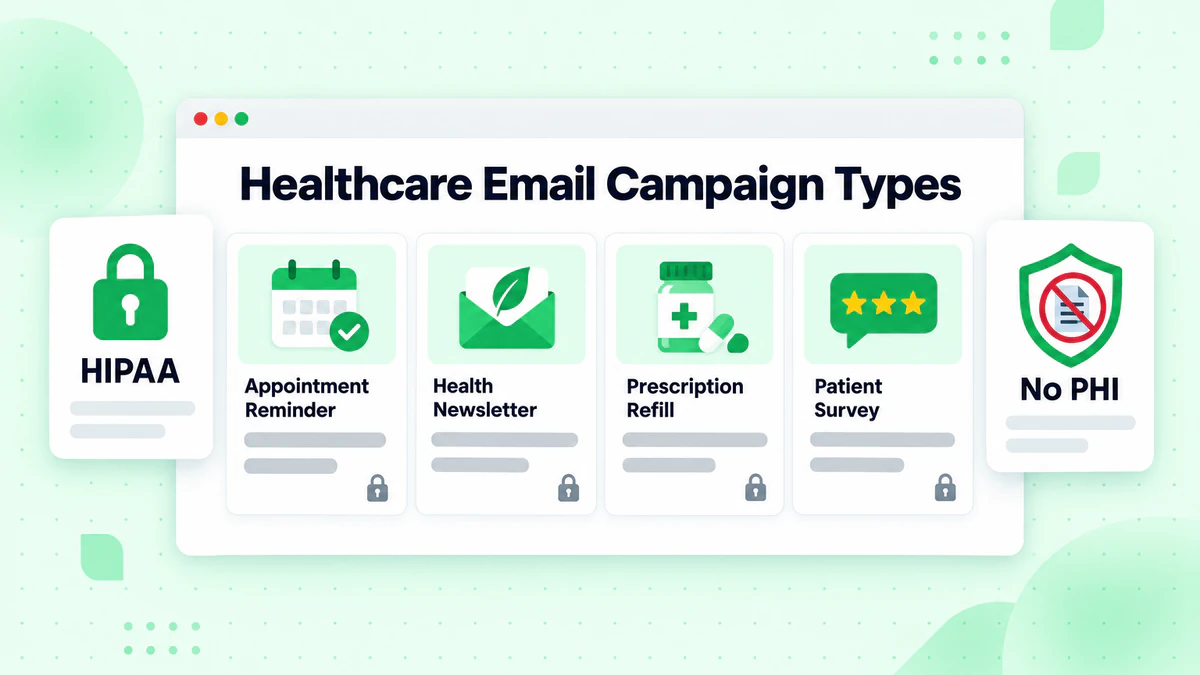
Appointment Reminder Emails
Appointment reminders are the cornerstone of healthcare email communication, reducing no-show rates by up to 38% when implemented effectively.
Best Practices:
- Send reminders at optimal intervals (7 days, 3 days, and 24 hours before)
- Include only necessary information (date, time, location, provider name)
- Provide easy rescheduling options
- Avoid including specific condition or treatment details in the subject line
Sample Appointment Reminder Structure:
Subject: Your Upcoming Appointment - [Date]

Dear [Patient First Name],

This is a reminder of your appointment:

Date: [Date]
Time: [Time]
Location: [Facility Name and Address]
Provider: [Provider Name]

Please arrive 15 minutes early for check-in.

[Reschedule Button] [Add to Calendar Button]

If you need to cancel or reschedule, please call [phone number]
or visit [patient portal link].

[Facility Name]
[Contact Information]
[Unsubscribe Link]
Patient Education Campaigns
Educational emails build trust, improve health outcomes, and position your organization as a valuable health resource.
Content Categories:
- Seasonal health tips (flu season preparation, summer safety)
- Preventive care reminders (screenings, vaccinations)
- General wellness information (nutrition, exercise, sleep)
- New service announcements
- Community health resources
Compliance Considerations:
- Avoid content that could imply knowledge of specific patient conditions
- Use general health information appropriate for broad audiences
- Don't combine educational content with treatment-specific recommendations
- Ensure all medical information is clinically accurate and reviewed
Newsletter Campaigns
Regular newsletters maintain engagement between visits and keep your organization top-of-mind.
Newsletter Content Ideas:
- Practice updates and new services
- Staff introductions and spotlights
- Community involvement highlights
- Health observance month recognition
- Patient success stories (with proper authorization)
- Technology and portal updates
Frequency Recommendations:
- Monthly newsletters for general patient populations
- Bi-weekly for active engagement programs
- Weekly only for time-sensitive health initiatives
Re-engagement Campaigns
Inactive patients represent both a health risk and a marketing opportunity. Re-engagement strategies can bring lapsed patients back to care.
Re-engagement Triggers:
- No appointment in 12+ months
- Overdue preventive screenings
- Incomplete treatment plans
- Expired prescriptions
- Lapsed chronic care management
Campaign Structure:
- Initial outreach: Gentle reminder of available services
- Value Reminder: Highlight benefits of continued care
- Personalized Offer: Easy scheduling options
- Final Attempt: Clear message about importance of care continuity
Email Design and Content Best Practices
Healthcare emails must balance professionalism, accessibility, and compliance while driving engagement.
Mobile-Optimized Design
With 67% of healthcare emails opened on mobile devices, mobile optimization is essential:
Design Requirements:
- Single-column layouts for easy scrolling
- Minimum 44px touch targets for buttons
- Font sizes of 14px minimum for body text
- Responsive images that scale appropriately
- Adequate white space for readability
Mobile-Specific Considerations:
- Preview text optimization for mobile inbox display
- Clear CTAs visible without scrolling
- Simplified navigation for smaller screens
- Fast loading times for varying connection speeds
Accessibility Standards
Healthcare organizations must ensure email accessibility for patients with disabilities:
WCAG Compliance Elements:
- Alt text for all images
- Sufficient color contrast (4.5:1 minimum)
- Logical reading order for screen readers
- Descriptive link text (avoid "click here")
- Proper heading hierarchy
Font and Layout:
- Sans-serif fonts for readability
- Minimum 16px font size for body text
- Line height of 1.5 for improved readability
- Avoid justified text alignment
- Use bullet points for easy scanning
Subject Line Strategies
Healthcare subject lines must balance engagement with compliance and professionalism.
Effective Subject Line Elements:
- Clear sender identification
- Relevant and specific content preview
- Appropriate urgency when warranted
- Professional tone
Subject Line Examples:
- ✅ "Your Annual Wellness Visit Reminder"
- ✅ "Important: Updated Patient Portal Features"
- ✅ "Flu Shot Clinics Now Available"
- ❌ "Your diabetes follow-up is overdue" (PHI in subject)
- ❌ "URGENT: Medical results waiting" (Fear-inducing, potentially misleading)
Call-to-Action Design
Healthcare CTAs should be clear, accessible, and action-oriented:
Primary CTA Examples:
- "Schedule Your Appointment"
- "Access Your Patient Portal"
- "View Available Times"
- "Download Your Records"
CTA Best Practices:
- Use contrasting colors for visibility
- Keep button text concise (2-4 words)
- Place primary CTA above the fold
- Include secondary CTAs for alternative actions
- Ensure buttons are large enough for mobile tapping
Measuring Healthcare Email Marketing Success
Tracking the right metrics enables continuous improvement while maintaining compliance.
Key Performance Indicators
Engagement Metrics:
- Open rate (healthcare benchmark: 21.48%)
- Click-through rate (healthcare benchmark: 2.69%)
- Click-to-open rate
- Forward/share rate
- Unsubscribe rate (healthcare benchmark: 0.17%)
Deliverability Metrics:
- Bounce rate (hard and soft)
- Spam complaint rate
- Inbox placement rate
- Sender reputation scores
Understanding your email marketing metrics helps optimize campaigns for better patient engagement. Regular monitoring of these metrics ensures your campaigns maintain optimal performance.
Outcome Metrics:
- Appointment scheduling rate
- Patient portal adoption
- Preventive care compliance
- No-show rate reduction
- Patient satisfaction scores
Attribution and Tracking
HIPAA places limitations on traditional email tracking methods:
Compliant Tracking Methods:
- Aggregate open and click data
- Non-identifiable engagement patterns
- Campaign-level performance metrics
- Anonymized A/B test results
Restricted Tracking:
- Individual patient-level tracking linked to PHI
- Behavioral tracking connected to health conditions
- Third-party tracking pixels that transmit PHI
- Cookie-based tracking without proper disclosure
Reporting and Analysis
Build a compliant reporting framework:
Regular Reporting Schedule:
- Weekly: Deliverability and engagement monitoring
- Monthly: Campaign performance analysis
- Quarterly: Strategic review and optimization
- Annual: Compliance audit and program assessment
Report Components:
- Executive summary of key metrics
- Campaign-by-campaign performance
- Segment-level insights
- Deliverability health check
- Compliance verification
- Recommendations for improvement
Advanced Strategies for Patient Engagement
Take your healthcare email marketing to the next level with advanced engagement tactics.
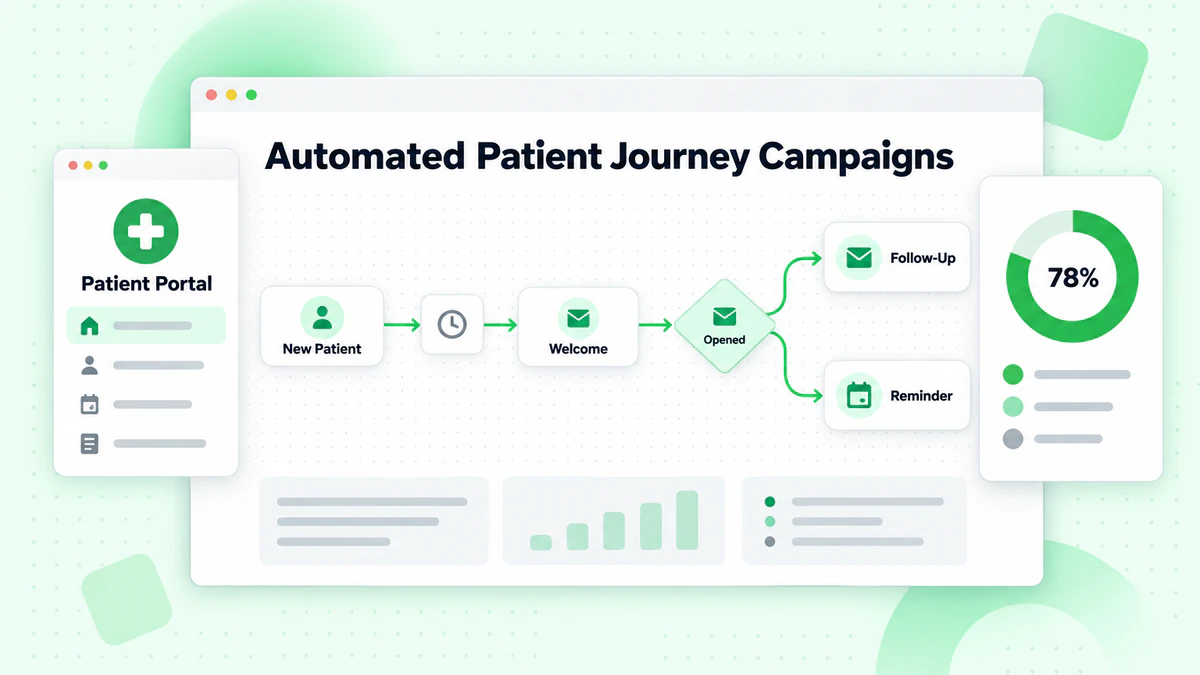
Automated Patient Journey Campaigns
Email automation enables personalized communication at scale while maintaining compliance:
New Patient Welcome Series:
- Welcome email with portal registration
- Practice introduction and what to expect
- Preventive care recommendations
- Patient satisfaction survey
Post-Visit Follow-Up:
- Thank you and satisfaction check
- Care instructions reminder
- Follow-up appointment scheduling
- Feedback request
Chronic Care Management:
- Condition education series
- Medication adherence reminders
- Self-monitoring encouragement
- Provider check-in scheduling
Personalization Within Compliance
Effective personalization doesn't require PHI:
Safe Personalization Elements:
- Patient first name
- Preferred provider name
- Last appointment date (without condition details)
- Upcoming appointment information
- Portal activity status
- Communication preferences
Dynamic Content Opportunities:
- Location-based service information
- Age-appropriate health content
- Seasonal health recommendations
- Preferred language content
Integration with Patient Portals
Maximize engagement by connecting email to your patient portal:
Integration Benefits:
- Streamlined authentication process
- Centralized preference management
- Secure message delivery options
- Enhanced engagement tracking
Email-to-Portal Pathways:
- Test result notifications with portal links
- Secure message alerts
- Appointment scheduling deep links
- Document and form access
Technology and Platform Considerations
Selecting the right technology stack is critical for HIPAA-compliant healthcare email marketing.
ESP Selection Criteria
When choosing an email service provider for healthcare:
Compliance Requirements:
- Business Associate Agreement (BAA) availability
- HIPAA compliance certification
- SOC 2 Type II certification
- HITRUST CSF certification (preferred)
Feature Requirements:
- End-to-end encryption capabilities
- Detailed audit logging
- Role-based access controls
- Data residency options
- Breach notification procedures
Healthcare-Specific Features:
- EHR/EMR integration capabilities
- Patient portal connectivity
- Healthcare-specific templates
- Compliance workflow automation
Email Verification Integration
Maintaining list hygiene is crucial for healthcare email success. BillionVerify provides healthcare-compliant email list verification that integrates seamlessly with your existing workflows:
Integration Options:
- Real-time API verification at patient registration
- Batch verification for existing lists
- Automated verification workflows
- Direct integration with major healthcare ESPs
Healthcare-Specific Benefits:
- HIPAA-compliant processing
- No PHI storage or transmission
- Detailed verification results
- Compliance documentation
Security Infrastructure
Build a robust security foundation:
Technical Requirements:
- TLS 1.2+ for all email transmission
- SPF, DKIM, and DMARC authentication
- IP reputation monitoring
- Encryption key management
- Regular security assessments
Operational Security:
- Staff training on email security
- Incident response procedures
- Regular access reviews
- Security policy documentation
Common Challenges and Solutions
Healthcare email marketers face unique obstacles. Here's how to overcome them.
Challenge: Maintaining Clean Patient Lists
Patient email lists degrade quickly due to job changes, address switches, and typos during collection.
Solution:
- Implement real-time email verification at collection points
- Conduct quarterly list hygiene audits
- Use double opt-in for marketing communications
- Clean your email list regularly to maintain deliverability
- Monitor bounce rates and remove invalid addresses promptly
Challenge: Balancing Personalization and Privacy
Patients expect personalized communication, but HIPAA limits what you can reference.
Solution:
- Focus on preference-based personalization
- Use implicit personalization (relevant content by segment)
- Leverage portal-based personalization where security is maintained
- Create condition-specific content accessible via secure links
Challenge: Multi-Location Coordination
Health systems with multiple locations struggle with consistent yet localized communication.
Solution:
- Develop centralized brand guidelines
- Create location-specific templates within brand standards
- Implement approval workflows for local content
- Use dynamic content for location-specific information
- Maintain centralized compliance oversight
Challenge: Provider Engagement
Getting physician buy-in for email marketing initiatives can be difficult.
Solution:
- Demonstrate ROI through no-show reduction data
- Share patient satisfaction improvements
- Involve providers in content development
- Highlight time savings from automation
- Provide easy opt-out for provider-specific communications
Challenge: Email Deliverability Issues
Healthcare emails often face deliverability challenges due to sensitive content triggers.
Solution:
- Monitor email deliverability metrics consistently
- Authenticate all sending domains properly
- Warm up new IP addresses gradually
- Avoid spam trigger words in subject lines
- Maintain proper list hygiene
Future Trends in Healthcare Email Marketing
Stay ahead of emerging trends shaping healthcare email marketing.
AI-Powered Personalization
Artificial intelligence is transforming healthcare email marketing:
Current Applications:
- Send time optimization based on individual patient behavior
- Subject line optimization for improved open rates
- Content recommendations based on engagement patterns
- Predictive analytics for re-engagement targeting
Emerging Capabilities:
- Natural language generation for personalized content
- Predictive health messaging based on population health data
- Automated compliance checking
- Intelligent segmentation refinement
Enhanced Interactivity
Interactive email elements are becoming more sophisticated:
Interactive Elements:
- In-email appointment scheduling
- Symptom checkers and health assessments
- Survey completion without leaving email
- Real-time availability displays
Benefits:
- Reduced friction in patient actions
- Higher engagement rates
- Better data collection
- Improved patient experience
Integration with Telehealth
The growth of telehealth creates new email marketing opportunities:
Telehealth Email Applications:
- Virtual visit reminders with direct join links
- Post-telehealth follow-up communications
- Telehealth promotion to appropriate patient segments
- Hybrid care coordination messaging
Conclusion
Healthcare email marketing represents a powerful opportunity to improve patient engagement, health outcomes, and operational efficiency. By implementing HIPAA-compliant strategies, maintaining clean email lists, and focusing on patient-centered communication, healthcare organizations can build lasting relationships with their patients while protecting sensitive information.
Success requires a foundation of compliance, supported by best practices in list management, content creation, and performance measurement. Regular email verification ensures your messages reach intended recipients, while thoughtful segmentation and personalization drive engagement without compromising privacy.
Start by auditing your current email practices against HIPAA requirements. Implement proper consent collection, verify your email lists with a trusted provider like BillionVerify, and develop content strategies that provide genuine value to patients. Use our bulk email verification for patient databases or integrate our real-time API with patient registration systems. Start your free trial or view pricing. With the right approach, healthcare email marketing becomes not just a marketing channel, but a vital tool for better patient care.
The future of healthcare email marketing lies in intelligent automation, enhanced personalization, and seamless integration with the broader patient experience. Organizations that master these elements today will be well-positioned to deliver exceptional patient communication for years to come.
Healthcare organizations building referral or outreach lists can source contacts from Google Maps dental and medical listings, Yelp healthcare profiles, and BBB directories for accurate, up-to-date contact data.