



The cheapest list isn't always the best list. Removing obviously invalid addresses can reduce immediate waste, but it won't answer the harder operational questions: How thoroughly does the service verify an address? How does it classify catch-all and unknown results? Can it protect signups in real time as well as clean a CSV? Does its pricing match your sending pattern? Will the output move cleanly into your CRM or ESP?
Those differences matter because contact databases decay quickly. Industry sources place annual email list decay at roughly 20% to 30%, so a list can lose about one-quarter of its validity in a year as people change jobs, switch providers, or abandon old addresses, according to MailMend's email hygiene analysis. A cleaning service should therefore be judged as part of an operating process, not as a one-time upload.
This comparison evaluates ten list cleaning services through the decisions marketing, sales, product, agency, and data teams face. The focus is on bulk versus real-time verification, SMTP depth, catch-all and unknown handling, pricing transparency, integrations, compliance considerations, and the work required to validate results on a representative list. BillionVerify is the featured AI-first option because it combines bulk cleaning, API workflows, structured diagnostics, automation, and agent support, but the strongest choice depends on your risk profile.
1. BillionVerify
BillionVerify addresses list quality across three operating points: single-address checks, bulk list cleaning, and real-time API verification. That combination lets teams screen new signups while also correcting older database records.
Its verification process extends beyond syntax. BillionVerify checks domain configuration, MX records, SMTP behavior, reputation signals, spam traps, disposable addresses, role accounts, and catch-all conditions. The sequence follows the technical model described in Mailboxlayer's validation documentation, where an MX lookup checks whether a domain can receive mail before SMTP interaction tests mailbox acceptance.
Where the platform fits operationally
For bulk work, users upload CSV files, monitor progress, receive notifications, apply filters, and export the resulting data to existing systems. Developers can call a real-time API that returns structured JSON, including status, SMTP results, MX records, catch-all scoring, reputation signals, and deliverability insights. Integrations cover Mailchimp, SendGrid, HubSpot, Salesforce, Klaviyo, Zapier, Make, and other CRM, ESP, and automation workflows.
The distinctive feature is the native MCP Server integration for AI agents. It can place verification inside signup, enrichment, outbound, or data-quality processes instead of limiting the work to a dashboard. Agencies can also use whitelabel portals to apply a consistent list-cleaning process across client accounts.
Practical rule: Separate catch-all, unknown, role-based, and disposable outcomes before deciding what to suppress. Removing every uncertain address can discard legitimate contacts, while accepting every result can increase sender-reputation risk.
BillionVerify states 99.9% SMTP-level accuracy across single checks, bulk cleaning, and API verification. That figure still needs testing against the buyer's own list composition. The same standard applies to reported examples, including bounce rates falling from 12% to below 1%, invalid checkout emails declining 90%, and inbox placement rising from approximately 74% to approximately 96%. These figures come from product material rather than independent benchmarks, so teams should compare a controlled sample before adopting the results broadly.
The trade-off is implementation effort. API, whitelabel, and AI-agent workflows may require engineering and configuration. Teams with strict security requirements should also verify controls directly because the product pages do not prominently identify third-party SOC 2 or ISO certification. For a focused comparison with another team-oriented option, see BillionVerify versus Bouncer for teams.
2. ZeroBounce
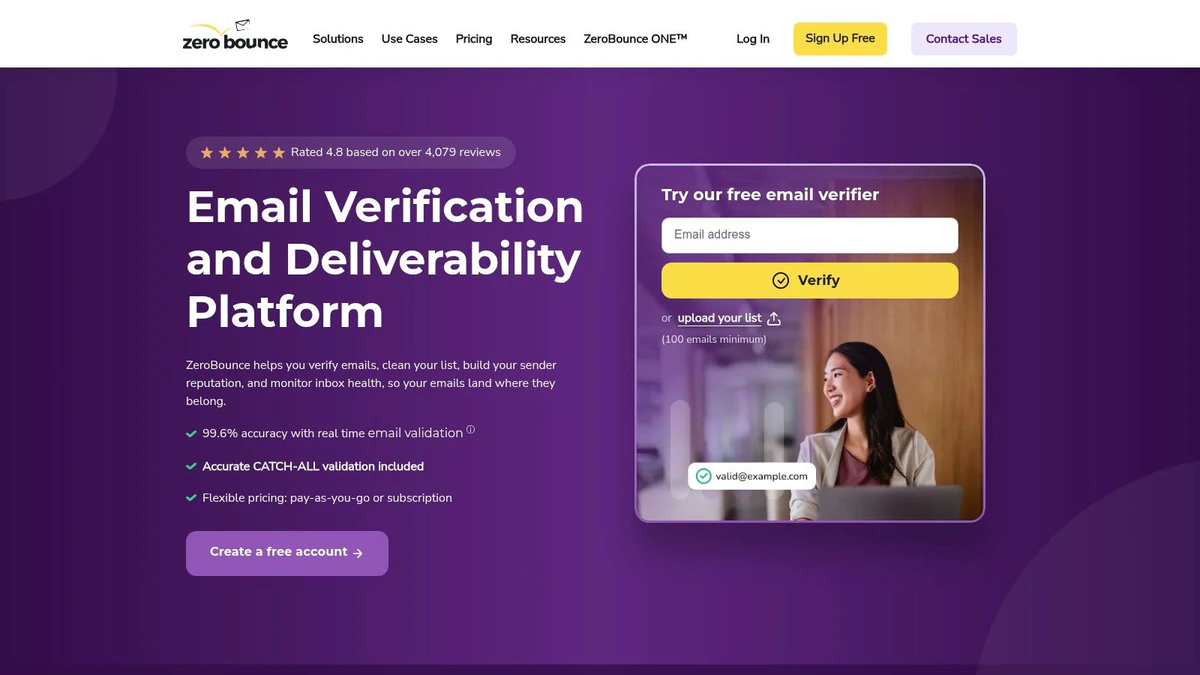
ZeroBounce suits teams that want email validation and broader deliverability diagnostics in one environment. Its bulk cleaning workflow handles existing files, while API and real-time validation support point-of-capture checks for forms, applications, and CRM ingestion.
The distinction is its surrounding deliverability toolkit. Alongside validation, ZeroBounce offers inbox placement testing, blacklist monitoring, and DMARC monitoring. That combination makes it more appropriate for a team investigating whether delivery problems originate in bad addresses, sender configuration, or inbox placement rather than just removing invalid contacts.
Unknown handling and subscription fit
ZeroBounce's treatment of uncertain outcomes is useful for cautious operations. Its policy provides refunds or free treatment for “Unknown” results, and credits don't expire. The service also offers a freemium tier with 100 free monthly validations, according to the product notes supplied for this comparison.
That model reduces the risk of paying repeatedly for addresses the system can't classify confidently. It also makes the platform easier to test before a larger migration, although the bundled ONE plan can be unnecessary for teams that only perform occasional list scrubs and don't need inbox or domain monitoring.
A verification result is an input to a sending decision, not a substitute for one. Teams should define whether unknown addresses are suppressed, quarantined, or reviewed manually.
ZeroBounce is strongest when one owner needs a combined view of address validity, sender reputation, authentication, and inbox placement. It's less compelling when the requirement is a narrow, low-touch validator with minimal recurring administration.
Website: ZeroBounce
3. NeverBounce
NeverBounce suits teams that need bulk verification, API access, and developer documentation in the same workflow. Its REST API returns granular JSON results, while SDKs and guides can reduce custom development for sales, marketing, marketplace, and product systems.
The operational distinction is between file cleaning and continuous checks. A marketer can upload a list for a campaign, while a developer sends new addresses through the API and stores result categories in a CRM or data warehouse. Marketplace integrations, including HubSpot and Zapier, reduce setup work for teams that do not want to build every connection.
Teams should test SMTP depth, catch-all treatment, and unknown classifications on their own data. Those outputs determine whether uncertain addresses are suppressed, held for review, or passed downstream. They also affect how much manual checking a clean result requires before sending.
The pricing question
NeverBounce does not make its full pricing information readily comparable from a public page. Prospective customers may need an in-app pricing view, signup, or account-level details before estimating unit economics. That adds procurement time and makes occasional-use costs harder to assess early.
The usage pattern matters. A one-time bulk scrub has different economics from recurring signup verification, even if both use the same API. Teams should compare expected volume, integration effort, retention requirements, and compliance processes rather than evaluate the headline feature list alone.
For a vendor-level reference, how BillionVerify compares can support the initial review. The practical decision still requires representative addresses, category definitions, catch-all domains, and unknown results tested across downstream tools.
Website: NeverBounce
4. Kickbox
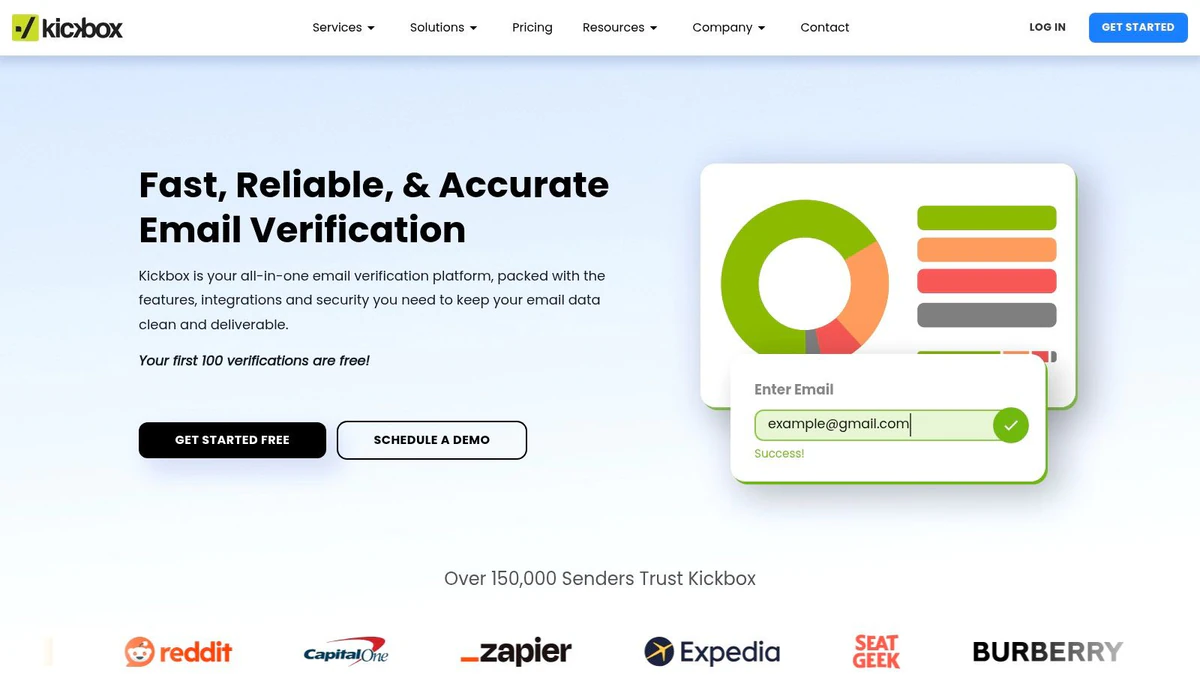
Kickbox combines bulk list cleaning and real-time API verification, with integrations for CRM and ESP workflows. Its HubSpot marketplace presence can reduce setup work for teams already using that ecosystem, while developers should assess how easily results can move into their own systems.
The service offers 100 free credits at signup, according to the supplied product information. That provides a limited way to test classifications on a representative sample before purchasing more credits. A real evaluation should include invalid addresses, role accounts, catch-all domains, and addresses recently collected through forms.
A validator, not a complete deliverability suite
Kickbox's pay-as-you-go model fits agencies with periodic client projects and businesses whose acquisition volume changes over time. It avoids committing to a recurring subscription, although buyers still need to estimate verification frequency and the cost of handling uncertain results.
Its scope is narrower than a broader deliverability program. Teams that require inbox placement tests, blocklist monitoring, DMARC oversight, or campaign-content diagnostics may need separate tools. SMTP depth, catch-all treatment, and unknown classifications deserve specific testing because they affect whether addresses are suppressed, reviewed manually, or allowed into a campaign.
The operational comparison matters more than a headline price. A HubSpot-centered team may prioritize integration speed, while a developer-led operation may require detailed SMTP responses and custom routing. how BillionVerify differs from Kickbox offers a starting comparison, but a shared test list provides stronger evidence.
Website: Kickbox
5. BriteVerify by Validity
BriteVerify, part of Validity, is a strong candidate for CRM-heavy organizations that treat email validation as one component of broader data quality. It supports real-time form validation, batch list cleaning, and API-based on-demand checks.
Its wider ecosystem covers email, phone, and postal address validation. That multi-channel scope can reduce vendor sprawl for enterprise teams that already need to standardize several contact fields across CRM records, lead forms, and customer data pipelines.
Enterprise alignment and buying friction
BriteVerify's enterprise orientation is also its main purchasing limitation. Pricing is typically handled through sales, which makes it less transparent than self-serve competitors. Large deployments may benefit from a customized commercial and implementation discussion, but smaller teams or buyers conducting a rapid comparison may find the process slower.
The service deserves particular scrutiny around exports, audit trails, retention, subprocessors, and regional data handling. Those questions matter whenever email addresses are personal data and verification results feed customer records. Teams shouldn't assume that a respected data-quality brand automatically satisfies their own security or compliance requirements.
A direct product comparison is available through BillionVerify versus Validity. The more useful exercise is to compare the workflow around the check: who uploads the data, who approves suppression rules, where results are stored, and how quickly a verified status reaches the sending system.
Website: BriteVerify
6. Emailable
Emailable combines a bulk verifier, single-address checks, API access, and an on-form widget. That makes it a practical option for teams that need both a periodic database cleanup and a way to stop poor-quality addresses at collection.
Its pricing presentation is one of the clearer parts of the product. A transparent calculator helps buyers estimate cost before they build a business case, while credits don't expire. Unknown results are refunded or treated as free, which makes uncertain classifications less expensive to investigate.
Strong for estimation, less flexible for tiny tests
The principal limitation is the pay-as-you-go minimum purchase of 5,000 credits, according to the supplied plan notes. That may be reasonable for a recurring marketing program, but it can be excessive for a small team testing a narrow form, a micro-batch, or a new acquisition source.
Emailable's HubSpot integration and marketplace applications reduce setup work for teams using mainstream marketing systems. Developers still need to confirm API response fields, webhook behavior, retry handling, rate limits, and whether the widget exposes enough control over what happens to risky or unknown addresses.
Implementation test: Don't stop at the dashboard result. Confirm that a rejected signup is blocked, a risky result is routed for review, and an approved result is written back to the correct CRM field.
Website: Emailable
7. EmailListVerify
EmailListVerify is positioned for cost-conscious, high-volume bulk verification. It supports list uploads, real-time API checks, deduplication, and integrations with platforms such as Mailchimp and Mailgun. Public SDKs also make it more suitable than a dashboard-only tool for teams building repeatable data workflows.
Deduplication deserves attention because duplicate records distort both sending volume and campaign reporting. Removing duplicates before verification can reduce redundant checks, but buyers should confirm whether deduplication is case-insensitive, how aliases are treated, and whether the original record identifiers survive export.
Validate the validator on edge cases
EmailListVerify's public material includes an accuracy claim of 97%, but the supplied notes correctly frame that claim as something buyers should validate on their own data. Accuracy depends on list source, domain mix, role accounts, catch-all behavior, and the age of the records. A result that looks strong on a clean opt-in file may behave differently on scraped, imported, or dormant CRM data.
Teams should therefore test the service on known-valid addresses, known-invalid addresses, role-based inboxes, disposable domains, catch-all domains, and addresses that other systems classify as unknown. Keep the original file and compare the provider's output with actual bounce results from a controlled, permission-based send.
For teams that need a repeatable process to clean email lists, EmailListVerify can be a pragmatic shortlist candidate. Its value is highest when low unit cost and straightforward integrations outweigh the need for a larger deliverability suite.
Website: EmailListVerify
8. MillionVerifier
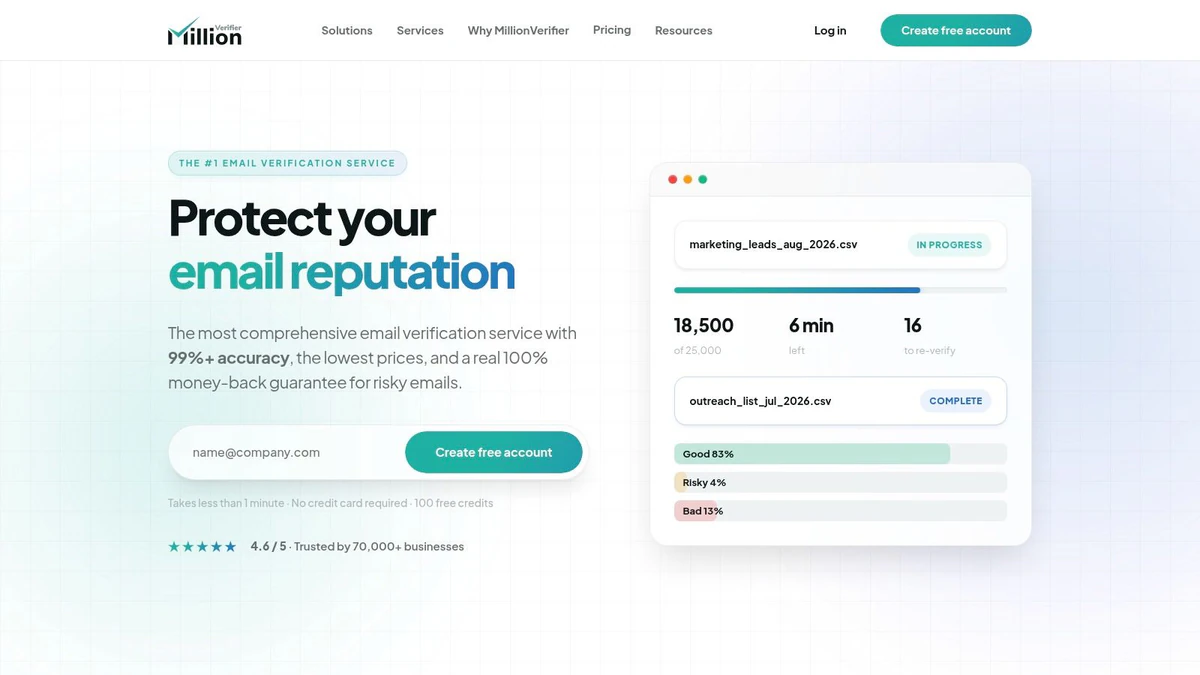
MillionVerifier is designed for teams that emphasize large-volume economics and ongoing automated hygiene. Its bulk cleaning, single checks, and REST API cover the basic verification paths, while EverClean automatically cleans connected ESP and CRM lists on an ongoing basis.
That continuous model addresses a problem many teams underestimate. Quarterly reviews are increasingly treated as a floor, while monthly cleaning is recommended for lists larger than 100K, according to Prospeo's email list cleaning guidance. Point-of-capture validation remains important, but automated follow-up cleaning helps catch decay that accumulates after collection.
Aggressive pricing needs independent testing
MillionVerifier emphasizes low-volume pricing, a buy-once credit model, and credits that don't expire. Catch-all handling is included, and more than 40 one-click integrations are listed in the supplied product notes. Those features suit teams that want to connect several sending systems without creating a custom integration for each one.
The limitation is evidentiary. Marketing accuracy claims should be tested on a representative sample because list composition changes the result. A buyer should also check how EverClean handles removals, synchronization failures, suppressed contacts, and records that shift from valid to risky between runs.
Website: MillionVerifier
9. DeBounce
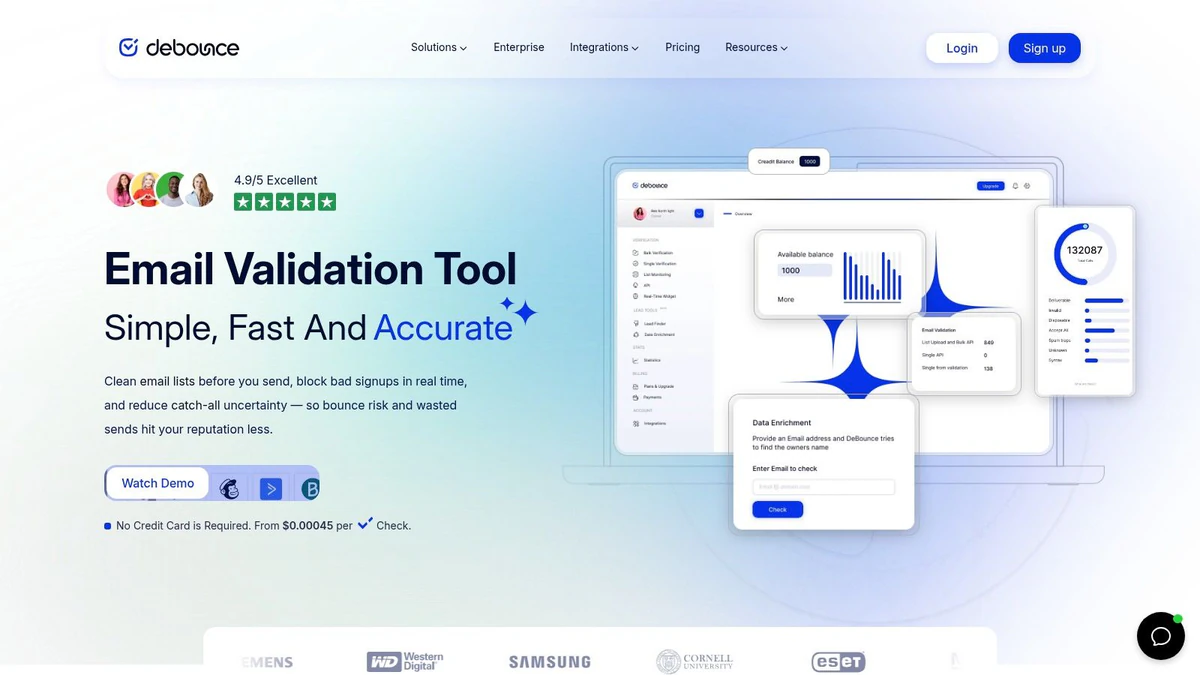
DeBounce appeals to buyers who want granular pricing, real-time verification, and control over uncertain results. It supports bulk validation, an API, an on-form widget, catch-all validation, list monitoring, and a public pricing calculator.
Its credit policies are unusually relevant to operational budgeting. Unknown results and duplicates aren't charged, credits don't expire, and the API is included without a separate credit pool, according to the supplied product notes. DeBounce also offers 100 free credits for initial testing.
Make the pricing model match the workflow
A transparent calculator makes it easier to model periodic scrubs and continuous signup protection separately. Those workloads shouldn't be blended into one estimate because a team may clean an existing database in batches while validating every new form submission indefinitely.
Buyers should confirm the cost of optional enrichment or additional features before approving a high-volume rollout. Extra-credit charges can change the economics even when the base validator appears inexpensive. The same review should cover API retry behavior, response latency, webhook support, export fields, and how the service identifies catch-all results.
DeBounce is a good fit for a team that wants to inspect pricing before speaking with sales and is comfortable managing verification decisions internally. It's less suitable when the business wants a fully managed deliverability program with inbox testing and authentication monitoring.
Website: DeBounce
10. Verifalia
Verifalia is an EU-based validator for teams that need fine-grained control over verification depth, queueing, and result detail. It supports asynchronous verification modes, configurable quality levels, retry logic, free deduplication, and a detailed result taxonomy.
That architecture creates a deliberate speed-versus-depth choice. A basic SMTP-oriented check may return quickly, while higher-quality asynchronous jobs can take longer because they use deeper verification and retry behavior. For a low-latency signup form, that delay may be unacceptable. For a compliance-sensitive database cleanup where diagnostic detail matters more than immediate response, it may be useful.
Control is valuable only when teams use it
Verifalia provides a transparent pricing matrix, daily free credits on its Free plan, and flexible credit or subscription models. Those features make initial technical testing easier and help teams compare different verification quality levels before committing.
The implementation burden is higher than with a simple upload-and-export service. Teams need to decide which quality level applies to which workflow, how long asynchronous jobs can remain queued, and what to do when the service returns an uncertain result. They should also review data-processing terms, retention, access controls, regional handling, and deletion procedures with their privacy stakeholders.
Website: Verifalia
Top 10 Email List Cleaning Services Comparison
| Provider | Core features | Accuracy & UX | Pricing & Value | Target audience | Unique selling points |
|---|---|---|---|---|---|
| BillionVerify 🏆 | AI-first API, bulk & single checks, SMTP/MX/catch‑all/reputation, CSV uploads & whitelabel | ★★★★★ 99.9% SMTP; sub-200ms API; structured JSON | 💰 Free 600/mo; ~$0.00014/verify; highly cost‑effective at scale | 👥 Marketing, Sales, Product, Agencies, Devs | ✨ Native MCP/AI-agent, whitelabel portals, wide CRM/ESP integrations |
| ZeroBounce | Bulk & real‑time validation + deliverability toolkit (inbox tests, blacklist/DMARC) | ★★★★☆ Detailed status codes; good UX for deliverability | 💰 Freemium 100/mo; subscription ONE plan for full toolkit | 👥 Teams needing validation + deliverability insights | ✨ Built‑in inbox testing & blacklist monitoring |
| NeverBounce | Bulk + real‑time API, granular JSON results, official SDKs | ★★★★ Reliable accuracy; strong developer docs | 💰 PAYG; pricing visible in‑app (varies) | 👥 Devs, Sales/Marketing stacks, Marketplaces | ✨ Mature SDKs & ecosystem integrations |
| Kickbox | Bulk & real‑time checks; HubSpot app and marketplace integrations | ★★★★ Fast checks; easy HubSpot UX | 💰 PAYG with trial credits (100) | 👥 HubSpot users, SMBs wanting quick setup | ✨ HubSpot-certified app; simple PAYG pricing |
| BriteVerify (Validity) | Real‑time form validation, batch cleaning; part of Validity suite | ★★★★ Enterprise UX; reliable form validation | 💰 Enterprise pricing via sales; less transparent | 👥 CRM-heavy enterprises, data quality teams | ✨ Multi-channel validation (email/phone/postal) within Validity |
| Emailable | Bulk, API, on‑form widget; native integrations (HubSpot) | ★★★★ Fast throughput; clear UI | 💰 Transparent pricing; non‑expiring credits; min purchase 5k | 👥 Teams wanting clear costs + HubSpot integrators | ✨ Refunds for "unknown"; pricing calculator |
| EmailListVerify | Bulk uploads, deduplication, real‑time API, SDKs | ★★★★ Volume-friendly UX; pragmatic docs | 💰 Competitive volume pricing; straightforward credits | 👥 High-volume scrubs, ESP/CRM users | ✨ Cost-efficient for large lists; many integrations |
| MillionVerifier | Bulk, single checks, EverClean auto-cleaning across ESPs | ★★★★ Targeted at high volume; simple UX | 💰 Aggressive low unit pricing; credits never expire | 👥 Large-volume senders, ESP-integrated teams | ✨ EverClean auto-clean; risky-email refund policy |
| DeBounce | Bulk, real‑time API, on-form widget, list monitoring | ★★★★ Transparent UX; public pricing calculator | 💰 Very transparent; free 100 credits; no-charge for unknowns/dupes | 👥 High-volume users wanting clear rates | ✨ Granular pricing & free unknown/duplicate policy |
| Verifalia | Async jobs, configurable quality levels, retry logic, EU-based | ★★★★ Fine-grained diagnostics; strong compliance posture | 💰 Daily free credits; flexible credit/subscription models | 👥 Teams needing compliance, deep mailbox control | ✨ Multiple validation modes; detailed result taxonomy |
Choose the Service That Matches Your Risk Profile
The right list cleaning service is the one that matches your data risk, sending pattern, and operating capacity, not the one with the lowest advertised unit price. A low-cost bulk validator may be perfectly adequate for an occasional newsletter scrub, but it may leave a product team without the low-latency API controls needed to block fake signups. An all-in-one deliverability suite may solve more problems than a sales team needs, while an enterprise data-quality platform may be justified when email, phone, and postal records must be governed together.
Start by defining the workload. Record the approximate list volume, how often the database changes, and whether the team performs periodic cleaning or needs continuous verification. The distinction matters because contact data decays roughly 20% to 30% annually, according to MailMend's list hygiene research, and point-of-capture validation reduces the number of bad addresses that enter the database in the first place.
Then compare the technical controls:
- Bulk workflow: Check CSV upload limits, progress visibility, notifications, deduplication, filtering, and export formats.
- Real-time protection: Review API latency, widgets, webhooks, retries, rate limits, and the action taken when verification returns an uncertain result.
- Verification depth: Confirm whether the service checks syntax, domain, MX records, SMTP behavior, reputation, spam traps, disposable addresses, and role accounts. Verification APIs commonly expose structured fields such as
syntax,mx_found,smtp_check,disposable, androle_based, as documented by MailProbe. - Catch-all and unknown handling: Find out whether these results are charged, refunded, suppressed, quarantined, or blended into a single risky category.
- Role-account policy: Don't treat
info@,sales@, orsupport@as automatically invalid. One 2026 study found 52.1% of role-based addresses were invalid, while disposable addresses represented only 0.035% of checks, with 94.8% of those disposable addresses invalid, according to BounceZero's role-based and disposable email study. The operational conclusion is to score and segment role accounts rather than delete them blindly. - Pricing transparency: Match pay-as-you-go, subscription, minimum-purchase, and non-expiring-credit models to actual usage. Confirm extra charges for enrichment, retries, monitoring, or deeper verification.
- Integrations and exports: Test the exact CRM, ESP, automation platform, field mapping, suppression behavior, and audit trail your team uses.
- Compliance and support: Review retention, deletion, access control, subprocessors, regional processing, contractual terms, and the support path available during a failed campaign or API incident.
Use bounce performance as an operating signal, not as a promise from a vendor. Bounce rates above roughly 2% are widely treated as a warning sign, while several sectors in a 2025 benchmark reported rates below 0.5%, including financial at 0.35%, retail and education at 0.31%, politics at 0.28%, marketing at 0.27%, and entertainment at 0.21%, according to Mailgun's email benchmark report. A separate dataset places the broader average around 2.79%, showing why a provider's result categories need to be interpreted against your own acquisition sources and sending practices.
Run the same representative sample through every shortlisted service. Include known-valid addresses, invalid records, role accounts, disposable domains, catch-all domains, duplicates, old CRM contacts, and recent signups. Measure valid, invalid, risky, catch-all, unknown, duplicate, and eventual bounce outcomes, then compare the labor required to route each category. Teams that regularly conduct hygiene are still only about 60% of senders, leaving nearly 40% with accumulated data risk, as reported in Scrap.io's email verification guide.
Choose the provider that fits the team's workflow, controls, and tolerance for manual review. The lowest price per check can become the most expensive option when unclear results, weak integrations, poor exports, or delayed signup decisions force employees to rebuild the process around the tool.
BillionVerify combines bulk list cleaning, single-address checks, structured real-time API results, catch-all and role-account detection, reputation signals, broad CRM and ESP integrations, and AI-agent support for automated verification workflows. Visit BillionVerify to test how its verification approach fits your representative list and signup pipeline before you commit to a long-term list hygiene process.