


Most advice about bulk email is stuck in the past. It still talks about “email blasts” as if success comes from writing a catchy subject line, loading a list, and pressing send.
That model breaks down fast. What is bulk email in practice now? It's still one message sent to many recipients, but it no longer behaves like a simple marketing tactic. It operates like a monitored delivery system with provider rules, reputation thresholds, and compliance requirements that can block a campaign before content even matters.
That shift matters because email sits at enormous scale. The number of email users is projected to reach about 4.5 billion in 2025, up from roughly 55 million in 1997, and typical marketing campaigns see 10–20% open rates as average, while a 3% to 5% bounce rate is a warning sign of poor list quality, according to Market.us email statistics. When you send into a channel that large, mailbox providers can't treat bulk mail casually. They classify it, score it, and filter it.
That's why verification now belongs at the front of the process, not the cleanup stage after a failed send.
Rethinking Bulk Email Beyond the Blast
Bulk email now sits closer to regulated infrastructure than old-school campaign execution. Once a sender reaches meaningful volume, mailbox providers stop treating email as simple marketing output and start evaluating it as an ongoing trust record tied to a domain, IP, authentication setup, complaint rate, and list quality.
Many teams still define bulk email by the tool they use, a campaign send, and spend most of their effort on subject lines, creative, and timing. Those choices matter after the technical baseline is in place. Google, Yahoo, and other providers first evaluate whether the sender is authenticated correctly, whether recipient engagement supports continued inbox placement, and whether the list creates bounce and complaint patterns that look risky.
That shift matters because bulk email no longer operates like a one-off promotion. It operates like a monitored service.
Why the old advice fails
The old playbook treated volume as a safe growth lever. Send to more contacts, get more chances to generate opens and clicks. That worked better when filtering systems were less strict and compliance expectations were lower.
Now a weak send affects the next one. A dirty list, inconsistent authentication, or a spike in complaints does not stay attached to one campaign. It affects how providers classify future mail from the same sending identity.
Practical rule: Bulk email is judged by message quality and by the reliability of the system behind it.
For a marketing manager, that changes the job. Performance is not just creative performance. It is also infrastructure performance. Verification belongs at the front of the process because it reduces invalid addresses before they turn into bounce signals, and those signals are part of how providers decide whether your mail deserves inbox placement.
Bulk email is a category with consequences
The simple definition of what is bulk email is one message sent to many recipients. The useful definition is operational. Bulk email is mail sent at a scale that triggers provider scrutiny, policy requirements, and reputation scoring that can affect the entire program.
Treat every send as part of a long-term infrastructure record.
That is why verification, authentication, and audience control are not cleanup tasks. They are compliance tasks. If a list includes stale addresses, role accounts, or contacts collected without clear consent, the problem appears quickly in bounce data, spam complaints, and lower placement rates. If you need a clearer line between promotional sends and triggered messages, this guide to transactional emails helps define where bulk programs should stop and operational messaging should start.
The Two Worlds of Email Bulk and Transactional
Bulk and transactional email may travel through the same general channel, but they don't play by the same expectations. Put them on the same setup without thinking, and one type can damage the other.
A simple way to understand it is this. Bulk email is a broadcast from a megaphone. Transactional email is a registered letter delivered to one person because they triggered it. One is scheduled by the business. The other is triggered by the recipient's action.
To make that distinction visual, this comparison helps:
Broadcast versus registered delivery
Microsoft's guidance is useful here. It defines bulk email, or “gray mail,” as messages some users want, such as opted-in newsletters, while others treat the same messages as spam. That differs from transactional email, which recipients almost always expect. Microsoft also makes clear that providers have a much lower tolerance for bounces and complaints from bulk sends, as explained in Microsoft's discussion of spam, junk, and bulk email.
That difference shapes filtering behavior.
| Attribute | Bulk Email | Transactional Email |
|---|---|---|
| Purpose | Marketing, newsletters, promotions, announcements | Account actions, receipts, resets, alerts |
| Trigger | Scheduled by a team | Triggered by a user event or system event |
| Audience | One-to-many | One-to-one |
| User expectation | Mixed. Some welcome it, some don't | Usually expected |
| Provider tolerance | Lower tolerance for complaints and bounces | Higher trust when properly separated |
If you want a deeper operational breakdown, this guide to transactional emails covers where teams often blur the line.
Why infrastructure separation matters
When teams mix both categories on the same sending infrastructure, they usually do it for convenience. One platform. One domain strategy. One reporting dashboard. That convenience can be expensive.
If a promotional campaign generates complaints or bounces, providers may apply that reputation signal broadly. The next password reset or receipt may face inboxing issues because the system that sent it has already lost trust.
Bulk mail asks, “Will the recipient welcome this?” Transactional mail answers, “The recipient asked for this.”
That's why experienced teams separate by domain strategy, stream, or provider setup whenever possible. Marketing mail should absorb marketing risk. Transactional mail should stay protected from it.
One practical piece of this puzzle is data quality. BillionVerify is a professional email verification service built to solve one problem: bad email data costs businesses money. In the bulk versus transactional context, that matters because poor address quality creates very different consequences depending on what kind of mail you're sending.
Later in the workflow, training teams often benefit from seeing this distinction explained aloud as well as documented.
The New Technical Mandates for Bulk Senders
The biggest change in bulk email isn't creative. It's structural. Providers now treat large-scale senders as participants in a regulated lane, and the entry requirements are technical.
That means you can't “best-practice” your way around fundamentals anymore. Authentication, unsubscribe handling, complaint control, and transport security now sit at the center of deliverability.
The threshold that changes how providers see you
Google states that senders delivering more than 5,000 messages per day to Gmail addresses are treated as bulk senders. That threshold has become a practical benchmark across the industry because it triggers tighter monitoring of bounce rates, spam complaints, and authentication, according to Mailgun's explanation of mass email sending and bulk sender treatment.
The mistake many teams make is assuming that this only applies to giant brands. It doesn't. A midsize ecommerce brand, publisher, or SaaS company can cross that threshold quickly during launches, newsletters, onboarding pushes, or sales campaigns.
The compliance baseline you can't skip
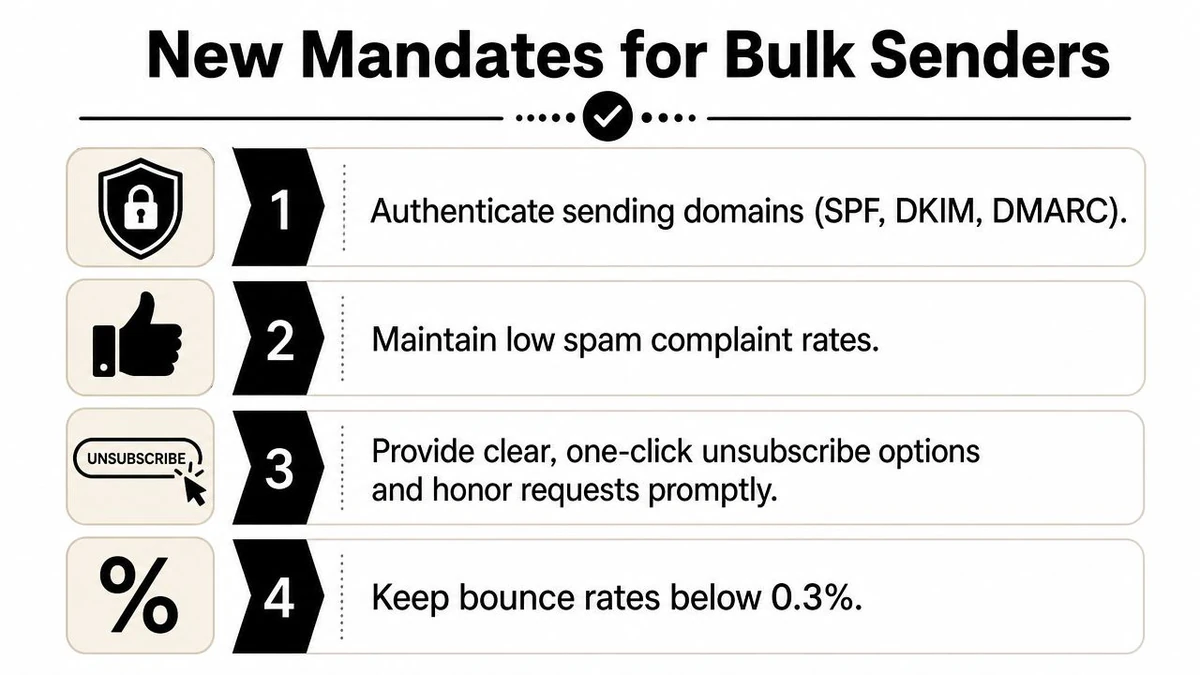
Here's the baseline bulk senders now need to treat as mandatory:
- Authenticate the sender: SPF and DKIM need to be configured so providers can verify that your mail is legitimate.
- Publish a DMARC record: Providers increasingly expect a visible policy, not silent ambiguity.
- Align identity signals: Your visible From domain and authentication signals need to make sense together.
- Use secure transport: TLS-secured connections are part of the modern baseline.
- Make unsubscribing easy: One-click unsubscribe isn't cosmetic. It gives recipients a cleaner exit than the spam button.
If you're trying to improve email deliverability, authentication is where technical cleanup starts, not where it ends.
A lot of teams also need this in application workflows, not only in campaign tools. For that, an email validation API guide is useful because it connects front-end data capture to downstream sender compliance.
If your infrastructure doesn't meet the baseline, content quality won't save the campaign.
One note on the infographic above. It includes a bounce-rate item that reflects a stricter operational target some teams use internally. The broader benchmark already covered earlier in this article remains the cited reference point from the verified data. The practical lesson is the same. Bulk sending leaves very little room for weak list quality.
Who Uses Bulk Email and Why
Bulk email isn't limited to newsletter teams. Different departments use it for different outcomes, and the sends look very different when the work is done well.

Marketing teams
An ecommerce team uses bulk email to launch a product, promote a seasonal collection, or recover dormant subscribers with a segmented offer. The strong version of this send is narrow and intentional. It goes to a defined audience with a message tied to recent behavior, purchase history, or declared interest.
The weak version is broad and lazy. Everyone gets the same campaign, regardless of relevance, and complaint risk rises because the send behaves like noise.
Sales and outbound teams
Sales teams also operate in bulk patterns, even if they don't like using the term. SDR managers schedule sequences, test message variants, and push outreach across large contact groups. The best teams keep a hard line between targeted outbound and “spray and pray” behavior.
A clean outbound operation depends on audience control. Teams need to know which contacts are real, which are risky, and which shouldn't be mailed at all. Without that filter, sender trust erodes fast.
The problem usually isn't volume by itself. It's irrelevant volume sent to weak data.
Media and content businesses
Publishers and media brands use bulk email as a traffic and retention channel. Daily briefings, niche newsletters, editorial roundups, and subscriber-only announcements all fit the model. These businesses live or die on consistency.
That's why media operators obsess over cadence and audience fit. If readers stop expecting the email, providers see weaker engagement. If the brand keeps mailing anyway, the list becomes harder to recover.
Bulk email also shows up in internal and organizational communication, although the stakes differ. A university, nonprofit, franchise network, or multi-location business may send one-to-many updates that aren't promotional in tone but still behave like bulk from an infrastructure perspective. The technical discipline still applies.
Across all of these cases, the pattern is the same. Bulk email works when the sender respects relevance, list quality, and infrastructure boundaries. It fails when teams treat the channel like unlimited reach with no cost for waste.
Mastering Deliverability Sender Reputation and List Hygiene
Deliverability doesn't come from luck, and it doesn't come from template polish. It comes from two linked systems. Sender reputation tells providers whether they trust your mail. List hygiene determines whether your behavior deserves that trust.
Many email senders focus on reputation only after they see a problem. By then, recovery is slower because providers are reacting to a pattern, not a single mistake.
Reputation is earned batch by batch
Think of sender reputation as a running record attached to your sending identity. Providers watch how recipients react to your mail and whether your infrastructure behaves consistently. A clean campaign helps. A sloppy one lingers.
The technical side matters here. The 2026 bulk sender requirements from Google, Microsoft, and Yahoo mandate SPF and DKIM, a published DMARC record, and TLS-secured connections. Failure increases the probability of rejection or filtering to spam, directly affecting sender reputation, according to Red Sift's summary of bulk sender requirements.
That requirement changes the conversation inside marketing teams. Authentication isn't an IT side quest anymore. It's a deliverability dependency.
List hygiene decides whether reputation holds
A well-authenticated sender can still hurt itself with bad data. Stale contacts, invalid addresses, role accounts, typo domains, and low-intent leads all produce signals that providers interpret as risk.
That's why list hygiene should be operational, not occasional. Good teams build it into intake, segmentation, and pre-send review.
A disciplined hygiene workflow usually includes:
- Pre-send verification: Check addresses before they ever enter a campaign audience.
- Suppression management: Remove known bad, bounced, or risky contacts from future sends.
- Segmentation by trust: Mail your strongest audience first, then evaluate response before expanding.
- Cadence control: Don't keep hitting disengaged groups with the same message frequency.
If you want a deeper breakdown of those mechanics, this guide to sender reputation factors and deliverability maps out the signals teams need to watch.
Strong reputation doesn't offset weak data for long. Weak data eventually rewrites your reputation.
There's also a strategic trade-off here. Marketers often want bigger audiences because larger sends feel like larger opportunity. Deliverability teams want narrower, cleaner lists because inbox placement is easier to protect. The right answer usually isn't “send less” or “send more.” It's “send to people whose presence on the list you can justify.”
That's where the discipline becomes practical. A smaller clean segment often gives you a more stable base for future campaigns than a larger questionable one. Once providers trust your stream, you have room to expand thoughtfully. If you burn that trust early, every later campaign starts under suspicion.
Improving Bulk Email ROI with Verification
Verification connects compliance, deliverability, and campaign economics. It is also the first control point a team can enforce before a bulk send enters provider systems that now expect authenticated, low-risk traffic from senders at scale.
That matters even for lists that look small on paper. Google and Yahoo do not judge sender quality by volume alone. They look at whether mail is wanted, whether the sender behaves consistently, and whether the stream produces complaint and bounce signals that resemble bulk abuse. Verification helps at the start of that chain. It checks whether the audience file is fit to enter your sending infrastructure at all.
What verification does
A proper verification workflow goes beyond catching typos. It checks syntax, domain readiness, and whether a mailbox appears deliverable and safe to contact. It also flags list segments that create avoidable risk, such as disposable addresses, role accounts, and other entries that tend to underperform or trigger complaints.
For a marketing manager, the payoff shows up in operations:
- Lower bounce exposure: Fewer invalid addresses reach the ESP.
- Better reputation stability: Bad records do not keep dragging down later campaigns.
- More reliable segmentation: Teams can separate usable demand from questionable records before launch.
- Less wasted spend: Sending volume goes to addresses with a real chance to receive mail.
That is why verification belongs at intake, not after the first campaign underperforms.
A practical workflow before launch
Trade show lists make the point quickly. Marketing often returns from an event with a CSV built from badge scans, form fills, partner sharing, and manual entry. That file typically includes a mix of real prospects, mistyped addresses, catch-alls, dormant mailboxes, and contacts who do not clearly remember opting in.
The right process is simple:
- Upload the raw list for verification. Do not mail from the untouched file.
- Review status categories. Keep records marked valid, and isolate or suppress risky ones.
- Filter before import. Only push the cleaned segment into the ESP or sales engagement platform.
- Send in controlled batches. Start with contacts who have the strongest recent relationship to your brand.
Teams that skip this step usually create expensive downstream problems. Once bad data enters the platform and the first campaign goes out, recovery gets harder. Bounce events, complaint pressure, and weak engagement all shape how providers classify the stream. By then, verification is still useful, but it is fixing damage instead of preventing it.
If you need the financial case, this email verification ROI guide explains how cleaner input data improves campaign efficiency and protects future sending capacity.
Verification will not fix weak positioning or irrelevant offers. It does something more foundational. It gives a bulk sender a cleaner, more compliant base to operate from, which is the first step toward meeting provider requirements instead of reacting to provider penalties.
From Bulk Sender to Smart Communicator
The useful answer to what is bulk email in 2026 isn't “sending one message to many people.” That's technically true but operationally incomplete.
Bulk email is now a managed infrastructure tier. Providers classify it differently, expect technical compliance, and react quickly when list quality or audience fit goes bad. Teams that still think in terms of blasts usually end up fighting bounce problems, complaint pressure, and unstable inbox placement. Teams that think like operators protect the channel before launch.
That means separating bulk from transactional mail, authenticating properly, giving recipients a clean unsubscribe path, and treating list hygiene as a routine control. It also means respecting the creative side. The message still has to feel relevant, timely, and expected. For that layer, these email copywriting examples are useful once the underlying data is clean.
The smartest first move is simple. Verify the list you already have before the next campaign goes out.
If you want a practical starting point, BillionVerify gives teams a straightforward way to clean existing lists before bulk sends, screen new addresses as they enter the funnel, and build a healthier sending foundation. If your goal is to stop preventable bounces and protect sender reputation, start by verifying the data you already plan to mail.