


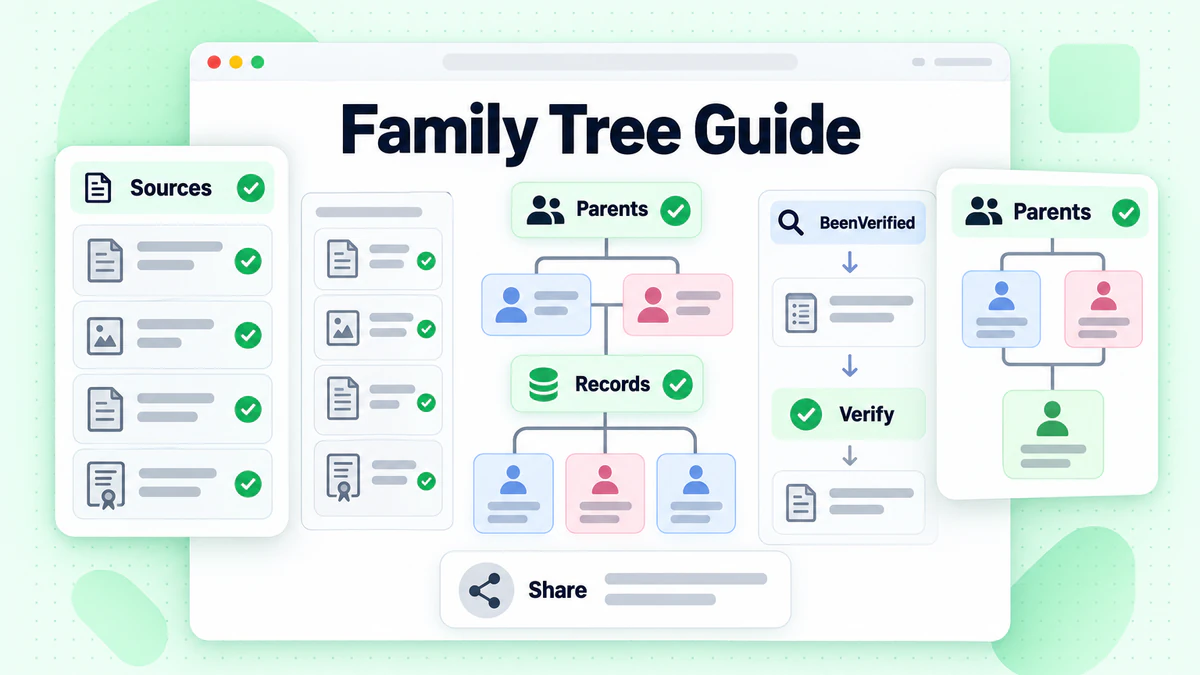
A family tree is a chart of your relatives across generations. It starts with you. It branches out to parents, grandparents and beyond. You can draw one by hand. You can also make a family tree online with a records service. This guide uses BeenVerified as the example.
You will learn each step, from your first box to a shared chart. You will see what the BeenVerified family tree search shows. We also cover the best free family tree builder options and the legal limits. Facts about BeenVerified come from its own site, checked in October 2026.
We are not affiliated with BeenVerified. BillionVerify is an email verification service. Building a family tree often leads to a reunion, or a first email to a lost cousin. At the end, we show how to check that contact before you write.
Key facts (checked October 2026):
- The BeenVerified Family Tree tab on the homepage starts from a person's full name.
- The cheapest BeenVerified plan worked out to $23.98 monthly when billed for three months.
- BeenVerified's genealogy page cites two UK sources, from 1921 and 1939, both limited to England and Wales.
- A US census has been taken every decade since 1790, per the National Archives.
- The National Archives keeps census pages closed for 72 years, so the 1950 census is the newest one open to the public.
What Is a Family Tree?
A family tree is a diagram of how one family connects. Each box is a person. Lines show parents, children and marriages. The oldest generation sits at the top or the edge. You sit at the start.
A good BeenVerified family tree, or any other, also holds facts. Names. Birth dates. Places. Marriages. Deaths. Each fact should point to a source, such as a birth record or a census page.
What a family tree shows
Most family trees show three things:
- Who belongs: every person, with full name and maiden name.
- How they connect: parent, child, spouse or sibling.
- When and where: the dates and towns of each life.
Some people add photos, stories and health notes. Those details turn a bare chart into a family history.
Family tree vs record research
The two work together, but they are not the same. A family tree is the result. A family tree search is the research that fills it. The stories are what both reveal.
BeenVerified defines a genealogy search as "the process of researching and tracing your family's history and ancestry." It adds that this search "helps create a family tree." This guide focuses on the tree. Deep record research is a topic of its own.
How to Use the BeenVerified Family Tree Search
BeenVerified offers a Family Tree option in its homepage search box. The headline above it reads, "Ready to build your family tree?"
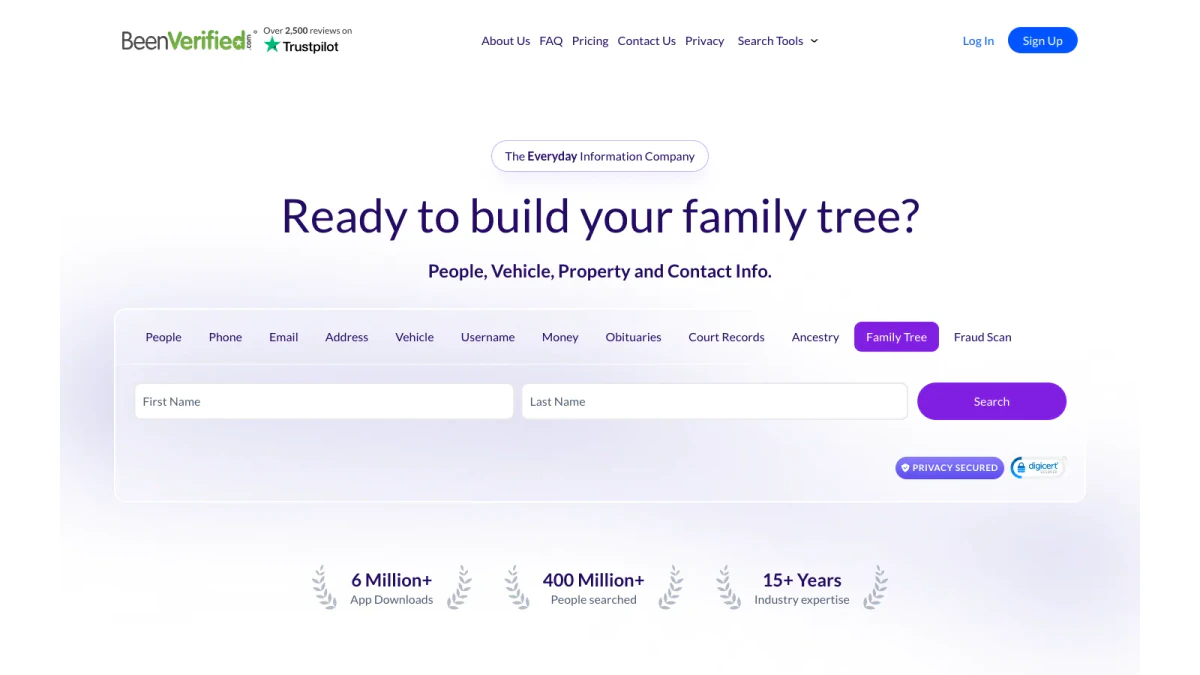
Screenshot: the BeenVerified homepage search box, Family Tree selected.
There is no separate family tree page on beenverified.com. The tab feeds into the genealogy tools on the same site. Here is how it comes together.
Step 1: Pick Family Tree
Go to beenverified.com. Click Family Tree in the search box. It asks for two things: First Name and Last Name.
Step 2: Enter a full name
Start with yourself or a parent. A parent is often the better first search. Your parents left a longer paper trail than you.
Step 3: Add a city and state
The full search form has more fields. It asks for First Name, Last Name, City and State. BeenVerified notes that "providing a location can help us narrow down your search." Use the place where the person lived longest.
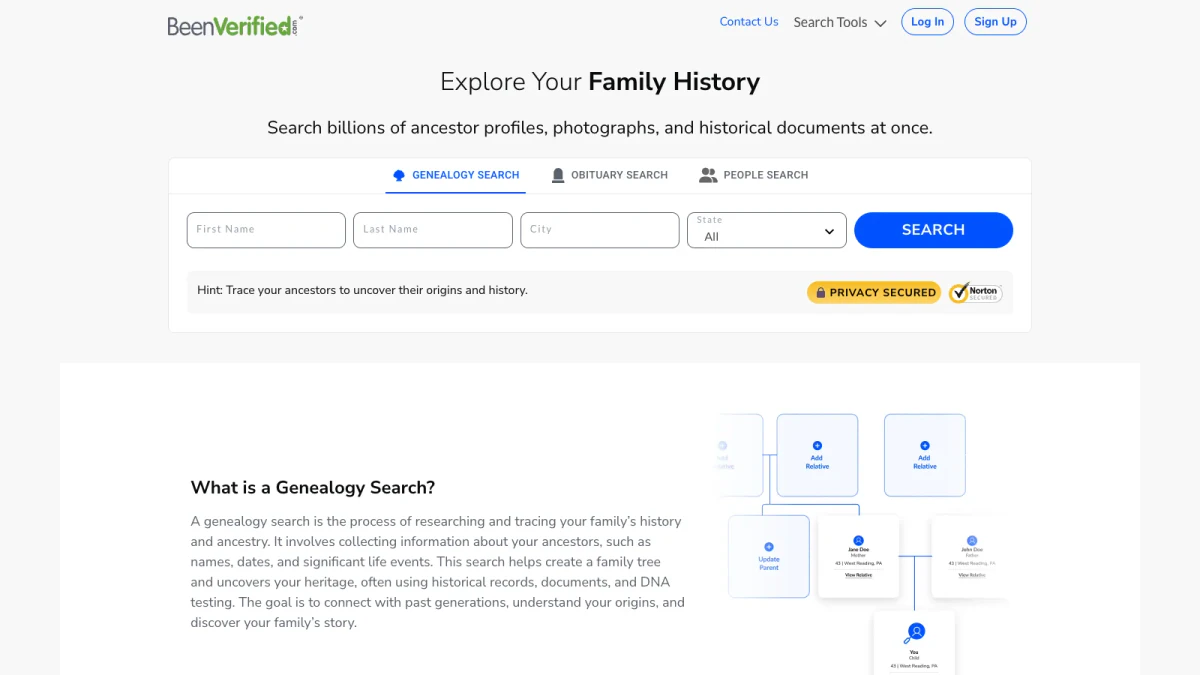
Screenshot: the BeenVerified family tree search page.
The same page has three tabs: Genealogy Search, Obituary Search and People Search. Each one starts from a name.
Step 4: Review the matches
The BeenVerified family tree search lists likely matches. Pick the right person by age, place and relatives. Most mistakes happen at this step. Slow down.
Step 5: Add relatives one by one
The genealogy page shows a sample tree. It starts with "You," then links a mother and a father. Empty boxes say "Add Relative" and "Update Parent." Each filled box has a "View Relative" link.
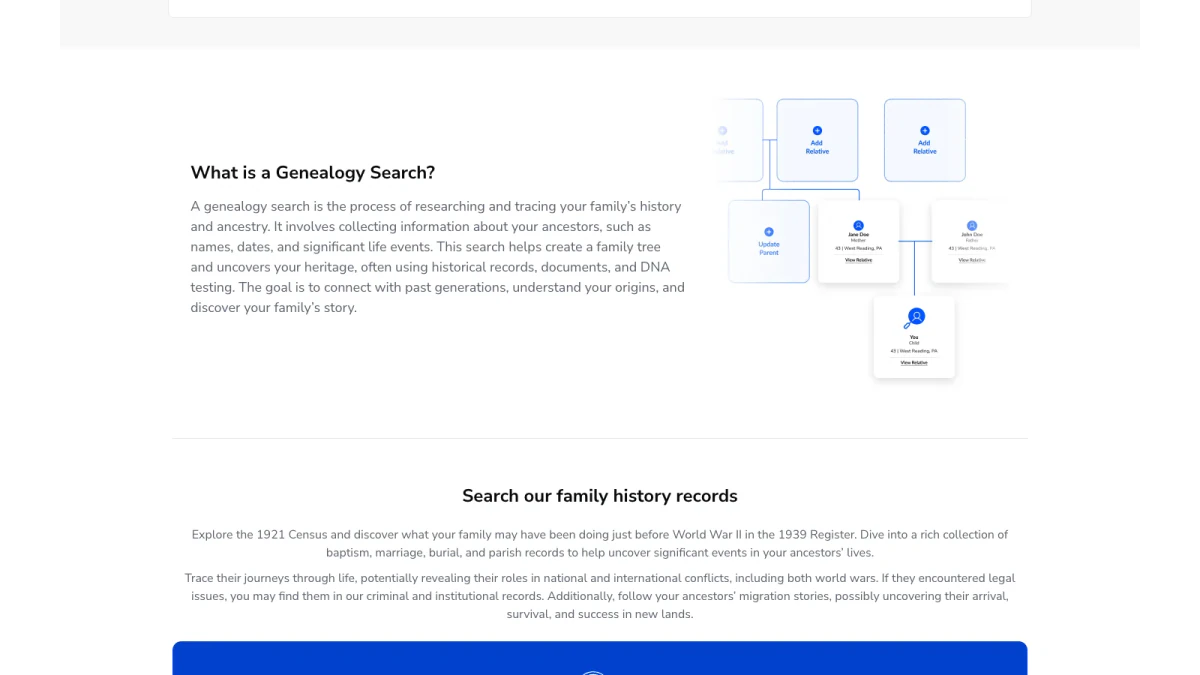
Screenshot: a sample chart from BeenVerified.
Work outward from you. Add parents first. Then add grandparents. Then fill in siblings, aunts, uncles and cousins.
Step 6: Open the full report
Full results sit behind a paid membership or a trial. BeenVerified's pricing says "any plan, all features." In October 2026, plans started at $23.98 per month on a 3 month term. Plans renew until you cancel.
What BeenVerified Family Tree Search Results Show
BeenVerified describes two kinds of data for building a tree.
Relatives and associates
Every BeenVerified people report can list family links. A subscription covers "names and aliases, relatives and associates, address histories" and more. Its apps page says reports "may contain public records, photos, ages, relatives, associates."
Relatives and associates are not the same. An associate might be a roommate or a business partner. Never add an associate to your family tree without proof.
Historical family records
BeenVerified's family tree search promises "billions of ancestor profiles, photographs, and historical documents." It names these record groups:
- Census records: "the 1921 Census" and "the 1939 Register." Both cover England and Wales.
- Church records: "baptism, marriage, burial, and parish records."
- Military records: roles "in national and international conflicts, including both world wars."
- Legal records: files from courts and institutions.
- Migration records: an ancestor's "arrival, survival, and success in new lands."
The page also mentions DNA. It suggests you "add DNA testing and use genealogy software tools" after you start with its database.
What to Collect Before You Start
A family tree grows faster when you start with what you already know. Spend an hour on this before any paid search.
Gather documents at home
Look for papers in drawers, boxes and old albums:
- Birth, marriage and death certificates.
- Family Bibles with handwritten dates.
- Funeral cards and newspaper clippings.
- Military papers and discharge forms.
- Old letters with return addresses.
Talk to older relatives
Older relatives are your best source. Ask for full names, maiden names and nicknames. Ask where people were born and where they moved. Ask who married whom and when. Write every answer down the same day.
Make a simple list
Before you search, list what you know for each person:
| Fact | Why it matters |
|---|---|
| Full name | Finds the right record |
| Maiden name | Links a woman to her parents |
| Birth year | Separates people with one name |
| Birthplace | Narrows where to look |
| Spouse | Confirms you have the right person |
Grow the Tree Generation by Generation
Good genealogists move slowly, one layer at a time. Skipping ahead causes errors that are hard to undo later.
Start with yourself
Put yourself in the first box. Add your birth date and place. Then add your spouse and children, if you have them.
Add your parents
Next, add your parents. Use their full names and your mother's maiden name. Confirm each date with a document.
Move to grandparents
Now add four grandparents. This is where many people get stuck. Older relatives can help. So can a census record from their childhood.
Keep going back
Each generation doubles the number of ancestors. Eight great-grandparents. Sixteen after that. Pick one line at a time. Finish it before you start the next.
Choose a chart type
Two chart types cover most needs:
- Pedigree chart: traces your direct ancestors only. It is easy to read.
- Descendant chart: starts with one ancestor and lists everyone after them. It is great for reunions.
Either way, the way to trace your family tree is patience. One person, one source, one box.
Using Kin Data From a Report
A name lookup can help you fill in living kin. Our guide to the BeenVerified people search explains how matches work.
Use that data with care:
- Treat names as leads. A listed name is a clue, not proof.
- Check ages. A "parent" who is two years older is likely a sibling or a mistake.
- Look at shared addresses. Families often lived together at some point.
- Watch for common names. Two John Smiths in one county can blur together.
BeenVerified itself warns about this. Its footer says data is "not necessarily 100% accurate, complete or up to date." It names relatives among the "sensitive items" that need your own due diligence.
Free Family Tree Options
BeenVerified is not free. You can still make a free family tree with public tools. A free family tree builder covers the basics for most families. Try these before you pay.
FamilySearch
FamilySearch is a free family tree service run by The Church of Jesus Christ of Latter-day Saints. It needs a free account. You can build a tree and search its record collections. A free family tree on FamilySearch is a strong starting point for most people.
The National Archives
The US National Archives runs a genealogy research hub. It covers census, military, immigration and land files. Most research there is free, and staff answer questions.
Census records
The US census has run every ten years since 1790. The National Archives census page explains a "72-year restriction on access." That makes 1950 the latest census you can view today. Old census pages list every person in a household, with ages and birthplaces. They are a free family tree goldmine.
Vital records
Vital records come from each state. The CDC keeps a guide called Where to Write for Vital Records. It lists the office and fees for every state.
Local sources
Do not skip local sources. Public libraries, county courthouses and historical societies hold papers that never went online. Many librarians help with genealogy for free.
When free tools are enough
A free family tree builder works well for most needs, and many free charts exist. Pay for a service when you need many sources in one place, or when you hit a wall. Compare options in our guide to BeenVerified alternatives.
How to Make a Family Tree Chart
A chart turns your notes into something people can read at a glance. You can make a family tree chart on paper, in a spreadsheet or in software.
Pick a layout
A pedigree layout fans out to the right. It fits your direct line on one page. A descendant layout drops down from one couple. It shows every child and grandchild. Choose the one that fits your goal.
Keep each box simple
Each box needs a name, a birth year and a death year. Add a place if space allows. Put longer notes in a separate file.
Use a standard format
Write surnames in capitals, such as "Mary JONES." Write dates as day, month and year. Use the maiden name for every married woman. These habits make your chart easy to share.
Print or share online
A free family tree builder can export a chart as a PDF. Print it for a reunion. Or share a private link with family. When you make a family tree chart, date the file. Charts change as you learn more.
How Far Back Can You Trace Your Family Tree?
Most people can trace a family tree back four or five generations with free sources. That reaches the late 1800s for many US families. Going further takes more work.
What sets the limit
Three things set the limit:
- Census access: the US census started in 1790, but early pages list only the head of each household.
- Local papers: church books and county files fill gaps before that.
- Migration: an ancestor who crossed an ocean leaves a second trail in the old country.
Tips to go further
To trace your family tree back past 1850, look at land deeds, wills and church books. Ask a county clerk what survives. A free family tree search across several sites can surface a missing link. Every extra generation adds stories worth keeping.
Questions to Ask Older Relatives
Talking to elders is the fastest way to grow a family tree. Their memories hold names that never made it into any database. Bring a list of questions.
- Where were you born, and where did your parents grow up?
- What were your grandparents' full names?
- Did anyone change their name or spelling?
- Who moved, and why?
- Which family stories did you hear as a child?
- Do you have photos, letters or a family Bible?
Record the answers with permission. Memories fade fast when no one writes them down. A short call today can save months of family tree search work later.
Free family tree search sites
Several sites let you run a free family tree search. FamilySearch is the largest free family tree option. The National Archives and many state archives also offer free indexes. Use them before you pay for a BeenVerified family tree report.
Why a Family Tree Matters
BeenVerified lists six reasons for this work. They match what most families say.
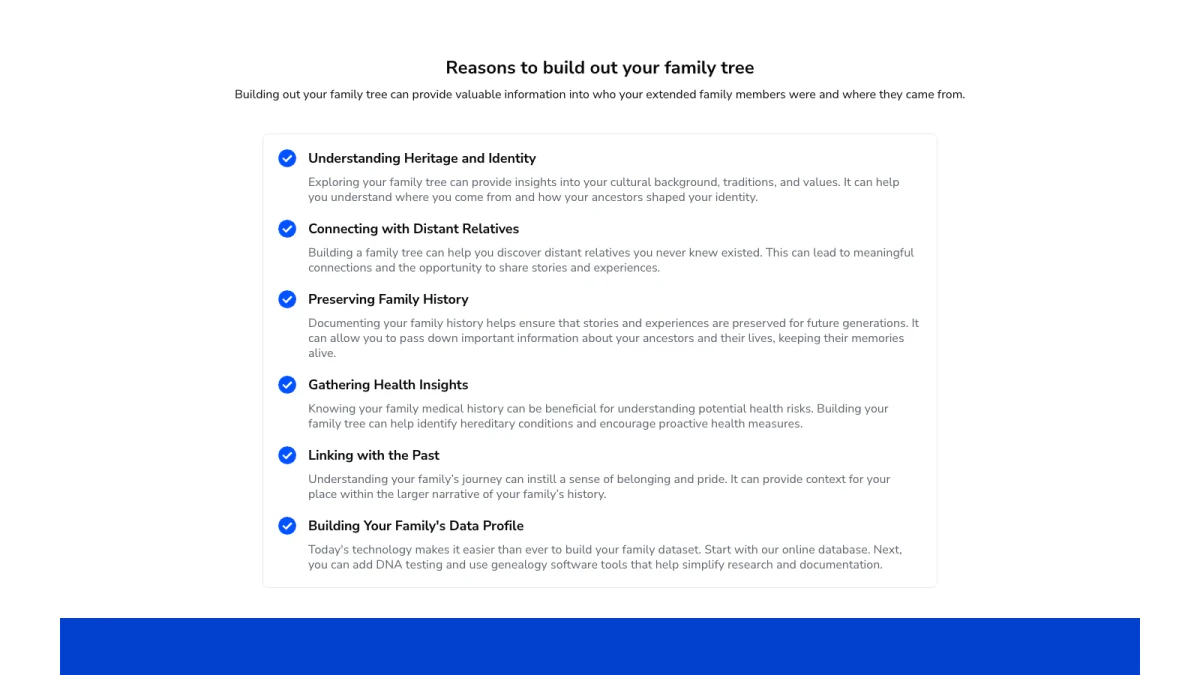
Screenshot: "Reasons to build out your family tree" on BeenVerified.
- Heritage and identity: understand "where you come from."
- Distant relatives: "discover distant relatives you never knew existed."
- Preserving history: keep stories "for future generations."
- Health insights: "identify hereditary conditions."
- Linking with the past: "instill a sense of belonging and pride."
- A family data profile: start online, then add DNA and software.
Health notes deserve extra care. A family medical history helps your doctor. Share it only with people you trust.
Tips for Better Family Tree Results
Small habits save hours of rework.
- Search spelling variants. Clerks wrote names as they heard them. Try "Smith," "Smyth" and "Schmidt."
- Use maiden names. A woman's papers before marriage sit under her birth name.
- Expect date gaps. Ages on old forms are often off by a year or two.
- Cite every fact. Note where each date came from. You will forget otherwise.
- Mark guesses as guesses. Use a question mark until a record confirms it.
- Back up your work. Export your tree now and then. Keep a copy offline.
Limits and Legal Use
A family tree is a personal project. The law still applies.
What the FCRA bans
BeenVerified is not a consumer reporting agency under the Fair Credit Reporting Act (FCRA). Its FCRA notice bans using its data to screen anyone for a job, a rental, credit, insurance or school. That rule covers family data too. Never use a relative's report to judge a tenant or an applicant.
Respect living relatives
Records about people who have died are open for most research. Living relatives are different. Do not publish their addresses, phone numbers or birth dates without consent. Many family tree tools hide living people by default. Keep that setting on.
Be careful with surprises
Family research can uncover adoptions, second marriages or unknown siblings. Think before you share. A kind private message beats a public post.
Sharing Your Family Tree With Relatives
A finished family tree is meant to be shared. It can reconnect people who lost touch years ago.
Reach out the right way
Start with one relative who is close to the person you want to reach. Ask them to pass on your message. A warm introduction works better than a cold one.
Check contact details first
Contact details from any lookup service can be old. People change numbers and abandon inboxes. Check before you reach out.
For a phone number, our phone number validator shows whether it is valid for its country. It also reports the line type and the E.164 format.
For an email, our reverse email lookup reads the domain, mail routing and any public profile. It uses public signals only.
Verify a reunion list before you send
Planning a reunion? You may have dozens of emails from cousins, old letters and search reports. Send to a stale list and many messages bounce.
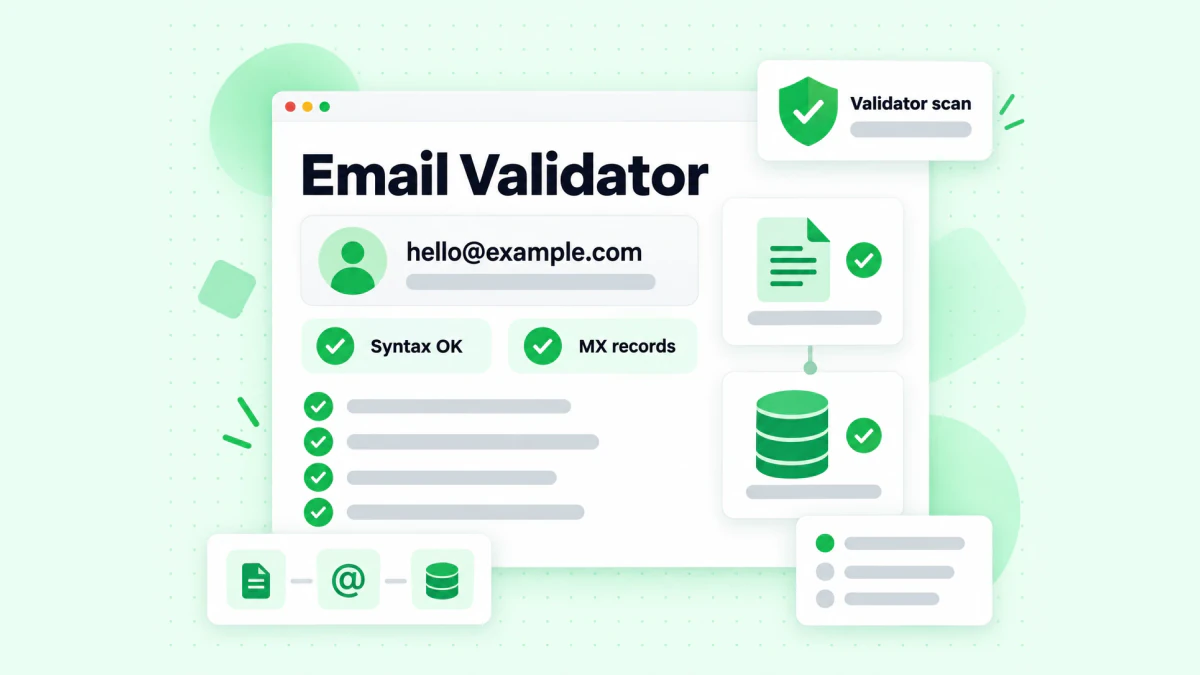
The BillionVerify email validator checks syntax and MX records for one address.
BillionVerify checks each inbox before you send. Upload a list and get each address sorted as valid, invalid, unknown or catch-all. You get 20 free credits every day you use your account, up to 600 a month. They never expire. A valid or invalid result costs one credit. Unknown results are free.
Make a Family Tree Online: Quick Plan
Here is the whole process in one place:
| Step | What to do | Tool |
|---|---|---|
| 1 | Collect papers and talk to elders | Pen and paper |
| 2 | Start a free family tree | FamilySearch or similar |
| 3 | Search census and vital records | NARA, state offices |
| 4 | Fill gaps with a paid search | A BeenVerified report |
| 5 | Confirm living kin | Name lookup |
| 6 | Check contact details | Phone validator and email check |
| 7 | Share the tree | Private link or export |
Start small. A tree with three solid generations beats one with ten shaky ones. When you are ready, make a family tree online and invite family to add what they know. Learn more about the service in our BeenVerified guide.
FAQs
What is a family tree?
A family tree maps one family over time. It shows who belongs and how they connect, with dates and places.
How do I make a family tree?
To make a family tree, start with yourself. Add parents, then grandparents. Back each fact with a document. You can make a family tree online or sketch one by hand for free.
How do I make a free family tree?
To make a free family tree, use a free service such as FamilySearch. Add census pages and state vital records. You can build several generations of a family tree online without paying.
How do I trace your family tree online?
To trace your family tree online, start with names and dates you already know. Search census, vital and church books. Then confirm each link with a second source.
Does BeenVerified have a family tree tool?
Yes, BeenVerified has a family tree tool, and the homepage has a Family Tree tab. It asks for a first and last name. It connects to BeenVerified's genealogy tools, which need a paid membership or trial for full results.
Is the BeenVerified family tree search free?
No, the BeenVerified family tree search is not free, although BeenVerified lets you start a search at no cost. Full results need a paid plan or a trial. For a free family tree search, start with FamilySearch and federal census indexes.
What records does BeenVerified use for a family tree?
BeenVerified names census records, the 1939 Register, church, military, legal and migration records. People reports also list relatives and associates.
How accurate is BeenVerified for family research?
Treat a BeenVerified report as a lead, not proof. Its reports can miss facts or lag behind. Relatives are among the items it says need your own checks.
Can I use BeenVerified to find living relatives?
Yes, BeenVerified can help you find living relatives for personal reasons such as a reunion. You cannot use it for jobs, housing, credit or insurance decisions. Those uses break the FCRA.
How do I check a relative's email before I write?
Before writing to a relative, look up the email's domain and public context. Then verify the inbox with BillionVerify before you write.