



You're adjusting a privacy dashboard before signing up for a service. One toggle stops personalized advertising. Another lets you export your account data. Later, you unsubscribe from a product newsletter, and the brand's system should remember that decision instead of sending one more campaign.
These small actions belong to a much larger idea: consumer directed choices. The person receiving a service gets meaningful control over what happens next, while the organization providing the service accepts responsibility for making that control understandable, usable, and enforceable.
That principle has roots in healthcare policy, but it now appears in consent banners, data portability requests, privacy settings, and email suppression lists. It also matters as software agents increasingly help people compare products and act on their behalf. For a useful perspective on how individual preferences shape automated purchasing, see Stimulead's 2026 playbook for AI shopping agents.
If you work in marketing, product, compliance, or data operations, you've probably already shipped a consumer-directed choice without using that name. Keeping clean email lists at no cost supports the same principle: your records should reflect what people chose, not what your system hopes they chose.
When the User Holds the Steering Wheel
A patient comparing deductible plans, a shopper switching off personalized ads, and a SaaS user exporting account data appear to be making unrelated decisions. In each case, though, the person on the receiving end of a service is deciding how much control to exercise and which trade-offs to accept.
The healthcare example may involve premiums, deductibles, provider access, and account funds. The digital example may involve relevance, privacy, convenience, or future contact. The interface changes, but the underlying question stays similar: does the user have a real choice, and can the organization honor it?
A privacy toggle only qualifies as meaningful control if the user can understand its effect. An unsubscribe link only works if future marketing genuinely stops. A data export button only helps if the resulting file is usable and the organization doesn't deliberately make the request difficult.
Practical rule: A choice is real when the user can understand it, exercise it, and rely on the organization to respect the result.
This is why the phrase appears in compliance meetings and product specifications. A consent flow defines who decides. A suppression rule defines whether the system remembers. A data portability feature defines whether the user can take something valuable with them instead of remaining locked into a service.
The healthcare lineage adds useful discipline. Consumer-directed plans offered more options. They moved some responsibility for spending, comparison, and service selection toward individuals. Digital teams face the same tension between giving people control and protecting them whenever they ask people to manage their own data, communications, or preferences.
What Consumer Directed Choice Actually Means
Strip away the policy language and consumer directed choice is a design philosophy: the end user gets meaningful decision-making power over a service, resource, or relationship. The organization still sets boundaries, explains consequences, protects people from avoidable harm, and follows applicable rules.
A restaurant menu offers a simple analogy. Customers can choose a meal, but they need readable prices, useful descriptions, and clear allergen information. A menu with dozens of vague options and hidden fees creates the appearance of freedom while making informed choice harder.
Three building blocks separate genuine direction from a decorative choice screen.
Information users can act on
People need to know what they're accepting, declining, exporting, or funding. “Personalized experience” tells a user less than “we'll use your activity to tailor ads.” “Manage preferences” is weaker than a clear explanation of which messages will stop and which service notices will continue.
Good information is specific, comparable, and placed next to the decision. It doesn't require a user to search a legal policy before understanding the immediate consequence.
Choice architecture without pressure
The order, labels, defaults, and visual emphasis of options shape behavior. A brightly colored accept button paired with a concealed reject link may technically provide a choice, but it makes refusal harder.
Strong architecture reduces unnecessary complexity without removing control. It can group related settings, show a recommended safe default, and make changes reversible. It shouldn't use urgency, shame, confusing labels, or repeated prompts to push people toward the organization's preferred outcome.
Accountability after the click
The organization must record the decision and apply it consistently. That includes updating downstream systems, suppressing future outreach, making exports available, and giving support staff enough context to resolve disputes.
This is also what consumer direction is not:
- It isn't unlimited freedom. Safety, eligibility, privacy, and legal boundaries still apply.
- It isn't a compliance shortcut. A checkbox doesn't replace clear notice or proper records.
- It isn't a guarantee that every option has equal value. The provider must help users understand meaningful differences.
- It isn't successful merely because selection rates rise. A high click rate can reflect confusion, pressure, or a convenient default.
The practical definition is straightforward: consumer directed choice gives people control, then supplies the information, structure, and accountability needed to make that control usable.
From Health Savings Accounts to Long-Term Care Budgets
Consumer directed choice didn't begin in a privacy dashboard. In the United States, it became a major health-policy concept through the Medicare Prescription Drug, Improvement, and Modernization Act of 2003, which established tax-advantaged Health Savings Accounts. The model paired high-deductible insurance with accounts that consumers could use for qualified medical expenses, shifting some purchasing decisions toward individuals. Federal evidence summarized by the CDC records how the model expanded through employer and government-sponsored insurance.
The Federal Employees Health Benefits Program began offering consumer-directed plans in 2003. In the American Postal Workers Union consumer-directed plan, enrollment rose from 4,500 people at launch in 2003 to more than 9,500 by 2005, while the federal program included three national and 13 local consumer-directed plans by 2005. By January 2012, insurer data reported 13.5 million Americans enrolled in HSA-eligible plans, up from 6.1 million in 2008 and 11.4 million in 2011. These milestones show how consumer choice scaled through policy, account structures, and wider access to high-deductible coverage.
The model also moved into publicly funded long-term-care services. A federal inventory found that 65% of the consumer-directed home- and community-based support programs examined had been implemented since 1990, while 23% began during the 1980s and 11% existed earlier. Medicaid funded all or part of 84 programs, representing 65% of the inventory, according to the Office of the Assistant Secretary for Planning and Evaluation.
What the care experiments revealed
The Cash and Counseling demonstration in Arkansas, Florida, and New Jersey, conducted from 1999 to 2003, tested whether beneficiaries could manage a defined contribution to purchase personal and community-based services. In Arkansas, consumer-directed participants received $4,605 in average personal-care expenditures over two years, compared with $2,349 for the agency-directed group. About 28% of people in the Arkansas agency-directed group received no personal-care services, and recipients generally received only about two-thirds of the hours in their care plans.
The result wasn't just “choice lowers costs.” Overall Medicaid spending increased by roughly $500 per person on average in the short run, showing that consumer direction can increase access and utilization. The deeper lesson is that nominal control only becomes real access when people have usable budgets, understandable information, administrative support, and a workable way to act.
Digital teams face the same distinction. A cookie banner may offer buttons without explaining tracking. An unsubscribe flow may confirm a request without updating every sending system. A data export may exist but produce a format that the user can't practically use. The interface can show choice while the infrastructure denies it.
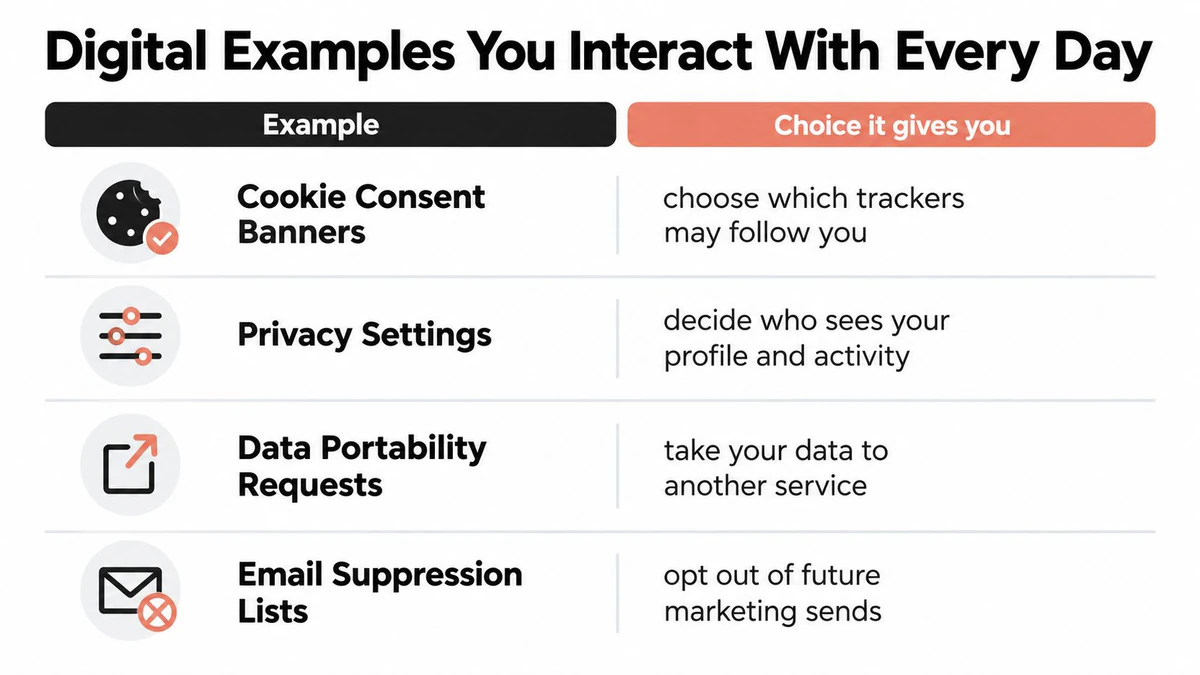
Digital Examples You Interact With Every Day
Digital products translate the healthcare framework into smaller, faster decisions. The user may not manage a care budget, but they still decide who can track them, which messages they receive, and whether they can move their data elsewhere.
Privacy settings
Privacy dashboards turn broad policy language into controls. Apple's App Tracking Transparency prompt, for example, asks users to decide whether an app can track activity across other companies' apps and websites. Google's ad personalization controls offer another model, where users can adjust how activity informs advertising.
The three-part test still applies:
- Information: Explain what changes when the setting is enabled or disabled.
- Architecture: Keep related controls together and avoid making refusal harder than acceptance.
- Accountability: Apply the setting across the systems that use the data, not just inside the visible dashboard.
A toggle without reliable enforcement is a preference theater. Users need a clear consequence and a dependable record of the decision.
Cookie consent banners
Consent banners should distinguish necessary operation from optional tracking and make the available actions understandable. A user shouldn't have to open several layers of settings to find a refusal path that was visible nowhere else.
The compliance layer matters too. The Federal Trade Commission's CAN-SPAM compliance guide requires commercial email to use accurate routing information, provide a clear and conspicuous opt-out method, and honor opt-out requests within 10 business days. The mechanism must remain capable of processing requests for at least 30 days after the message is sent, and senders must offer a way to stop all marketing messages even when they also provide category-level preferences.
Cookie consent and email consent aren't identical legal concepts, but they share a product requirement: the user's refusal must be as operationally real as the organization's acceptance.
Data portability requests
Portability gives users a route out. Regulations such as Article 20 of the EU General Data Protection Regulation establish a framework for receiving personal data in a structured, commonly used, machine-readable format.
Good implementation starts before the request arrives. Define which data is portable, validate the requester, create an export that another service can interpret, and communicate status without making the user negotiate with support. The organization should also preserve a record of the request and its outcome.
Email suppression lists
Suppression is the marketing version of honoring a decision not to hear from a brand. It covers opted-out contacts, invalid addresses, and addresses that create unnecessary delivery risk.
Google defines spam rate as the percentage of messages delivered to an engaged recipient's inbox that the recipient later marks as spam. Its sender guidance tells bulk senders to keep spam rates below 0.3%, while Gmail recommends keeping user-reported spam rates below 0.1% and preventing them from reaching 0.3% or higher. Google's sender guidance also states that bulk senders above the critical threshold can become ineligible for mitigation, with eligibility returning only after the rate remains below 0.3% for seven consecutive days.
Suppression isn't lost reach. It's the system remembering the user's boundary.
For practical campaign planning, BillionVerify's email marketing playbook provides a useful reference point for connecting audience quality, message relevance, and responsible sending.
Why More Options Does Not Always Mean Better Outcomes
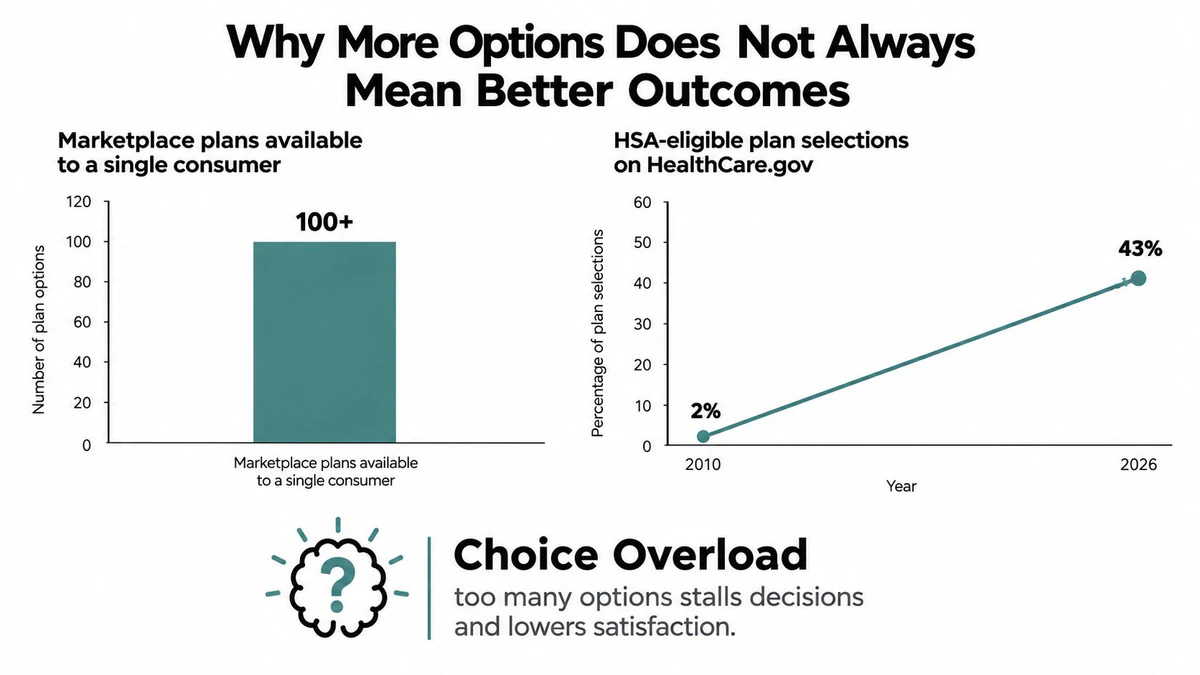
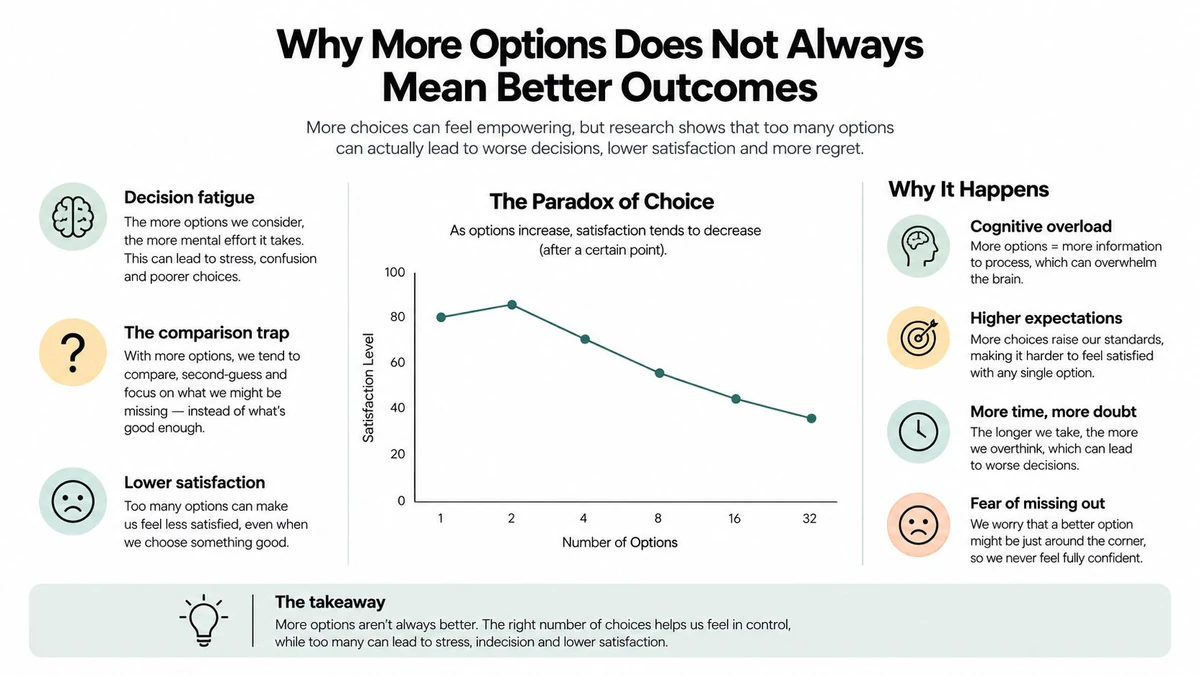
More choice sounds like a benefit until the user has to compare every option under time pressure. Marketplace consumers can face more than 100 plan options, while Medicare Advantage enrollees face an average of 42, making comparison difficult even for financially literate shoppers, as reported in Health Affairs Scholar.
The same problem appears in digital consent. A banner with dozens of toggles may give users more theoretical control while making the important decision harder to find. A short flow with clear categories can provide better practical control if every category is explained and the settings remain reversible.
Behavioral economics helps explain why. Loss aversion can make an immediate fee feel more important than a long-term benefit. Anchoring can cause a user to treat the first price or plan as a reference point. Heuristics, emotions, and social influence can push people toward familiar or prominent choices even when another option better fits their needs.
The cost signal can be blunt
RAND analyzed claims and enrollment data from more than 800,000 households covered by 59 large U.S. employers from 2003 to 2007. Families that switched from traditional plans to consumer-directed plans spent 21% less on healthcare during the first year. Roughly two-thirds of the reduction came from initiating fewer episodes of care, while one-third came from lower spending per episode. Name-brand drug use declined 4.9%, specialist visits declined 6.5%, and hospital stays declined 17.7%. These findings are detailed in the RAND research brief.
Lower utilization can reflect better shopping, negotiated prices, or avoided low-value care. But earlier RAND evidence found that cost-sharing reduced appropriate and inappropriate care in roughly equal proportions. A person may skip an unnecessary visit, or delay treatment that would have prevented a more serious problem later.
Design test: Don't ask only whether a user completed the choice. Ask whether the choice produced a result that served the user's needs.
Digital teams should test comprehension, reversal, downstream satisfaction, and error rates. An experiment can compare a compact consent flow with a more detailed one, but success shouldn't be defined only by acceptance or completion. A practical guide to the value of controlled experimentation is LLMrefs on A/B testing benefits.
For email operations, the equivalent is bulk email list cleaning. Removing risky records can protect recipients and sender reputation, but teams should also examine why those addresses entered the database, whether consent was clear, and whether legitimate contacts are being excluded by an overly aggressive rule.
What This Means for Marketers and Product Teams
Consumer direction becomes credible when it reaches the operational layer. Marketing teams need suppression rules. Product teams need validation at the point of data entry. Compliance teams need records showing what the user saw, selected, and later changed.
A signup flow illustrates the connection. If a form accepts fake, disposable, or malformed addresses, the company stores a weak data point and may send future messages to an address that never gave meaningful consent. Real-time verification can block obvious problems before they spread into CRM records, automation journeys, and campaign audiences.
For marketers, the goal isn't to preserve every possible contact. Sending to invalid, unwanted, or spam-trap addresses increases delivery risk and can contribute to recipient complaints. For product teams, verification should be paired with a clear explanation when an address is rejected, plus an accessible correction path. For compliance officers, the workflow should preserve consent records, preference changes, suppression events, and portability requests.
Comparing the building blocks
| Building Block | Healthcare Example | Digital Example |
|---|---|---|
| Information | Explain deductible exposure, account use, provider rules, and qualified expenses | Explain what tracking, personalization, or marketing consent changes |
| Choice architecture | Present plan and service options in a way people can compare | Use clear buttons, balanced defaults, grouped settings, and reversible choices |
| Accountability | Apply the selected plan or care budget consistently | Update suppression systems, honor exports, and enforce privacy preferences |
The technical implementation should match the promise made in the interface. If a user opts out of marketing, every sending source needs access to the suppression state. If a user requests portability, the export process needs defined ownership and a usable output. If a product blocks an address, the user needs a clear explanation rather than a silent failure.
Creative and audience experiments benefit from the same discipline. Teams can use resources such as AdManage.ai on creative testing to think about structured experimentation, but the evaluation criteria should include trust and downstream quality, not only immediate conversion.
Teams that want to improve email segmentation strategy should treat preference data as a user-controlled signal. Segmenting by stated interests can improve relevance. It shouldn't become a reason to ignore an opt-out, infer sensitive traits carelessly, or create a second path around a suppression request.
A Decision Checklist for Teams Building Consumer Choice
Use this checklist before launching a consent flow, signup form, preference center, or data-management feature.
- Confirm understanding. Ask whether representative users can explain the consequence of each meaningful option, not merely whether they can find the button.
- Test the architecture. Put the flow in front of real users and watch for hesitation, mistaken selections, and failed reversals.
- Treat suppression as quality data. Remove opted-out and invalid contacts from future sends, and preserve the reason for suppression.
- Document consent. Store the timestamp, source, displayed language, version history, and later preference changes.
- Build portability and deletion paths early. Assign owners, define the output, validate identity, and test the workflow before a request becomes urgent.
- Measure what happens afterward. Track retention, satisfaction, equity, adverse events, continuity, and realized value instead of relying only on selection rates.
For email teams, an Email Validation API can support real-time checks at registration and automated hygiene before campaigns. The right implementation connects that validation with suppression logic, consent records, and the systems where customer preferences live.
BillionVerify helps marketing, product, and operations teams verify addresses in real time, clean uploaded lists, and return structured deliverability data for safer segmentation and sending. Visit BillionVerify to connect email verification with the consumer choice workflows your team needs to honor.