


Most advice gets this wrong from the start. A lead isn't just an email address, and if your team treats it that way, you'll confuse contact capture with revenue potential, then wonder why the pipeline feels full but sales still starves.
A useful way to think about what is lead in lead generation is to split it into layers. First, someone becomes reachable. Then, they show interest. Then, your team decides whether that person is qualified enough for a next action, whether that's nurture, verification, routing, or sales follow-up.
That distinction matters because a contact record can look complete and still be useless. The right lens is practical: if the person hasn't raised a hand in some meaningful way, you don't have a lead yet, you have data.
The Question Most Lead Generation Guides Get Wrong
The common mistake is treating a lead like a neat row in a CRM. That's too shallow for B2B, where a person can be identifiable, reachable, and still not worth a sales call. A better starting point is to separate identity, interest, and intent.
Identity says, “We know who this is.” Interest says, “They did something that suggests curiosity.” Intent says, “They've signaled enough buying motion that a human should pay attention now.” If you collapse those three into one label, your reporting gets noisy and your follow-up gets lazy.
Practical rule: if you can't say why a contact deserves the next action, you don't have a lead definition yet, you have a storage problem.
That's why a good breakdown of what is lead in lead generation should move from capture to qualification, not from capture straight to sales. A law-firm example can make this easier to see. In a guide like law firm lead generation strategy, the valuable part isn't just getting people to land on a page, it's turning that visit into a meaningful, follow-up-ready contact.
The rest of this article follows that logic. First comes the basic definition, then the lead types teams use, then the routes that bring contacts in, and finally the role of verification in deciding whether a contact is safe to email at all.
Defining a Lead Beyond the Dictionary
Start with the simplest distinction. A website visitor is anonymous traffic. A lead is a person or organization you can identify and reach for follow-up because they've given you a signal, like a form submission, a webinar registration, a content download, a reply to outreach, or a free-tool signup.
The easiest analogy is a classroom. A student sitting in the back is like anonymous traffic. A student who raises a hand is closer to a lead, because they've shown intent and made themselves visible. The name written on the roll matters too, because without identity, there's no way to respond.
A practical definition for teams is this, a lead is an identifiable person or organization that has entered a commercial relationship with your business and shown enough fit, permission, or behavior to justify a next action. That next action may be verification, enrichment, qualification, nurture, or outreach. It isn't always a sales call.
For teams that handle email data, BillionVerify is a professional email verification service built to solve one problem, bad email data costs businesses money. That matters because even an identifiable contact can still be weak, invalid, or insufficiently qualified for outreach.
The important nuance is that lead generation and contact management are not the same thing. Lead generation creates identifiable contacts. Qualification decides which of those contacts deserve real sales attention. In B2B, that difference is huge, because a large share of leads aren't ready for sales when they first arrive, which is why qualification and verification can't be treated as optional cleanup work.
The Main Types of Leads Teams Actually Use
Not every lead label means the same thing. Some labels describe readiness, some describe source, and some describe the kind of data you have. Teams get into trouble when they mix those categories together and then build routing rules on top of the confusion.
Lifecycle labels are not source labels
MQL and SQL are lifecycle stages. They tell you how far a contact has moved through your process, not where they came from. An MQL has shown marketing engagement, while an SQL has demonstrated stronger buying intent and has been accepted for sales follow-up.
That's different from inbound and outbound, which describe how the contact entered the funnel. Inbound means they came to you through a form, download, webinar, or similar action. Outbound means your team reached out first.
A staffing audience often needs that distinction in plain language, especially when comparing audience lists, outreach motion, and follow-up ownership. A useful reference for that kind of operational thinking is dreach guides for staffing agencies, because it shows how different lead types can demand different workflows.
Lead types at a glance
| Lead Type | Typical Signal | Owning Team | Next Action |
|---|---|---|---|
| MQL | Marketing engagement | Marketing | Nurture or pass for review |
| SQL | Buying intent | Sales | Sales follow-up |
| Inbound lead | Form, download, webinar | Marketing or SDR | Route quickly |
| Outbound lead | Cold email reply, booked meeting | SDR or sales | Qualify and continue the sequence |
| Demographic lead | Role, title, seniority | Marketing operations | Segment and score |
| Firmographic lead | Company size, industry, fit | RevOps or sales ops | Prioritize or suppress |
If you're cleaning and organizing contact data, the cold email verification guide can be a useful companion to this topic because outbound teams need more than just a name and email. They need a contact that fits the campaign and can be reached.
How Inbound and Outbound Leads Enter the Funnel
Two leads can look identical in a CRM and still mean very different things. A SaaS company might capture an inbound demo request from someone who filled out a form after comparing vendors. An SDR team might reach out to a target account and get a reply from someone who had never heard of the company that morning.
The fields may match, name, email, company, maybe title. The context does not. Inbound usually signals self-declared interest. Outbound depends more on list quality, relevance, and timing.
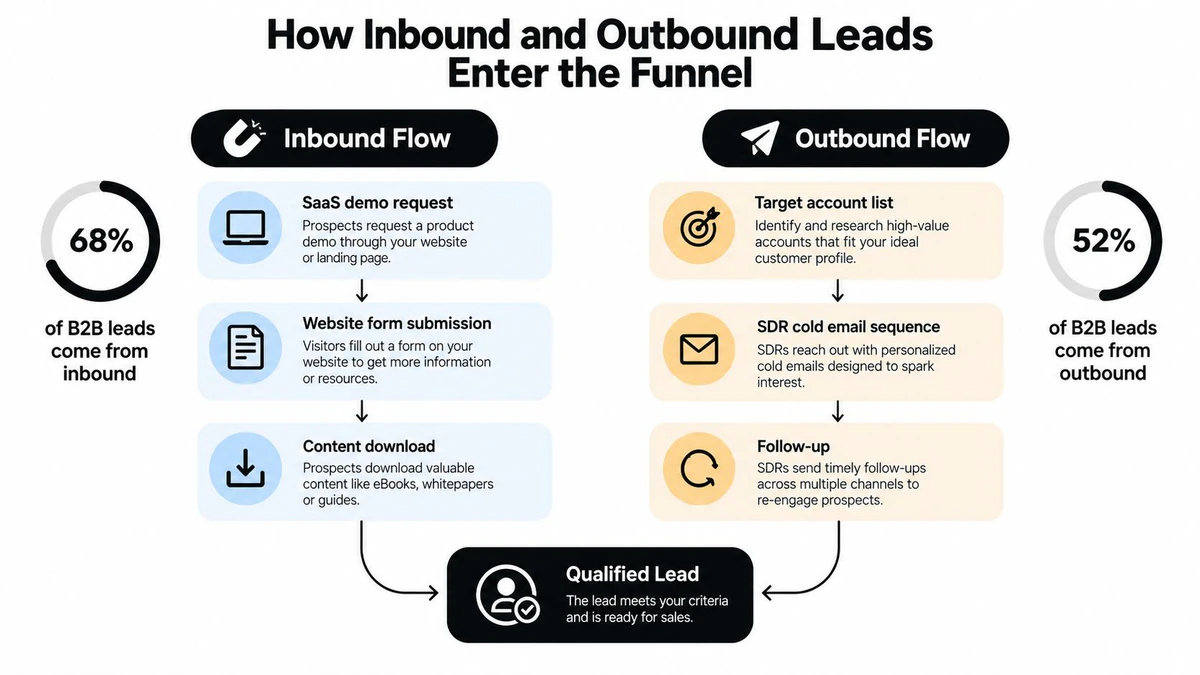
An inbound flow starts with capture, then routing, then a fast response. An outbound flow starts with target selection, then list cleaning, then outreach, then follow-up. Skip those steps and the funnel may look active on paper while underperforming in practice.
Channel choice changes what enters the funnel and how much trust you can assume at the start. That is why the first action should match the source. A form fill may move to routing and speed-to-lead. A cold reply may need qualification before sales spends time on it.
For teams building outbound lists, list building for email marketers fits this stage because list source and list hygiene shape the first response a lead receives. A clean list still needs qualification, but a poor list can weaken the sequence before it starts.
Scoring, Qualifying, and the Speed-to-Lead Effect
Lead scoring is how teams turn judgment into a repeatable rule. Instead of asking every rep to guess whether a contact is worth time, scoring gives the team a shared way to rank fit and intent. That score can be built from explicit rules, like industry, company size, and job title, or from behavioral models that watch what people do.
What adds points and what subtracts them
High-intent behavior usually gets positive weight. A pricing-page visit, a demo request, or repeated engagement with key pages can push a contact toward sales attention. Disqualifying signals should pull the score down, like a disposable email address, irrelevant industry, or other signs that the contact isn't a fit.
That logic works because not every response is equally valuable. A download might justify nurture. A demo request may justify a fast handoff. A role mismatch may justify suppression.
Operational rule: scoring only matters if someone acts on it. A score that sits in a database is decoration, not qualification.
The timing side matters just as much. A Harvard Business Review study covering 1.25 million leads across 42 companies found that contacting a lead within one hour made the company nearly seven times more likely to qualify it than contacting the lead after another hour, and more than 60 times more likely than waiting at least 24 hours (speed-to-lead response research). That's not just a marketing statistic, it's an operating rule.
If the lead is hot, the clock starts immediately. If the lead is cold or weakly qualified, nurture can make more sense than a rushed call. Many teams move contacts through a path like lead, MQL, SAL, SQL, and then opportunity, but the handoff only works when each stage means something different.
real-time email verification for leads becomes useful here because a score is only as trustworthy as the contact data underneath it. Bad data can make a high-score lead impossible to reach.
What Email Verification Adds to the Lead Definition
A lead can be identifiable and still be a poor email target. The mailbox might be invalid, disposable, a role account, a catch-all, or tied to a server that won't reliably accept mail. Verification sits in that gap between “we have a contact” and “we should send.”
BillionVerify's verification layer is built around structured results, including status, SMTP results, MX records, catch-all scoring, and deliverability insights. That matters because different problems need different handling. A structured JSON response can help automation decide whether to keep, suppress, or route a contact.
SMTP behavior also needs careful interpretation. An address that returns a temporary server response isn't always permanently bad, and a verification workflow needs to separate a hard failure from a temporary one. That's why a useful verifier doesn't just say “good” or “bad,” it returns an evidence-based result.
What verification can't prove is just as important. A clean address doesn't prove intent, authority, consent, or message relevance. It reduces bounce risk and complaint risk, but it doesn't turn a contact into a qualified buyer.
Post-verification checklist: confirm consent or lawful basis, check ICP fit, review engagement, and then decide whether sales, nurture, or suppression is the right next move.
For workflow teams, the Email Validation API is the obvious fit when verification needs to happen before a form submission enters the CRM or outbound sequence. That's especially useful when teams want to block bad data at the edge instead of cleaning it later.
Common Misconceptions That Distort the New Pipeline
Lead generation gets distorted when teams collapse several separate jobs into one label. Contact capture, qualification, deliverability, and intent are related, but they answer different questions. A person can be real, reachable, and still not be ready for sales.
The first misconception is that more leads always mean better results. A 2012 MarketingSherpa benchmark found that 73% of B2B leads were not sales-ready, which is a clear warning that volume can inflate dashboards without improving revenue. A funnel full of unready contacts is still a weak pipeline.
The second misconception is that a verified email equals a qualified lead. Email verification helps with deliverability and data hygiene, and it is useful for trimming bad addresses before they reach a CRM or outbound sequence. It does not tell you whether the contact is the right role, the right fit, or legally ready for outreach. The guide to email hygiene for agencies is useful here because it keeps list quality work separate from lead qualification.
The third misconception is that MQL and SQL are interchangeable labels. An MQL has shown marketing engagement, while an SQL has crossed into sales-ready behavior and has usually been accepted for follow-up. Treating them as the same thing creates bad handoffs and confused ownership.
A practical definition is this. A lead is an identifiable person or organization that has entered your commercial orbit, shown enough fit or interest to justify a next action, and still needs the right mix of verification, qualification, and routing before sales spends time on it. That definition gives teams something actionable, unlike the vague shorthand of “someone with an email address.”