



Every e-commerce business faces the same challenge: cart abandonment. Customers add products to their carts, begin checkout, and then disappear. Industry statistics show that nearly 70% of online shopping carts are abandoned before purchase completion. What many store owners don't realize is that invalid email addresses play a significant role in this problem—and email verification offers a powerful solution. For foundational concepts, read our complete guide to email verification.
In this comprehensive guide, we'll explore how implementing email verification in your e-commerce workflow can dramatically reduce cart abandonment, recover lost sales, and improve overall customer experience. Whether you're running a small Shopify store or managing enterprise-level e-commerce operations, these strategies will help you capture more revenue from every visitor.
The Hidden Connection Between Email and Cart Abandonment
Cart abandonment isn't always about price or shipping costs. Often, it's about friction in the checkout process—and email validation plays a bigger role than most merchants realize.
Why Customers Enter Invalid Emails
Understanding why customers provide invalid email addresses helps you address the root causes. Customers enter incorrect emails for several reasons, each requiring different solutions.
Accidental Typos
The most common cause of invalid emails is simple typing errors. On mobile devices especially, customers frequently mistype their email addresses. "gmail.com" becomes "gmial.com" or "gmal.com." Without email verification catching these mistakes, confirmation emails never arrive, orders seem lost, and customers blame your store.
Intentional Fake Emails
Some customers enter fake email addresses to avoid marketing communications. They don't realize these same addresses are needed for order confirmations, shipping updates, and receipts. When they don't receive expected communications, they may dispute charges or contact support, creating operational overhead.
Outdated Email Addresses
Customers sometimes use old email addresses they no longer access. They might remember an old work email or a defunct domain. These addresses may technically exist but won't reach the customer, breaking your communication chain.
The True Cost of Invalid Emails in E-commerce
Invalid email addresses create a cascade of problems that directly impact your bottom line. Let's quantify these costs.
Lost Recovery Opportunities
Cart abandonment emails recover 5-15% of abandoned carts on average. If your store has 1,000 abandoned carts monthly worth $100 each, that's $100,000 in potential revenue. Recovering just 10% means $10,000 in additional sales. But if 15% of your email addresses are invalid, you're losing $1,500 monthly in recovery opportunities from invalid addresses alone.
Increased Support Costs
Customers who don't receive order confirmations contact support. Each support ticket costs $5-25 to resolve. If invalid emails cause even 50 additional support tickets monthly, that's $250-1,250 in unnecessary support costs—costs that proper email verification eliminates entirely.
Damaged Sender Reputation
Sending transactional emails to invalid addresses causes bounces. High bounce rates damage your sender reputation, affecting deliverability to valid addresses too. When your legitimate order confirmations land in spam folders, customer trust erodes and support volume increases further. Learn more about how to reduce email bounce rate to protect your deliverability.
How Email Verification Reduces Cart Abandonment
Implementing email verification at key points in your e-commerce funnel directly addresses these issues and reduces cart abandonment rates.
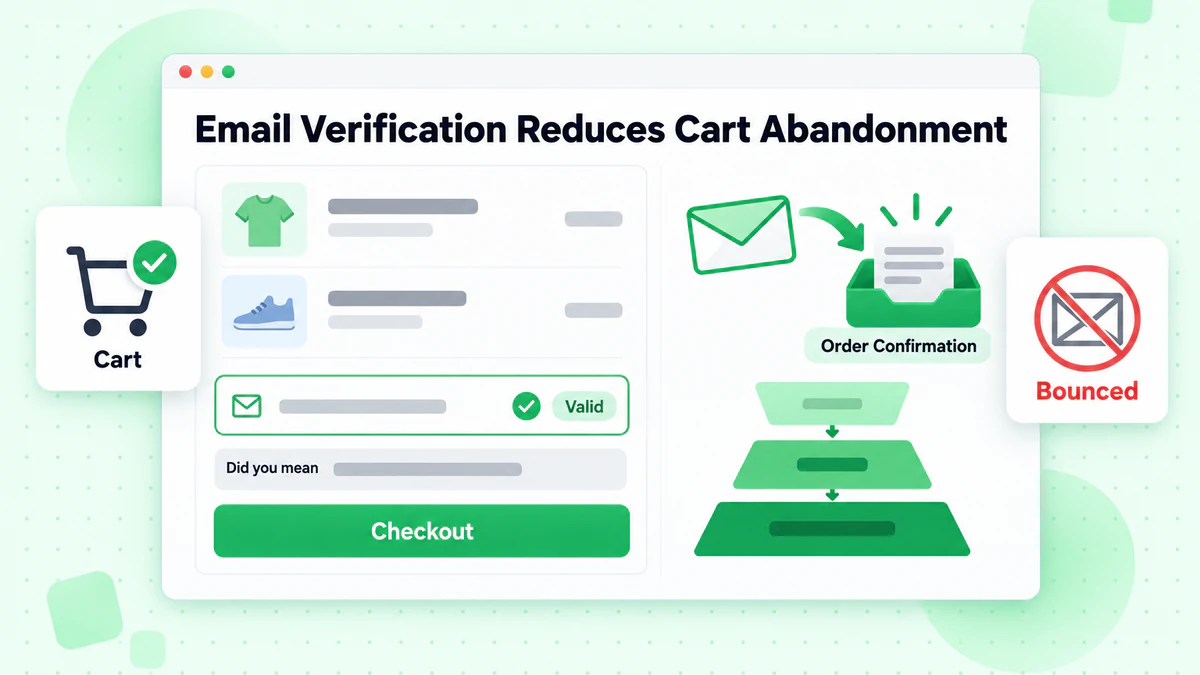
Real-Time Validation at Checkout
The most impactful implementation validates email addresses in real-time as customers enter them during checkout. This catches typos immediately, before customers progress further in the purchase flow. Learn more about real-time email verification implementation strategies.
Immediate Typo Correction
When a customer types "john@gmial.com," real-time email verification identifies the typo instantly. Instead of accepting the invalid address, your checkout form can suggest "Did you mean john@gmail.com?" This simple intervention prevents countless lost orders and frustrated customers.
Reduced Form Friction
Counterintuitively, adding validation reduces friction. When customers know their email is correct, they proceed with confidence. Without validation, doubt creeps in: "Did I type that right?" This uncertainty contributes to abandonment as customers second-guess their information.
Mobile Optimization Benefits
Mobile checkout abandonment rates exceed desktop by 10-15 percentage points. Mobile keyboards make typos more common. Real-time email verification is especially valuable for mobile users, catching errors that small screens and autocorrect issues create.
Pre-Purchase Account Verification
For stores requiring account creation, email verification during registration prevents problems before they reach checkout.
Confirming Customer Intent
Verifying emails at registration confirms the customer's ability to receive communications. This establishes a working communication channel from the first interaction, ensuring all subsequent transactional emails reach the customer.
Building Trust Early
When customers successfully receive a verification email, they gain confidence in your store's professionalism. This trust carries through to checkout, reducing abandonment driven by uncertainty about whether the store is legitimate.
Guest Checkout Optimization
Many customers prefer guest checkout to avoid creating accounts. Email verification remains essential in these flows.
Single Point of Contact
In guest checkout, the email address is your only connection to the customer. If it's invalid, you have no way to send order confirmation, shipping updates, or resolve issues. Verifying this single data point is critical for maintaining the customer relationship.
Streamlined Recovery
Valid email addresses enable abandoned cart recovery campaigns. Even without an account, you can re-engage customers who left items in their carts—but only if their email addresses actually work.
Implementing Email Verification in Your E-commerce Platform
Different e-commerce platforms require different implementation approaches. Here's how to add email verification to popular platforms.
Shopify Integration
Shopify stores can implement email verification through apps and custom code.
Using Shopify Apps
Several Shopify apps provide email verification functionality. These integrate with your checkout flow without requiring custom development. Look for apps offering real-time verification, as batch verification after checkout misses the critical intervention point.
Custom Theme Integration
For more control, integrate email verification APIs directly into your Shopify theme. This requires modifying checkout liquid files and adding JavaScript for real-time validation. BillionVerify's API integrates smoothly with custom Shopify implementations.
WooCommerce Implementation
WooCommerce's flexibility allows multiple integration approaches for email verification.
WordPress Plugins
Email verification plugins for WooCommerce add validation to checkout forms. Choose plugins that perform real-time API verification rather than simple regex checks, as regex alone misses most invalid addresses.
Custom PHP Integration
For custom WooCommerce builds, integrate email verification directly into your checkout processing. Hook into WooCommerce's validation filters to verify emails before order creation.
Magento Configuration
Magento's enterprise focus makes email verification particularly important given the typically higher transaction values.
Extension Installation
Magento extensions for email verification integrate with the checkout flow. Ensure selected extensions support your Magento version and perform real-time verification rather than post-checkout batch processing.
API Integration
For maximum control, integrate email verification APIs directly into Magento's checkout process. This allows customization of error messages, retry behavior, and integration with existing customer management workflows.
Custom E-commerce Platforms
Custom-built e-commerce platforms have the most flexibility for email verification implementation.
API Integration Best Practices
Integrate email verification API calls into your form validation logic. Perform verification asynchronously to avoid blocking the user interface. Cache results appropriately to avoid re-verifying the same address multiple times during a session.
Error Handling Strategies
Design graceful error handling for verification failures. Network issues shouldn't prevent checkout completion. Implement fallback strategies that capture potentially invalid addresses for later verification while allowing the transaction to proceed.
Email Verification Best Practices for E-commerce
Beyond basic implementation, these best practices maximize the impact of email verification on your e-commerce metrics.
Timing Your Verification
When you verify matters as much as whether you verify.
Verify on Field Blur
Trigger verification when the customer moves from the email field to the next field (on blur). This provides immediate feedback without interrupting typing. Avoid verifying on every keystroke, as this creates excessive API calls and distracting feedback.
Confirm Before Submission
Regardless of blur verification, re-verify before form submission. The customer may have edited the field after initial verification. This final check ensures the submitted address is valid.
Handling Verification Results
How you respond to verification results affects conversion rates.
Soft vs. Hard Blocks
Not all "invalid" results require blocking checkout. Distinguish between definitely invalid addresses (hard blocks) and suspicious-but-possible addresses (soft warnings). Blocking too aggressively frustrates customers with unusual but valid addresses.
Helpful Error Messages
Generic "invalid email" messages frustrate customers. Provide specific, actionable feedback: "This email domain doesn't exist. Please check for typos." or "We couldn't verify this email. Please double-check the spelling."
Suggestion Implementation
When verification suggests corrections (like fixing common domain typos), present these as clickable options. "Did you mean john@gmail.com?" with a button to accept the correction reduces friction compared to making customers retype.
Balancing Security and Conversion
Email verification shouldn't create unnecessary barriers.
Allowing Edge Cases
Some valid email addresses may fail verification due to strict server configurations. Consider allowing form submission with warnings for these cases rather than hard blocking. You can follow up with these orders manually if needed.
Rate Limiting Considerations
Implement verification rate limiting to prevent abuse. However, ensure legitimate customers entering multiple emails (perhaps trying variations to find the right one) aren't blocked from completing checkout.
Advanced E-commerce Email Verification Strategies
Beyond checkout validation, advanced strategies further optimize your e-commerce email effectiveness.
Pre-Campaign List Verification
Before sending marketing campaigns to your customer database, verify the list to remove addresses that have become invalid since last verification. Use bulk email verification to efficiently process your entire customer database.
Reducing Campaign Bounces
Customer emails decay over time. People change jobs, switch providers, and abandon accounts. Verifying your list before major campaigns ensures maximum deliverability and protects your sender reputation. Learn how to clean your email list effectively.
Segmentation by Email Quality
Segment your customer list by email verification confidence. Send to high-confidence addresses first, then test lower-confidence segments carefully. This protects your reputation while maximizing reach.
Transactional Email Optimization
Transactional emails have high open rates but require delivery to be effective.
Order Confirmation Delivery
Order confirmations should reach customers within minutes. Invalid addresses make this impossible. Real-time verification at checkout ensures order confirmations reach customers, reducing "where's my order" support tickets.
Shipping Notification Success
Shipping notifications are among the most anticipated emails customers receive. Ensuring these reach customers requires valid email addresses captured during checkout.
Re-Engagement Campaign Preparation
Before re-engaging dormant customers, verify their email addresses are still valid.
Identifying Valid Dormant Addresses
Some inactive customers have valid emails but simply haven't purchased recently. Others have abandoned their email addresses entirely. Verification distinguishes between recoverable and unreachable customers.
Protecting Reputation During outreach
Re-engagement campaigns to stale lists risk high bounce rates. Pre-verification removes invalid addresses, protecting your sender reputation while reaching customers who can actually receive your messages.
Measuring Email Verification ROI for E-commerce
Quantifying the return on your email verification investment helps justify the expense and optimize implementation. For detailed ROI calculations, see our guide on the ROI of email verification.
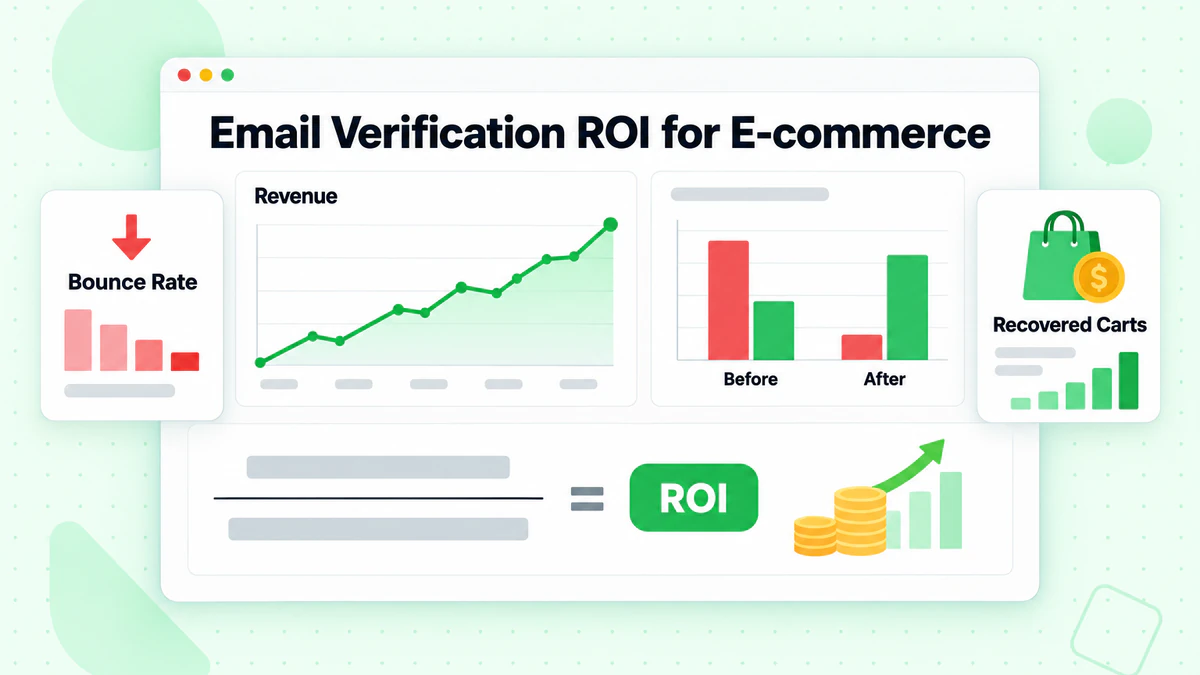
Key Metrics to Track
Monitor these metrics before and after implementing email verification.
Cart Abandonment Rate
Track overall cart abandonment rate and, specifically, abandonment at the email capture step. Email verification should reduce abandonment at this step by providing immediate typo correction.
Email Capture Quality
Monitor the percentage of captured emails that are verified valid. This metric indicates how many potential communication breakdowns you're preventing.
Support Ticket Volume
Track support tickets related to missing order confirmations or communications. These should decrease significantly after implementing email verification.
Cart Recovery Success Rate
Measure your abandoned cart email recovery rate. With better email quality, more recovery emails reach customers, increasing the recovery success rate.
Calculating Dollar Impact
Translate metrics into financial impact.
Recovery Revenue Improvement
If email verification improves your cart recovery rate from 8% to 10%, calculate the additional revenue: 2% more recovered carts × average cart value × monthly abandoned carts = additional monthly revenue.
Support Cost Reduction
Reduced support tickets translate directly to cost savings: fewer tickets × cost per ticket = monthly savings.
Deliverability Value
Improved sender reputation means better inbox placement for all emails. If overall open rates improve 5%, calculate the value of that improvement across all customer communications.
Case Study: E-commerce Email Verification Success
Let's examine a realistic scenario demonstrating email verification impact.
Initial Situation
An online fashion retailer processes 10,000 orders monthly with a cart abandonment rate of 68%. Their cart recovery email program recovers 7% of abandoned carts worth an average of $85.
Without email verification, approximately 12% of captured emails are invalid. This means:
- 6,800 abandoned carts monthly
- 816 potentially invalid email addresses in abandonment pool
- Recovery emails to these addresses bounce, damaging sender reputation
After Email Verification Implementation
After implementing BillionVerify's real-time email verification, the retailer sees significant improvements:
- Invalid email capture drops from 12% to under 1%
- Cart abandonment at email step decreases 8% (customers appreciate typo correction)
- Cart recovery rate improves from 7% to 9% (more emails delivered)
- Support tickets about missing confirmations drop 60%
Financial Impact
Monthly revenue improvement:
- Additional recovered carts: 2% × 6,800 = 136 carts
- Additional revenue: 136 × $85 = $11,560
- Annual additional revenue: $138,720
Support cost savings:
- Reduced tickets: 150 fewer tickets monthly
- Savings: 150 × $15 average = $2,250 monthly
- Annual savings: $27,000
Total annual impact: $165,720 from an email verification investment of approximately $3,000 annually—a 55:1 ROI.
Choosing the Right Email Verification Service for E-commerce
Not all email verification services suit e-commerce needs equally. Evaluate providers on these criteria.
Speed Requirements
E-commerce requires real-time verification. Services must return results in under 500 milliseconds to avoid checkout friction. BillionVerify's sub-200ms average response time exceeds this requirement.
Integration Flexibility
Your verification service must integrate with your e-commerce platform. Look for JavaScript libraries for frontend validation, server-side SDKs for backend processing, and webhook support for advanced workflows.
Accuracy for Transactional Email
E-commerce emails are transactional—they must arrive. Choose services with high accuracy rates that minimize false positives (wrongly rejecting valid addresses) while catching truly invalid addresses.
Scalability
E-commerce traffic fluctuates dramatically during sales events. Ensure your verification provider handles traffic spikes without degraded performance or increased latency.
Pricing Model
Per-verification pricing suits e-commerce well since costs scale with transactions. Avoid services requiring large upfront commitments that don't flex with seasonal variations.
Conclusion
Email verification is no longer optional for serious e-commerce operations. The connection between valid email addresses and reduced cart abandonment is clear and measurable. By implementing real-time email verification at checkout, you prevent typos, enable cart recovery campaigns, ensure transactional email delivery, and ultimately capture more revenue from every visitor. For help choosing the right solution, see our best email verification service comparison.
The ROI case is compelling: email verification typically returns 50x or more its cost through recovered sales, reduced support expenses, and improved customer experience. For e-commerce businesses competing on margins, this optimization opportunity cannot be ignored.
BillionVerify provides the speed, accuracy, and integration flexibility that e-commerce businesses need. Our real-time email verification API catches invalid addresses before they enter your system, protecting your sender reputation and ensuring every customer communication reaches its destination.
Ready to reduce cart abandonment and increase your e-commerce sales? Implement email verification today and start recovering the revenue you've been losing to invalid email addresses.
When evaluating verification providers, compare BillionVerify against ZeroBounce, Clearout, and NeverBounce on e-commerce-specific metrics like checkout speed and real-time API throughput. Our Klaviyo integration and Mailchimp integration make connecting verification to your e-commerce email stack seamless.