



Frustrated by undelivered messages and unclear engagement numbers, many Email Marketing Managers find that a messy database can quietly sabotage even the best B2B campaigns. Growing demand for accountability means that simply sending more emails is no longer enough. By adopting a systematic email verification strategy, you can reduce inbox errors, strengthen security, and drive meaningful results in your 2026 marketing efforts.
Quick Summary
| Key Takeaway | Explanation |
|---|---|
| 1. Conduct Regular Email Audits | Regularly audit your email database to eliminate inactive contacts and duplicates that hurt campaign performance. |
| 2. Implement Real-Time Verification | Use real-time email verification solutions to maintain accuracy and prevent invalid contacts from entering your list. |
| 3. Configure Bulk List Cleaning | Set up bulk cleaning processes to manage large datasets effectively and remove invalid or risky addresses. |
| 4. Detect Disposable Emails | Utilize advanced algorithms to identify and filter out disposable and role-based email addresses to enhance engagement. |
| 5. Review Verification Reports | Systematically analyze verification reports to track quality metrics and identify areas for continuous improvement. |
Step 1: Audit Your Current Email Database
Auditing your email database requires a systematic approach to identify and eliminate potential quality issues that could impact your marketing effectiveness. By applying cybersecurity data management principles, you can create a robust process for maintaining clean email lists.
Start by running a comprehensive verification process across your entire email database. This involves several critical steps:
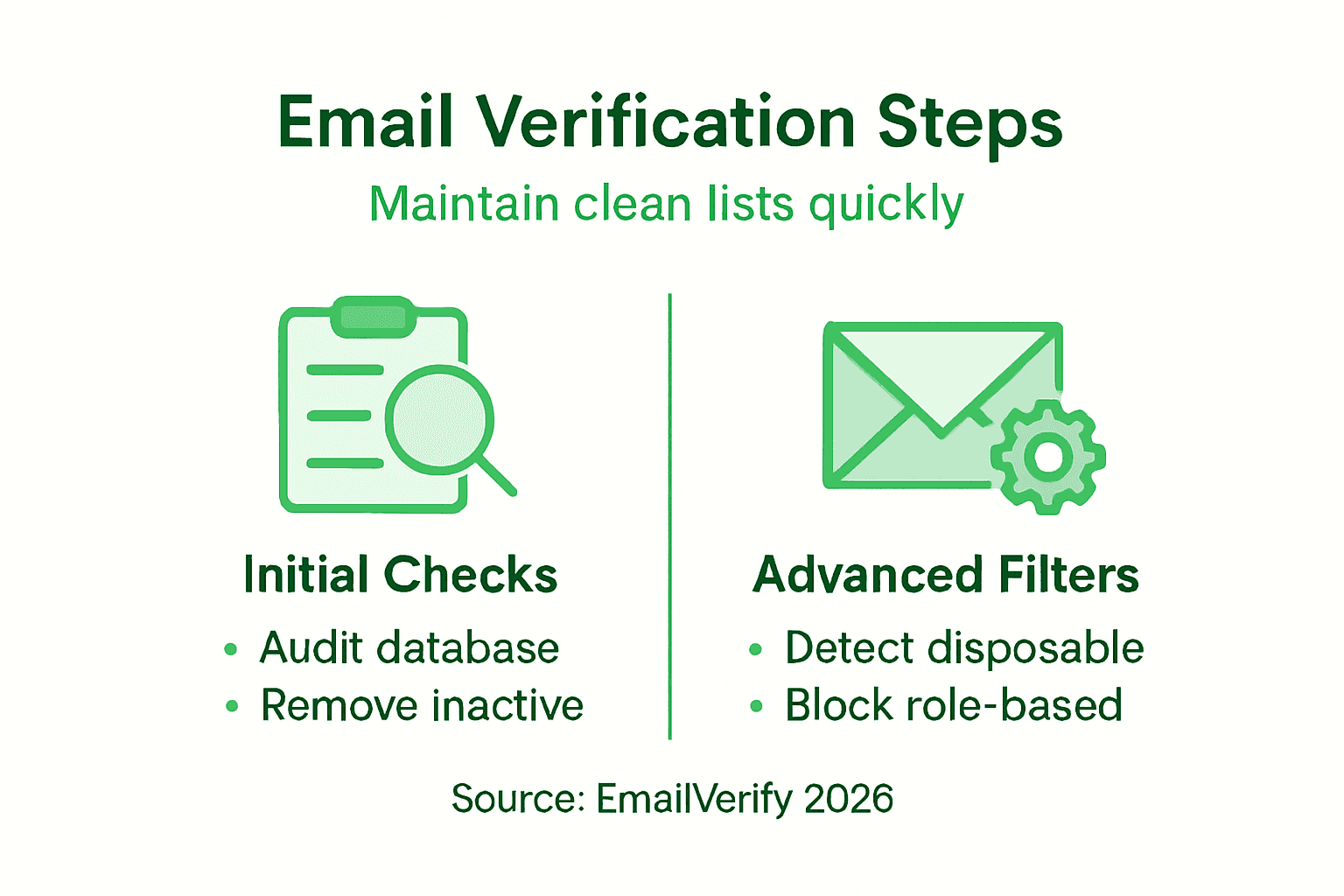
- Identify inactive contacts who haven't engaged with your emails in 6-12 months
- Remove duplicate email addresses that might skew your campaign metrics
- Flag potential spam traps using advanced email validation techniques
- Validate domain and email syntax to ensure technical correctness
To execute this effectively, use automated verification tools that can rapidly scan and categorize your email list. These tools help you understand the health of your database by providing detailed insights into email quality, bounce potential, and engagement likelihood.
Here's a summary of email database issues and their impact on marketing effectiveness:
| Issue Type | Potential Impact | Recommended Prevention |
|---|---|---|
| Inactive Contacts | Lower engagement rates | Regular activity audits |
| Duplicate Addresses | Skewed reporting metrics | Automated deduplication |
| Spam Traps | Damaged sender reputation | Advanced validation tools |
| Syntax/Domain Errors | Increased bounce rates | Syntax and domain checks |
A clean email database is not just about quantity, but about maintaining high-quality, responsive contacts who genuinely want to hear from your brand.
Pro tip: Perform a complete email database audit at least quarterly to maintain optimal list hygiene and marketing performance.
Step 2: Integrate a Real-Time Verification Solution
Real-time email verification is crucial for maintaining the integrity of your marketing database. By implementing multifactor authentication techniques, you can ensure your email lists remain accurate and secure throughout your marketing campaigns.
To successfully integrate a real-time verification solution, follow these strategic steps:
- Select a robust verification API that offers instant email validation
- Configure automatic verification triggers for new email list entries
- Establish real-time validation checkpoints during user registration
- Implement secondary validation mechanisms to catch complex email issues
The goal is to create a seamless validation process that operates invisibly in the background. Modern verification solutions can check email addresses in milliseconds, preventing invalid or potentially harmful contacts from entering your database. These tools analyze multiple data points including domain validity, syntax correctness, and potential spam indicators.
Real-time verification is not just a technical requirement, but a strategic approach to maintaining the quality of your digital communication channels.
Pro tip: Choose a verification solution that provides comprehensive reporting and allows for customizable validation rules to match your specific business needs.
Step 3: Configure Bulk Email List Cleaning
Configuring bulk email list cleaning requires a strategic approach that ensures comprehensive data quality and compliance. By applying systematic configuration management principles, you can develop a robust process for maintaining the integrity of your email database.
To effectively configure your bulk email list cleaning strategy, implement these critical steps:
- Define clear validation parameters for email address filtering
- Establish automated cleaning workflows to process large datasets
- Create tiered verification levels based on email quality scores
- Set up periodic comprehensive list audits
Successful bulk email list cleaning goes beyond simple removal of invalid addresses. It involves sophisticated filtering mechanisms that can identify potential risks such as disposable emails, role-based accounts, and potential spam traps. Modern cleaning solutions use advanced algorithms to assess email quality across multiple dimensions.
Bulk email list cleaning is not just a technical task, but a strategic process that directly impacts your marketing effectiveness and communication quality.
Pro tip: Implement a staged cleaning approach that allows for incremental refinement, giving you granular control over your email list quality.

Step 4: Enable Disposable and Role-Based Detection
Detecting and filtering out disposable and role-based email addresses is critical for maintaining a high-quality marketing database. By leveraging advanced email classification techniques, you can significantly improve the accuracy and reliability of your email verification process.
To effectively implement disposable and role-based email detection, consider these strategic approaches:
- Build comprehensive exclusion databases of known disposable email domains
- Develop sophisticated pattern recognition algorithms for identifying role-based addresses
- Create dynamic scoring mechanisms to assess email quality
- Implement real-time domain reputation checking
Successful detection goes beyond simple blacklisting. Modern verification systems use machine learning algorithms to analyze subtle patterns and characteristics that distinguish legitimate personal email addresses from disposable or generic role-based accounts. This includes examining email syntax, domain reputation, and historical engagement metrics.
Disposable and role-based email detection is not just about filtering out bad addresses, but about protecting the integrity of your communication ecosystem.
Pro tip: Regularly update your detection algorithms to stay ahead of emerging email obfuscation techniques used by spammers and temporary email services.
Step 5: Review Verification Reports for Quality Assurance
Quality assurance in email verification requires a systematic and comprehensive approach to analyzing detailed verification reports. By utilizing rigorous audit evaluation methods, you can ensure the integrity and reliability of your email verification process.
To effectively review verification reports, implement these strategic assessment techniques:
- Examine comprehensive verification metrics across multiple dimensions
- Analyze bounce rate and invalid email percentages
- Compare current results against historical performance benchmarks
- Identify patterns of potential verification gaps
Successful report review involves more than just scanning numbers. Advanced practitioners look for nuanced insights that reveal underlying data quality trends. This means diving deep into granular details such as domain-level rejection rates, syntax error frequencies, and potential systemic verification challenges.
Compare leading email verification strategies for business results:
| Strategy | Security Benefit | Effect on List Quality |
|---|---|---|
| Real-Time Verification | Prevents fraudulent signups | Keeps records updated |
| Bulk List Cleaning | Removes risky addresses | Enhances campaign reach |
| Disposable Detection | Blocks temporary emails | Preserves engagement |
| Report Review | Identifies ongoing issues | Drives continuous improvement |
Quality assurance is not a one-time event, but a continuous process of refinement and improvement in your email verification strategy.
Pro tip: Create a standardized review checklist to ensure consistent and thorough evaluation of verification reports across different marketing campaigns and data sources.
Keep Your Email Lists Spotless and Powerful with BillionVerify
The challenge of maintaining clean and responsive email lists is clearly outlined in "Email Verification Tips 2026: Ensure Clean Lists Fast." Whether you are grappling with inactive contacts, duplicate addresses, or the sneaky presence of disposable and role-based emails, these issues can severely damage your sender reputation and reduce your marketing impact. The article emphasizes the importance of real-time verification, bulk cleaning, and detailed quality assurance - all critical steps to protect your communication ecosystem and boost engagement.
BillionVerify is designed to solve these exact pain points. With a real-time email verification API boasting 99.9% accuracy, bulk email list cleaning, and advanced disposable and role-based detection, you get a comprehensive toolbox for keeping your lists fresh and compliant. Combine that with catch-all server detection and detailed verification reports to continuously improve your data quality. Start taking control of your email marketing success today by visiting BillionVerify for reliable solutions.
Ready to eliminate invalid and harmful contacts fast with trusted technology?
Explore how real-time email verification and bulk email list cleaning can transform your campaigns now. Don’t let bad data hold your marketing back. Visit https://billionverify.com and experience the power of clean, accurate email lists today.
Frequently Asked Questions
How can I perform an effective audit of my email database?
To conduct an effective audit, start by identifying inactive contacts who haven't engaged in the last 6-12 months and remove duplicate email addresses. Regularly verify your email list to ensure it remains clean and accurate.
What steps should I follow to implement real-time email verification?
To implement real-time email verification, select a robust verification API and configure automatic triggers for new entries. Ensure you establish validation checkpoints during user registration to maintain accuracy consistently.
How often should I clean my bulk email lists?
You should perform bulk email list cleaning at least quarterly to maintain optimal email quality. Define clear validation parameters and establish automated workflows to efficiently process large datasets.
What criteria should I use for filtering disposable and role-based email addresses?
Filter disposable and role-based email addresses by building exclusion databases of known disposable domains and using pattern recognition algorithms to identify role-based accounts. Continuously analyze email quality to keep your contacts reliable.
How can I review verification reports for ongoing quality assurance?
Review verification reports by examining metrics such as bounce rates and invalid email percentages. Identify patterns that indicate verification gaps and use these insights to drive continuous improvement in your email list quality.