



Enterprise email lists decay rapidly, with invalid addresses accumulating from user churn, typos, and spam traps. Selecting the right verification strategy ensures your campaigns reach real inboxes, protect sender reputation, and maximize ROI. This guide provides a clear framework comparing real-time versus bulk methods, multi-layer technology, integration capabilities, and pricing models to help marketing and data executives make informed decisions that scale with business growth.
Key takeaways
| Point | Details |
|---|---|
| Multi-layer verification reduces bounce rates by over 98% compared to basic syntax checks. | Combines domain validation, mailbox existence, and risk detection for comprehensive accuracy. |
| Real-time API excels for immediate validation during signups, while bulk suits scheduled large-scale hygiene. | Real-time prevents invalid leads; bulk cleans existing databases efficiently. |
| CRM and marketing integration automates workflows, boosting operational efficiency by 30-50%. | Pre-built connectors sync verification results and eliminate manual data entry. |
| Risky emails like disposable addresses and spam traps severely harm deliverability if left unchecked. | Advanced detection layers protect sender reputation and reduce complaint rates. |
| Flexible pricing with volume discounts and trial periods helps customize enterprise solutions cost-effectively. | Negotiable contracts allow scalable growth without long-term lock-ins. |
How to choose the right email verification strategy for enterprises
Selecting an email verification platform requires evaluating multiple dimensions that directly impact campaign performance and operational efficiency. Scalability stands first: your solution must handle millions of verifications monthly without degradation. Accuracy demands multi-layer validation technology that goes beyond simple syntax checks to confirm mailbox existence and detect hidden risks.
Integration capability with existing CRM and marketing platforms streamlines workflows and eliminates data silos. You need seamless API connections to systems like Salesforce, HubSpot, and Marketo to automate verification at every touchpoint. Evaluation criteria for enterprise email verification include scalability, accuracy, integration, verification frequency, pricing flexibility, and risk detection capabilities to ensure comprehensive list hygiene.
Verification frequency presents a strategic choice: real-time validation during data capture versus bulk processing on scheduled intervals. Each mode serves distinct operational needs and resource requirements. Pricing flexibility matters equally, as enterprise volumes demand customized contracts with volume discounts and trial periods to validate performance before commitment.
Risk detection capabilities separate basic from advanced platforms. Your verification strategy must identify disposable emails, role-based addresses, spam traps, and catch-all domains that threaten deliverability. Prioritize providers offering proprietary algorithms for these edge cases to minimize false positives while maintaining rigorous filtering.
Key evaluation criteria include:
- Scalability: Capacity to verify millions of emails monthly
- Accuracy: Multi-layer technology beyond syntax validation
- Integration: Native connections to major CRM and marketing systems
- Frequency options: Real-time API and bulk processing modes
- Pricing flexibility: Volume discounts and negotiable contracts
- Risk detection: Advanced identification of problematic email types
When evaluating platforms, follow this decision framework:
- Define monthly verification volume and growth projections
- List required CRM and marketing platform integrations
- Determine whether real-time, bulk, or hybrid verification fits workflows
- Assess risk tolerance for disposable and catch-all domains
- Compare total cost of ownership including operational efficiencies
- Request trials to validate accuracy and integration performance
This structured approach ensures your high deliverability verification strategy aligns with business objectives and technical requirements.
Core multi-layer email verification strategies
Multi-layer verification combines several validation stages to achieve accuracy rates that basic checks cannot match. Syntax validation forms the first layer, catching obviously malformed addresses with invalid characters or structural errors. Domain validation follows, confirming that the domain exists, has valid DNS records, and can receive mail.

Mailbox existence verification via SMTP handshake represents the critical third layer. This process connects to the recipient mail server to confirm the specific mailbox exists and accepts messages, drastically reducing hard bounces. Multi-layer verification technology combining syntax checking, domain validation, mailbox existence, and advanced detection reduces bounce rates by over 98% in enterprise email lists.
Advanced detection layers identify hidden threats that standard validation misses. Disposable email detection spots temporary addresses from services like Mailinator or Guerrilla Mail that users abandon immediately. Role-based address detection flags generic mailboxes like info@ or sales@ that rarely engage with marketing content. Spam trap identification prevents sending to honeypot addresses that ISPs use to identify poor list hygiene practices.
Catch-all domain handling requires sophisticated heuristics because these servers accept all addresses, making traditional verification ambiguous. Quality platforms use proprietary algorithms analyzing response patterns and historical data to assess catch-all address legitimacy without excessive false positives.
Blacklisting protection stems directly from these verification layers. By removing spam traps, invalid addresses, and high-risk contacts before sending, you maintain clean sender reputation with ISPs. Complaint rates drop when you avoid role-based and disposable addresses that generate spam reports.
Key multi-layer verification components:
- Syntax checking: Validates email structure and character legality
- Domain validation: Confirms DNS records and mail server existence
- SMTP verification: Tests actual mailbox existence via server handshake
- Disposable detection: Identifies temporary email services
- Role-based filtering: Flags generic organizational addresses
- Spam trap identification: Prevents honeypot address contact
- Catch-all analysis: Applies heuristics to ambiguous domains
Pro Tip: Enterprises should prioritize verification platforms offering proprietary heuristics for catch-all domains to minimize false positives while maintaining strict filtering on clearly risky addresses.
The technical advantages of multi-layer verification extend beyond bounce reduction to measurable improvements in engagement metrics. When you send only to validated, active mailboxes, open rates and click-through rates increase because your messages reach real people. Conversion rates improve as lead quality rises and sales teams spend time on genuine prospects rather than dead ends.
Modern enterprise verification technology processes these layers in milliseconds for real-time validation or handles millions of records hourly for bulk operations. This scalability ensures verification never becomes a bottleneck in your marketing workflows. Independent email verification deliverability study data confirms that comprehensive verification approaches deliver consistently superior results across industries and list sizes.
Real-time versus bulk verification methods
Real-time API verification validates email addresses at the moment of data capture during form submissions, registrations, or checkout processes. This immediate validation prevents invalid addresses from entering your database, maintaining list quality from the start. Integration with signup forms provides instant feedback to users, allowing them to correct typos before submission.
Bulk verification processes entire email lists on scheduled intervals or before major campaigns. This method efficiently cleans large datasets containing thousands or millions of addresses, identifying decay that accumulates over time from user churn and address changes. Bulk processing typically costs less per verification when handling large volumes.
Real-time validation reduces invalid signups by approximately 25%, directly improving lead quality and reducing wasted sales effort. Marketing teams spend time nurturing genuine prospects rather than chasing dead addresses. Customer acquisition costs decrease when every lead represents a real potential customer.
Bulk verification reduces bounce rates up to 20% over time by systematically removing accumulated invalid addresses. Regular bulk cleaning every 30 to 90 days maintains list health as natural decay occurs. This scheduled maintenance approach suits databases where most addresses remain stable between verification cycles.
System resource demands differ significantly between methods. Real-time verification requires constant API uptime and fast response times under 200 milliseconds to avoid form submission delays. Your infrastructure must handle peak traffic loads without degradation. Bulk verification needs scalable batch processing capacity to handle millions of records within reasonable timeframes, typically measured in hours rather than milliseconds.
| Feature | Real-Time API | Bulk Verification |
|---|---|---|
| Validation timing | Immediate at capture | Scheduled intervals |
| Primary use case | Form signups, registrations | List hygiene, pre-campaign cleaning |
| Cost structure | Per-verification, higher unit cost | Volume discounts, lower unit cost |
| Infrastructure needs | High uptime, low latency | Batch processing capacity |
| Lead quality impact | 25% reduction in invalid signups | 20% bounce rate improvement |
| Integration complexity | API implementation required | File upload or scheduled jobs |
Operational considerations:
- Real-time validation provides immediate user feedback for typo correction
- Bulk processing allows flexible scheduling around campaign timelines
- Hybrid approaches combine both methods for comprehensive coverage
- Real-time prevents list pollution; bulk remediates existing contamination
- API rate limits may require request throttling for high-traffic forms
- Bulk verification supports compliance with data retention policies
Pro Tip: Combine real-time validation for lead capture with regular bulk verification every 60 days for optimal results. This hybrid approach maintains ongoing list quality while catching decay between campaigns.
The real-time vs bulk verification decision depends on your operational workflow and data quality priorities. High-volume lead generation benefits most from real-time validation, while established databases with periodic campaign cycles favor bulk processing. Many enterprises implement both methods, using real-time for new data and bulk for maintenance.
Detailed bulk verification workflow implementation typically involves exporting lists from your CRM, uploading to the verification platform, processing records through multi-layer checks, and importing results with status flags for each address. Automation tools can schedule these workflows to run without manual intervention.
Integration capabilities with CRM and marketing systems
Seamless integration with existing marketing technology stacks amplifies verification value by automating data hygiene across every customer touchpoint. Robust APIs enable direct connections to popular CRM platforms like Salesforce, HubSpot, and Microsoft Dynamics, eliminating manual export and import workflows. Pre-built connectors reduce integration complexity and accelerate time to value.
Automated workflows trigger verification at strategic points in the customer lifecycle. New contact creation in your CRM can automatically initiate real-time validation before the record becomes active. Email list imports trigger bulk verification jobs that append validation status to each record. Marketing automation platforms can segment contacts based on verification results, ensuring campaigns target only validated addresses.
Real-time synchronization of verification results ensures marketing databases remain current without manual updates. When verification identifies an invalid address, the status updates immediately in your CRM, preventing future sends. Valid status confirmations flow back to enable immediate campaign inclusion. This bidirectional data flow maintains consistency across systems.
Operational efficiency improvements of 30 to 50% are common when verification integrates tightly with marketing workflows. Marketing teams spend less time on manual list hygiene tasks and data quality troubleshooting. Campaign deployment accelerates when verification runs automatically rather than requiring separate processing steps. IT resources shift from maintaining custom integrations to focusing on strategic initiatives.
Integration benefits:
- Native API connections to 20+ major marketing and CRM platforms
- Automated verification triggers on contact creation or import
- Bidirectional data sync maintains consistent validation status
- Webhook support enables custom workflow automation
- Batch API endpoints handle high-volume operations efficiently
- OAuth authentication ensures secure data transmission
Enterprise evaluation criteria should include:
- Platform support for your specific CRM and marketing automation tools
- Availability of pre-built connectors versus custom API integration
- Documentation quality and developer support resources
- Webhook and automation trigger capabilities
- Data mapping flexibility for custom fields and attributes
- Rate limit policies for high-volume API usage
The email deliverability workflow integration creates a closed-loop system where verification continuously monitors and maintains list quality. Marketing operations become more predictable and reliable when verification happens automatically rather than as an occasional manual task. Campaign performance improves systematically as invalid addresses never reach send lists.
Modern verification platforms provide REST APIs with comprehensive endpoints for single-address validation, bulk job submission, result retrieval, and account management. Webhook notifications alert your systems when bulk jobs complete or validation status changes. This event-driven architecture enables reactive workflows that respond immediately to data quality issues.
Handling risky emails: disposable, role-based, and catch-all domains
Disposable email addresses from temporary services like Mailinator, 10MinuteMail, or Guerrilla Mail represent low-value contacts who deliberately avoid lasting engagement. Users create these addresses to access gated content, receive one-time discounts, or bypass registration requirements without commitment. Marketing to disposable addresses wastes resources and skews engagement metrics downward.
Role-based addresses such as info@, support@, sales@, or admin@ typically route to shared mailboxes monitored by multiple team members. These addresses serve organizational functions rather than individual recipients. While technically valid, role-based addresses generate lower engagement rates and higher complaint rates because recipients didn't personally opt in. ISPs view high role-based sending volumes as poor list hygiene.
Catch-all domains accept email sent to any address at that domain, regardless of whether the specific mailbox exists. A catch-all configuration means validation receives positive responses even for non-existent addresses. This creates verification ambiguity: the domain is valid, but the specific recipient may not be. Catch-all domains require advanced heuristics analyzing historical patterns and domain reputation to assess address legitimacy.
Accurate detection and filtering of these risky email types reduces bounce rates and improves sender reputation with ISPs. When you consistently send to engaged, valid recipients rather than problematic addresses, inbox placement rates increase. Spam folder delivery decreases as ISPs recognize your clean sending practices. Blacklist risk diminishes because you avoid the honeypot addresses and complaint sources that trigger listing.
Detection approaches:
- Disposable domain databases: Maintain updated lists of known temporary email providers
- Pattern recognition: Identify structural similarities in disposable service addresses
- Role-based syntax analysis: Flag common organizational mailbox prefixes
- Catch-all SMTP testing: Analyze server responses to random addresses
- Historical data analysis: Track domain behavior patterns over time
- Reputation scoring: Assign risk levels based on multiple factors
Recommended handling workflow:
- Run verification to flag disposable, role-based, and catch-all addresses
- Segment flagged addresses into separate suppression lists
- Apply different sending policies based on risk tolerance
- Consider manual review for high-value catch-all domain prospects
- Monitor engagement metrics by segment to validate filtering decisions
- Update suppression rules based on performance data
Enterprises should prioritize providers with advanced heuristics to minimize false positives on catch-all domains. Overly aggressive filtering can remove legitimate business contacts, while insufficient filtering allows problematic addresses through. The optimal balance requires sophisticated algorithms trained on large datasets.
Risk mitigation extends beyond initial verification to ongoing monitoring. Email addresses can become risky over time as domains change configuration or users switch to disposable services. Regular re-verification every 60 to 90 days catches these changes before they impact campaigns. Engagement-based suppression complements verification by removing addresses that consistently fail to open or click regardless of technical validity.
Pricing and contract considerations
Enterprise email verification pricing typically follows a pay-per-verification model with volume-based discount tiers. Providers charge per address checked, with rates decreasing as monthly volume increases. Common tier breaks occur at 100,000, 500,000, 1 million, and 5 million verifications monthly. Bulk verification generally costs less per address than real-time API validation due to processing efficiency.
Flexible contract terms allow enterprises to scale verification usage without long-term commitments that become constraints. Month-to-month agreements provide maximum flexibility for testing and seasonal volume fluctuations. Annual contracts typically offer additional discounts but should include clauses for volume adjustments based on business growth.
Trial periods enable performance validation before financial commitment. Quality providers offer free trial credits or limited-time access to test accuracy, integration ease, and support responsiveness. Use trials to verify claimed detection rates against your actual email lists and validate API integration with your existing systems.
Additional costs may arise from premium features, dedicated support, or custom integration assistance. Some providers charge separately for advanced risk detection, priority processing, or dedicated account management. Integration support fees can apply for custom API development or specialized connector building. Clarify all potential charges upfront to calculate total cost of ownership accurately.
Cost comparison factors:
- Base per-verification pricing across volume tiers
- Real-time versus bulk verification rate differences
- Contract length discounts and commitment requirements
- Included versus premium feature pricing
- Integration and setup fees
- Support tier costs (standard, priority, dedicated)
- Data retention and re-verification policies
Enterprises should compare total cost of ownership including operational efficiencies gained through automation. A higher per-verification price may deliver better ROI if superior accuracy reduces bounce rates and integration capabilities save staff hours. Calculate costs based on realistic monthly volumes including growth projections rather than current minimums.
Negotiation opportunities exist for custom plans based on specific verification volume and frequency patterns. Providers value predictable revenue from large enterprise accounts and often accommodate special pricing structures. Discuss your exact needs: perhaps you need high real-time volume but minimal bulk processing, or vice versa. Custom contracts can align pricing with your unique usage patterns.
Key negotiation points:
- Volume commitments in exchange for deeper discounts
- Rollover credits for unused monthly allocations
- Flexible tier adjustments based on seasonal fluctuations
- Bundled pricing for multiple verification methods
- Trial extension for thorough evaluation
- Service level agreements for uptime and response times
Request detailed pricing examples with your projected volumes. Ask for case studies showing cost savings other enterprises achieved through improved deliverability and reduced bounce rates. Calculate payback period based on expected improvements in campaign ROI and operational efficiency.
Summary comparison and situational recommendations
Comprehensive comparison of verification strategies reveals distinct strengths matching different enterprise scenarios. Scalability varies: some platforms excel at real-time validation under high concurrent load, while others optimize for massive bulk processing throughput. Accuracy differences stem from verification layer depth and risk detection sophistication. Integration breadth determines workflow automation potential.
| Factor | Real-Time API Focus | Bulk Processing Focus | Integrated Platform |
|---|---|---|---|
| Best for | High-volume signups | Periodic list hygiene | Automated workflows |
| Scalability | Concurrent API calls | Batch throughput | Both modes supported |
| Accuracy | Multi-layer validation | Comprehensive checks | Advanced risk detection |
| Integration | API-first design | File-based workflows | Native CRM connectors |
| Pricing | Higher per-unit cost | Volume discounts | Flexible hybrid pricing |
| Risk detection | Essential types | Full spectrum | Proprietary algorithms |
Real-time API verification receives top recommendation for enterprises prioritizing lead quality at data capture. E-commerce platforms, SaaS signup flows, and high-volume registration systems benefit most from immediate validation that prevents invalid addresses from entering databases. The 25% reduction in invalid signups directly improves sales team efficiency and customer acquisition costs.
Bulk verification suits enterprises with established databases requiring periodic maintenance. B2B companies with stable contact lists, newsletter publishers, and organizations running monthly or quarterly campaigns achieve optimal results with scheduled bulk cleaning. The 20% bounce rate improvement protects sender reputation while maintaining cost efficiency.
Multi-layer verification with comprehensive risk detection stands as essential regardless of operational mode. Enterprises cannot afford to skip disposable email detection, spam trap identification, or catch-all domain analysis. These advanced layers protect sender reputation and prevent the deliverability degradation that threatens campaign ROI.
Integrated platforms deliver maximum operational efficiency for enterprises managing complex marketing technology stacks. When verification connects natively to your CRM, marketing automation, and email service provider, automation eliminates manual data quality tasks. The 30 to 50% efficiency improvement justifies premium pricing through staff time savings and faster campaign deployment.
Situational recommendations:
- High-growth SaaS: Real-time API with aggressive filtering to maintain lead quality during rapid user acquisition
- Enterprise B2B: Hybrid approach with real-time for new contacts and quarterly bulk verification for database maintenance
- E-commerce: Real-time validation at checkout with disposable and role-based filtering to reduce fraud and improve customer data
- Email marketing agencies: Bulk verification with client-by-client processing and detailed reporting for transparency
- Marketing automation users: Integrated platform with native CRM connectors and automated workflow triggers
Final selection criteria prioritize accuracy and integration over price alone. Poor verification that misses spam traps or generates false positives costs more through damaged reputation and lost opportunities than premium pricing for superior technology. Evaluate providers based on verification methodology transparency, integration breadth with your existing systems, and demonstrated results with similar enterprise clients.
Explore BillionVerify's AI-first email verification solutions
BillionVerify delivers enterprise-grade verification combining the multi-layer accuracy and flexible deployment options discussed throughout this guide. Our AI-first email verification solutions apply machine learning to catch-all domain analysis and disposable email detection, achieving accuracy rates exceeding 98% while minimizing false positives that competitors miss.
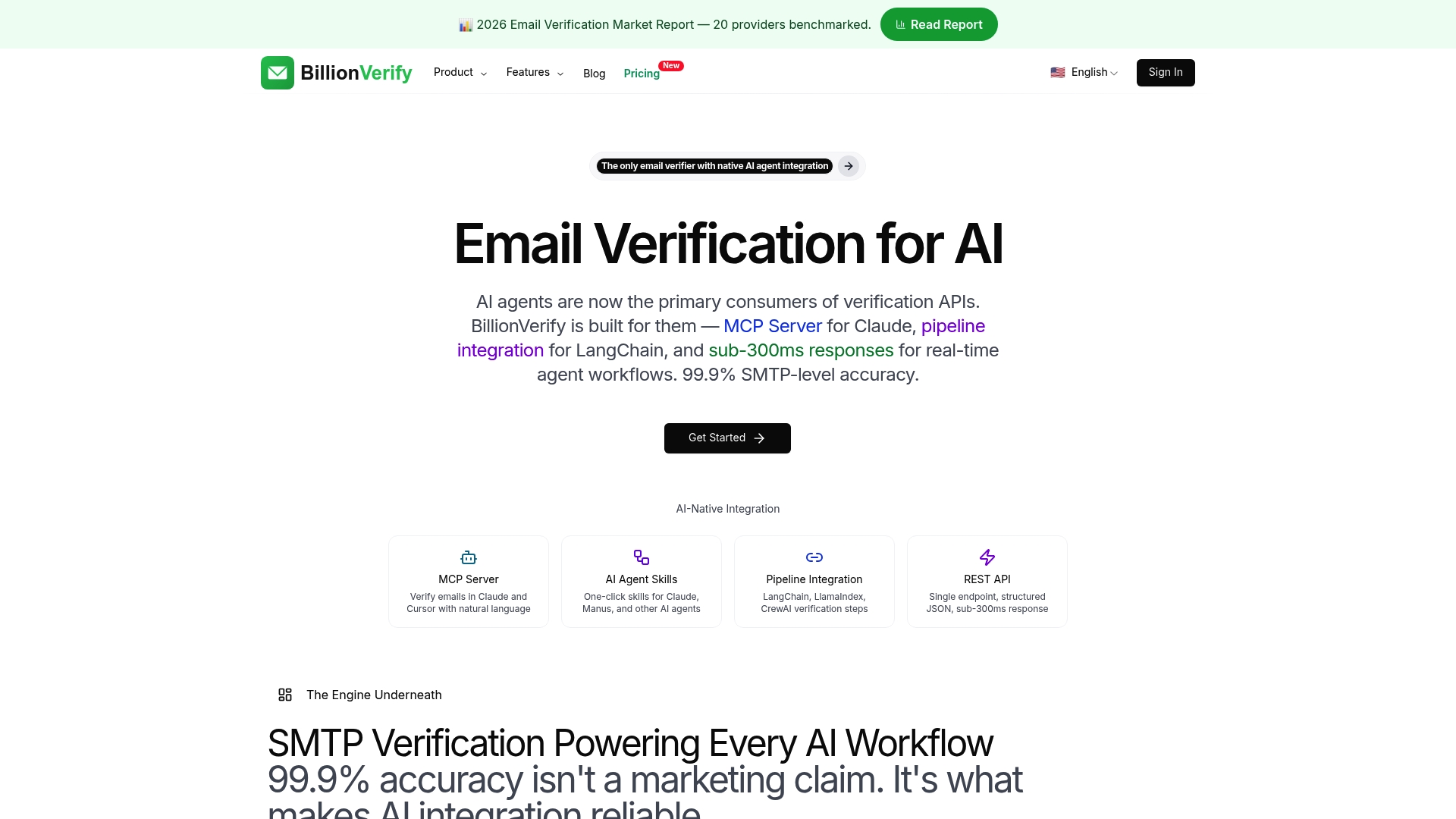
The platform supports both real-time API validation and bulk processing modes, adapting to your specific workflow requirements. Real-time verification integrates seamlessly with signup forms and registration processes, while bulk verification handles millions of records efficiently for scheduled list maintenance. Flexible pricing scales with your verification volume, offering volume discounts and trial credits to validate performance with your actual email lists.
Seamless integration with major CRM and marketing platforms automates verification across your customer lifecycle. Pre-built connectors for Salesforce, HubSpot, Marketo, and 20+ other systems eliminate manual data transfers and keep validation status synchronized. This automation delivers the 30 to 50% operational efficiency improvements that justify verification investment through reduced staff hours and faster campaign deployment.
Our enterprise email verification platform provides the comprehensive risk detection, scalability, and integration capabilities that marketing and data management executives require. Discover how BillionVerify can reduce bounce rates, protect sender reputation, and improve campaign ROI effectively.
Frequently asked questions
What are the main advantages of multi-layer email verification?
Multi-layer verification combines syntax checking, domain validation, SMTP mailbox confirmation, and advanced risk detection to achieve accuracy rates exceeding 98%. This comprehensive approach identifies not just invalid addresses but also risky types like disposable emails, spam traps, and role-based addresses that harm deliverability. By removing these problematic contacts before sending, you protect sender reputation and maintain strong inbox placement rates with ISPs.
When should enterprises use real-time versus bulk verification?
Real-time API verification works best for immediate validation during user signups, registrations, and data capture forms where preventing invalid addresses at entry maintains list quality continuously. Bulk verification suits periodic large-scale data hygiene for established databases, typically run every 30 to 90 days before major campaigns or as scheduled maintenance. Many enterprises implement both methods: real-time for new contacts and bulk for existing database cleaning.
How do integration capabilities impact email verification effectiveness?
Integration automates verification workflows by connecting directly to CRM and marketing platforms, eliminating manual exports and imports that waste staff time. Automated data synchronization updates validation status in real time, ensuring campaigns always target current, verified addresses. This integration delivers 30 to 50% operational efficiency improvements through reduced manual tasks, faster campaign deployment, and consistent data quality across marketing systems without IT intervention.
What pricing models do enterprise email verification services typically offer?
Most services charge per verification with volume-based discount tiers that reduce unit costs as monthly usage increases. Common breaks occur at 100,000, 500,000, 1 million, and 5 million verifications monthly. Flexible contracts range from month-to-month agreements offering maximum adaptability to annual commitments providing deeper discounts. Trial periods with free credits allow performance validation before financial commitment, helping enterprises assess accuracy and integration fit with actual email lists.