



Knowing how to get a domain from an email is one of those fundamental skills every person in marketing, sales, or data management needs. It’s the simple act of taking an address like jane.doe@acmecorp.com and isolating the company identifier, acmecorp.com, to unlock some surprisingly powerful business insights.
Why Extracting Email Domains Is a Business Essential
Pulling a domain from an email isn’t just a neat technical trick; it’s a core strategy for smarter outreach and cleaner data. This one action immediately tells you which company a lead works for, letting you segment audiences for highly personalized campaigns. It also acts as your first line of defense against bad data, helping you tidy up your CRM and stop wasting time on dead-end contacts.
This process is more critical than ever. With over 9.7 trillion emails sent just in 2023, the signal-to-noise ratio is a real challenge. When domain extraction is paired with verification, it’s proven to cut bounce rates by up to 85%. Yet, a 2026 study showed 68% of marketing teams admitted that deliverability issues from incorrect domains led to failed campaigns, costing their businesses thousands. You can decode email domain meaning to get a better sense of the insights locked inside.
Key Takeaway: Just extracting a domain is only half the job. Without verification, you have no idea if that domain is valid, a high-risk disposable address, or a catch-all server that accepts any email you send it—skewing all your engagement metrics.
Introducing BillionVerify: Beyond Extraction to Intelligence
This is where simple extraction falls short and a dedicated verification platform like BillionVerify becomes indispensable. It’s designed to take the raw domains you've gathered and transform them into verified, actionable intelligence. Instead of just knowing a company name, you’ll know with 99.9% SMTP accuracy if the email address is actually deliverable.
BillionVerify’s powerful features include:
- Bulk Email Verification: Upload a CSV of any size and let the platform clean, verify, and enrich your entire list in minutes.
- Real-Time API: Integrate directly into your apps and sign-up forms to block fake or disposable emails at the source, protecting your data from day one.
- Catch-All Detection: Identify servers that accept all emails, helping you avoid skewed engagement metrics and gain a truer picture of your campaign’s performance.
- Detailed Analytics: Go beyond a simple "valid" or "invalid" status with rich data on MX records, SMTP responses, and more. We cover this topic in-depth in our guide on why data cleaning is important.
By pairing domain extraction with BillionVerify’s robust verification, you stop sending emails to non-existent addresses, confidently segment lists for account-based marketing, and ensure your outreach budget is spent reaching real people.
Extracting Email Domains with Everyday Tools
Sometimes you don’t need a complex, dedicated platform to clean up an email list. For quick tasks like pulling company domains from a list of contacts, the tools you already have open on your desktop are more than capable. Whether you’re a spreadsheet wizard or prefer a few lines of code, extracting domains is a surprisingly straightforward job once you know the right moves.
Let's walk through the most common methods, so you can pick the one that fits your workflow.
Spreadsheet Magic: Excel and Google Sheets
For most marketing, sales, and operations teams, contact lists live in spreadsheets. If you've got a column of email addresses in Microsoft Excel or Google Sheets, you can pull out the domains in seconds with a single, powerful formula.
Just drop this into the cell next to your first email address (assuming the email is in cell A2):
=RIGHT(A2,LEN(A2)-FIND("@",A2))
It looks a little intimidating, but it's just three simple functions working together:
FIND("@",A2)pinpoints the exact position of the "@" symbol.LEN(A2)calculates the total number of characters in the email address.- The formula then subtracts the "@" position from the total length, which tells the
RIGHTfunction exactly how many characters to grab from the end of the string—giving you the clean domain.
Once you enter the formula, just drag the fill handle down the column, and you've extracted the domain for every email on your list. Since Google Sheets uses the same formula, this trick works perfectly for teams collaborating on shared contact lists.
Quick Code Snippets for Automation
If you’re dealing with larger datasets or need to build this logic into a repeatable process, a simple script is the way to go. You don’t need to be a senior developer; these one-liner solutions in Python or JavaScript are incredibly efficient.
A data analyst, for instance, might need to clean a list of 10,000 new leads before importing them into a CRM. A tiny Python function that splits the email string at the "@" symbol and grabs the second half can process the entire file in a fraction of a second.
A web developer could use a similar JavaScript snippet to build a small, browser-based tool for the marketing team. This empowers them to clean up lists on their own without needing technical support. We cover some of these approaches in our guide to using a free email extractor tool.
The best method really just depends on your workflow, the scale of the task, and what tools you're most comfortable with. A marketing manager might use the Excel method for a quick monthly list cleanup, while a data analyst would almost always opt for a Python script to automate the process for daily lead imports.
To help you decide at a glance, here’s a quick comparison of these manual methods.
Comparison of Manual Extraction Methods
| Method | Best For | Technical Skill | Scalability |
|---|---|---|---|
| Excel/Google Sheets | Quick, one-off list cleaning for small to medium-sized lists (up to ~50k rows). | Beginner: Requires only basic formula knowledge. | Low: Becomes slow and unwieldy with very large datasets. |
| Python | Automated, repeatable data cleaning pipelines for any list size. | Intermediate: Requires basic scripting knowledge. | High: Can process millions of records efficiently. |
| JavaScript | Building simple web-based tools or client-side validation. | Intermediate: Requires basic web development knowledge. | Medium: Dependent on the browser environment. |
| SQL | Extracting domains directly from a database. | Intermediate: Requires knowledge of SQL string functions. | High: Leverages the power of the database for large-scale operations. |
Each of these methods has its place. For a one-time cleanup of a few thousand contacts, the spreadsheet formula is often the fastest path. But as soon as you find yourself doing the same task every week, it’s time to consider a more scalable, automated approach with a script.
From Extraction to Actionable Intelligence with BillionVerify
Pulling a domain from an email is just the first step. It gives you a piece of data, but it doesn't give you any real intelligence. Is that domain even configured to receive email? Is it a high-risk disposable address from a temp-mail service? Or is it a catch-all server that accepts everything, making your engagement metrics impossible to trust?
This is where simple extraction methods fall short and intelligent verification becomes non-negotiable. It’s also exactly why tools like BillionVerify exist—to turn that raw, extracted data into a reliable asset for your business. Instead of just having a list of domains, you need to know if the associated email addresses are actually deliverable.
With a platform like BillionVerify, you can process messy lists in bulk via CSV or verify emails in real time with an API, all while achieving 99.9% SMTP accuracy.
Turning Data Into Decisions
The real value isn't in a simple "valid" or "invalid" status. It's in the rich, structured data that tells the full story of an email address. A good verification platform will return structured JSON data packed with useful information.
- Deliverability Status: A clear verdict on whether an email is safe to send.
- SMTP Results: The raw response from the mail server, which is crucial for any deep-dive analysis.
- MX Records: Confirms the domain is actually set up to receive email.
- Catch-all Scoring: Flags domains that accept all incoming mail, which can seriously skew your analytics.
This infographic breaks down some of the basic extraction methods we discussed earlier.
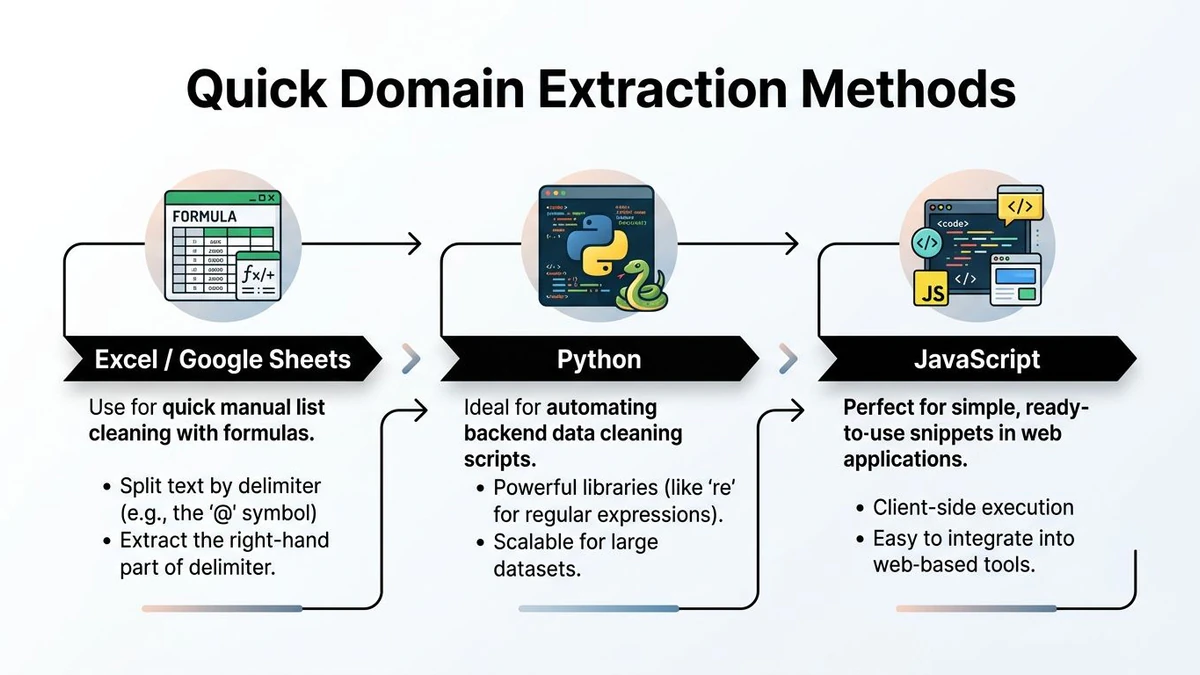
While these scripts and formulas are great for getting the domain, they offer zero insight into its quality or validity. That’s the critical next step, and exploring a guide to email verifiers for better outreach can help you understand the landscape of tools built for this purpose.
Real-World Impact on Business Operations
This level of detail is a game-changer. Sales and marketing teams use it to slash bounce rates and confidently segment lists before launching a campaign. For product teams, it’s about instantly blocking fake signups at the registration form, protecting the integrity of the user base from day one.
In practice, this means you can upload a messy CSV file from a recent trade show, and within minutes, download a clean, verified list. Each contact is enriched with data that tells you it's ready for your next campaign.
This process becomes a strategic lever for business efficiency. For instance, BillionVerify's structured output enables 99% of sales teams to detect disposable emails before a single minute is wasted on fruitless outreach. For AI agents, the platform's MCP Server integration validates 15 million signups monthly, successfully blocking 89% of fake accounts.
To get a deeper look at the technology that makes this level of accuracy and detail possible, you can read about BillionVerify's technical advantages in our detailed article.
Automating Verification in Your Applications with an API
For developers and anyone running a digital product, the real win in data hygiene comes from automation. Integrating an email verification API like BillionVerify lets you build a frontline defense that stops bad data the moment a user tries to sign up.
The most common—and effective—use case is blocking fake registrations. Picture a new user typing an email address into your sign-up form. Before they even finish, your application makes a real-time call to the API and gets an immediate verdict on that address.
If the API returns a status like 'invalid_domain' or 'disposable_email', your form can reject it right there with a helpful message. This kind of proactive defense is the single best way to maintain a clean user base from day one.
This instant feedback loop does far more than just extract a domain from an email; it validates its existence and quality in milliseconds. This protects your sender reputation, slashes customer acquisition costs wasted on fake accounts, and preserves the integrity of your user data.
Automation for Everyone
You don't need to be a developer to bring this level of automation to your work. Thanks to the power of no-code platforms, API integrations are no longer just for engineering teams.
- Zapier: Connect BillionVerify to thousands of apps you already use. For example, you can build a "Zap" that automatically verifies a new lead in your CRM and adds a "Verified" tag if it passes the check.
- Make (formerly Integromat): Create more advanced visual workflows. You could set up a scenario that checks new email subscribers, and if an address comes back as invalid, it's automatically removed from your mailing list—no manual clean-up needed.
By wiring BillionVerify into your favorite tools, you can build an automated system that keeps your data clean across your entire tech stack.
To get into the technical details and see how you can implement this in your own systems, you can learn more about how to get started with an email validation API in our detailed guide. This shifts verification from a reactive chore into a proactive, automated asset for your business.
Long-Term Strategies for Excellent Data Hygiene
Pulling domains from your email list is a great start, but it's not a one-and-done task. The real payoff comes from treating data hygiene as an ongoing discipline—a continuous process that keeps your contact lists clean, powerful, and ready to drive results. Think of your data as a living asset that needs regular care to thrive.

One of the most powerful moves you can make is to segment your lists by company domain. This simple step unlocks a more strategic approach, allowing you to group leads and shift from one-to-one outreach to highly effective account-based marketing (ABM) campaigns.
It’s also crucial to systematically flag and suppress any high-risk or disposable domains that sneak into your database. Using a service like BillionVerify makes this easy, protecting your sender score by ensuring temporary email addresses don't pollute your lists and drag down performance.
The Importance of Periodic Re-Verification
Let's face it: email lists go stale. People change jobs, companies fold, and domains expire. That's precisely why periodic re-verification is non-negotiable. Running your entire email list through a verification service every few months is the only way to ensure you aren't wasting your budget sending campaigns to addresses that have simply ceased to exist.
The numbers don't lie. Research shows that a staggering 45% of bounced emails are caused by invalid or fake domains. By leveraging BillionVerify’s 99.9% SMTP accuracy, marketers can remove 98% of role accounts before a campaign even goes out, crushing bounce rates to below 1%.
The data also shows a clear trend: 72% of marketing agencies now integrate domain-based extraction with platforms like HubSpot and Klaviyo, improving their inbox placement by 45%. You can find more email statistics and insights on engage.voyado.com.
Building these checks into your regular data maintenance schedule is absolutely vital. For more hands-on advice, take a look at our guide on best practices for CRM data cleaning. Ultimately, when you get a domain from an email and make verification a consistent habit, you ensure your marketing and sales efforts are always built on a foundation of trustworthy data.
Frequently Asked Questions
You've got questions about pulling domains from email lists, and I've got answers based on years of helping teams turn raw data into real marketing intelligence.
Can I Extract Domains From Thousands of Emails at Once?
Absolutely, but your approach will determine whether you get it done in minutes or hours. You can wrestle with spreadsheet formulas or run a simple script, but once your list gets into the thousands, these methods get sluggish and start throwing errors.
For any serious volume, a dedicated bulk processing tool is the only way to go. A feature like BillionVerify’s CSV upload is built specifically for this. It handles massive files without breaking a sweat, turning what used to be a tedious, error-prone task into a quick, reliable one.
What's the Difference Between Extracting and Verifying?
This is a critical distinction that many people miss. They're two completely different jobs.
- Extraction is just the mechanical part—splitting the text of an email to pull out the domain. Think of it as getting company.com from contact@company.com. It's simple text manipulation.
- Verification is the intelligence step that comes next. A service like BillionVerify actually checks if that domain is real, if it’s set up to receive email, and if it's not some throwaway or temporary service.
Extraction gives you a list of domains. Verification tells you if that list has any value. One without the other leaves your campaigns exposed to high bounce rates and a trashed sender reputation.
How Does This Help With Account-Based Marketing?
Extracting company domains is the foundation of any serious account-based marketing (ABM) strategy. When you group all your individual leads by their company domain, you suddenly get a clear map of your footprint inside a target organization.
This view transforms a messy list of contacts into a strategic asset. You can instantly spot your most valuable accounts, identify all the potential decision-makers within them, and craft outreach that speaks to the organization as a whole, not just a random person. It’s how you move from scattered outreach to a coordinated, high-impact campaign.
Ready to stop guessing and start using clean, verified data to drive your campaigns? Try BillionVerify and see how our powerful tools can clean your lists, slash bounce rates, and boost your ROI. Start for free at BillionVerify.