


The median B2B cost per lead reached $213 in early 2026, but that number only matters if you know what kind of lead you're buying and whether it's verified. When lead-to-customer conversion averages 0.94%, or about one customer for every 106 captured leads, the question isn't how many names a vendor can hand over, it's how many of those records survive sales scrutiny and turn into pipeline.
The Real Cost of Buying Leads in 2026
The headline number is simple, and it should make every buyer more skeptical. In early 2026, the median B2B cost per lead reached $213, with channel costs ranging from $98 for organic content and SEO to $487 for account-based marketing, while another benchmark places average B2B CPL at about $198. Digital Applied's 2026 lead generation statistics make the economics hard to ignore, because a quote only looks cheap until you ask what kind of downstream conversion it buys.
Why CPL Can Be Misleading
A vendor can hand you a thousand leads and still create a weak pipeline if the leads are poorly targeted, stale, or slow to contact. The more important question is how many of those records survive sales scrutiny. That matters because the same research notes a lead-to-customer conversion rate of 0.94%, or roughly one closed-won customer for every 106 captured leads. A low CPL does not matter if the records never survive qualification, and a high CPL can still be a bargain if the vendor delivers contacts that sales can work.
Practical rule: judge a lead generation company on the cost of a qualified opportunity, not on the cost of a raw name.
That distinction changes how you read every proposal. Organic SEO at $98 per lead may look attractive versus account-based marketing at $487, but the comparison is incomplete unless the vendor shows what happens after capture. If one channel delivers cleaner intent and faster follow-up, it can outperform a cheaper source that fills the CRM with records that never get worked.
Budget is already concentrated here
The market scale explains why this decision gets so much scrutiny. One industry estimate projects the global lead generation market will grow from about $4.28 billion in 2023 to roughly $15.55 billion by 2031, a 17.5% CAGR; the same research also says organizations generate an average of 1,877 leads per month, and 53% of marketers allocate at least half their budget to lead generation. Keywordseverywhere's lead generation stats show that this is not a side tactic, it is a core operating expense.
That is why the vendor comparison should start with data quality, not with volume claims. A lead source that looks inexpensive on paper can become expensive once sales spends time on bounced emails, dead numbers, wrong titles, and unqualified accounts. For teams comparing vendors, the more useful question is whether the company reduces waste downstream. The clearest way to test that is to compare a BillionVerify database vs external verification, then trace how many records still hold up after routing, outreach, and qualification.
What a Lead Generation Company Actually Does
A lead generation company is a third-party provider that finds, qualifies, and delivers sales-ready contacts for another business. In practice, that means blending data sourcing, outreach, inbound capture, and routing so sales teams aren't starting from zero every week. The useful vendors don't just fill a spreadsheet, they create a handoff that aligns with how a buyer moves through the funnel.
Think of it like a sports organization
Your in-house SDR team is the starting lineup. A lead generation company is the scouting department, training staff, and farm system that keep the roster full. The best providers don't replace your sales motion, they support it by making sure the people who reach reps already match the rules you care about.
That's why the internal data stack matters so much. High-quality systems rely on contact data such as email, title, and phone, firmographic data like industry, headcount, and revenue, technographic data about the tools a company uses, and intent, trigger, and behavioral data that help prioritize timing and routing. Prospeo's data guide frames the issue clearly: better segmentation improves message relevance and makes fast-tracking possible for high-intent leads.
What buyers should expect to see before a lead reaches sales
A vendor should be able to explain how it collects, verifies, enriches, and routes records before a rep ever touches them. That means understanding the difference between a contact who merely exists and one who matches an ICP, shows intent, or just triggered a relevant event. If a provider can't describe those layers, it's probably delivering volume with weak prioritization.
A provider that can't explain its data layers is usually selling speed, not fit.
For buyers comparing provider ecosystems, BillionVerify partner agencies fit into the part of the workflow where verification and list hygiene protect the handoff. The company itself matters less here than the role it plays in a modern stack, which is to keep records usable before they get sequenced, routed, or scored.
Types of Lead Generation Companies and When to Use Each
The category gets messy because “lead generation company” can mean four very different things. Some vendors run outbound and book meetings. Others manage inbound capture. Some sell contact data. Others specialize in paid or content-driven demand. Matching the model to the motion matters more than choosing the flashiest agency.
Service models and best-fit signals
| Service Model | Typical Deliverable | Best Fit Signal |
|---|---|---|
| Outsourced cold outbound and appointment setting | Verified contacts, sequences, booked meetings | You need meetings fast and have a clear ICP |
| Inbound demand generation agency | Content, landing pages, nurture, qualified inquiries | You already have traffic channels to convert |
| B2B contact list and data provider | Lists, enrichment, segmented records | Your CRM or outbound team needs cleaner inputs |
| Content or paid-channel specialist | Campaigns, ads, content, landing pages | You need demand creation, not just lead capture |
A cold outbound shop is useful when your sales team already knows who it wants to reach and only needs help scaling outreach. Inbound agencies make more sense when the problem is underperforming traffic or weak conversion from content and landing pages. Data providers solve a different issue, which is input quality, not channel strategy. Paid and content specialists usually fit teams that need to shape demand before sales ever enters the picture.
For contractor and home-service buyers comparing motion types, a useful external reference is compare Angi alternatives for contractors from Transactional LLC, since it helps frame how local lead supply differs from broader B2B motions.
Verification belongs in the stack whenever record quality affects routing, sequencing, or reporting. A service such as BillionVerify fits that role because bad email data can raise bounce rates, distort conversion metrics, and waste rep time before a campaign has a fair chance to perform. That matters most in outbound and database-driven workflows, where one dirty list can distort every metric after capture.
Pricing Models and What You Get for the Money
Most pricing debates break down because buyers compare headline rates instead of deliverables. A per-lead fee, a retainer, and a performance model can all be fair if the definitions are tight, but each one shifts risk in a different way. In a market where channel costs already span from $98 to $487 per lead, a quote that looks inexpensive on paper may only be moving cost into cleanup, sales effort, or missed opportunity.
Three common pricing structures
Per-lead and per-appointment pricing is the easiest to understand, and the easiest to misuse when qualification rules are vague. If the vendor counts every form fill as a lead, you are buying volume, not pipeline. Retainers usually fit content, inbound, and automation-heavy programs, where the provider is paid for sustained output rather than one-off records. Performance or hybrid models tie part of the fee to qualified meetings or revenue, which sounds safer, but only works when both sides agree on what counts as qualified.
Strong retainer programs usually include automation and nurture, because marketing automation can increase qualified leads by up to 451%. That benchmark matters for buyers who assume raw list purchases are always cheaper. A cleaner, better-scored nurture flow can outperform a pile of cheap names that never engage, especially once sales time and follow-up failure are included in the economics.
What to inspect before you sign
Watch the exit clause first. If the vendor will not define how you leave, you are probably agreeing to a relationship that protects their revenue more than your pipeline.
Check deliverable definitions, reporting cadence, and who owns the data after delivery. If your current vendor line item mixes sourcing, cleaning, and verification into one opaque price, review Best Email Verification Pricing before you sign, because bundled pricing often hides where quality controls happen.
The cheapest quote usually means weaker qualification, slower support, or less transparent sourcing. That is why a vendor contract should read like an operating agreement, not a marketing brochure. If the definitions are loose, the pricing comparison is fake.
KPIs That Reveal Vendor Performance
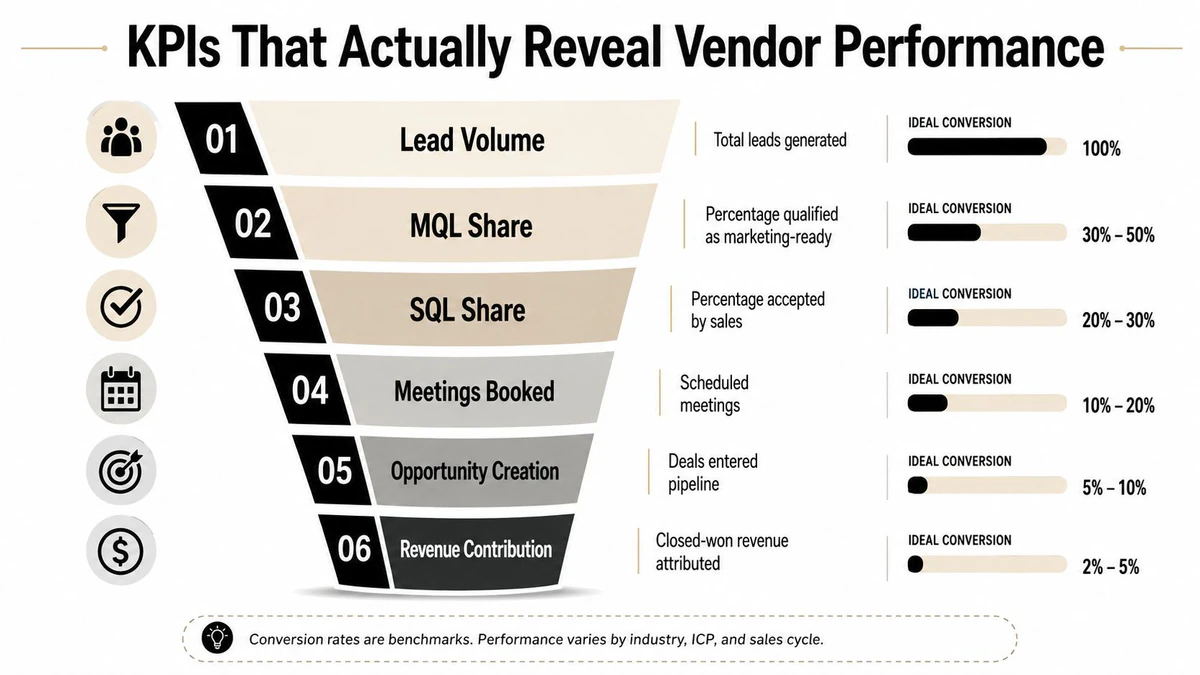
A vendor can report healthy lead volume and still miss the pipeline. The audit starts by tracing each source through the funnel, then separating results by channel so you can see where quality degrades. That is the only way to tell whether a lead generation company is producing revenue opportunities or just moving names into a CRM.
The stage-by-stage view
Start with lead volume, then track MQL share, SQL share, meetings booked, opportunity creation, and revenue contribution. That sequence shows where the handoff breaks. If volume is high but SQL acceptance is weak, the cause is usually ICP targeting, scoring rules, or weak data at acquisition.
One useful filter is whether the vendor can defend record quality before sales ever touches the lead. Comparing performance against an industry Email Verification Benchmark gives that conversation a baseline, especially when a provider claims strong deliverability but never shows verification results.
Use downstream economics, not vanity counts
Buyer guidance keeps moving toward cost per opportunity and customer acquisition cost instead of CPL alone. The logic is simple. A lead source can look inexpensive at the top of the funnel and still become costly after sales time, no-shows, and poor-fit accounts are included. A vendor that produces fewer leads but more opportunities is often the better economic choice.
The Insight Collective's KPI framework is useful because it treats lead generation as a measured funnel, not a single event. That framing matters during vendor audits across channels, because one source can look strong on raw lead count and weak on revenue contribution.
If MQLs do not become SQLs, start with the source, the scoring, and the record quality.
The contract should force that visibility. A useful report does more than count delivered leads. It shows how each source moved through the funnel, where the drop-offs occurred, and what those losses cost in actual pipeline.
Why Data Quality and Verification Decide Everything
Email still sits at the center of lead generation. One 2026 compilation says 78% of companies cite email as their most-used lead generation tactic, while another says 50% of businesses consider it the most impactful channel. SalesHandy's lead generation statistics makes the operational implication clear, if email is a primary acquisition channel, bad addresses are not a housekeeping issue, they are a revenue leak.
Cleaner records beat bigger lists
The contrarian view is the right one here. In 2026, the strongest lead generation strategy is often fewer but cleaner records, not larger lists. Invalid addresses raise bounce rates, trigger spam filters, and hurt sender reputation at the exact moment deliverability matters most.
Verification changes the economics before sales ever sees the lead. AI-first email verification platforms are built to reduce bad email data, and they do that through single checks, bulk list cleaning, and real-time API access. They also return structured JSON with status, SMTP results, MX records, catch-all scoring, and deliverability signals, which gives operators something they can audit instead of guessing from a deliverability claim.
What verification changes in practice
Clean data changes routing, sequencing, and inbox placement. Teams that verify before sending can remove role accounts and disposable addresses, then segment by deliverability risk instead of treating every contact as equal. CSV uploads with live progress, notifications, export-ready filters, and integrations with HubSpot, Salesforce, Mailchimp, SendGrid, Klaviyo, Zapier, and Make make it easier to keep hygiene inside the workflows teams already use.
The technical payoff is straightforward. Verified records are easier to trust when you build outbound, nurture, or signup flows. Product teams get fewer bad signups that later distort conversion reporting. Sales teams get fewer dead dials and fewer bounced sequences, which matters because both outcomes consume time without moving pipeline.
The same logic applies at the form level, where a bad signup becomes a bad downstream conversion event before it ever reaches a rep. The Email Validation API matters most when verification has to happen at the point of capture, not after a campaign has already gone out. That is the difference between cleaning up a list and preventing the bad record from entering the system in the first place.
A Practical Vendor Evaluation Checklist and Sample RFP
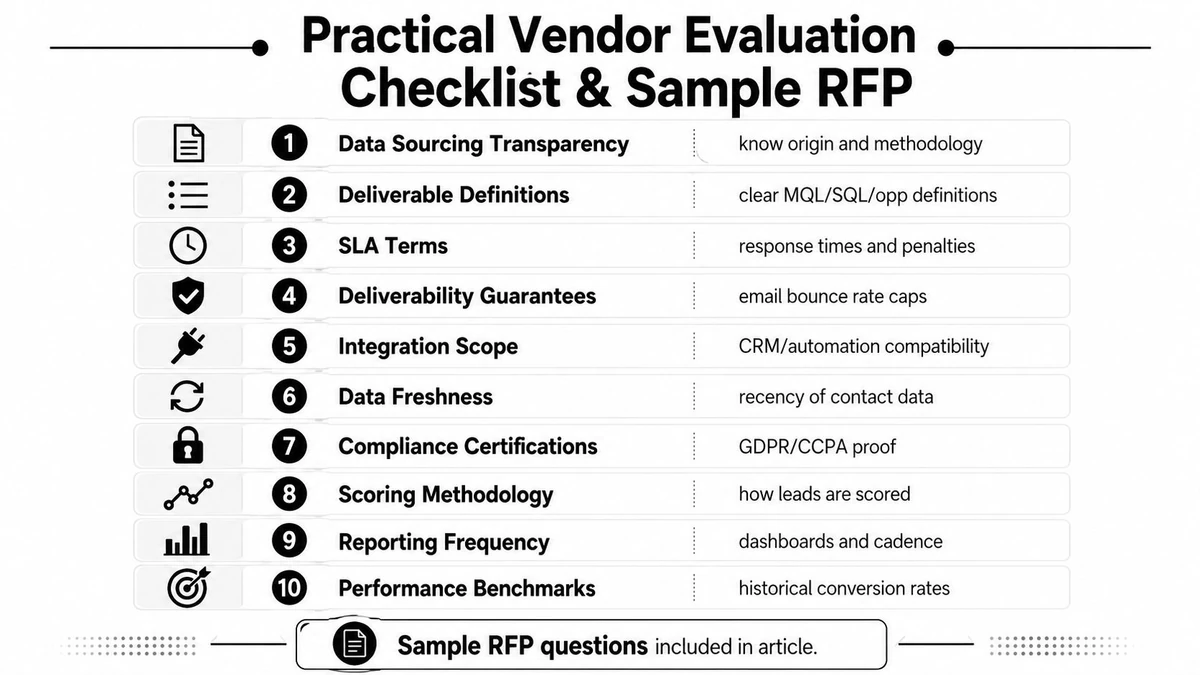
A vendor review should feel like due diligence, not a sales meeting. If you're asking a lead generation company to own quality, then the RFP needs to pressure-test sourcing, verification, integration, and governance before the contract is signed. The right questions are blunt, because vague answers usually mean the vendor is hiding weak process.
Ten-point checklist
- Data sourcing transparency. Ask where records come from and how they're assembled.
- Deliverable definitions. Get exact definitions for MQL, SQL, meetings, and opportunities.
- SLA terms. Make sure response times and penalties are written down.
- Deliverability guarantees. Require bounce-rate caps or clear remediation terms.
- Integration scope. Confirm CRM and automation compatibility before launch.
- Data freshness. Ask how often the contact data is updated.
- Compliance certifications. Verify GDPR and CCPA posture where relevant.
- Scoring methodology. Understand how leads are prioritized before delivery.
- Reporting frequency. Insist on a regular dashboard cadence.
- Performance benchmarks. Request historical conversion ranges by channel.
Five RFP questions that force clarity
- How do you validate email addresses before delivery?
- What is your average bounce rate across the last 90 days?
- How do you handle catch-all domains and role-based accounts?
- Which systems do you integrate with natively, and what requires custom work?
- What happens if delivered leads fail to meet agreed definitions?
BillionVerify's workflow is a useful reference point here because modern verification vendors often expose API, AI-agent support through an MCP Server, and integrations that fit the rest of the stack. That matters less as a feature list than as a governance signal, since it shows whether the provider thinks about hygiene as an operating layer instead of an afterthought.
Red flag: if a vendor refuses to explain sourcing methodology, walk away.
Also avoid exclusivity clauses, vague deliverable language, and any proposal that skips deliverability guarantees. Those are usually signs that the quote is cheaper only because the provider hasn't priced in cleanup, accountability, or rework.
Choosing a Lead Generation Company by Team Type
Marketing, sales, and product teams don't need the same vendor. A marketing team running e-commerce or media campaigns should lean toward inbound demand gen support and keep list hygiene tight so platforms like Mailchimp or Klaviyo don't get polluted by bad records. Sales and SDR teams running cold outbound should prioritize appointment-setting partners that supply verified contacts and connect cleanly to HubSpot or Salesforce.
Product and developer teams have a different problem. They need signup quality controlled at the point of entry, which is where API-first verification belongs, including real-time checks and AI-agent workflows. BillionVerify also supports a whitelabel portal for agencies and a free tier with no credit card required, which makes it easier to test verification before standardizing on a workflow.
One decision rule for each team
- Marketing teams. Choose inbound or content-led vendors when traffic already exists and conversion is the bottleneck.
- Sales teams. Choose outbound partners when target accounts are clear and speed-to-meeting matters.
- Product teams. Choose API-first verification when fake signups or bad registrations are hurting data quality.
The simplest way to decide is to trace the bottleneck first. If the problem is demand creation, buy demand generation. If the problem is meeting flow, buy appointment setting. If the problem is record quality, fix verification before you add more volume.
If bad email data is inflating your CPL or making outbound look worse than it is, start by cleaning the inputs before you buy more leads. BillionVerify gives teams email verification, bulk list cleaning, and real-time API checks so sales, marketing, and product workflows can work from cleaner records. Visit it if you want to compare your current lead flow against a stack built around verification instead of guesswork.