



High email bounce rates silently drain your marketing budget and damage your sender reputation with every campaign. Whether you're facing spam trap hits, outdated contacts, or low engagement, the right verification strategy can reduce bounces by 98% while protecting your domain authority. This guide walks you through proven methods to clean your list, choose the right verification approach, and measure real deliverability improvements.
Key takeaways
| Point | Details |
|---|---|
| Hard vs soft bounces | Hard bounces signal permanent failures requiring immediate removal, while soft bounces indicate temporary issues that may resolve. |
| Pre-verification prep matters | Deduplication and removing inactive addresses before verification improves accuracy and reduces processing costs. |
| Multi-layer verification wins | Combining spam trap detection, disposable email filtering, and role-based address identification cuts bounce rates dramatically. |
| Balance reach with quality | Aggressive cleaning maximizes deliverability but may lose valid contacts, requiring strategic tradeoffs based on campaign goals. |
| Track success metrics | Monitor bounce rates below 2%, engagement increases of 10-25%, and consistent deliverability above 95% to measure ROI. |
Understanding email bounce rates: types and impact
Email bounces occur when messages fail to reach recipient inboxes, and understanding the distinction between bounce types is critical for protecting your sender reputation. Hard bounces result from permanent delivery failures like invalid addresses, closed accounts, or nonexistent domains. Soft bounces stem from temporary issues such as full mailboxes, server downtime, or message size limits.
ISPs treat these bounce types very differently when evaluating your sender reputation. Hard bounces trigger immediate red flags because they indicate poor list hygiene and outdated contact management. Repeated hard bounces can land your domain on blocklists within weeks, devastating your deliverability across all campaigns.
Soft bounces receive more tolerance from email providers, but excessive soft bounce rates still damage your reputation over time. Most ISPs retry soft bounces for 72 hours before classifying them as hard bounces. If your soft bounce rate climbs above 5%, it signals systemic problems with your list quality or sending infrastructure.
The financial impact extends beyond blocked emails. High bounce rates increase your cost per acquisition by wasting sends on unreachable contacts. Multi-layer email verification can reduce bounce rates by 98%, transforming deliverability and protecting campaign ROI.
Implementing proven bounce rate reduction methods protects your domain reputation while maximizing the value of every send. The key is addressing both bounce types through systematic verification before they compound into reputation damage.
Prerequisites: preparing your email list for verification
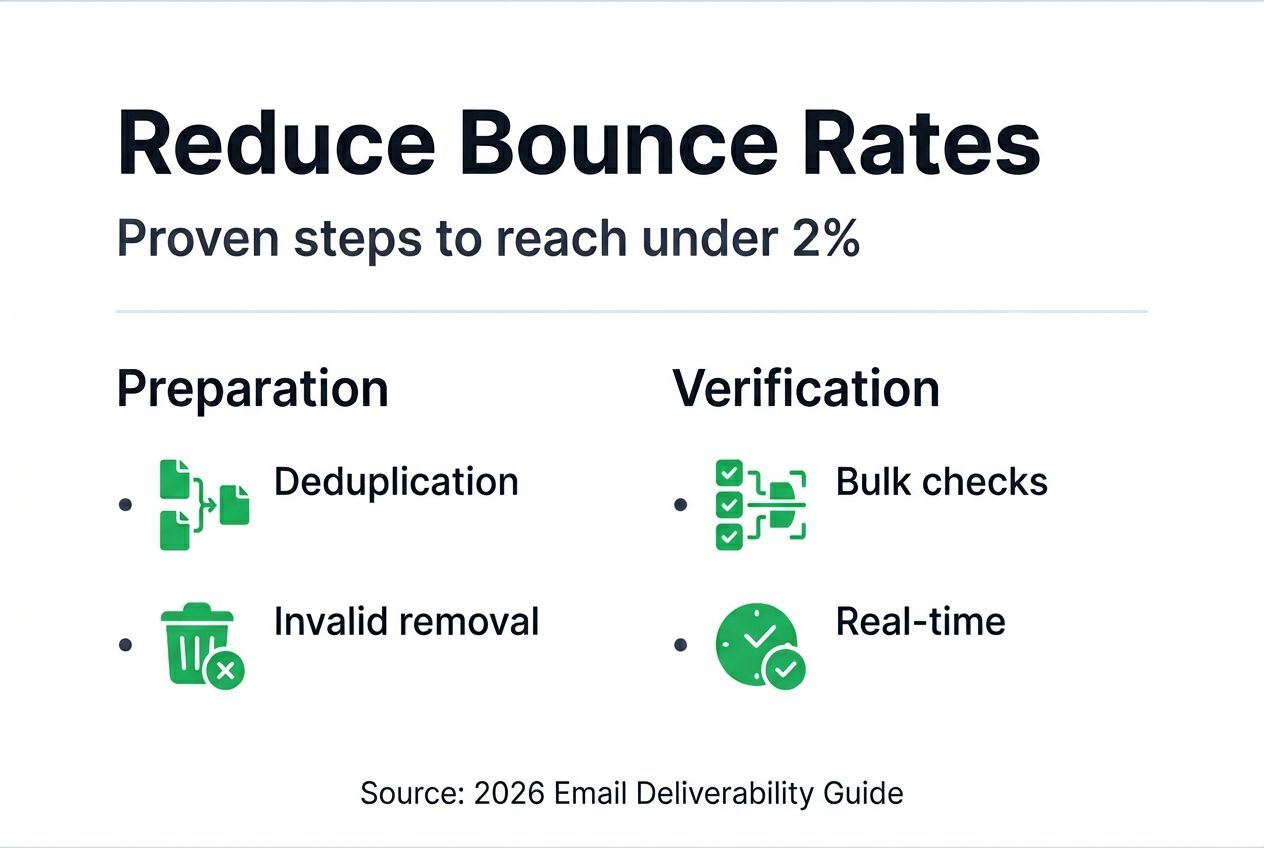
Successful verification starts with proper list preparation, not with the verification tool itself. Deduplication removes contacts appearing multiple times across your database, which artificially inflates your list size and wastes verification credits. Running deduplication first ensures you only verify unique addresses, reducing costs by 15-30% on average.
Removing obviously invalid entries before verification improves processing speed and accuracy. Strip out addresses with syntax errors, missing @ symbols, or placeholder text like "test@test.com." Eliminate inactive subscribers who haven't opened emails in 12+ months, as these contacts rarely convert and increase bounce risk.
Organizing your data into clean CSV or Excel files with consistent formatting streamlines bulk verification. Ensure each row contains one email address with no extra spaces, special characters, or formatting issues. Separate lists by acquisition source or engagement level to prioritize high-value segments.

Pro Tip: Always run deduplication before verification to eliminate redundant checks and reduce processing costs by up to 30%.
Here's your pre-verification checklist:
- Remove duplicate email addresses across all database sources
- Delete contacts inactive for 12+ months
- Strip syntax errors and placeholder addresses
- Standardize file format with one email per row
- Segment lists by value or acquisition channel
| Preparation Step | Impact on Verification | Time Required |
|---|---|---|
| Deduplication | Reduces cost 15-30% | 10-30 minutes |
| Remove inactive | Improves accuracy 20% | 15-45 minutes |
| Format cleaning | Speeds processing 25% | 5-15 minutes |
| Segmentation | Enables priority verification | 20-60 minutes |
A structured pre-send checklist including deduplication increases deliverability by 20%, making preparation time a high-ROI investment. Following email list hygiene practices creates a foundation for verification success and sustained low bounce rates.
Step-by-step email verification and list cleaning process
Multi-layer verification combines several detection methods to catch different types of problematic addresses before they damage your campaigns. The process starts with spam trap identification, which flags addresses used by ISPs and blocklist operators to catch poor senders. Next comes disposable email detection, blocking temporary addresses from services that expire within hours or days.
Role-based address filtering identifies generic emails like info@, support@, or sales@ that rarely belong to individual decision-makers and often trigger spam complaints. Catch-all domain detection reveals servers configured to accept all emails regardless of validity, helping you assess delivery risk. Finally, syntax and DNS validation confirms proper email structure and active mail servers.
For large existing lists, bulk verification processes thousands of addresses simultaneously before campaign sends. Upload your cleaned CSV file, select verification depth, and receive detailed results within minutes to hours depending on list size. The system flags each address as valid, invalid, risky, or unknown with specific reasons.
Real-time verification at capture points prevents bad emails from entering your database initially. Integrate verification APIs at signup forms, checkout pages, and lead magnets to validate addresses as users submit them. This proactive approach blocks 90% of problematic contacts before they cost you money.
- Upload deduplicated list to bulk verification platform
- Configure verification depth and risk tolerance settings
- Process list and download results with status codes
- Remove all hard invalid and high-risk addresses immediately
- Implement real-time API at all email capture points
- Set up automated re-verification every 90 days
- Monitor bounce rates and adjust settings as needed
| Verification Approach | Pros | Cons | Best For |
|---|---|---|---|
| Bulk only | Cost effective, handles large volumes | Misses new bad signups | Cleaning existing lists |
| Real-time only | Prevents bad entries, protects sender reputation | Higher per-check cost | New contact acquisition |
| Hybrid (both) | Comprehensive protection, sustained low bounces | Requires budget for both | Enterprise marketing teams |
Pro Tip: Combine bulk cleaning quarterly with real-time checks at capture to maintain bounce rates below 1% while preventing list degradation.
Real-time verification achieves 15-25% better hard bounce reduction than bulk-only methods by stopping problems at the source. Understanding email verification methods for marketers helps you choose the right approach, while comparing real-time versus bulk email validation clarifies when each method delivers maximum value.
Common mistakes that increase bounce rates and how to fix them
Ignoring role-based emails represents one of the most frequent hygiene errors that inflate bounce and complaint rates. Addresses like admin@, info@, or noreply@ typically route to shared inboxes monitored by multiple people or automated systems. These contacts generate 3-5 times higher complaint rates than individual addresses because recipients didn't personally opt in.
Disposable email services create temporary addresses that expire within hours, making them useless for long-term engagement. Marketers who skip disposable email detection waste sends on contacts that vanish before the first follow-up. Worse, high volumes of disposable addresses signal to ISPs that you're not validating signups, damaging your sender score.
Mismanaging soft bounces by retrying excessively or too quickly compounds deliverability problems. Some marketers attempt immediate resends after soft bounces, which ISPs interpret as aggressive sending behavior. Others never retry, missing opportunities to reach temporarily unavailable contacts once their inbox clears.
Skipping CRM integration of verification results creates a disconnect between your validation efforts and actual sending practices. Without syncing invalid addresses back to your email platform, you continue sending to known bad contacts in future campaigns. This defeats the entire purpose of verification and wastes your investment.
Pro Tip: Configure your verification platform to automatically flag and block role-based, disposable, and high-risk addresses before they reach your sending queue.
Common mistakes include:
- Sending to role-based emails without individual consent
- Allowing disposable email signups at capture forms
- Retrying soft bounces too aggressively or not at all
- Failing to sync verification results with email platform
- Running verification once and never re-checking contacts
- Ignoring engagement metrics when evaluating list quality
Addressing these common email hygiene mistakes prevents bounce rate creep and protects the deliverability gains from your initial verification work.
Tradeoffs and alternative approaches in email verification
Aggressive verification settings maximize deliverability by removing every questionable address, but this approach risks losing valid contacts who use unusual email providers or corporate domains. Conservative settings preserve audience size by keeping risky addresses, but accept higher bounce rates and potential reputation damage. Your optimal balance depends on campaign goals, industry, and acceptable risk levels.
B2B SaaS companies often benefit from aggressive cleaning because their ideal customers use standard corporate email providers. Removing catch-all domains and role-based addresses improves targeting precision and reduces wasted sales outreach. E-commerce brands may prefer conservative settings to preserve customer reach, especially if serving international markets with diverse email infrastructure.
Bulk verification offers cost efficiency for processing large existing lists before major campaigns. However, it creates a gap between verification and sending where new bad signups accumulate. Real-time verification costs more per check but prevents list degradation by blocking invalid addresses immediately. Hybrid approaches combine both methods for comprehensive protection.
| Strategy | Deliverability Impact | Audience Reach | Cost | Ideal Scenario |
|---|---|---|---|---|
| Aggressive cleaning | 95-99% deliverability | May lose 5-15% contacts | Medium | B2B, sender reputation recovery |
| Conservative cleaning | 85-92% deliverability | Preserves 98% contacts | Low | E-commerce, broad consumer reach |
| Bulk verification | 90-95% deliverability | Depends on settings | Low | Quarterly list hygiene |
| Real-time verification | 95-98% deliverability | High quality growth | High | Continuous acquisition |
| Hybrid (bulk + real-time) | 97-99% deliverability | Optimal balance | Medium-High | Enterprise marketing teams |
Prioritize deliverability over audience size when recovering from blacklisting, launching cold outreach, or protecting high-value domains. Prioritize reach over perfect deliverability when serving price-sensitive consumers, running promotional campaigns, or working with tight budget constraints. Most enterprise teams find hybrid approaches deliver the best long-term ROI.
Exploring bulk email verification best practices helps you optimize your chosen strategy for maximum impact while managing tradeoffs between cost, reach, and deliverability.
Expected results and metrics: how to measure success
Successful verification campaigns typically reduce bounce rates from 15%+ to below 2% within the first month after cleaning. This dramatic improvement protects your sender reputation and unlocks better inbox placement across all campaigns. The timeline varies based on list size and initial quality, but most marketers see measurable results within 2-4 weeks.
Engagement rates consistently increase 10-25% following comprehensive list hygiene because you're targeting real people who can actually receive and read your messages. Open rates climb as ISPs reward improved sender behavior with better inbox placement. Click-through rates rise because engaged subscribers represent a higher percentage of your cleaned list.
Spam complaint reduction serves as a critical success indicator beyond bounce rates. Lower complaint rates signal that your list contains people who genuinely want your content. Target complaint rates below 0.1% to maintain optimal sender reputation with major ISPs.
Deliverability consistently above 95% confirms your verification efforts are working and your sender reputation remains strong. Track this metric weekly during the first month post-cleaning, then monthly for ongoing monitoring. Sustained high deliverability proves your investment in verification delivers lasting ROI.
Key success metrics to monitor:
- Bounce rate drops to 2% or lower within 30 days
- Hard bounce elimination approaching 99%
- Soft bounce reduction by 60-80%
- Engagement rate increases of 10-25%
- Spam complaint rate below 0.1%
- Deliverability maintaining 95%+ consistently
- Inbox placement rate improvement of 15-30%
Bounce rates typically drop from over 15% to under 2% within one month of comprehensive verification and cleaning. Regular monitoring of bounce rate reduction benchmarks helps you track progress and identify when re-verification is needed to maintain optimal performance.
Improve your email deliverability with BillionVerify
BillionVerify's AI-first email verification platform transforms the strategies in this guide into automated, scalable processes that protect your sender reputation 24/7. The platform combines bulk verification for existing lists with real-time API integration at every capture point, creating comprehensive protection against bounce rate creep.
Seamless integration with over 20 major email marketing platforms and CRMs means verification results sync automatically, eliminating manual data transfers and ensuring your sending lists stay clean. The multi-layer verification engine detects spam traps, disposable addresses, role-based emails, and risky domains with enterprise-grade accuracy.
Marketing teams using BillionVerify consistently achieve bounce rates below 2% while improving engagement metrics by 15-30%. The platform scales to handle millions of verifications monthly, making it ideal for enterprise operations and high-growth marketing teams. Implementing email verification methods for marketers through BillionVerify delivers measurable ROI within the first campaign cycle.
FAQ
What is the difference between hard and soft email bounces?
Hard bounces indicate permanent delivery failures caused by invalid addresses, closed accounts, or nonexistent domains that require immediate list removal. Soft bounces result from temporary issues like full mailboxes or server downtime that may resolve within 72 hours. ISPs treat hard bounces much more severely when calculating sender reputation scores.
How often should I clean my email list to reduce bounce rates?
Monthly verification maintains optimal bounce rates by catching inactive addresses and recent changes before they accumulate. Real-time verification at signup complements periodic bulk cleaning by preventing bad contacts from entering your database initially. The combination of both approaches sustains bounce rates below 1% long-term. Understanding email list cleaning frequency helps you establish the right maintenance schedule.
Can real-time email verification prevent future bounces?
Real-time checks validate addresses during signup, blocking invalid entries before they reach your database and eliminating future bounces from those sources. This proactive approach reduces hard bounces by 90%+ compared to periodic cleaning alone. When combined with quarterly bulk verification of existing contacts, real-time validation creates comprehensive bounce prevention. Explore the benefits of email verification API to understand implementation value.
What metrics indicate successful bounce rate reduction?
Bounce rates below 2% combined with engagement rate increases of 10-25% confirm effective verification. Additional success indicators include spam complaint rates under 0.1% and consistent deliverability above 95% across campaigns. Track these metrics weekly initially, then monthly once rates stabilize. Review bounce rate success metrics for detailed benchmarking guidance.