



Bounce rates and sender reputation headaches are all too familiar for email marketing professionals striving to reach customers across continents. The need for accurate email verification goes far beyond syntax checks, impacting deliverability and protecting against costly blacklisting by providers. This introduction sheds light on common misconceptions about email verification, explores technical and security-driven approaches, and outlines how thoughtful verification strategies can safeguard campaign performance for global tech teams.
Key Takeaways
| Point | Details |
|---|---|
| Importance of Email Verification | Email verification ensures email addresses are valid and capable of receiving messages, helping businesses maintain effective communication. |
| Common Myths | Misconceptions exist around email verification, including the belief that all tools are the same and that one-time verification is sufficient due to high email list decay rates. |
| Sender Reputation Risks | A poor sender reputation can lead to high bounce rates and potential blacklisting, making regular email list hygiene essential for successful campaigns. |
| Cost Considerations | Organizations should evaluate various pricing models for email verification to align with their operational needs and budget, alongside compliance requirements like GDPR. |
Email Verification Defined and Common Myths
Email verification is the systematic process of validating and authenticating email addresses to ensure they are real, active, and capable of receiving messages. Beyond simple syntax checking, this critical practice helps businesses maintain clean email lists and prevent potential communication failures.
The verification process involves several sophisticated techniques to assess email validity:
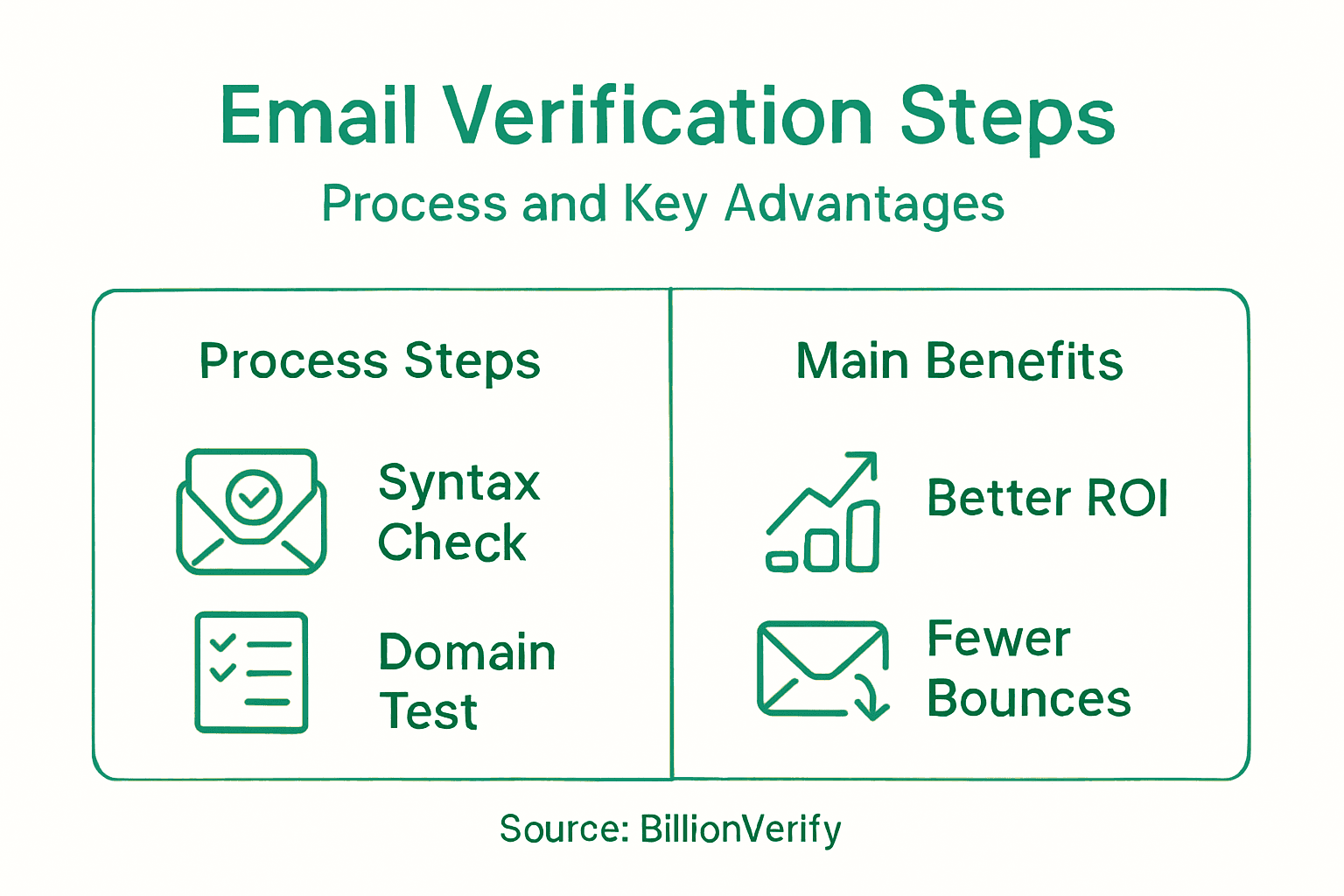
- Syntax validation: Checking email format for correct structure
- Domain verification: Confirming the domain actually exists and can receive mail
- SMTP connection: Testing whether the mail server responds and accepts messages
- Mailbox existence: Determining if the specific email address is legitimate
Many marketing professionals misunderstand email verification, leading to several prevalent myths. Understanding email verification nuances can dramatically improve communication strategies.
Common myths about email verification include:
- All verification tools are identical: Different services offer varying levels of accuracy and depth
- Verification guarantees 100% delivery: It improves deliverability but doesn't promise absolute message receipt
- One-time verification is sufficient: Email lists decay approximately 22.5% annually, requiring regular cleaning
Real-world impact matters. Unverified email lists can lead to significant problems like:
- Higher bounce rates
- Decreased sender reputation
- Potential blacklisting by email providers
- Wasted marketing resources
Pro tip: Implement automated email verification as a recurring monthly process to maintain list hygiene and maximize marketing effectiveness.
Variations in Email Verification Approaches
Email verification is not a monolithic process, but rather a complex landscape of approaches tailored to different technological and security requirements. Authorship-based verification techniques represent one sophisticated method that goes beyond traditional validation mechanisms.
Key variations in email verification approaches include:
- Profile-based methods: Creating comprehensive author profiles from multiple training texts
- Instance-based approaches: Using individual document analysis and machine learning classifiers
- Syntax validation: Checking email format and structure
- Domain authentication: Verifying domain legitimacy and mail server capabilities
The verification landscape can be broadly categorized into several critical methodological approaches:
Technical Validation
- SMTP connection checking
- Domain existence verification
- Mailbox response testing
Security-Driven Verification
- Authorship confirmation techniques
- Deep learning classifier implementations
- Writing style analysis
Real-world verification strategies require nuanced understanding of these different methodological frameworks. Technical teams must select approaches aligned with their specific communication and security requirements.
Advanced email verification transcends simple syntactic checks, integrating sophisticated machine learning and behavioral analysis techniques.
Pro tip: Combine multiple verification approaches to create a robust, multi-layered email validation strategy that enhances security and communication reliability.
How Email Verification Solutions Operate
Modern email verification solutions employ sophisticated multi-layered techniques to authenticate and validate email addresses across complex digital ecosystems. Academic email validation systems demonstrate the intricate approaches used to verify email legitimacy and institutional affiliation.
Email verification solutions typically operate through several critical processing stages:
- Syntax Analysis: Checking email address format for structural integrity
- Domain Validation: Confirming domain existence and mail server configuration
- SMTP Verification: Testing live connection and response capabilities
- Mailbox Existence: Determining actual receivability of the email address
The comprehensive verification process can be broken down into key operational components:
Initial Screening
- Pattern recognition for valid email structures
- Removing obviously invalid addresses
- Identifying potential disposable or temporary emails
Deep Technical Validation
- DNS record examination
- Mail exchanger (MX) record checking
- Server response time analysis
Technical architectures behind email verification integrate multiple validation techniques to ensure maximum accuracy and reliability. These systems continuously update their algorithms to adapt to evolving email communication landscapes.
Effective email verification transcends simple checklist approaches, incorporating machine learning and real-time data analysis to provide comprehensive validation.
Pro tip: Implement a multi-stage email verification strategy that combines automated technical checks with periodic manual review to maintain the highest data quality standards.
Deliverability Impact and Sender Reputation Risks
Sender reputation represents a critical metric that directly influences email marketing success, determining whether messages reach their intended recipients. Comprehensive sender reputation analysis reveals the complex ecosystem of factors impacting email deliverability.

Multiple components contribute to sender reputation and potential risks:
The following summarizes key sender reputation factors and their business outcomes:
| Factor | Direct Impact | Business Outcome |
|---|---|---|
| Bounce Rate | Inbox placement | Marketing effectiveness |
| Spam Complaints | ISP filtering | Campaign reach |
| Authentication | Trustworthiness | Customer engagement |
| Engagement Metrics | Deliverability | Revenue and retention |
- Bounce Rates: High percentage of undeliverable emails
- Spam Complaints: Recipient engagement indicating unwanted communication
- Email Authentication: Verification of domain and sender legitimacy
- Engagement Metrics: Open rates, click-through rates, and interaction signals
Key risks associated with poor sender reputation include:
Inbox Placement Challenges
- Automatic filtering to spam folders
- Reduced visibility of marketing communications
- Decreased overall campaign effectiveness
Potential Blacklisting
- Permanent blocking by email service providers
- Complete elimination of communication channels
- Significant financial and operational disruptions
Technical infrastructure plays a crucial role in maintaining a positive sender reputation. Internet Service Providers (ISPs) continuously evaluate sender behavior to protect their users from potentially harmful communications.
Sender reputation is a dynamic score that requires consistent monitoring and proactive management to ensure optimal email deliverability.
Pro tip: Implement a regular email list hygiene protocol that includes verification, segmentation, and periodic cleaning to maintain a strong sender reputation and maximize communication effectiveness.
Email Verification Costs, Compliance, and Alternatives
Organizations must navigate the complex landscape of email verification, balancing technical requirements, financial considerations, and regulatory compliance. Email verification under GDPR highlights the critical intersection of data protection and communication strategies.
Cost considerations for email verification solutions vary across multiple dimensions:
Here's a comparison of email verification solution pricing models and their practical implications:
| Pricing Model | Typical Cost Range | Ideal Use Case | Drawbacks |
|---|---|---|---|
| Per-Email Pricing | $0.0010 - $0.0200 | Small or variable lists | Costs increase with volume |
| Monthly Subscription | Based on tiered volume | Consistent, high-volume use | May pay for unused credits |
| API Integration | Setup + ongoing fees | Automated business platforms | Technical maintenance needed |
| Enterprise Custom | Negotiated rates | Large-scale organizations | Complex purchasing process |
- Per-Email Verification Pricing: Typically ranges from $0.0010 to $0.0200 per email
- Monthly Subscription Models: Structured around volume tiers
- API Integration Costs: Initial setup and ongoing maintenance expenses
- Enterprise Custom Solutions: Negotiated pricing for large-scale implementations
Alternative approaches to traditional email verification include:
Free Verification Tools
- Limited feature sets
- Basic syntax and domain checking
- Suitable for small-scale operations
Open-Source Validation Libraries
- Community-developed solutions
- Customizable but require technical expertise
- Lower direct financial investment
Regulatory compliance demands rigorous approaches to email list management. Data protection regulations like GDPR mandate transparent consent mechanisms and secure data handling practices.
Email verification is not just a technical process, but a critical component of responsible digital communication and data management.
Pro tip: Conduct a comprehensive cost-benefit analysis comparing verification solution expenses against potential revenue loss from unverified email lists.
Strengthen Your Email Campaigns with Accurate Verification
The article emphasizes the crucial challenge of maintaining clean email lists to avoid high bounce rates, protect sender reputation, and maximize deliverability and ROI. These pain points are common across businesses striving for effective email marketing. Terms like bounce rates, sender reputation, and email list hygiene highlight the risks of unverified lists causing wasted resources and lost revenue.
BillionVerify addresses these exact challenges by offering a comprehensive solution featuring a real-time email verification API with 99.9% accuracy, bulk list cleaning, and advanced detection of disposable and role-based emails. By integrating multiple verification layers, we help you avoid costly blacklisting and improve inbox placement.
Take control of your email marketing success today by visiting BillionVerify to explore our proven verification services. If you want to deepen your understanding of how verification works, check out our detailed email verification solutions and how they directly impact email deliverability.
Are you ready to boost your ROI and protect your sender reputation with a trusted partner?

Start cleaning your email lists now and experience measurable results with BillionVerify. Visit https://billionverify.com to get started and take your campaigns to the next level.
Frequently Asked Questions
What is email verification and why is it important?
Email verification is the process of validating email addresses to ensure they are real and can receive messages. It is important because it helps maintain a clean email list, enhancing deliverability rates and overall campaign effectiveness.
How can email verification improve sender reputation?
Email verification reduces bounce rates and spam complaints, which are critical factors in maintaining a positive sender reputation. A good sender reputation increases the likelihood of emails landing in the inbox rather than being filtered out or marked as spam.
What techniques are commonly used in the email verification process?
Common techniques include syntax validation, domain verification, SMTP connection testing, and mailbox existence checks. These methods work together to ensure that the email addresses on a list are valid and capable of receiving messages.
How often should I verify my email list?
To maintain list hygiene and effectiveness, it is recommended to verify your email list on a regular basis, ideally every month, as email lists can decay by about 22.5% annually.